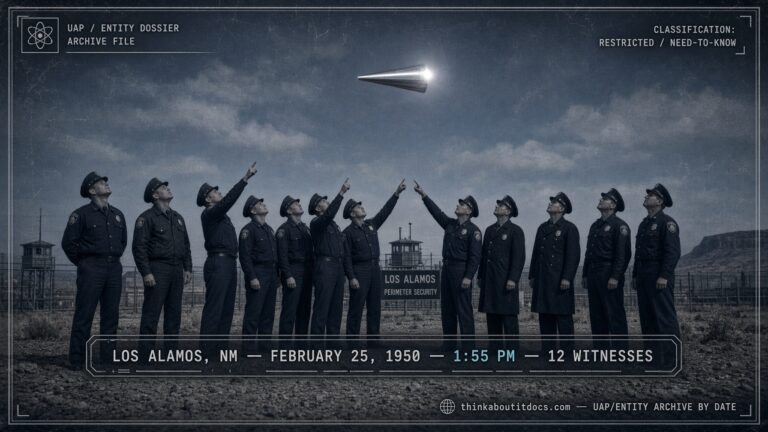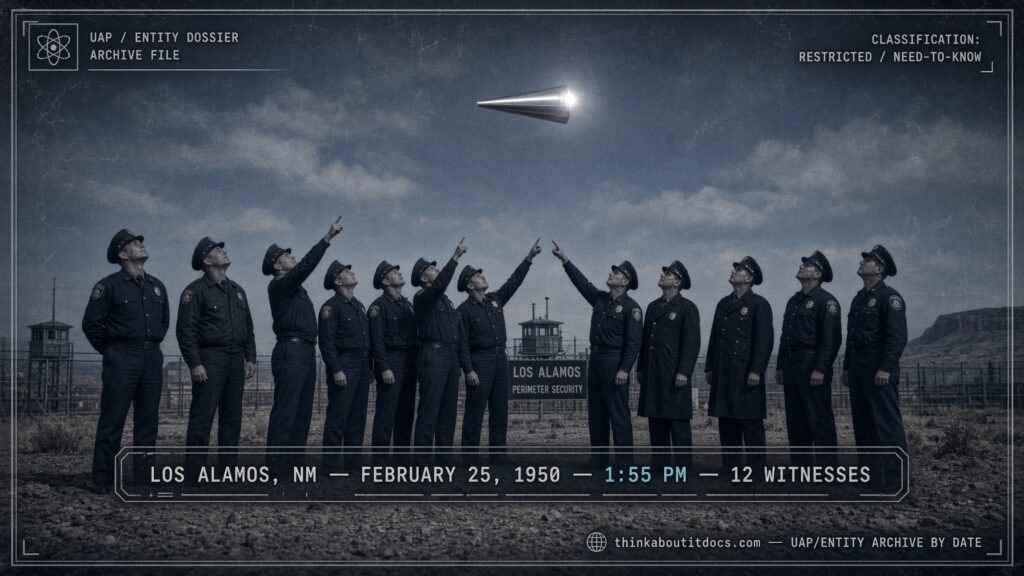
February 25, 1950 — twelve AESS inspectors at Los Alamos track a silver cylindrical object for two hours.
THINK ABOUTIT UFO|UAP SIGHTINGS REPORT
1950: The Los Alamos AESS Cylinder Case
Twelve Atomic Energy Security Service inspectors — trained to watch Los Alamos for exactly this kind of anomaly — spent two hours tracking a silver, tapered cylinder that sped up, slowed down, fluttered, oscillated, and changed course in front of all of them at once.
Date: February 25, 1950, BBU 645
Sighting Time: 1:55-3:55 p.m.
Day/Night: Day
Location: Los Alamos, New Mexico
Urban or Rural: Rural (secured facility perimeter)
No. of Entity(‘s): Not Applicable
Entity Type: Not Applicable
Entity Description: Not Applicable
Hynek Classification: DD (Daylight Disc — elongated/cylindrical variant)
Duration: Approximately 2 hours overall; individual observation segments ranged from 3 seconds to 2 minutes
No. of Object(s): 1
Description of the Object(s): A cylinder with tapered ends, silver and flashing/reflective, exhibiting fluttering and oscillating motion
Shape of Object(s): Cylindrical, tapered at both ends
Size of Object(s): Not specified
Color of Object(s): Silver, flashing/reflective
Distance to Object(s): Not specified
Height & Speed: Alternated between slow and fast movement, fluttering and oscillating, with repeated course changes over the two-hour observation period
Number of Witnesses: 12 (Atomic Energy Commission Atomic Energy Security Service inspectors)
Special Features/Characteristics: Twelve Simultaneous Trained Security Witnesses, Two-Hour Extended Observation Window, Repeated Speed and Course Changes, Fluttering/Oscillating Flight Behavior, Nuclear Facility Security Personnel
Case Status: Unexplained
Source: Berliner
Summary/Description: Twelve Atomic Energy Commission Atomic Energy Security Service (AESS) inspectors at Los Alamos, New Mexico, independently and collectively observed a silver, flashing, cylindrical object with tapered ends over a two-hour period. The object’s behavior varied dramatically across the observation window: it flew slowly at times and rapidly at others, fluttered and oscillated in its motion, and repeatedly changed course. Individual observation segments during the two-hour window ranged from as brief as three seconds to as long as two minutes, consistent with the object moving in and out of view or behind obstructions rather than remaining continuously visible throughout.
Related Cases: Not Applicable
Detailed Report
The witness count alone sets this case apart: twelve trained security inspectors, whose professional role was specifically to monitor the Los Alamos perimeter for exactly this kind of anomaly, watched the same object over a sustained two-hour period. That is a fundamentally different evidentiary situation from the single- or two-witness sightings that dominate this archive’s 1950 record — twelve independent professional observers watching the same object for two hours makes simple misperception or individual error a much less plausible explanation, though it does not by itself identify what the object was.
The described flight behavior — alternating slow and fast movement, fluttering, oscillating, and repeated course changes — reads as genuinely erratic rather than a single consistent flight path, which is itself notable: a conventional aircraft or balloon would not typically alternate between these different behaviors within one continuous observation window. No source consulted for this report offers a specific conventional candidate (balloon, aircraft, atmospheric phenomenon) that would account for this full range of behavior over two hours.
This is the second AEC/AESS-witnessed sighting at Los Alamos documented in this archive within roughly a year, following similar patterns from the 1949 Sandia/Los Alamos green fireball wave, though this case’s cylindrical shape and extended erratic-flight duration distinguish it from the brief green fireball transits more typical of that earlier wave.
RESEARCHER’S NOTES
The Los Alamos Cylinder Case — New Mexico 1950 and the Weight of Twelve Trained Witnesses
- Classification issues/corrections: Filed as DD given the daytime timing and object shape, though its cylindrical, non-disc form sets it apart from the more typical round or discus-shaped daylight sightings in this archive; no entity or close approach is claimed.
- Source chain assessment: Documented through Don Berliner’s compilation with a specific Blue Book Unknown case number (BBU 645), suggesting derivation from an original case file; the named witness count (twelve AESS inspectors) without individual names is consistent with an institutional security report rather than a civilian witness account.
- Pattern context/comparative cases: Twelve-witness sightings are rare in this archive; the closest comparison by witness count is the July 1949 Longview, Washington sightings (150-200 witnesses, but a general public crowd rather than trained security personnel). This case’s combination of large witness count and specifically trained, security-cleared observers is close to unique in the 1949-1950 record reviewed this session.
- Physical evidence/evidentiary weight: No photograph or instrument data is documented, but the number and professional training of the witnesses substantially strengthens the case’s evidentiary basis relative to smaller, less credentialed sightings elsewhere in this archive.
- Geographic/historical context: This case continues the pattern of unusual aerial activity at Los Alamos that runs through 1949 into 1950 in this archive, following the green fireball wave and the earlier AFOSI-cataloged incidents at the same facility.
Twelve trained security inspectors, watching the same object shift between slow and fast, fluttering and oscillating, over two full hours — this is one of the best-witnessed sightings in this archive’s early-1950 record, and its erratic, sustained behavior resists any single conventional explanation offered in the sources available.
“Fly slow then fast, flutter and oscillate, change course.”
Don Berliner, describing the February 25, 1950 Los Alamos AESS cylinder case.