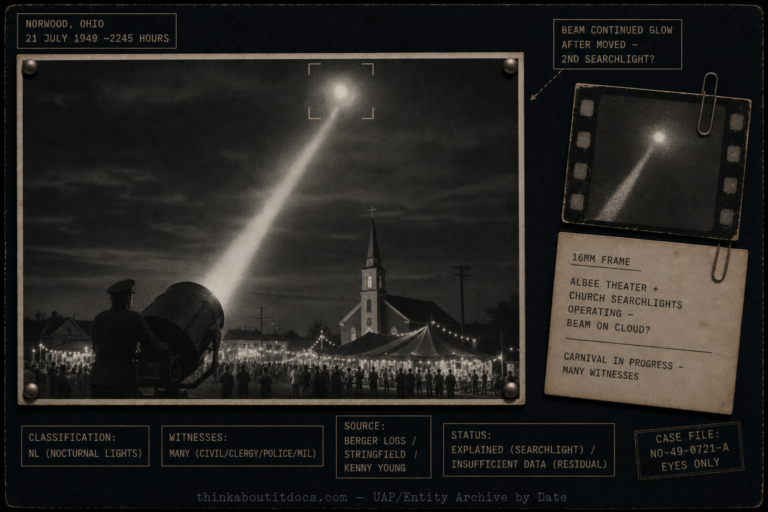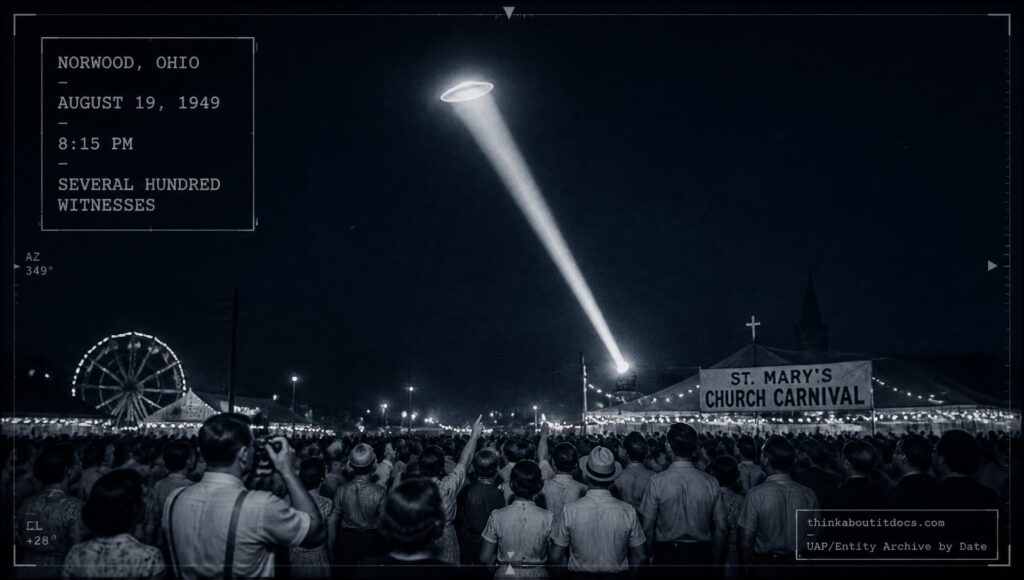
August 19, 1949 — several hundred witnesses at a Norwood, Ohio church carnival watch a searchlight-illuminated disc for two hours.
THINK ABOUTIT UFO|UAP SIGHTINGS REPORT
1949: The Norwood, Ohio Searchlight Sighting
A church carnival, a war-surplus searchlight, and an ROTC sergeant with nothing more dramatic in mind than lighting up the night sky for the crowd — and then the beam caught something that didn’t move like an aircraft, hung motionless, and stayed in view for two hours while several hundred people watched and one man took ten photographs.
Date: August 19, 1949
Sighting Time: 8:15 p.m. to approximately 10:15 p.m.
Day/Night: Night
Location: Sts. Peter and Paul Church, Norwood (Cincinnati), Ohio
Urban or Rural: Urban
No. of Entity(‘s): Not Applicable
Entity Type: Not Applicable
Entity Description: Not Applicable
Hynek Classification: NL (Nocturnal Lights)
Duration: Approximately two hours
No. of Object(s): 1
Description of the Object(s): A stationary, circular, disc-shaped object that glowed when caught by the searchlight beam and repeatedly flew in and out of the beam
Shape of Object(s): Round/disc-shaped
Size of Object(s): Not specified in the sources consulted
Color of Object(s): Glowing white/silver when illuminated by the searchlight
Distance to Object(s): One source estimates an altitude of roughly four miles
Height & Speed: Stationary for extended periods, described as circular/stationary rather than in transit
Number of Witnesses: Several hundred
Special Features/Characteristics: Searchlight-Illuminated, Photographed (10 still photographs by witness Davidson), Extended Duration, Large Public Crowd, Reported Animal Reactions
Case Status: Unexplained
Source: Keyhoe, Donald E. Flying Saucer Conspiracy, Holt, New York, 1955; Hill, H. Edward. Catalog Through 1950
Summary/Description: During the Jitney Carnival at Sts. Peter and Paul Church in Norwood, a Cincinnati suburb, Reverend Gregory Miller had purchased an 8-million-candlepower searchlight from Army surplus for the event, operated by Sergeant Donald R. Berger of the University of Cincinnati’s ROTC. At the height of the festivities, around 8:15 p.m., Berger’s sweeping searchlight beam suddenly crossed a stationary, circular object in the sky. Reverend Miller and, soon after, much of the crowd gathered to watch. Several hundred witnesses observed the object over roughly two hours as it repeatedly flew in and out of the searchlight beam, appearing to glow when illuminated; animal reactions in the area were also reported. A witness named Davidson took ten still photographs of the disc-shaped object during the sighting. One source estimates the object’s altitude at roughly four miles when caught by the beam.
Related Cases: 1949: Sgt. Berger’s Ohio Searchlight Sightings

Detailed Report
What distinguishes this case is the accident of circumstance that produced it: a war-surplus searchlight bought for a parish carnival, operated by a trained ROTC sergeant, happened to sweep across something that behaved unlike any aircraft of the era — stationary for extended periods, repeatedly re-entering and leaving the beam rather than simply passing through it once, and visible continuously for roughly two hours to an audience that grew from the carnival’s own attendees into a crowd of several hundred.
The photographic record — ten still images taken by a witness named Davidson — is unusual for a case this early; most 1949 reports in this archive rest entirely on verbal testimony. No description of the photographs’ content or quality beyond their existence is preserved in the sources consulted for this report, and no indication survives of what became of the original prints or negatives.
Donald Keyhoe’s 1955 book Flying Saucer Conspiracy is the primary published source for this account, with H. Edward Catalog Through 1950 independently cataloging the same event with additional detail (the estimated four-mile altitude, the animal reactions). The two-source convergence, from different research traditions, adds some weight to the basic outline of the case even without access to the original photographs.
RESEARCHER’S NOTES
The Norwood Searchlight Case — Ohio 1949 and the Value of an Accidental Instrument
- Classification issues/corrections: Filed as NL (Nocturnal Lights) — the object was seen only via illumination at night, at an estimated altitude of several miles, with no close approach and no entity involved. This is a case whose classification is straightforward even though its evidentiary profile (photographs, large crowd, extended duration) is unusually rich for the NL category.
- Source chain assessment: Two independent published sources (Keyhoe 1955; Hill’s Catalog Through 1950) describe the same event with overlapping but not identical detail, which is a modestly stronger footing than the single-source cases common in this archive, though neither source appears to be a primary field investigation conducted at the time.
- Pattern context/comparative cases: Searchlight-illuminated sightings are uncommon in this archive; most nocturnal light cases rely on ambient moonlight, city lights, or the object’s own luminosity. The accidental nature of this instrumented sighting — a searchlight bought for entirely unrelated reasons — sets it apart from any deliberately organized observation effort.
- Physical evidence/evidentiary weight: Ten photographs were reportedly taken, which if they survived would be significant physical evidence — but no copies, descriptions of content, or chain of custody are documented in the sources available for this report, so their evidentiary weight cannot presently be assessed beyond their reported existence.
- Geographic/historical context: This sighting falls within the same general wave of Ohio-area reports that includes this archive’s January 1949 Cincinnati white-ball sighting, though no source connects the two events directly.
A searchlight bought for a church carnival turned an ordinary summer evening into one of 1949’s better-witnessed sightings, purely by accident of where it happened to point. That accidental instrumentation, plus a two-hour duration and a photographic record whose fate remains unknown, is what keeps this case worth remembering even without a resolution.
“Davidson took ten ‘still’ photographs of the large disc-shaped object that flew in and out of the searchlight beam.”
Donald E. Keyhoe, Flying Saucer Conspiracy, 1955, describing the Norwood, Ohio sighting.