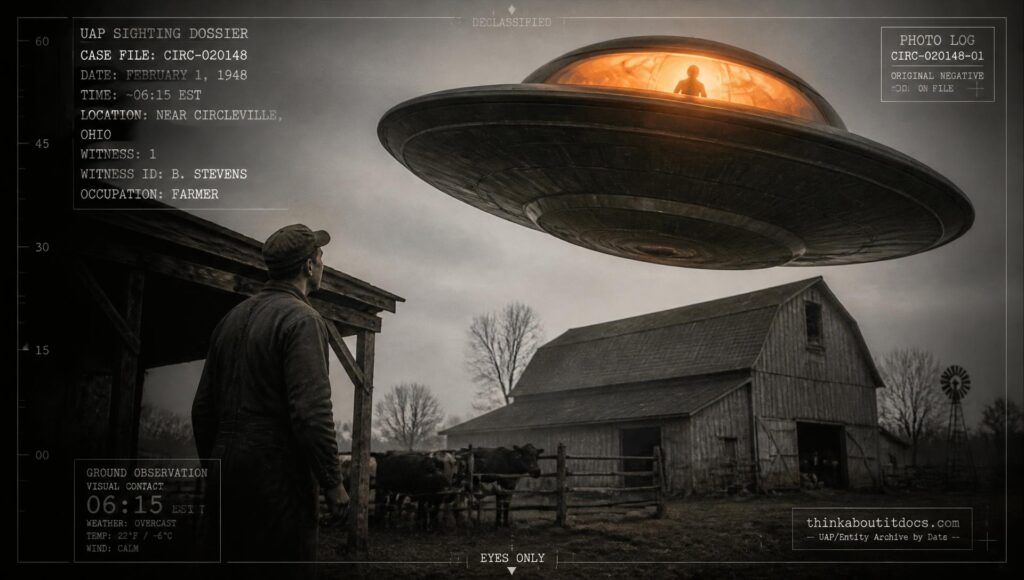
February 1, 1948 — Circleville, Ohio. Farmer B. Stevens watched a man-like silhouette through a transparent, glowing dome above his barn — the dome darkening moments later before the craft flipped and departed.
THINK ABOUTIT UFO|UAP ENTITY ENCOUNTER REPORT
1948: The Circleville, Ohio Occupant — Farmer B. Stevens
A farmer walking to his cattle shed before dawn found a 60-foot metallic saucer hanging low over his own barn, its glowing orange dome tilted just enough to reveal the silhouette of someone — or something — looking down at his farm. Then, as if it realized it had been seen, the dome went dark, and the whole thing flipped over and vanished at speed. It’s one of the more specific and quietly unsettling entity sightings of early 1948.
Date: February 1, 1948
Sighting Time: Early morning
Day/Night: Pre-dawn/early morning
Location: A farm near Circleville, Ohio
Urban or Rural: Rural — working farm property
No. of Entity(s): 1 (silhouette only)
Entity Type: Humanoid (man-like silhouette)
Entity Description: Visible only as a man-like silhouette against the illuminated interior of the object’s transparent dome; no further physical detail (facial features, clothing, coloring) could be discerned due to the backlit viewing conditions.
Hynek Classification: CE-III — Close Encounter of the Third Kind. An occupant was directly observed in association with the craft at close range, meeting the standard definition for this classification tier, though no direct interaction between witness and occupant occurred.
Duration: Not precisely specified; long enough for the witness to register the object’s size, structure, the occupant’s silhouette, and the sequence of the dome darkening before departure
No. of Object(s): 1
Description of the Object(s): Metallic, saucer-shaped, with a dome-shaped, transparent center that emitted a brilliant orange light. The object appeared to Stevens as unambiguously real and solid rather than any kind of atmospheric or optical phenomenon.
Shape of Object(s): Saucer-shaped with a central dome
Size of Object(s): Approximately 60 feet in diameter, 10-12 feet thick
Color of Object(s): Metallic body; brilliant orange-lit dome
Distance to Object(s): Close range, hovering low directly above one of the farm’s barns
Height & Speed: Low altitude, hovering, before flipping over and departing at high speed
Number of Witnesses: 1 — farmer B. Stevens
Special Features/Characteristics: The object’s dome was specifically noted as transparent, allowing direct visual observation of the interior and its occupant’s silhouette — a detail distinct from most craft descriptions in this archive’s record, which typically describe opaque hulls with no interior visibility; the occupant’s apparent attention was directed at the barns below, which Stevens speculated was connected to a green light illuminating one of the structures, suggesting the witness attempted to rationally account for the object’s specific interest in his property; the dome’s darkening — immediately following, in Stevens’s account, the moment the occupant could be observed — is a sequence that, if accurately perceived, would suggest either a deliberate response to detection or simply a coincidental change in the object’s internal lighting; the object’s departure maneuver (flipping over before high-speed acceleration) is a specific behavioral detail rather than a vague description of simply flying away.
Case Status: Unexplained
Source: Michael David Hall, UFOs: A Century of Sightings, 1999
Related Cases: 1948: February UFO|UAP & Entity Sightings Archive
Detailed Report
Early on the morning of February 1, 1948, farmer B. Stevens was walking from his house toward the cattle shed on his property near Circleville, Ohio, to check on his animals, as he did routinely. On the way, he spotted a metallic, saucer-shaped object hovering low, directly above one of his barns. Stevens immediately understood the object to be real and solid, ruling out in his own mind any possibility that he was seeing a reflection, an atmospheric effect, or a trick of the early morning light.
He estimated the object at roughly 60 feet in diameter and 10 to 12 feet thick, with a dome-shaped center that gave off a brilliant orange light. Crucially, the dome was transparent — not merely illuminated from within, but genuinely allowing a view through it. When the object inclined slightly, changing the angle at which Stevens was viewing the dome, he was able to make out the silhouette of a man-like figure inside.
The occupant’s silhouette appeared to Stevens to be focused on the farm’s barns below. Stevens, in his own account, speculated this attention might be connected to a green light he had illuminating one of the barn structures — an attempt to rationalize why the object might be specifically interested in his property rather than simply passing through the area. Shortly after Stevens observed the silhouette, the dome darkened, and he could no longer see the occupant inside. The object then flipped over and departed at high speed.
RESEARCHER’S NOTES
A Window That Closed
- On the transparent dome as a distinguishing feature: Most craft descriptions across this archive’s chronological record describe opaque hulls, with occupants (when reported at all) typically observed either standing outside a landed craft or glimpsed through small windows or portholes. A fully transparent dome allowing direct silhouette observation of an occupant, at a distance close enough to register detail, is a comparatively rare and specific structural claim, and it’s the detail that most directly elevates this case to CE-III status under the Hynek framework.
- On the sequence of the darkening dome: Stevens’s account places the dome’s darkening immediately after his own observation of the occupant’s silhouette. Read one way, this could suggest the occupant became aware of being watched and responded by somehow altering the dome’s transparency or internal lighting — an interpretation Stevens himself does not explicitly claim, but which the sequence invites. Read more cautiously, it could simply reflect an unrelated change in the object’s own lighting cycle that happened to coincide with Stevens’s observation. This report does not resolve which interpretation is correct, but notes that Stevens’s own account stops short of explicitly claiming the occupant reacted to being seen — the darkening is reported as a sequence of events, not asserted as cause and effect.
- On the single-witness limitation: As with many farm and rural sightings in this archive, this remains fundamentally a single-witness account, with no independent corroboration, physical trace, or photograph. The specificity and internal consistency of Stevens’s account — precise dimensions, a plausible (if speculative) explanation for the object’s interest in his property, a clear behavioral sequence — are qualities that lend the account credibility as a genuine attempt at careful description, though they do not substitute for independent verification.
A farmer on his way to feed his cattle looked up and found something looking back down at him — for just long enough to register a silhouette, a shape, a moment of mutual awareness, before the light went out and it was gone. Whatever watched Circleville, Ohio from inside that orange-lit dome left no trace behind except one man’s careful account of exactly what he saw, in exactly the order he saw it.