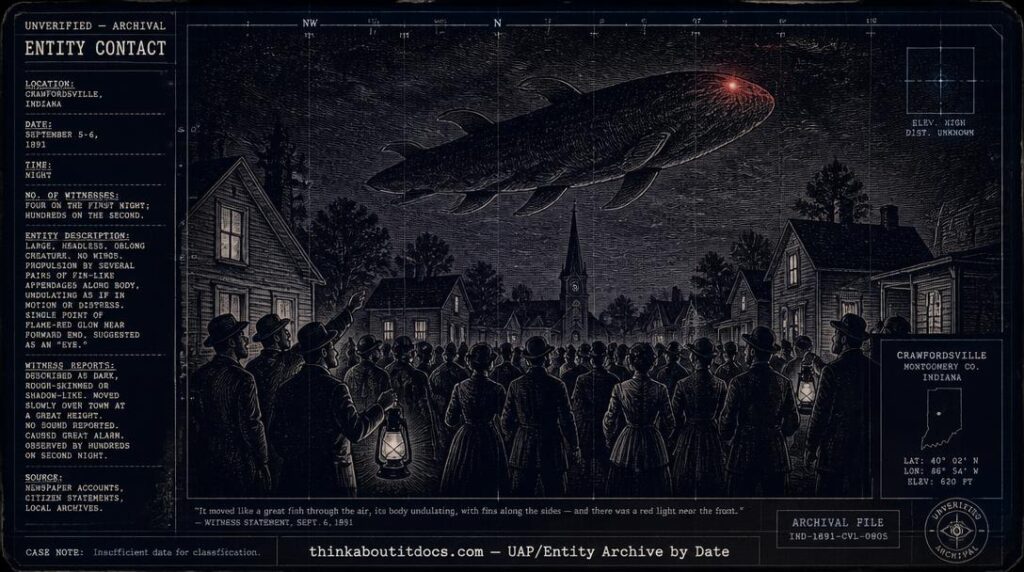
The September 5–6, 1891 Crawfordsville, Indiana encounter — a headless, fin-propelled aerial creature returned on two consecutive nights, eventually watched by hundreds of townspeople, hovering low enough that witnesses reported feeling its heat.
THINK ABOUTIT ENTITY ENCOUNTER REPORT
1891: Crawfordsville, Indiana — The Headless Aerial Creature
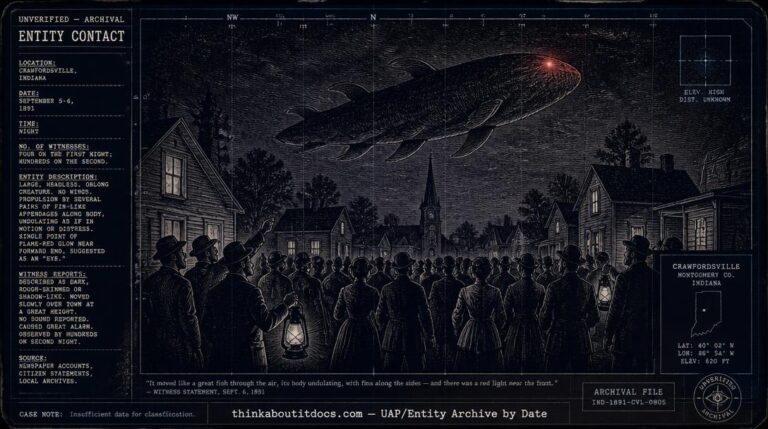
At around two o’clock in the morning on September 5, 1891, two icemen hitching up a wagon in Crawfordsville, Indiana looked up to find something sailing toward them roughly a hundred feet in the air — headless, oblong, twenty feet long and eight feet wide, propelling itself through the night sky with several pairs of fins. It circled a nearby house. The noise woke a Methodist pastor, the Rev. G.W. Switzer, and his wife, who watched it too. The men and the object parted ways that night. It came back the next evening — and this time hundreds of Crawfordsville residents were watching, drawn out by a phenomenon that had, in the space of twenty-four hours, become the talk of the town.
On its second appearance, the creature hovered at around 300 feet, its fins flapping violently, a flaming red “eye” visible against the dark, “squirming as if in agony” and issuing a wheezing, plaintive sound. At one point it swooped low over a crowd of onlookers, close enough that they swore afterward they had felt its hot breath. The Brooklyn Eagle carried the story on September 10, 1891 — a considerable distance for a small-town Indiana sighting to travel in the newspaper landscape of 1891, and a sign of how seriously the report was being taken even outside the immediate area. It remains one of the most heavily multi-witnessed living aerial entity cases anywhere in the pre-aviation record.
Date: September 5–6, 1891
Sighting Time: Approximately 2:00 AM (first night); evening (second night)
Day/Night: Night
Location: Crawfordsville, Montgomery County, Indiana, USA
Urban or Rural: Small town
No. of Entity(‘s): One
Entity Type: Non-human aerial living creature — “headless, oblong” form, not believed by contemporary or later researchers to be any known animal
Entity Description: Headless, oblong body approximately 20 feet long and 8 feet wide; propelled itself through the air using several pairs of fin-like attachments; on the second night, described as having a flaming red “eye”; movement described as “squirming as if in agony”
Hynek Classification: Not Applicable — non-craft living aerial entity, outside the standard Hynek close encounter scale
Duration: Not precisely recorded for either night; the second night’s hovering display was sustained long enough for a large crowd to gather and observe it at length
No. of Object(s): Not Applicable
Description of the Object(s): Not Applicable
Shape of Object(s): Not Applicable
Size of Object(s): Not Applicable
Color of Object(s): Not Applicable
Distance to Object(s): Not Applicable
Height & Speed: First night: approximately 100 feet altitude, moving toward the two icemen before departing. Second night: hovered around 300 feet, at one point swooping low enough over a crowd for witnesses to report feeling its breath
Number of Witnesses: Night one — two icemen, Rev. G. W. Switzer, and his wife (four named/described witnesses). Night two — hundreds of Crawfordsville residents
Special Features/Characteristics: Fin-propelled flight with no visible wings; sustained hovering behavior; flaming red “eye” visible on the second night; audible wheezing, plaintive sound; described by witnesses as appearing to be “squirming as if in agony”; heat reportedly felt by onlookers during a low pass; returned to the same location on consecutive nights
Case Status: Unexplained.
Source: Brooklyn Eagle, September 10, 1891; Jerome Clark, Anomalistic List; Contact U.K.
Summary/Description: At approximately 2:00 AM on September 5, 1891, two icemen hitching a wagon in Crawfordsville, Indiana saw a headless, oblong aerial creature roughly 20 feet long and 8 feet wide, propelled by several pairs of fin-like attachments, flying about 100 feet overhead and circling a nearby house. The noise woke Methodist pastor Rev. G. W. Switzer and his wife, who also witnessed it. The creature returned the following evening, this time observed by hundreds of townspeople, hovering at roughly 300 feet with a flaming red “eye,” flapping its fins violently, “squirming as if in agony,” and emitting a wheezing, plaintive sound. At one point it swooped low over a group of onlookers, who reported feeling its heat. The story was picked up by the Brooklyn Eagle on September 10, 1891.
Related Cases: 1890–1895: UFO|UAP & Entity Sightings Archive
Detailed Report
The Crawfordsville case survives primarily through the account published in the Brooklyn Eagle on September 10, 1891, five days after the first sighting, and through later compilation by Fortean researcher Jerome Clark in his Anomalistic List. According to the original report, at around two o’clock in the morning on September 5, 1891, two men were in the process of hitching up a wagon when they were startled by what the newspaper account called a “horrible apparition” sailing through the sky toward them. The object was headless and oblong in shape, roughly twenty feet long and eight feet wide, and appeared to propel itself using several pairs of fin-like attachments rather than wings. It circled a nearby house at an estimated altitude of one hundred feet before the men’s movement apparently prompted it to fly off.
The commotion was loud enough to wake a Methodist pastor, the Rev. G. W. Switzer, and his wife, both of whom independently observed the object circling in the sky. This gave the first night’s sighting four described witnesses rather than a single account — a detail that likely contributed to the story’s credibility and its subsequent pickup by a newspaper outside the immediate area.
According to Clark’s account, the creature was not finished with Crawfordsville. It returned the following evening, and this time its presence had become known widely enough that hundreds of the town’s citizens turned out to watch. Witnesses on the second night described its fins flapping violently and a flaming red “eye” visible on its form. The creature hovered at approximately three hundred feet, appearing to “squirm as if in agony” and producing a sound described as wheezing and plaintive. At one point during the display, it swooped low over a group of onlookers — close enough, according to their later accounts, that they felt what they described as its hot breath.
No physical trace, photograph, or captured specimen resulted from either night’s sighting. The case has not been definitively linked to any known natural phenomenon, animal, or hoax explanation in the available record, and neither the original 1891 newspaper account nor later Fortean compilations offer a conventional resolution.
RESEARCHER’S NOTES
The Crawfordsville Creature — Indiana 1891 and the Problem of a Living Aerial Entity
- Classification Issues: This case resists standard categorization within this archive. It is not a structured craft, and the entity’s described behavior — organic-sounding motion, an apparent expression of distress (“squirming as if in agony”), an audible plaintive sound, and heat radiating from its body — reads far more like an encounter with a living creature than a mechanical or clearly non-biological phenomenon. It is filed here as an entity encounter rather than a UFO sighting for that reason, though “entity” in the sense used elsewhere in this archive (a humanoid or intelligence-bearing being) may not be the most precise fit either. The case sits in its own category.
- Source Chain Assessment: This case has an unusually strong witness count for its era, spread across two separate nights: four described witnesses on the first night (two icemen, a named pastor, and his wife), and an estimated crowd of hundreds on the second. The story’s pickup by the Brooklyn Eagle, a major regional paper well outside Crawfordsville’s immediate area, five days after the first sighting, indicates it was treated by contemporaries as more than a local curiosity. The modern secondary compilation by Jerome Clark adds narrative detail (the “flaming red eye,” the “hot breath”) not fully specified in the shorter archive summary, and ideally these details should be checked against the original 1891 newspaper text directly if a scan can be located.
- Pattern Context: Living, biological-seeming aerial entities are a recurring but comparatively rare category in this archive relative to structured craft and humanoid contact cases. The Crawfordsville creature’s combination of large size, fin-based propulsion, and apparent physical distress sets it apart even within that smaller category — it reads less like a cryptid sighting (which would typically emphasize physical description alone) and more like an account of a creature in genuine pain or agitation, a detail worth flagging for anyone building a comparative catalog of pre-1900 aerial entity behavior.
- Geographic and Historical Context: Crawfordsville, Indiana in 1891 was a modest county seat, not a location with any particular reputation for anomalous activity before or after this case, which argues against a standing local hoax tradition or folklore explanation specific to the town. The two-night return pattern — appearing, then reappearing at the same general location roughly twenty-four hours later — is a detail worth comparing against similar short-interval return patterns in other multi-night cases in this archive.
Two icemen hitching a wagon before dawn watched something fly toward them that had no head, no wings, and no obvious explanation — and came back the next night in front of half the town. Whatever moved through the sky over Crawfordsville on those two September nights in 1891, it did not behave like a machine, and the witnesses who described it did not describe a machine. They described something that seemed to be suffering. That detail alone keeps this case from resolving neatly into any of the archive’s usual categories, and it has resolved into none of them since.
“One hundred feet in the air, twenty feet long and eight feet wide, the headless, oblong thing — apparently some bizarre variety of living creature — propelled itself with several pairs of fins and circled a nearby house.”