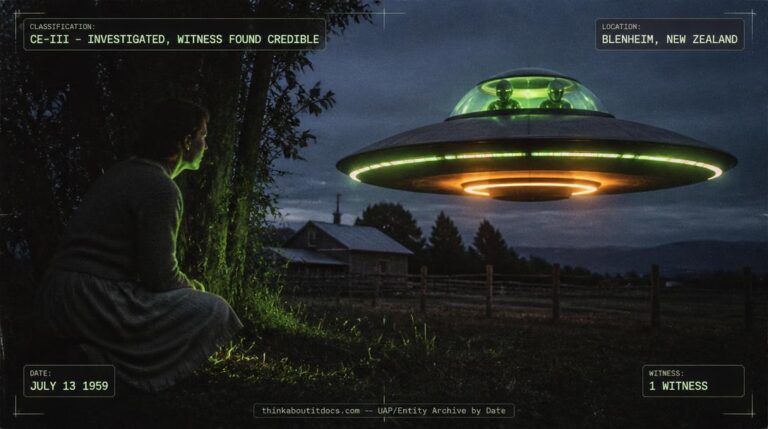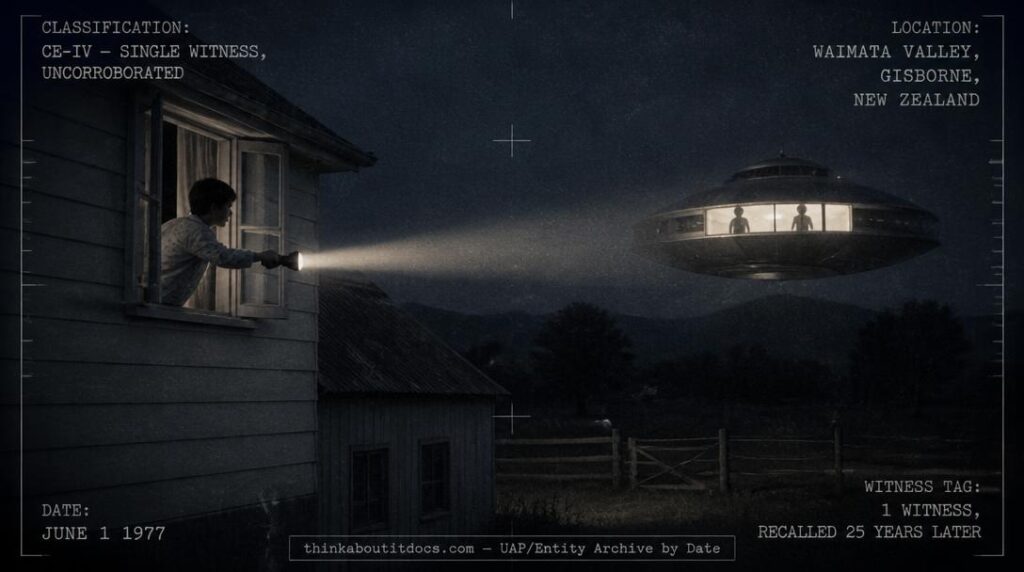
Recreation of the June 1977 Waimata Valley, Gisborne account, in which a teenage boy signaled a hovering craft with a torch — the start of a personal narrative recalled and submitted to NUFORC roughly 25 years later.
THINK ABOUTIT UFO|UAP|ENTITY ENCOUNTER REPORT
1977: The Waimata Valley Scout Ship, Gisborne, New Zealand
On the night of June 1, 1977, a 16-year-old on his family’s farm in the Waimata Valley near Gisborne, New Zealand, decided to signal the next UFO that flew over his house with a torch — and, by his own decades-later account, found himself aboard a small “scout ship,” in telepathic conversation with its crew, before an in-flight medical procedure went wrong and he was taken to a larger vessel for repairs.
Date: June 1, 1977
Sighting Time: 11:00 PM (23:00)
Day/Night: Night
Location: Family farm, Waimata Valley, near Gisborne, New Zealand
Urban or Rural: Rural — family farm
No. of Entity(‘s): Multiple. Two entities were first seen in the craft’s window; the witness’s account centers on two recurring, distinctly characterized individuals — one tall, human-familiar entity and one shorter, distrustful entity that followed him throughout — with additional undifferentiated crew glimpsed at points, including a group of about four at his departure.
Entity Type: Multiple humanoid types reported
Entity Description: One tall entity, described by the witness as relaxed, conversational, and familiar with human behavior, communicated telepathically at length, performed a medical procedure on the witness, and was reportedly enthusiastic about humans generally. A separate, shorter entity (described in the original filing as brown-suited, a detail not independently confirmed in the narrative text available here) was distrustful of the witness, followed him closely throughout his time aboard, and was reportedly wary of humans as a species. Additional, less-described crew members were present at various points.
Hynek Classification: Corrected from the original filing’s CE-V to CE-IV (Close Encounter of the Fourth Kind — abduction). This site does not use CE-V, which falls outside Hynek’s original classification scale; CE-IV is the correct category for an account involving boarding, examination, and return, and fits this narrative directly.
Duration: 2+ hours
No. of Object(s): Two craft described — a smaller “scout ship” that first appeared over the witness’s house, and a larger “mother ship” he was transferred to for medical repairs. The original field listed this as “Multiple.”
Description of the Object(s): A metallic, disc-shaped craft with windows, described as hovering quietly with no unusual sound, light, or odor noted by the witness. He describes its interior as conventional and uncluttered — corridors, separate rooms, a flight control area he found intuitively navigable, and furnishings comfortable for both humans and the craft’s occupants, at normal temperature throughout.
Shape of Object(s): Disc
Color/Description of Object(s): Metallic disc, with windows the witness reports being able to see both into (from the ground) and out of (once aboard)
Size of Object(s): Not specified — the witness distinguishes between a smaller “scout ship” and a larger “mother ship” but gives no dimensions for either
Distance to Object(s): Approximately 10-20 meters above the witness when the craft first stopped over him
Height & Speed: Not specified. The craft reportedly hovered quietly, then, following an injury sustained during the onboard medical procedure, “bolted to space” — no altitude or velocity figures are given for either phase.
Number of Witnesses: 1
Special Features/Characteristics: The witness reports being able to perceive the entities’ telepathic communication, including conversations not directed at him, and states that whatever method the entities normally used to suppress human memory of such encounters did not work on him. He describes an extended, detailed exchange with the tall entity touching on Cold War politics, a medical procedure on his nose that was interrupted when he pulled away from the instrument, and a brief, contested episode involving a small item he attempted to keep from the craft as a souvenir. The account was submitted to NUFORC roughly 25 years after the events it describes, based entirely on the submitter’s unaided memory.
Case Status: Insufficient Data — a single, anonymous, first-person account recalled roughly 25 years after the fact, with no photograph, no named corroborating witness, and no independent verification of any part of the core narrative
Source: NUFORC (National UFO Reporting Center); the submission itself also references three separate, distinct incidents from the same general period and region as context — see Related Cases
Summary/Description: A New Zealand man submitted a first-person account to NUFORC describing an experience from 1977, when he was a 16-year-old living on his family’s farm in the Waimata Valley near Gisborne, during a period of repeated UFO sightings reported along the valley road. After signaling a passing craft with a torch, he recalls being taken aboard, engaging in extended telepathic conversation with the crew — including a lengthy disagreement about Cold War politics — and undergoing a medical procedure on his nose that was interrupted when he pulled away, resulting in an injury that led to his transfer to a larger vessel for repair before being returned home. He states he retained full conscious memory of the experience without hypnosis and was submitting the account decades later because he felt free to discuss it.
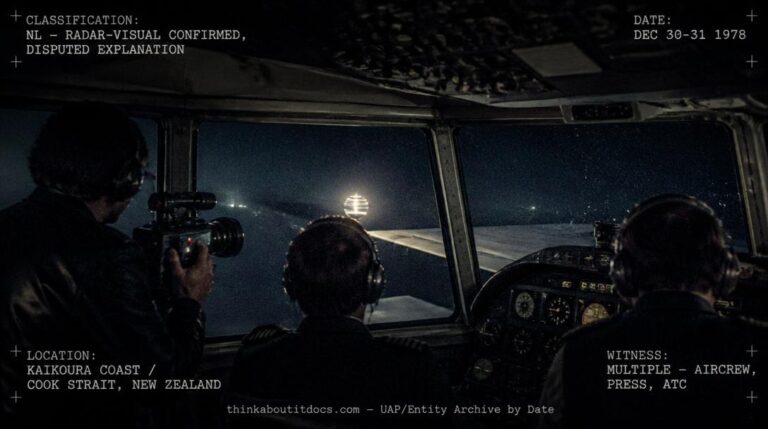
Related Cases: The witness’s own submission references three separate, distinct incidents from the same general period, of markedly different evidentiary quality: (1) A December 2, 1977 report of a farmer near Waimata Valley Road who allegedly fired on two humanoid entities carrying one of his dogs, sourced only to a 1993 online bulletin board posting sixteen years after the fact, with no named farmer and no independent investigation cited. (2) A separately documented 1977 Gisborne-area case involving three women who reported “missing time” while watching the sky, later explored via 1989 regression hypnosis by named investigators Keith Basterfield and Bill Chalker (following original investigation by Bryan Dickeson), published in M. Dykes’s 1981 book “Strangers In Our Skies” — a more formally sourced case than most referenced here, though still reliant on hypnotic regression, a method with well-documented reliability concerns. (3) The December 1978-January 1979 Kaikoura Lights, a genuinely well-documented and famous New Zealand case involving airline pilot sightings, television news video footage, and a formal joint RNZAF/police/observatory investigation — real and independently verifiable, but not directly connected to this witness’s own personal account beyond sharing the same general region and era.
Detailed Report
This account was submitted to NUFORC by an adult recalling an experience from when he was 16, roughly a quarter-century after it reportedly occurred. He frames it as a direct response to months of reported UFO activity along Waimata Valley Road near his family’s farm: having decided to attract the attention of a passing craft with a torch, he describes being taken aboard what he calls a “scout ship,” where he found himself able to perceive the crew’s telepathic conversation, including an internal disagreement over whether he was worth their attention. What follows, by his account, is an extended, conversational encounter: a lengthy discussion with a tall, human-familiar entity that touched on why extraterrestrial visitors might not feel welcomed by humanity, a specific disagreement over Cold War politics in which the entity pressed him to regard Americans and Russians as equally “the same species,” a period of unsupervised wandering through the craft trailed by a wary, shorter entity, and finally a medical procedure on his nose that went wrong when he pulled away mid-procedure, leading to an injury serious enough, in his telling, to require transfer to a larger vessel for repair. He describes being shown footage of his mother searching for him at home as the reason he was ultimately returned rather than allowed to stay, and closes with a minor, almost domestic episode: being caught trying to keep a small souvenir from the ship before his return.
The witness’s own submission adds three further reports as regional context, each with a different level of sourcing. The weakest is a December 1977 account of a farmer allegedly firing on two entities near his home, which traces only to an anonymous 1993 online bulletin-board post — sixteen years removed from the event, with no named party and no known formal investigation. Better sourced is a separate 1977 case involving three women who reported a period of missing time, which drew a real, named investigation by Bryan Dickeson and, later, by Keith Basterfield and Bill Chalker (the same investigator behind this archive’s Father Gill case), using hypnotic regression and published in a real, cited 1981 book — genuine sourcing, though hypnotic regression itself is a method ufology and psychology researchers alike have long flagged for reliability concerns around suggestibility and confabulation. Best documented of the three is the December 1978-January 1979 Kaikoura Lights case, a real and independently famous New Zealand UFO event involving multiple pilot sightings, television news footage, and a formal government investigation — but it is a separate case entirely, connected to this witness’s account only by shared regional and temporal context, not by any direct evidentiary link.
RESEARCHER’S NOTES
The Waimata Valley Scout Ship — 1977 and a Single Testimony Told 25 Years Later
- Classification Assessment: The original CE-V classification has been corrected to CE-IV. This archive follows Hynek’s original CE-I through CE-IV scale plus DD and NL; CE-V, sometimes used elsewhere for later, non-Hynek concepts like human-initiated contact protocols, is not a category this site applies. CE-IV — close encounter involving abduction — is the accurate fit for a boarding-and-return narrative like this one.
- Source Chain Assessment: This is a single, anonymous, first-person account, submitted to a legitimate reporting database (NUFORC) but based entirely on unaided personal recollection roughly 25 years after the events described, with no named witness, no photograph, and no physical evidence of any kind. A previous version of this page’s analysis treated corroborating regional context as if it lent “significant weight” to the core narrative; that overstates what the supporting material actually establishes. None of the three referenced regional cases corroborates this witness’s personal account directly — at most, they establish that this was a real, independently documented period of UFO reporting in the area, which is a different and much more limited claim than corroboration of this specific story.
- Evidentiary Weight: No photograph, physical trace, or second witness supports the core account. The narrative’s high level of specific, novelistic detail — extended dialogue, a debated ideological position on Cold War politics, a physical injury with an in-story causal chain, a small stolen-souvenir subplot — is worth naming plainly: this level of narrative construction, while not proof of fabrication, is also not itself evidence of accuracy, and readers should weigh a quarter-century-old, unaided personal memory accordingly.
- Pattern and Comparative Context: The broader claim of a genuine 1977 UFO “flap” centered on the Waimata Valley and Gisborne area has real, independent support — most substantially through the well-documented Kaikoura Lights case from the same region roughly 18 months later, and to a lesser extent through the Dickeson/Basterfield/Chalker-investigated missing-time case. A regional pattern of reports is not the same as confirmation of any single account within it, including this one.
- Geographic and Historical Context: Gisborne and the surrounding Waimata Valley, on New Zealand’s North Island east coast, were a genuine focal point of UFO reporting activity in the late 1970s, culminating in the internationally reported Kaikoura Lights case. This witness’s account situates itself within that real regional history, even though the personal narrative itself remains entirely unverified.
This is a single, richly detailed personal account, recalled decades after the fact and never corroborated by any other witness, photograph, or physical trace. It sits within a real and independently documented regional UFO flap, but that regional context confirms the era, not the story. The case stands as Insufficient Data — preserved here as testimony, not as an established event.
“I didn’t need hypnosis to recall this.”