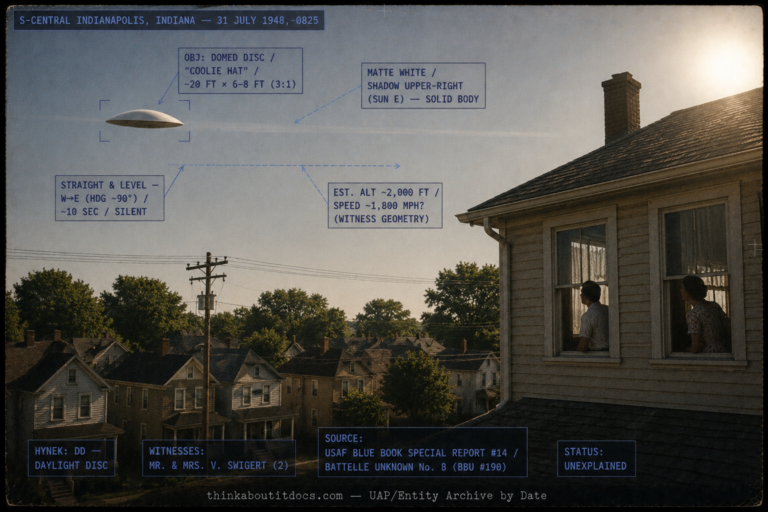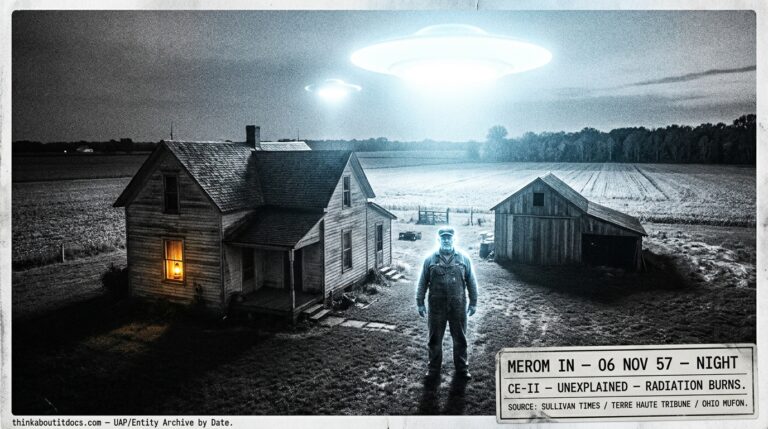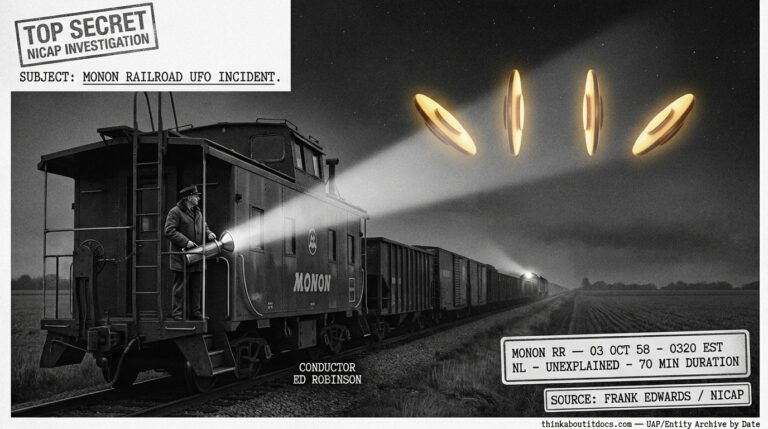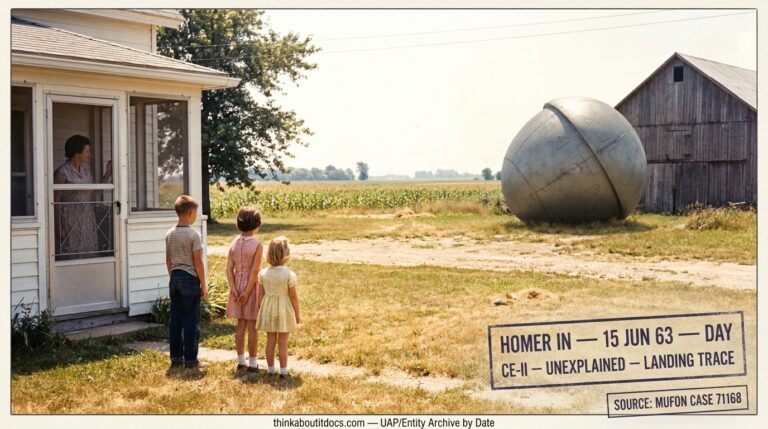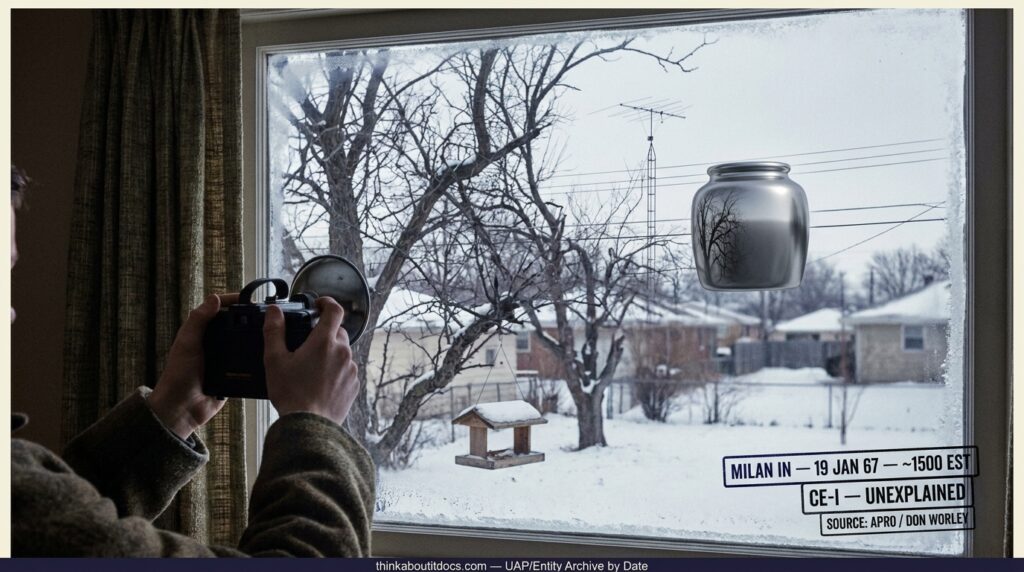
Milan, Indiana, January 19, 1967 — A silvery beanpot-shaped object roughly 6 feet across glides at walking speed past the window of the Thompson residence as 14-year-old Reed Thompson photographs it with a Kodak Hawkeye. Don Worley investigation for APRO.
THINK ABOUTIT UFO|UAP SIGHTING REPORT
1967: Milan, Indiana UFO Encounter
On January 19, 1967, fourteen-year-old Reed Thompson was sitting in his underwear watching television in the living room of his family’s home in Milan, Indiana — a small town in southeastern Indiana, not Connersville as the page title suggests — when a noise like a diesel train engine starting up drew his attention to the large east-facing windows behind him. What he saw over a neighbor’s red-roofed house at the level of the TV antenna and power lines was not a street light. It was moving. It followed the contour of the ground down a slope, disappeared behind a line of small fir trees, reappeared, made an angle turn, and began gliding up the slope directly toward the Thompson house at walking speed — about three miles per hour. Reed Thompson grabbed his sister’s Kodak Hawkeye camera, hands shaking, and shot what would become one of the strangest color photographs in the APRO archive: a silvery, squat, rounded object that bore no resemblance to any previously reported UFO. The APRO Bulletin called it a bean jar. Don Worley of Connersville — one of the most meticulous civilian investigators in Indiana — spent weeks on the case. The state police questioned the boy. A local photographer with years of experience declared the photograph genuine. Time-Life and Dell turned it down — not because they doubted it, but because it did not look like anything anyone had seen before.
⚠ LOCATION CORRECTION:
The page title says “Connersville, Indiana.” The witness lived in Milan, Indiana (Ripley County). Don Worley, the APRO investigator, was from Connersville (Fayette County). The sighting occurred in Milan.
Date: January 19, 1967
Sighting Time: Approximately 3:00–4:00 PM (witness got home from school and was watching TV; later estimated as 1600)
Day/Night: Day — winter afternoon
Location: Milan, Ripley County, Indiana — Thompson family residence (NOT Connersville as listed in the page header; Don Worley, the investigator, was from Connersville)
Urban or Rural: Small town — Milan, population approximately 1,800
No. of Entity(‘s): None observed
Entity Type: N/A
Entity Description: N/A
Hynek Classification: CE-I (Close Encounter of the First Kind) — structured object observed at close range (as close as the far side of the yard, approximately 30–50 feet during window passage; object passed directly outside the windows)
Duration: Several minutes — from initial observation at approximately 200 yards through multiple approach phases to final disappearance
No. of Object(s): 1
Description of the Object(s): Witness described it as silvery, the same color and brightness all over, more squat or rounded than it appeared in the photograph. No ports, no protrusions, sharp clean edge. In the photograph, it appeared as an unusual shape compared to a bean jar or beanpot — dark gray rather than silvery (the discrepancy between visual observation and photographic reproduction noted by the investigator). Glassy, highly reflective surface — tree branch reflections visible on the left side of the object in the photograph.
Shape of Object(s): Bean-jar or beanpot — unique morphology not previously reported in the UFO literature; squat, rounded, somewhat taller than wide
Size of Object(s): Approximately 6 feet by 6 feet
Color of Object(s): Silvery to the naked eye; photographed as dark gray on Ektachrome 127 film
Distance to Object(s): Initially approximately 200 yards; as close as immediately outside the windows during passage
Height & Speed: Low altitude — approximately TV-antenna and power-line level (15–30 feet); speed approximately 3 mph (walking speed), following ground contour. Departed by moving up a slope and disappearing instantly.
Number of Witnesses: 1 — Reed Thompson, age 14. No other witnesses came forward. Neighborhood was largely empty during working hours.
Special Features/Characteristics: Photographic evidence — color photograph taken with Kodak Hawkeye camera on Ektachrome 127 film. One successful photograph from the bedroom window; earlier attempts from the living room produced a double exposure due to failure to advance the film. Authenticated by a local photographer with years of experience who determined it was not a double exposure or montage. Tree-branch reflections visible on the object’s surface in the photograph indicate the object was airborne near the tree, not thrown or hanging near the window. Continuous diesel-engine-like sound accompanied the object throughout the sighting; the sound ceased simultaneously with the object’s disappearance. Object navigated by angling around obstacles rather than curving, and followed ground contour.
Case Status: Unexplained
Source: APRO Bulletin — Don Worley investigation, Connersville, Indiana. Francis L. Ridge, Regional Encounters: The FC Files. APRO staff artist Richard Beal illustration based on Worley’s sketches. State police investigation (15 minutes by telephone, 45 minutes in person).
Summary/Description: Fourteen-year-old Reed Thompson observed a small, squat, silvery, beanpot-shaped object at close range as it glided at walking speed past the windows of his family home in Milan, Indiana on January 19, 1967. He photographed it in color with a Kodak Hawkeye camera on Ektachrome 127 film. The photograph was authenticated by a professional photographer and investigated by Don Worley for APRO. State police conducted a personal interview. The object’s unique morphology — described as resembling a bean jar — had no precedent in the UFO literature. Tree-branch reflections on the object’s surface in the photograph confirmed it was airborne near the tree canopy.
Related Cases: 1963 Homer Indiana Landing (acorn morphology, same state, unusual shape class) | 1965 Kecksburg, Pennsylvania (acorn/bell-shaped object)
Detailed Report
The Milan beanpot case is one of the more unusual close-encounter photographs in the APRO archive — unusual not because the photograph is ambiguous, but because the object it depicts does not look like anything else. Don Worley, one of Indiana’s most thorough civilian UFO investigators, spent considerable time on the case and found the witness credible, the photograph genuine, and the behavioral details internally consistent.
Reed Thompson, age 14, had arrived home from school and was watching television in the living room of the Thompson residence in Milan, Ripley County, Indiana. The large east-facing windows behind him looked out over the surrounding neighborhood. At approximately 3:00 PM, he heard a noise he compared to a diesel train engine starting up. Glancing toward the railroad tracks, he saw what he initially took for a street light above a neighbor’s red-roofed house, approximately 200 yards away, at the level of a TV antenna and power lines. Then he realized it was moving.
The object followed the contour of the ground, descending into a small valley behind a line of fir trees and reappearing on the other side. It made an angle turn — not a curve — and began moving up the slope directly toward the Thompson house at approximately walking speed (3 mph). Reed described shock and disbelief. He felt like he was going to have a heart attack. He ran for his sister’s camera — a Kodak Hawkeye loaded with Ektachrome 127 color film — stopped halfway, turned around to look again, then grabbed the camera and positioned himself 4–5 feet from the living room window. His first shot was botched: in his excitement, he forgot to advance the film, producing a double exposure that also caught part of a curtain and tree limb. He moved a step closer and attempted another shot. Then he rushed to a bedroom for a better angle and, advancing the film to a fresh frame, captured the only clear photograph as the object glided past that window.
He then threw on clothes (he had been sitting in his underwear) and ran outside. The object had moved past the house, was approximately 100 yards away down a slope near a large sycamore tree, and then moved along a row of small fir trees, made another turn, moved west a short distance, and disappeared instantly. The diesel-engine sound, which had persisted throughout the entire sighting, stopped simultaneously with the disappearance.
Don Worley’s investigation produced several notable findings. The object in the photograph appeared dark gray, but Thompson said it appeared silvery to his naked eye — a discrepancy Worley flagged as significant, possibly indicating that the object’s surface properties interacted differently with film emulsion than with the human eye. The glassy, highly reflective surface showed tree-branch reflections on its left side in the photograph — a detail Worley identified as proof that the object was airborne near the tree, not thrown or suspended near the window. The local photographer who examined the photograph declared it genuine, ruling out double exposure and montage. State police questioned Thompson — 15 minutes by telephone, 45 minutes in person.
The Thompson family attempted to sell the photograph to Time-Life and Dell, both of which declined — not, apparently, on grounds of suspected fraud, but because the object did not resemble any previously reported UFO type. APRO commissioned staff artist Richard Beal to produce a drawing based on Worley’s sketches and descriptions.
Researcher’s Notes
The Milan Beanpot — Ripley County 1967 and the Unclassifiable Object Problem
- Location Correction: The existing page title reads “Connersville, Indiana UFO Encounter.” This is incorrect. The witness lived in Milan, Ripley County — approximately 50 miles south-southeast of Connersville. Don Worley, the APRO investigator, was from Connersville. The sighting occurred at the Thompson residence in Milan. The page title should be corrected to “1967: Milan, Indiana — The Reed Thompson Beanpot Photograph.”
- Source Chain and Investigation Quality: The source chain is strong for a single-witness case. Don Worley conducted an in-person investigation and spent considerable time with the witness. The state police conducted a separate interview. A professional photographer authenticated the image. APRO published the case with both narrative and illustrative support. Francis L. Ridge (Regional Encounters: The FC Files) subsequently archived it. The investigation was thorough by 1967 civilian standards. The only significant weakness is the absence of corroborating witnesses — the neighborhood was largely empty during working hours.
- Photographic Evidence Assessment: The photograph is the case’s primary strength and its primary puzzle. Worley’s analysis identified tree-branch reflections on the object’s glassy surface, placing it definitively near the tree canopy at the stated distance rather than suspended near the camera. The visual-to-photographic color discrepancy (silvery to the eye, dark gray on Ektachrome) is consistent with the known spectral response characteristics of Ektachrome reversal film, which can render highly reflective metallic surfaces as darker than they appear visually, particularly under overcast winter daylight. The double-exposure on the first frame is consistent with camera-handling error by an excited, inexperienced teenager using an unfamiliar camera. The behavioral details — stopping halfway to the camera to look again, forgetting to advance the film — are hallmarks of genuine panic rather than calculated fraud.
- Morphological Uniqueness and the Anti-Hoax Argument: Worley himself and the APRO editors noted the most compelling anti-hoax argument: the object looked like nothing previously reported. A hoaxer, they observed, would logically fabricate a disc, a cigar, or another familiar shape — not a bean jar. The complete absence of any prior report matching this morphology makes it either an entirely novel observation or an entirely original fabrication. The object’s behavioral characteristics — ground-contour following, angle turns rather than curves, walking speed, instantaneous disappearance with simultaneous cessation of sound — add further details that resist easy explanation by conventional models.
 A fourteen-year-old boy, a bean jar in the sky, a photograph that looks like nothing else in the archive, and magazines that turned it down because they could not categorize it.
The Milan beanpot is either one of the most inventive hoaxes ever attempted by a teenager in his underwear, or it is exactly what it appears to be: a small, slow, silvery object of unknown origin that glided through a quiet Indiana neighborhood on a winter afternoon in 1967.
The archive holds the photograph.