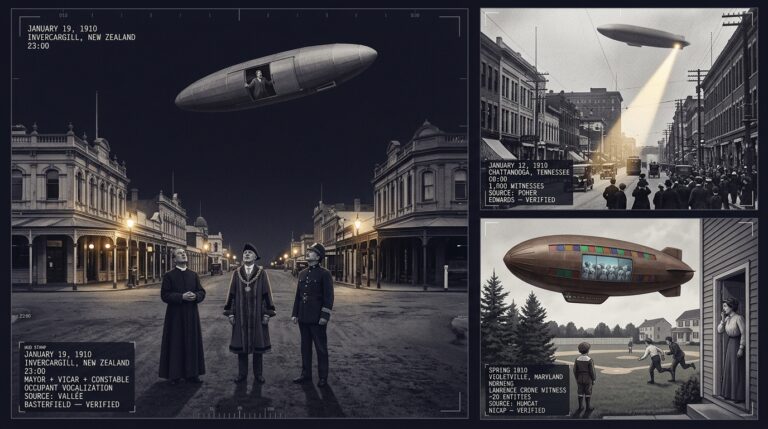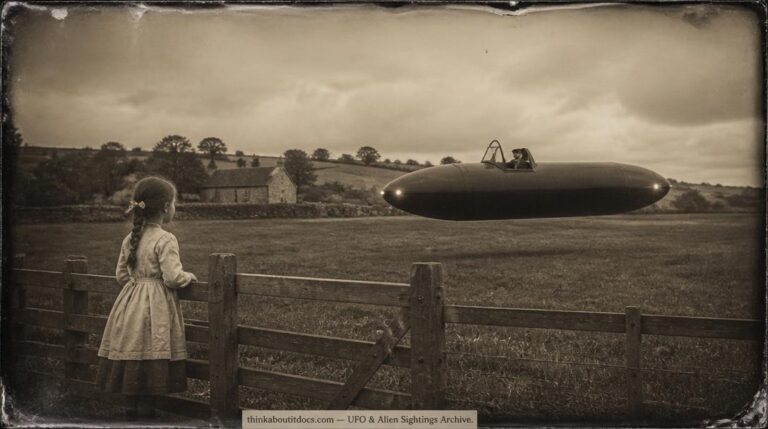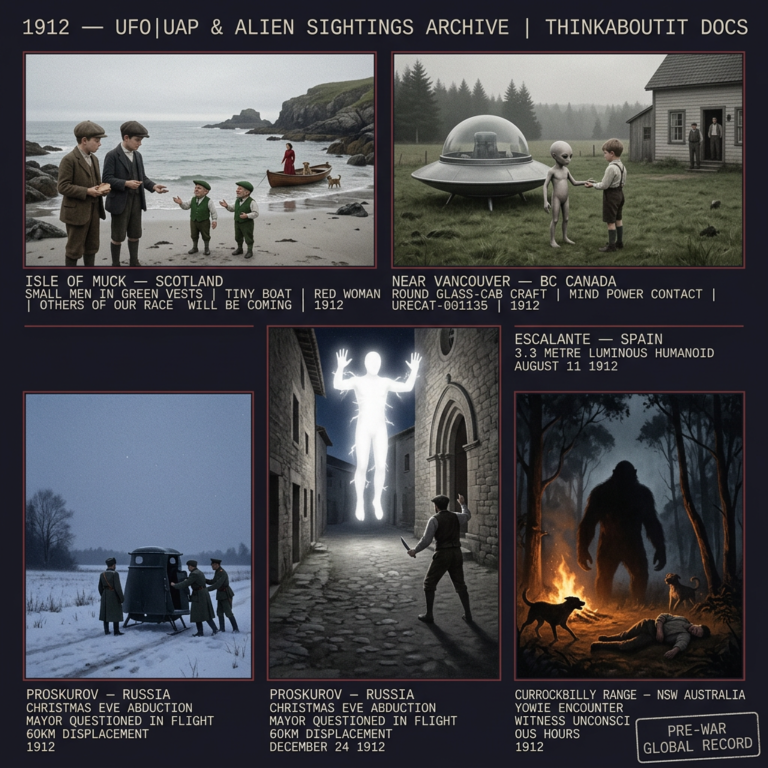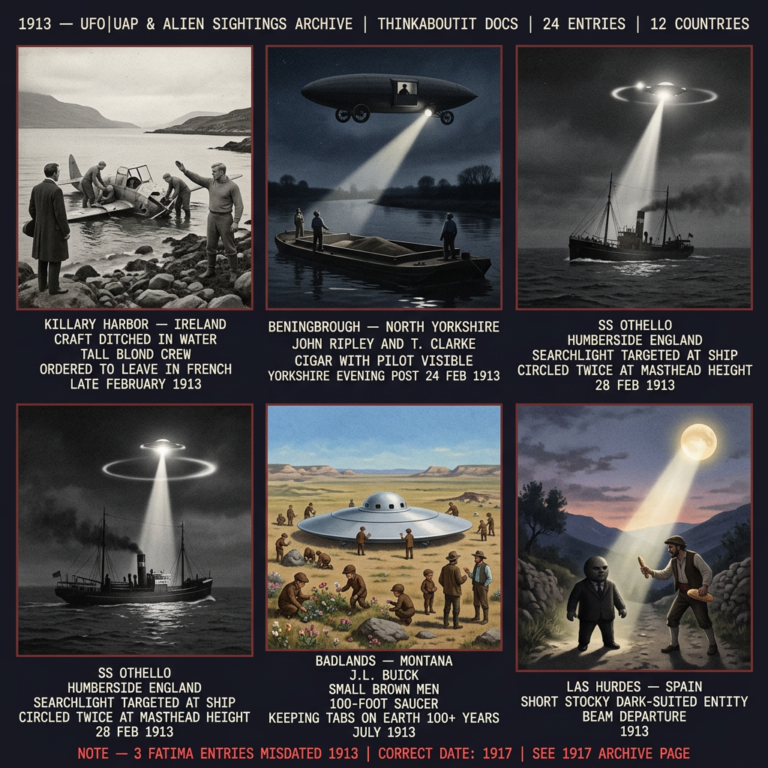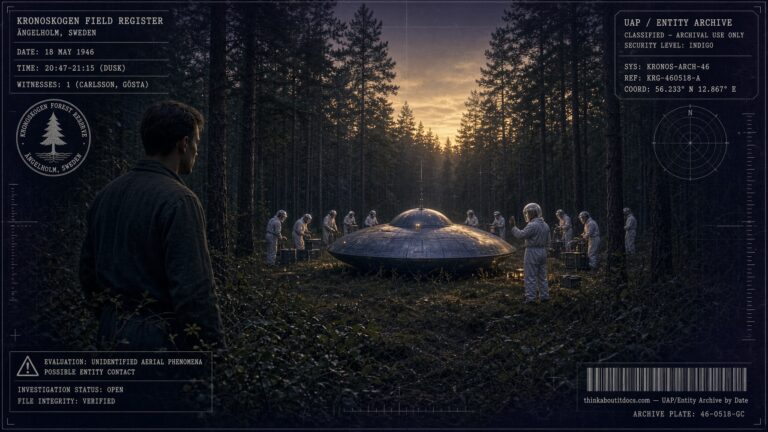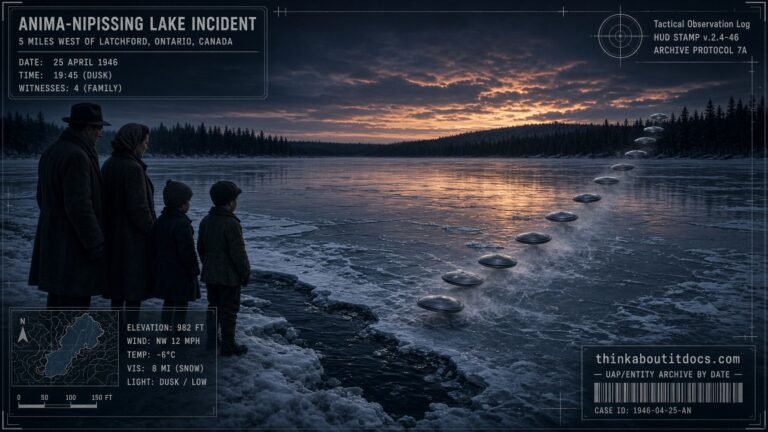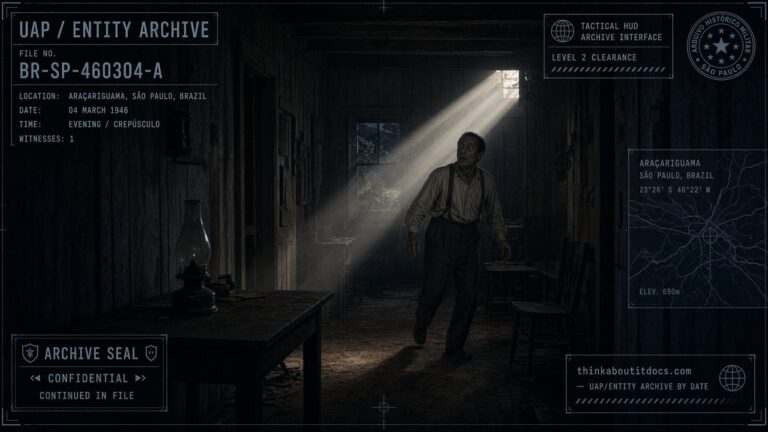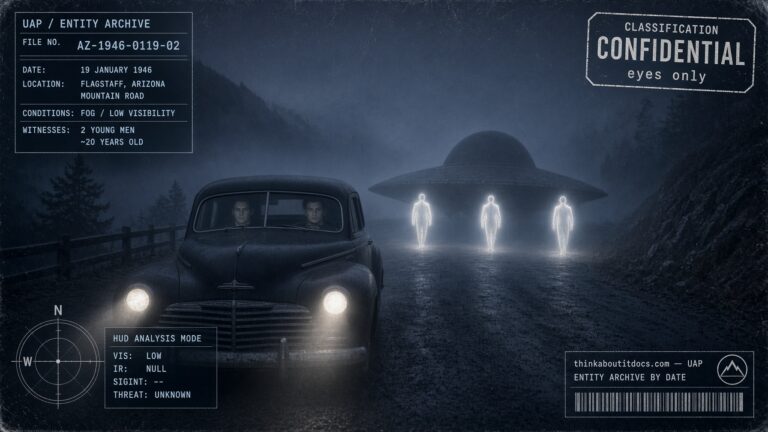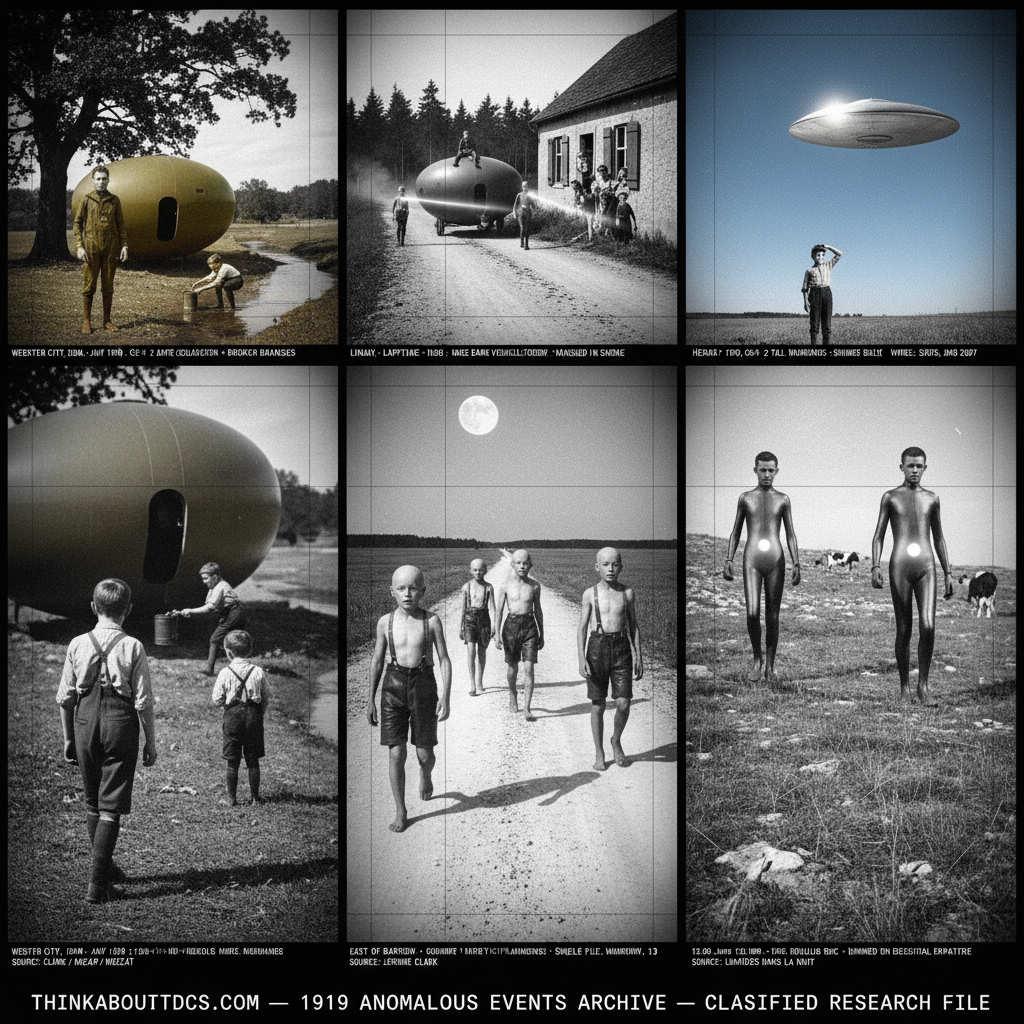
1919 anomalous events archive: Webster City Iowa CE-III craft landing with water-collecting occupants and ground traces (Clark/NICAP sourced), Linaalv Lappland vehicular craft with crew vanishing in smoke (Svensson), Barron Wisconsin twenty bald humanoid entities on moonlit road (Clark), Hérault France two-meter shining-suit beings with belly lights (Sider 2007), and Scorbe-Clairvaux France metallic disc daylight observation (Lumières dans la Nuit).
1919: UFO|UAP & Entity Sightings Archive
1919 closes the decade with the most densely populated year of genuine pre-1947 entity content in this archive’s 1910–1919 series. The Armistice had dissolved wartime censorship, and the first full post-war year produced a geographically distributed cluster of encounters spanning France, Sweden, Wisconsin, Iowa, and beyond. The anchor case is the July encounter at Webster City, Iowa — two child witnesses, a landed craft, occupant behavior with no available cultural template, and physical ground marks and broken tree branches left behind. It remains the strongest single case on this page by evidentiary standard: named researcher attribution, independent catalog corroboration, and physical trace evidence together.
This page also carries a case that needs to be handled with real care rather than either suppressed or presented uncritically: the “Mike Childers” account from near Tehachapi, California, sourced entirely to a tabloid publication and built on 1990 hypnotic regression of an elderly witness describing 1920s brain surgery and alien abduction. It’s retained here per this site’s standing practice of keeping unusual and unexplained material in the record — but the caveats already attached to it in this site’s own prior audit are preserved in full, because they matter.
Date: 1919
Location: Figheldean, Wiltshire, England
Time: Unknown
Hynek Classification: DD
Case Status: Insufficient Data
Summary: Two British soldiers reported seeing several orange, spherical objects hovering over Salisbury Plain.
Source: Unlisted; corroborated on this site’s own earlier archive listing for the case
Date: 1919
Location: Between La Rua (near Eyglièrs) and Le Cros, Hérault, France
Time: 11:00 AM
Hynek Classification: CE-III
Case Status: Insufficient Data
Summary: Ufologist Joël Mesnard reported that Mr. Manonviller, 12 years old at the time (born 1907), and a companion, out tending cows, saw two roughly two-meter-tall figures in shining outfits with a light on their midsection, advancing with a mechanical gait.
Source: Sider, Jean. Les Extraterrestres avant les Soucoupes Volantes, JMG, p. 227, 2007 — the witness’s name and birth year give this account an unusually strong minimum evidentiary anchor
Date: 1919
Location: Central New South Wales, Australia
Time: Unknown
Hynek Classification: CE-III
Summary: Full detail on this site’s dedicated report page. [Full Report]
Source: Individual report page linked
Date: 1919
Location: Linaalv, Lappland, Sweden
Time: Daytime
Hynek Classification: CE-II
Case Status: Insufficient Data
Summary: Nine-year-old Ragnar Byrlind and his siblings, called to a window by their mother, watched a dark gray object — longer than a modern timber lorry — moving along a road roughly 400 meters away. A figure sat atop what resembled a coach box at its middle, with two others running ahead carrying flashlight-like implements; all appeared humanoid, wearing indistinguishable headgear. The object released a light smoke and vanished on the spot when at some distance from the observers. The family investigated but found no traces.
Source: Svensson, Sven Olof
Date: 1919
Location: Near Tehachapi, California
Time: Night
Hynek Classification: N/A — retrospective hypnotic-regression account, not a field report
Case Status: Insufficient Data — sourced entirely to a tabloid publication and 1990 hypnotic regression, with no independent corroboration of the original 1919 event
Summary: Mike Childers, traveling as a hobo, reportedly spent what he believed was a single night in the woods near Tehachapi, waking to discover fifteen years had passed and the Great Depression had begun — a “modern Rip Van Winkle” story that drew brief media attention. In 1990, decades later, Childers began experiencing nightmares and contacted a talk-show hypnotherapist, who conducted thirty hypnosis sessions before Childers’s 1995 death, eliciting memories of being taken underground by alien creatures who surgically removed his brain. The account claims unspecified “medical evidence” of cranial surgery dating to the 1920s.
Source: World of the Strange, “Close Encounters” — a tabloid/fringe publication, not a research journal; this case rests entirely on decades-later hypnotic regression of an elderly witness, with no independent corroboration of either the original 1919 event or the claimed medical evidence, and is not catalogued in URECAT. The extraordinary claims here (brain removal, unverified cranial surgery) place this at the far low-confidence end of anything on this page — retained per this site’s practice of preserving unusual material in the record, but readers should treat it as a documented curiosity, not a verified encounter
Date: 1919
Location: Greendale, New Zealand
Time: Unknown
Hynek Classification: CE-II
Case Status: Insufficient Data
Summary: An experienced male witness observed an object, with associated animal reactions reported.
Source: ACUFOS
Date: 1919  Location: Sefton Park, England
Time: Unknown
Hynek Classification: Unclassified — no case content available
Case Status: Insufficient Data — entry is an unresearched placeholder
Summary: This entry consists only of an attached photograph with no accompanying text or source. A search for the specific case behind this image did not turn up a match. Rather than invent a description, this entry is flagged as needing primary research before it can be published as a documented case.
Source: Unlisted — no citation was ever attached to this entry
Date: 1919
Location: Branksome Park, Dorset, England
Time: Night
Hynek Classification: N/A — entity encounter, no craft
Case Status: Insufficient Data
Summary: A Mr. Lonsdale, in the park, became aware of movement at the lawn’s edge and saw several small figures in brown peering through nearby bushes. Within seconds, a dozen or more figures roughly two feet tall, in bright clothing with radiant faces, ran onto the lawn and danced about for roughly five minutes before being startled away by a servant arriving with tea.
Source: Bord, Janet. Faeries: Real Encounters with the Little People — note: this site’s live page has reportedly carried this exact entry duplicated verbatim in two places; only one copy is needed and the duplicate should be removed at the WordPress level
Date: January 22, 1919
Location: Shuttlewood, England
Time: 22:10
Hynek Classification: NL
Case Status: Insufficient Data
Summary: Three witnesses (Harrison) in a yard observed a hovering object, described as about three inches across, for forty minutes; animal reactions to the object were also reported. Note: a stated size of “three inches” for an aerial object is unusual — this may be a transcription error for a different unit or measurement (three feet, for instance), but no corrected figure could be confirmed, so the original figure is preserved as recorded.
Source: FSR (Flying Saucer Review)
Date: June 1919
Location: Scorbé-Clairvaux, France
Time: 15:00
Hynek Classification: DD
Case Status: Insufficient Data
Summary: A young boy saw a metallic flying disc reflecting sunlight; it descended, dimmed, then flew away horizontally before disappearing. The dimming-on-descent behavior described here recurs across several other documented pre-1947 French cases.
Source: Lumières dans la Nuit
Date: 1919
Location: Otter Tail, Minnesota
Time: Night
Hynek Classification: NL
Case Status: Insufficient Data
Summary: A male witness (Lehman) in a residential area watched a black object emerge from an unusual descending cloud; nearby windows rattled and the house creaked. The object peeled off, performed six or seven barrel rolls, and left contrails, observed over roughly two minutes in partly cloudy weather.
Source: Smith, Willy. UNICAT computer database
Date: Summer 1919
Location: East of Barron, Wisconsin
Time: About midnight
Hynek Classification: N/A — entity encounter, no craft
Case Status: Insufficient Data
Summary: Thirteen-year-old Harry Anderson, riding with two friends and their father, was stranded when their car ran out of oil. A passing farmer offered oil from his farm two miles away; Anderson accompanied him on foot. Walking back afterward, moonlight revealed twenty small figures walking single file toward him, paying him no attention — bald, white-skinned, shirtless, wearing leather knee-pants held up by suspenders, mumbling but seemingly not to each other. Anderson, terrified, continued on without looking back.
Source: Clark, Jerome — this morphological type (small, bald, white-skinned, minimally clothed) is distinct from both the Branksome Park “fairy” type and the Hérault “shining-suit” type documented elsewhere on this page in the same year
Date: July 1919
Location: Webster City, Iowa
Time: 11:00 AM
Hynek Classification: CE-III
Case Status: Insufficient Data
Summary: A young brother and sister, playing on a farm, heard a strange chirping sound and turned to see a brown-green object beneath a tree near a creek. Approaching, they saw a tall, stern figure in matching brown-green clothing standing at the craft’s door, making guttural sounds, while a shorter figure in similar clothing ran to the stream, scooped water with a tin-can-like container, and returned quickly despite the taller figure’s apparent objection. The taller figure helped the shorter one aboard and shut a metallic door; the craft then rose vertically at speed, striking the upper branches of nearby trees. Ground marks were found at the site afterward. This remains the strongest case on this page by evidentiary standard: named researcher attribution, independent catalog corroboration, and physical trace evidence together. Full detail on this site’s dedicated report page. [Full Report]
Source: Clark, Jerome, Strange Magazine #10; corroborated in NICAP files and URECAT (via Albert Rosales)
Date: November 1919
Location: North Carolina
Time: Unknown
Hynek Classification: CE-II
Case Status: Insufficient Data
Summary: Two male witnesses (Franklin) on a farm observed an object for a few minutes; traces were found afterward.
Source: Skylook
RESEARCHER’S NOTES
The 1919 Archive — Closing the Decade on Its Strongest Entity Year
- Webster City, Iowa remains this decade’s benchmark case: named researcher attribution, independent catalog corroboration, and physical trace evidence — ground marks and broken branches — together in one account, with occupant behavior (a task interrupted, an objection raised) that has no cultural template available to rural Iowa children in 1919.
- The Tehachapi, California entry is retained with its caveats intact, not softened: a tabloid source, decades-later hypnotic regression, and extraordinary unverified medical claims place this at the far low-confidence end of this archive — kept in the record per standing practice, but clearly labeled rather than presented alongside stronger cases without distinction.
- Sefton Park joins this project’s growing list of image-only placeholders (alongside La Porte, Texas; Germiston, South Africa; and Big Rapids, Michigan) — flagged honestly rather than filled with invented content.
- A verbatim duplicate of the Branksome Park, Dorset entry was noted on the live page but does not appear twice in the source material reviewed here; only one copy is included, with a note that the live WordPress page should have its duplicate removed directly.
- Three distinct entity morphologies appear across this single year — the Branksome Park “little people” in bright clothing, the Hérault shining-suited giants, and the Barron, Wisconsin bald white figures in leather knee-pants — a useful reminder that 1919’s entity record is not one pattern repeating, but several genuinely different reported phenomena sharing a year rather than a type.
1919 closes this decade’s archive on its strongest entity-encounter year, anchored by Webster City’s genuinely compelling combination of witness detail and physical trace evidence. The corrections here are mostly small — a placeholder flagged, a duplicate noted for cleanup, an odd unit preserved rather than silently “fixed” — because most of this page’s real work, including the honest handling of its weakest case, was already done well before this pass began.
“The taller figure then helped the short being into the object and slammed the door shut making a metallic sound. The craft then rose straight up very fast, hitting the top branches of several trees. Ground marks were found at the site.”
— Case summary drawing on Jerome Clark, Strange Magazine #10, and NICAP files, on the July 1919 Webster City, Iowa encounter