Three cases from February 1952, headlined by the USS Philippine Sea radar pursuit off the Korean coast.
1952: February UFO|UAP & Entity Sightings Archive
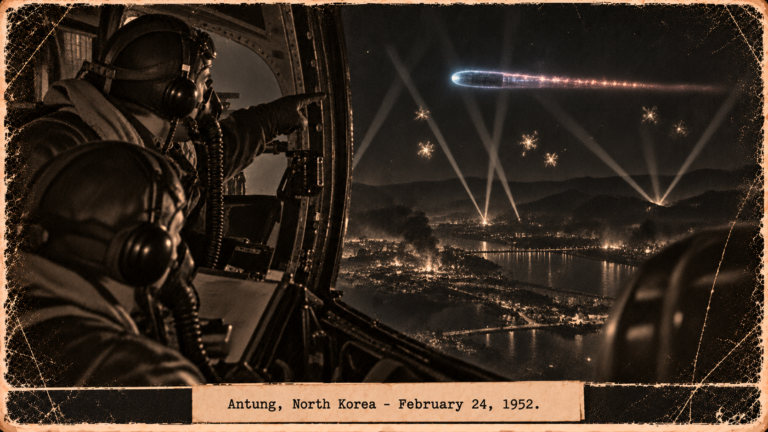
At 11:15 p.m. on February 24, 1952, a B-29 flying a leaflet-drop mission over North Korea was locked in searchlights at 22,000 feet when its navigator saw a bluish cylinder with a pulsing tail rise out of the dark behind them, level off about 4,000 feet away, and swing toward the bomber on what looked like an intercept course. It slipped under the Superfortress within about 2,000 feet, “the size of an automobile,” and the crew’s counter-measures operator picked up weak electronic signals. ATIC’s own missile specialists wrote that it looked like a subsonic surface-to-air missile, possibly of a German wartime type the Soviets might now field.
This February 1952 UFO sightings archive gathers the month’s documented cases from Air Force and Blue Book files: the Antung B-29 encounter, a Pittsburgh pilot’s pulsing “buzz-bomb” flame, a bomb-scoring radar target at 1,090 mph, a hovering object over Washington, a carrier radar track that split in two, and a green fireball at Walker AFB. Several cases here, including Granite City, Baltimore and the Walker AFB fireball, carry Blue Book evaluations that change how they should be read, and the entries below are corrected to the cards.
Date: February 1952 (day not given)
Location: Gonzales, Texas
Time: Not recorded
Summary: A civilian man reported an aluminum-colored object in normal flight for about 15 minutes. Project Blue Book filed it as Other (“saucer fan”).
Source: Project Blue Book record card; Blue Book February 1952 case list
Source Status: The card gives only “Feb 52”; no day or time is legible. A separate OSI report in the same file concerns Gonzales on May 20–21, 1952 and is held for the May page.
Date: February 1, 1952
Location: 10 miles west of Terre Haute, Indiana
Time: 9:30 p.m.
Summary: A military aircraft pilot saw a close group of moving lights changing color from blue to green to yellow.
Source: Sparks #354; Project 1947; Blue Book files (attribution uncertain in the surviving record)
Date: February 2, 1952
Location: Eastern Pacific, about 30.38°N, 140.02°W
Time: About 8:50 a.m. local
Summary: A MATS aircrew flying from Travis AFB to Hickam AFB saw what looked like a red rocket burst about 500 yards off the port wing. The crew tentatively thought it was of celestial origin; Blue Book filed it as Astro (meteor).
Source: Air Intelligence Information Report (MATS, Andrews AFB); Blue Book February 1952 case list
Date: February 2, 1952
Location: East of Pusan, South Korea
Time: 10:30 a.m. and 10:40 a.m.
Summary: Radar recorded an unidentified target at 767 mph; a second track ten minutes later, from position 35°30’N, 129°40’E, recorded a target at 1,257 mph.
Source: Sparks #355; Jan Aldrich
Date: February 2, 1952
Location: East of South Korea, aboard USS Philippine Sea
Time: 7:35 p.m.
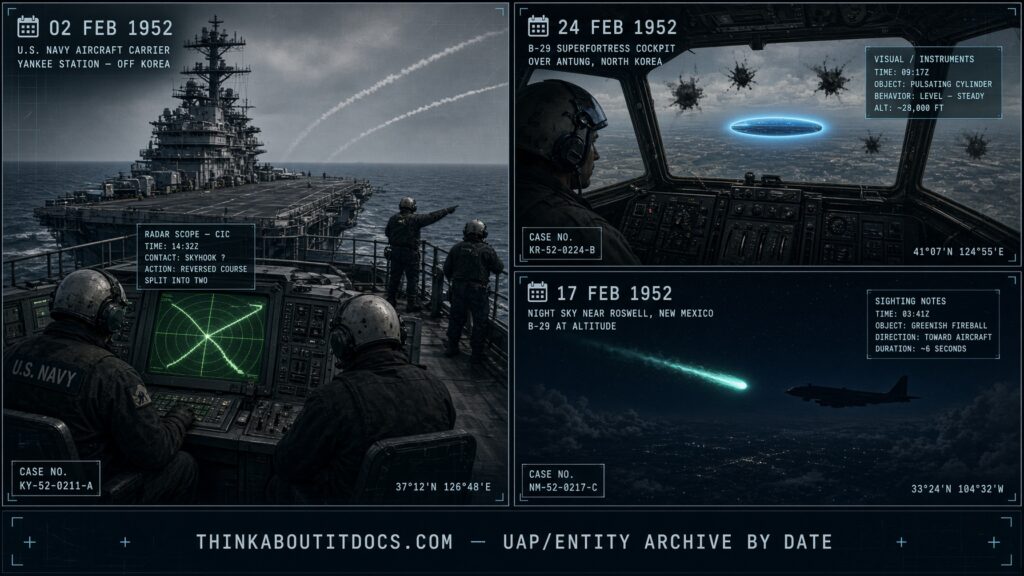
Summary: While the carrier held a southerly heading at 13 knots, radar picked up an approaching target from due north at 25 miles, which veered off in a wide left turn to the east — at which point visual observers spotted exhaust trails — then reversed course away from the ship, accelerating from roughly 600 mph to 1,800 mph at 52,000 feet altitude. The target then split into two separate returns, 5–12 miles apart, following a slightly zigzagging course due north until lost from radar at about 110 miles. Visual observers reported sighting three exhaust flames during the encounter.
Source: Sparks #356; J. Allen Hynek, The UFO Report, pp. 126–128
Date: February 6, 1952
Location: Dobbins AFB, Georgia
Time: Not recorded
Summary: An OSI agent reported a spheroid object. The object was recovered and identified as an Air Defense Command training balloon.
Source: Project Blue Book record card (Was Balloon)
Date: February 11, 1952
Location: Kansas City, Missouri
Time: 12:05–12:15 p.m. CST
Summary: A housewife watching a B-36 cross the city through 6 x 30 binoculars saw a round, bright object just north of the bomber’s vapor trail. It drifted over her position and south of the city during about ten minutes. Air Force analysts concluded it was most likely a Rawinsonde balloon released from Fairfax Airport at 11:30 a.m.
Source: Air Intelligence Information Report; Central Air Defense Force; Blue Book (Balloon)
Date: February 11, 1952 (BBU 1052)
Location: Pittsburgh, Pennsylvania
Time: About 3:00–3:15 a.m. EST
Summary: Major Richard J. Gedeon and Capt. George P. Arns, flying a Beech AT-11 from Cleveland to Langley AFB, saw a brilliant yellow-to-orange, comet-shaped light on a reciprocal course for about a minute, its flame pulsing every one to two seconds. Both pilots had seen jets at night and neither had seen a pulsating flame. Gedeon compared it to the V-1 buzz bombs he saw in Belgium. ATIC’s status report said “description similar to meteor”; Tactical Air Command formally disagreed. See the Full Report.
Source: Project Blue Book file (TAC letters of Feb 23, Feb 25 and May 6, 1952; OSI questionnaire; ATIC status report); Sparks #357
Source Status: Corrected: the Maj. R. J. “Gedson” in Sparks is Gedeon on the signed statement.
Date: February 12, 1952
Location: Between Friendship Airfield and Baltimore, Maryland
Time: About 8:30 p.m. and 9:00 p.m. EST
Summary: A MATS C-47 pilot and copilot on a local flight from Andrews AFB saw a bright white object, about one-sixth the size of the rising moon, move slowly then accelerate very rapidly away to the southwest of Washington. About half an hour later, 10 miles south of Baltimore, they saw one approach Washington, turn left, hold position for about a minute 2–3 miles from the city, and vanish. See the Full Report.
Source: MATS Air Intelligence Information Report; ATIC status report; Blue Book (Aircraft); Sparks #358
Date: February 13, 1952
Location: Granite City, Illinois
Time: About 10:30 p.m. CST (2230)
Summary: Detachment 4 of the 3903d Radar Bomb Scoring Group tracked a “target” that at first behaved like the bomber cleared for its scoring run, then sped up 20 miles out, turned to 197° and descended, reaching an estimated 1,090 mph before the plot ended. ATIC’s June 1953 review judged it a probable radar malfunction or ducting. See the Full Report.
Source: 3903d RBS Group report of Feb 19, 1952; ATIC comment of June 3, 1953; Blue Book (Other: radar malfunction; Insufficient Data); Sparks #359
Date: February 14, 1952
Location: About 31°45’N, 159°10’E, between Midway Island and Japan
Time: About 1545Z (local time not clear on scan)
Summary: A MATS pilot saw an aircraft with running lights fly 1,000–1,500 feet to the right of his plane, then turn across its course. It was judged a multi-engine, medium-sized aircraft of B-29 or C-54 type. Blue Book filed it as Aircraft.
Source: MATS Air Intelligence Information Report; Blue Book February 1952 case list
Source Status: New entry; solved. The date of information is hard to read on the scan; the Blue Book list gives Feb 14.
Date: February 16, 1952
Location: About 60 miles east of Pusan, Korea
Time: 2:40 p.m. and 3:50 p.m.
Summary: USMC Ground Control Intercept Squadron 3 at Yongil tracked an unidentified target at 4,320 knots (roughly 5,000 mph) on CPS-5 radar. A second track at 3:50 p.m., a few miles off the South Korean coast, showed a large target — radar-equivalent to 6–8 jet aircraft — traveling at 1,380 knots (roughly 1,600 mph) on a 170° heading, fading momentarily before continuing on a 120° heading until lost. A visual sighting of a contrail was reported in the direction of the radar track.
Source: Marine Air Control Group 2 report of Feb 22, 1952; Sparks #360; Jan Aldrich; McDonald files
Source Status: Blue Book lists two evaluations for this case: Insufficient Data (first track) and Aircraft (second). The antenna turned at 4 rpm, so the plots were 15 seconds apart.
Date: February 17, 1952
Location: 25 miles southeast of Roswell, New Mexico (near Walker AFB; about 33°15’N, 104°10’W)
Time: 1:45 a.m. MST (0845Z)
Summary: The crew of a B-29 on letdown to Walker AFB, including an instructor pilot, a squadron commander and a bombardier, saw a ball of greenish-blue fire about three feet across, about a mile ahead at around 15,000 feet, for about two seconds. They said it did not look like a meteor. Blue Book filed it as Astro (meteor).
Source: CSAF message items; ATIC status report; Blue Book (Astro); Sparks #361
Date: February 18, 1952
Location: Whaleyville, Virginia, and the Virginia–North Carolina line
Time: About 11:45 a.m. EST
Summary: A man at Whaleyville told Langley AFB he saw a “jet” explode in flight; a woman reported a white flash and falling pieces. An Eastern Air Lines pilot climbing south reported a bright flash and a trail of black smoke. The Coast Guard and Air Force searched the Dismal Swamp and found nothing. OSI Norfolk concluded it was a meteorite that exploded entering the atmosphere.
Source: OSI Norfolk report (Feb 1952); Blue Book (Astro, cards missing)
Date: February 19, 1952
Location: Bandar Abbas, Iran
Time: Midday
Summary: Residents, an Iranian newspaper correspondent and the Bandar Abbas telegraph chief reported a strange shining object flying low from east to west and out to sea, followed minutes later by a severe explosion that shook buildings. The U.S. Air Attaché in Iran forwarded the report to ATIC, which weighed it alongside the Korea missile case.
Source: USAF message to ATIC; Blue Book (Insufficient Data)
Date: February 20, 1952
Location: Greenfield, Massachusetts
Time: About 3:00 p.m.
Summary: A Congregational minister saw three very bright, apparently spherical, silver objects, about half the sun’s diameter, in perfect V formation against a deep blue sky. They moved slowly to the zenith, hovered, changed formation and dashed away at tremendous speed. He later said the experience left him in a state of shock.
Source: NICAP, The UFO Evidence, p. 69; Project Blue Book “information only” file
Date: February 20, 1952
Location: Mount Diablo, California
Time: 11:30 p.m.
Summary: USAF pilot Montgomery and the copilot of a B-25 bomber saw a bright yellow light on a collision course climb and accelerate. Blue Book filed it as a balloon.
Source: Sparks #362; Project 1947; FUFOR Index; Blue Book list (Balloon, cards missing)
Source Status: The Blue Book list names Montgomery and Watkins and marks the cards as missing.
Date: February 22, 1952
Location: El Paso, Texas
Time: Not recorded
Summary: A civilian amateur photographer tried to photograph a rainbow-like circle and later found two round objects, resembling Saturn, on the developed negative. Biggs AFB intelligence and ATIC examined the film and found emulsion flaws; Blue Book filed it as Other (flaw in negative).
Source: Air Intelligence Information Report; ATIC photo interpretation (W. Willner); Blue Book (Other)
Date: February 23, 1952
Location: Atlantic Ocean, about 36°50’N, 8°50’W (off southwest Portugal)
Time: About 2:15 a.m. to 2:37 a.m. (Zulu)
Summary: A MATS pilot flying from Port Lyautey, French Morocco, to Lisbon at 8,500 feet saw three instantaneous, very high-intensity white flashes. The third was off his right wingtip about a mile away. Blue Book filed it as Insufficient Data.
Source: MATS Air Intelligence Information Report; Blue Book February 1952 case list
Date: February 24, 1952 (BBU 1061)
Location: Over Antung, North Korea (Blue Book lists Sinuiju, Feb 23)
Time: 2315 local Korean time
Summary: A B-29 navigator on a leaflet-drop mission, with the bomber held in searchlights at 22,000 feet, saw a bluish, cylindrical object with a rapidly pulsing exhaust come in from 7 o’clock, climb, level off about 4,000 feet away, turn toward the B-29 and pass beneath it, coming within about 2,000 feet. ATIC’s missile specialists judged it a subsonic surface-to-air guided missile, possibly of the German Schmetterling type. See the Full Report.
Source: ATIC Appendix IV and status report; FEAF message; ATIC guided missiles group evaluation of Feb 29, 1952; Sparks #363
Source Status: Date corrected: the file says the night of Feb 24, 2315 local (the Air Intelligence report summary says Feb 23); the live page’s 10:15/11:15 p.m. is resolved to 2315.
Date: February 26, 1952
Location: Near Albany, New York (about 74°W, 43°N; CIRVIS report)
Time: Not recorded
Summary: A military aircraft crew reported a UFO that was assessed as a probable meteor. Blue Book filed it as Astro (meteor).
Source: Blue Book February 1952 case list
Date: February 28, 1952
Location: Cambells Creek, Newfoundland
Time: Not recorded
Summary: A civilian reported an unidentified sighting. Blue Book filed it as Insufficient Data; the case file is marked missing.
Source: Blue Book February 1952 case list (case missing)
EXECUTIVE SUMMARY
A B-29 Over Antung, a Pittsburgh Flame and a Month the Cards Corrected
February 1952 holds twenty-two entries, and its core is military. A B-29 navigator over Antung gave ATIC missile specialists a case they read as a possible Soviet surface-to-air missile, a Marine radar squadron at Yongil tracked a target at about 5,000 mph, and the USS Philippine Sea radar track that accelerated from 600 to 1,800 mph and split in two comes straight from Hynek’s own published report. At home, a pair of senior pilots near Pittsburgh watched a pulsing flame they said was not a jet, and a MATS crew over Baltimore watched an object stop and hover near Washington, five months before the capital’s summer radar flaps.
The cards also pare the month back. Blue Book solved Granite City as a probable radar malfunction, filed Walker AFB, Mount Diablo and Albany as meteors or balloons, and listed Baltimore as an aircraft, so only the Pittsburgh and Antung cases stay on the unknown list. The record is full of small solved cases (Dobbins, Kansas City, El Paso) that show how ATIC actually worked, and it carries a three-flash Atlantic report and a Bandar Abbas explosion that were never resolved.
“Since the object resembles a surface-to-air guided missile, the incident has been referred to the ATIC guided missiles group.”
— Project Blue Book status report, Korea, February 24, 1952