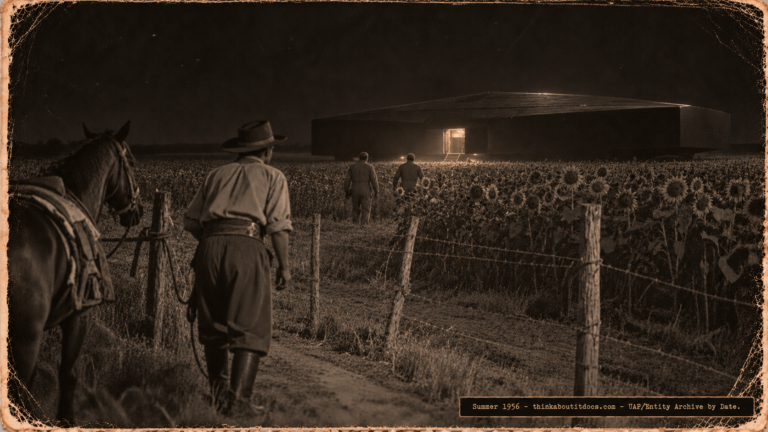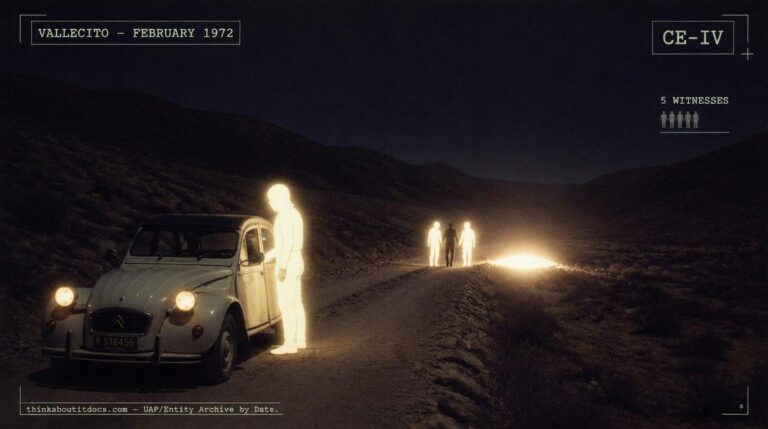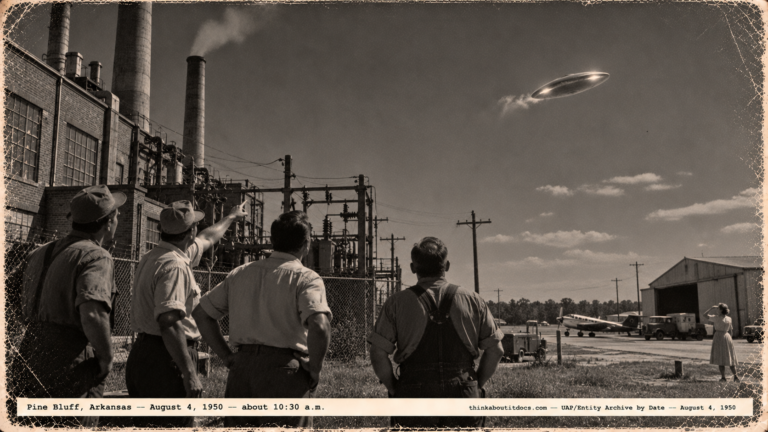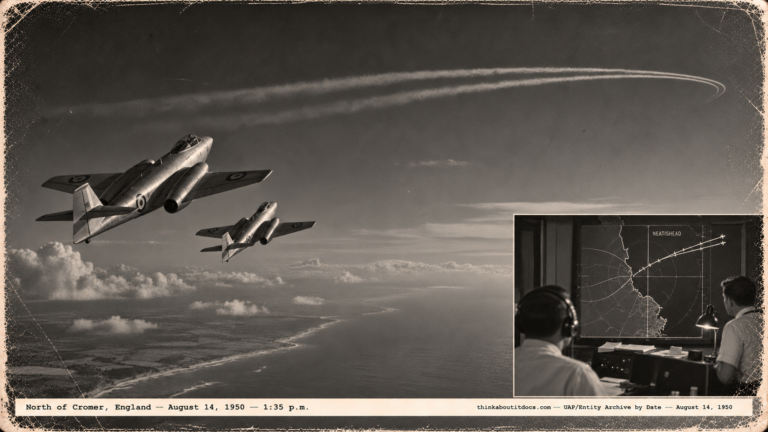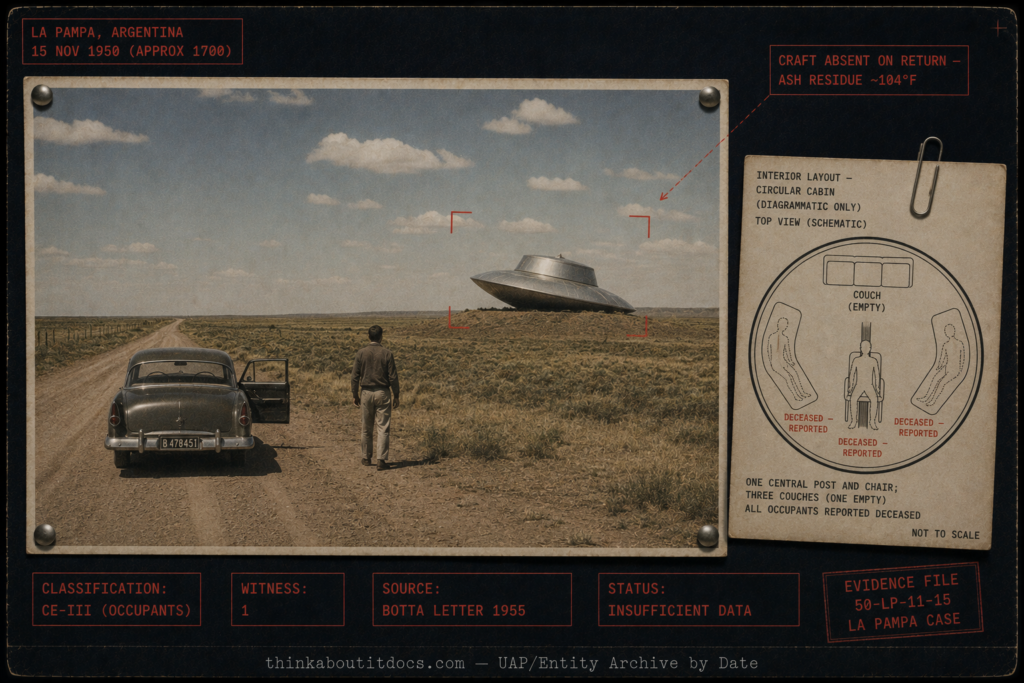
The Botta encounter, near Epu Pel, La Pampa, Argentina, May 1950 — a claimed landed saucer with dead crew that reduced to ash before corroboration; classified CE-III, status Insufficient Dat
THINK ABOUTIT UFO | UAP SIGHTING REPORT
1950: Epu Pel, La Pampa, Argentina — The Burnt Saucer Encounter
On a clear autumn afternoon in May 1950, an Italian-born architect driving alone across the empty plains of La Pampa claims he saw a silver disc tilted on a rise of ground three hundred meters off the road. What he says he did next is what makes this one of the strangest stories in the early South American record: he stopped, walked up to it, found the door standing open, and climbed inside. In the gloom — choking on an odor he likened to ozone and garlic — he says he found the crew still at their stations, three small humanoid figures in lead-gray coveralls, all of them dead. He fled, returned the next day with friends, and found only a smoking pile of silver-red ash where the craft had stood. The trouble is that the architect told no one for five years, the evidence reduced itself to cinders before any witness but him could see it, and the tale did not reach print until a Caracas newspaper ran it anonymously in 1955. It is a foundational entry in the discredited “landed saucer with dead occupants” genre — preserved here as a documented claim, weighed for exactly what it is.
Date: May 15, 1950
Sighting Time: Afternoon (clear sky, scattered cloud)
Day/Night: Day
Location: Near Epu Pel / General Acha, La Pampa, Argentina (witness driving ~280 km out from Bahía Blanca)
Urban or Rural: Rural
No. of Entity(‘s): 3 observed (a fourth implied by an empty couch and the open door)
Entity Type: Humanoid (reported deceased)
Entity Description: Reported as 1.2 to 1.4 m tall, in a lead-gray coverall puffed at the shoulders; round head with sparse light hair, light tobacco-brown skin, straight nose, no facial hair; large, dilated, glassy eyes; body described as entirely human in proportion. The seated figure’s hands gripped two handles on a black control box; two identical figures lay on side couches. All three were described as dead.
Hynek Classification: CE-III (occupants observed) — with CE-II physical-trace elements (ground ash, drained vehicle battery, odor)
Duration: Not recorded (brief interior inspection, on the order of minutes)
No. of Object(s): 1 on the ground; later 2 identical discs and 1 “cigar” reported aloft
Description of Object(s): A grounded two-part craft — lower section an inverted saucer, upper section cylindrical with a cupola topped by a round “lantessrn”-like fixture; rectangular portholes with rounded corners; tilted ~20° on a rise; lower rim described as worn/damaged, suggesting it was not new. On the return visit, two identical discs and a motionless cigar-shaped object were reported departing at high speed.
Shape: Disc (with cupola); cigar-shaped carrier reported separately
Size: ~10 m diameter, ~4 m total height (per witness estimate; no instrumented measurement)
Color: Silvery / chromium, highly polished; reported to shift toward rose as the discs accelerated
Distance: Witness states he entered the craft
Height & Speed: Grounded; later objects estimated at ~600 m altitude, accelerating to high speed before merging with the carrier
No. of Witnesses: 1 for the core encounter (the architect alone); companions reported seeing only the ash pile and the departing objects the following day
Special Features/Characteristics: Strong ozone-and-garlic odor; heavy, hard-to-breathe interior air; Saturn-model sphere and “magic-eye” instrument details described; car battery reportedly drained afterward; the craft reduced to a 2 m × 5 m pile of silver-red ash measured at ~104 °F on the return visit; a photo was claimed but its disposition is unknown
Case Status: Insufficient Data
Source: Originally surfaced in El Universal (Caracas), May 7, 1955; witness letter published in Le Courrier Interplanétaire (Switzerland), reprinted in UFO-Nachrichten (Germany) and the International UFO Reporter (US); relayed by José Escobar Faria (Brazil) and Leonard H. Stringfield; carried in humanoid-encounter catalogs (Vallée / HUMCAT lineage)
Summary/Description: The witness — an Italian-born architect working in Bahía Blanca, variously recorded as Enrique Caretenuto Botta or Enrico Carotenuto Bossa, age 46 — was driving alone across La Pampa when a silvery object on the ground caught his eye some 300 m off the road. Approaching on foot, he found a saucer-shaped craft with an open door, entered it, and reported finding three small humanoid occupants in gray coveralls, all dead, amid an overpowering ozone-and-garlic smell. He drove to General Acha, told friends, and persuaded them to return with him. After a thunderstorm they reached the site to find the craft gone, replaced by a smoking pile of warm silver-red ash. As they stood there, identical discs and a cigar-shaped carrier were seen overhead, departing at speed. The account was not made public until 1955.
Related Cases: Aztec, New Mexico, 1948 — documented crashed-saucer-with-bodies hoax (Scully / Newton–GeBauer, exposed by J.P. Cahn) | January 1950 Mojave “intact disk with dead occupants” story referenced in the March 31, 1950 FBI memo | Ombúes near Viale, Entre Ríos, Argentina, 1956 — regional landed-craft companion case
Detailed Report
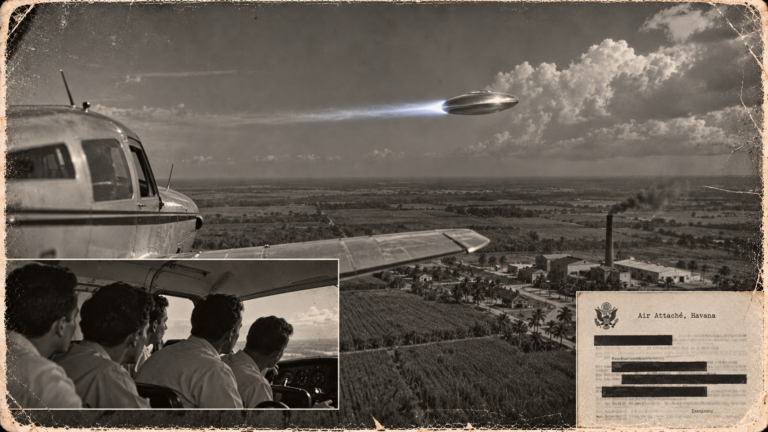
The Botta narrative is, in its construction, one of the most complete “entered-the-craft” accounts of the entire pre-Adamski period. The architect describes pulling off a remote La Pampa road after spotting a silver object tilted about twenty degrees on a low rise. From fifty meters he studied it through his windscreen, briefly mistaking it for a wrecked aircraft before the geometry told him otherwise. On foot at ten meters he registered it as a “saucer,” roughly ten meters across and four high, built in two parts — an inverted-saucer base under a cupola-topped cylinder — with rounded-corner portholes and a worn lower rim. The door, about 90 by 120 cm, stood open near the base of the tower.
Inside, by his account, the air was heavy and reeked of ozone and garlic. The cabin was circular, perhaps 3.5 m across, dimly lit by a slow-pulsing orange-white ceiling lamp. At the center, in a vermilion chair on a central post, sat a small figure in a lead-gray coverall, hands locked on two handles projecting from a black instrument box, head fallen to its chest. Two more identical figures lay on side couches; a third couch was empty. He describes touching one rigid, cold arm. The instrument detail is lavish — a dashboard with “magic-eye” indicators, a semi-opaque “television” disc, a transparent 25 cm sphere ringed like Saturn. He says panic took him and he scrambled out, dizzy in the open air, and found his car sluggish to start, as if the battery had run down.
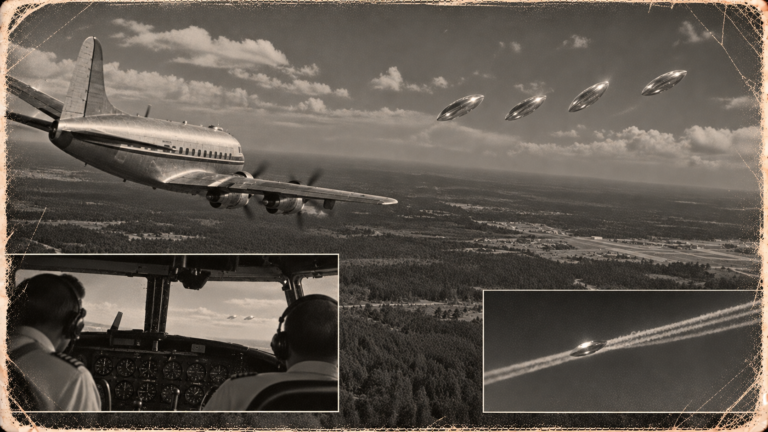
Reaching General Acha, he convinced friends to return with him. By the time they arrived, after a violent thunderstorm, the craft was gone — in its place a two-meter-high, five-meter-wide mound of smoking silver-red ash he measured by hand at about 104 °F. As the group stood there, they reported two discs identical to the first rising overhead at roughly 600 m, joined by a motionless cigar-shaped object; the discs reddened as they accelerated, merged with the carrier, and the carrier shot away.
That is the story as the witness told it. What must sit beside it is how and when it arrived. The encounter is dated May 1950, but it entered the public record only on May 7, 1955, when El Universal in Caracas ran a vague item about an unnamed “Italian architect living in Venezuela” who had seen a downed craft and dead crew “a few years ago.” Investigators then located the man, who supplied a first-person letter to the Swiss saucer bulletin Le Courrier Interplanétaire; from there it was reprinted in Germany and the United States and absorbed into the humanoid catalogs. Every vivid detail above descends from that single delayed, self-authored letter.
RESEARCHER’S NOTES
The Botta Account — La Pampa 1950 and the Self-Erasing Craft
- Classification. The live record’s CE-IV is incorrect and has been set aside. CE-IV denotes abduction or direct contact in which the witness is taken or interacted with by beings — none of which occurs here. Botta entered a grounded craft of his own accord and observed occupants who were, by his account, already dead. That is a textbook CE-III (occupant observation), carrying CE-II physical-trace elements: the ground ash, the measured heat, the drained battery, and the chemical odor. CE-III with CE-II support is the accurate frame, and it is deliberately narrower than the abduction label the old page assigned.
- Source chain. This is the weak joint of the whole case. The chain runs witness → five-year silence → anonymous 1955 newspaper item → the witness’s own letter to a saucer-enthusiast bulletin → foreign reprints → Escobar Faria and Stringfield → catalog. There is no contemporaneous 1950 report, no independent investigator at the scene, no police or press record from the time of the event, and no surviving physical sample. Leonard Stringfield’s involvement situates the story squarely within the crash-retrieval literature, a body of material of contested reliability; Escobar Faria functioned as a relay to APRO and FSR rather than as a field investigator here. The provenance is self-originating and unverifiable at every link.
- Pattern context. The account belongs to a recognizable 1948–1955 wave of “landed or crashed saucer with small dead crew” stories that flourished alongside Frank Scully’s Behind the Flying Saucers — the Aztec tale (a proven Newton–GeBauer fraud), the January 1950 Mojave “dead occupants” rumor that even reached an FBI memo, and similar items. Botta’s version is distinguished only by its first-person interior tour. Its hallmarks are the genre’s hallmarks: small humanoids in coveralls, an undamaged-then-vanished craft, evidence that conveniently destroys itself, and a narrator who is the sole source. The resemblance is not corroboration; it is a family likeness to material that did not survive scrutiny.
- Physical / evidentiary weight. Effectively nil. The one corroborating party — the friends — arrived only after the craft had reduced itself to ash, so they attest to a smoking mound and some lights in the sky, not to a saucer or to bodies. The claimed photograph cannot be located. No ash, no battery, no measurement, no negative, no second witness to the interior. A narrative this elaborate resting on a single delayed self-report cannot support an “Unexplained” finding, and nothing here has been positively explained away either. Insufficient Data is the only honest disposition, with the heavy caveat that the case’s structure matches that of stories later shown to be fabricated.
The Botta encounter endures because it is a good story, told in convincing detail by a literate, technically minded witness. But detail is not evidence, and a craft that turns to ash before anyone else can examine it leaves the historian with only the teller’s word. Dated to 1950 yet unheard of until 1955, sole-sourced, and cut from the same cloth as the era’s exposed crash hoaxes, it belongs in the chronological record as a vivid and influential claim — catalogued honestly as a CE-III occupant report of insufficient evidentiary weight, not as a verified landing.