A New South Wales woman recalled, partly under hypnosis, an abduction involving several distinct types of beings aboard an unidentified craft, circa 1967.
THINK ABOUTIT ABDUCTION REPORT
1967 New South Wales Alien Abduction: A Multi-Entity Encounter Case
Around 1967, a 20-year-old woman in rural New South Wales began recalling — partly consciously, partly through hypnosis — a pattern of abduction experiences that had apparently recurred over a period of years. Her fragmentary memories describe several distinct types of beings, a needle inserted into her ear, and a claim that her captors were refugees from a dying planet struggling to reproduce. It’s a genuinely strange account, and also a case study in exactly the kind of evidentiary limits that make single-witness, hypnotically-recovered testimony difficult to evaluate.
Editor’s Note: This page presents the account as catalogued by Australian researcher Keith Basterfield, who himself rated it a 4 out of 5 against his own evidentiary framework — not a full, unqualified match. Memory recovered partly through hypnosis carries well-documented reliability concerns; see Researcher’s Notes before treating any detail here as established fact.
Date: Circa 1967 — the witness, then 20 years old, recalled a pattern of abductions occurring over multiple prior years, rather than a single dated incident
Sighting Time: Not documented
Day/Night: Not documented
Location: Rural New South Wales, Australia (specific locality not documented)
Urban or Rural: Rural
No. of Entity(‘s): Multiple, of at least three distinct described types
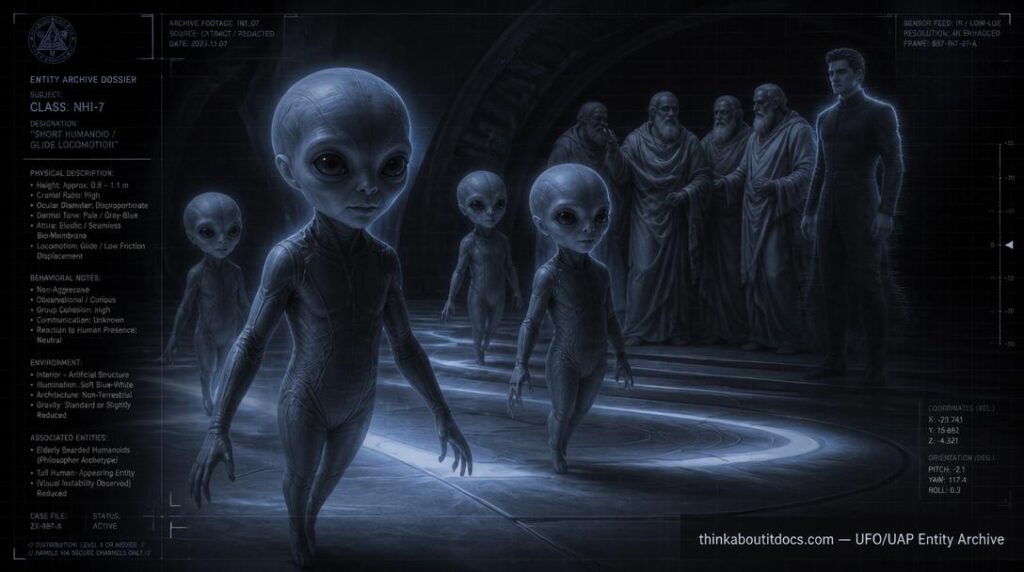
Entity Type: Several short beings with large eyes, a slit-like mouth, small nose, no ears, and large heads; a separate group of elderly men resembling classical Greek philosophers; and one being that appeared tall, handsome, and fully human, which the witness came to believe was a deliberate disguise over a shorter, non-human form
Entity Description: The short beings wore elastic-style body suits and appeared to glide rather than walk
Hynek Classification: CE-IV (Close Encounter IV) — corrected from the source material’s original CE-III. This case describes an actual abduction with onboard medical examination and direct communication, which is specifically what CE-IV covers, rather than the close-range observation-only definition of CE-III
Duration: Not documented
No. of Object(s): 1
Size of Object(s): Not documented
Distance to Object(s): Not documented
Shape of Object(s): Not documented
Color of Object(s): Not documented
Number of Witnesses: 1
Special Features/Characteristics: Recollections emerged partly through spontaneous conscious memory and partly through hypnotic regression; the witness was told telepathically that the beings came from a dying planet experiencing reproductive difficulty; a thin, needle-like instrument was reportedly inserted into her left ear during an examination; she was told she would forget the experience but that the beings would return; onboard atmosphere was reported as normal; case rated 4 out of 5 by researcher Keith Basterfield against his own evidentiary framework, based on the CUFOS definition of an abduction (taken against will; by non-human beings; to a non-terrestrial enclosed space assumed to be a craft; subjected to examination; communication with the beings)
Case Status: Insufficient Data — a single, uncorroborated witness whose account was recovered partly through hypnosis, a technique with well-documented reliability limitations; no independent verification of any detail is possible
Source: Case originally investigated by the UFO Investigation Centre (UFOIC); catalogued by Keith Basterfield, “Australian Abductions: A Catalogue of Cases” (2005), Project 1947
Summary/Description: A young New South Wales woman recalled, partly consciously and partly under hypnosis, a recurring pattern of abduction experiences involving several types of beings, an ear examination, and telepathic communication describing the beings as refugees from a dying, reproductively struggling planet. The case is catalogued among Australia’s documented abduction reports, rated 4 out of 5 against a standard evidentiary framework for abduction claims.
Related Cases: None documented.
Detailed Report
Around 1967, a 20-year-old woman in rural New South Wales began recalling a series of abduction experiences that, by her own account, had recurred over a period of years rather than occurring as a single incident. These recollections surfaced partly through spontaneous conscious memory and partly through hypnotic regression, and were later catalogued by Australian UFO researcher Keith Basterfield as part of his broader survey of Australian abduction cases, sourced originally to the UFO Investigation Centre (UFOIC).
Her fragmentary memories centered on several shortish beings with large eyes, a slit-like mouth, a small nose, no visible ears, and disproportionately large heads. These beings wore elastic-style body suits and moved in a way she described as gliding rather than walking. She recalled the beings communicating with her telepathically, informing her that they were refugees from a dying planet and that their species was experiencing significant difficulty reproducing. She was also told that she would forget the experience, but that the beings would return.
During at least one recalled examination, a long, thin, needle-like object was inserted into her left ear. She described the atmosphere aboard the object as normal, with no reported discomfort from the environment itself. Beyond the primary group of short beings, she recalled encountering a being that presented as tall, handsome, and fully human in appearance — which she came to believe was a deliberate disguise concealing a shorter, non-human form. She also described seeing a separate group of elderly men whose appearance reminded her of classical Greek philosophers, present elsewhere aboard the object.
In cataloguing this case, Basterfield applied a five-point evidentiary framework based on the Center for UFO Studies (CUFOS) definition of an abduction, which requires that a witness be taken against their will by non-human beings to a non-terrestrial enclosed space understood to be a craft, subjected to examination-type procedures, and engaged in communication with the beings. This case was rated 4 out of 5 against that framework — a strong match, though not a full one, by Basterfield’s own scale.
Researcher’s Notes
The 1967 New South Wales Abduction — Recurring Memory, Hypnosis, and the Limits of a Single-Witness Case
- This is a CE-IV case, not CE-III. The original source material classified this as CE-III, close observation of animate beings associated with a craft. But the account describes an actual abduction — removal to an enclosed space, a physical examination, and direct communication — which is precisely what CE-IV is defined to cover. CE-III is the wrong tier for a case involving direct contact of this kind.
- Memory recovered partly through hypnosis carries serious, well-documented limitations. Hypnotic regression has been shown in controlled psychological research to increase confidence in recalled memories without necessarily increasing their accuracy, and can be vulnerable to unintentional suggestion from the person conducting the session. This doesn’t mean the witness’s account is false, but it does mean the hypnotically-recovered portions of this case cannot be treated with the same evidentiary weight as a fully consciously recalled, contemporaneously reported event.
- This is not a single dated incident, and the site’s original “Date: 1967” field oversimplified that. Basterfield’s own catalogue entry describes the witness recalling multiple abductions occurring over a period of years, with 1967 marking when she was 20 and the recollections were recorded — not a single event. That distinction matters for how the case should be read.
- The three-tiered entity hierarchy is an unusually elaborate detail for this era. Short large-headed beings, a separate group of elderly “Greek philosopher” figures, and a disguised human-appearing being together form a more structured, multi-tiered entity cast than most single-witness cases from this period describe. Whether this reflects a genuinely complex encounter or elaboration introduced during years of recall and hypnotic regression is not something this source material can resolve either way.
- Basterfield’s own 4-out-of-5 rating is worth taking at face value. The researcher who catalogued this case applied his own evidentiary framework transparently and did not rate it a full match. That kind of self-imposed scoring, short of full endorsement, is a useful model for how this page treats the case as well — genuinely documented, but not fully verifiable.
This case remains exactly what it is in the record: a single, sincerely reported account of a recurring, deeply strange experience, partly recovered through a memory-recovery method with known limitations, and rated by its own cataloguer as a strong but incomplete match to standard abduction criteria. It’s preserved here on those terms.
“They had come from a dying planet.”
— as recalled by the witness, circa 1967