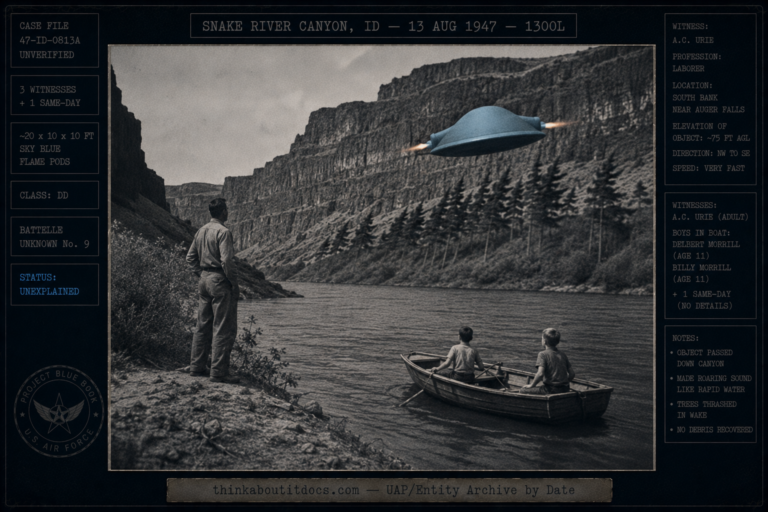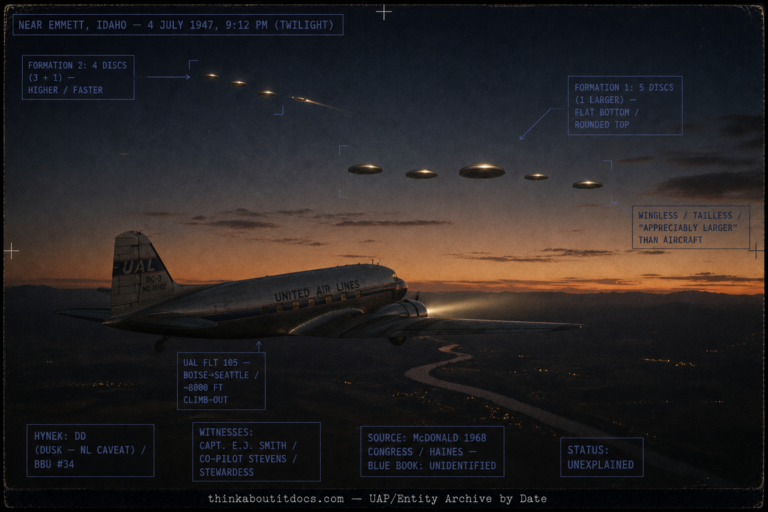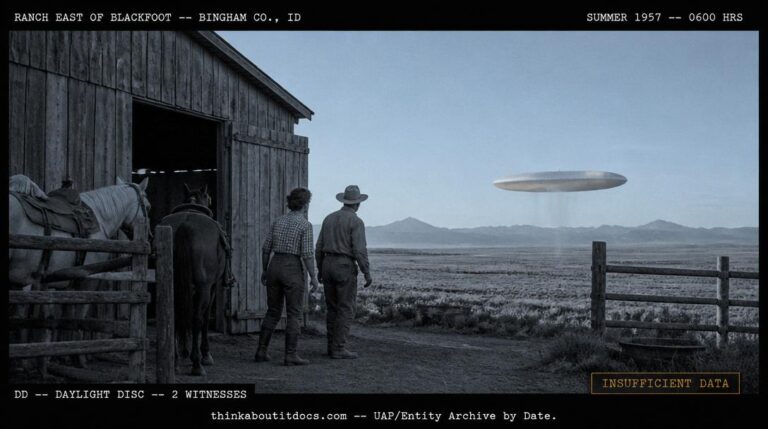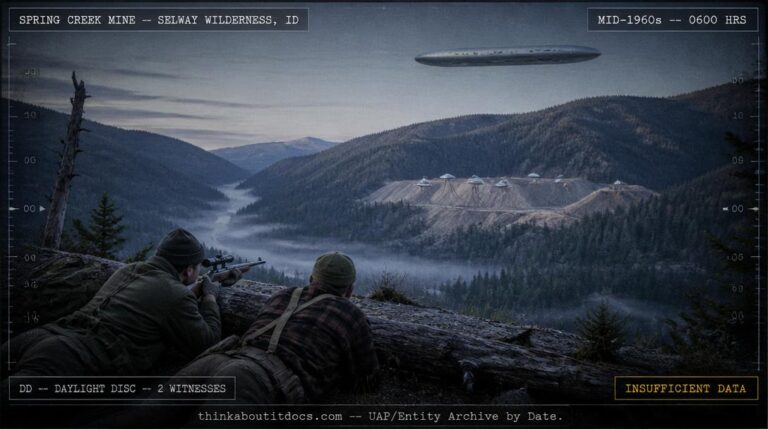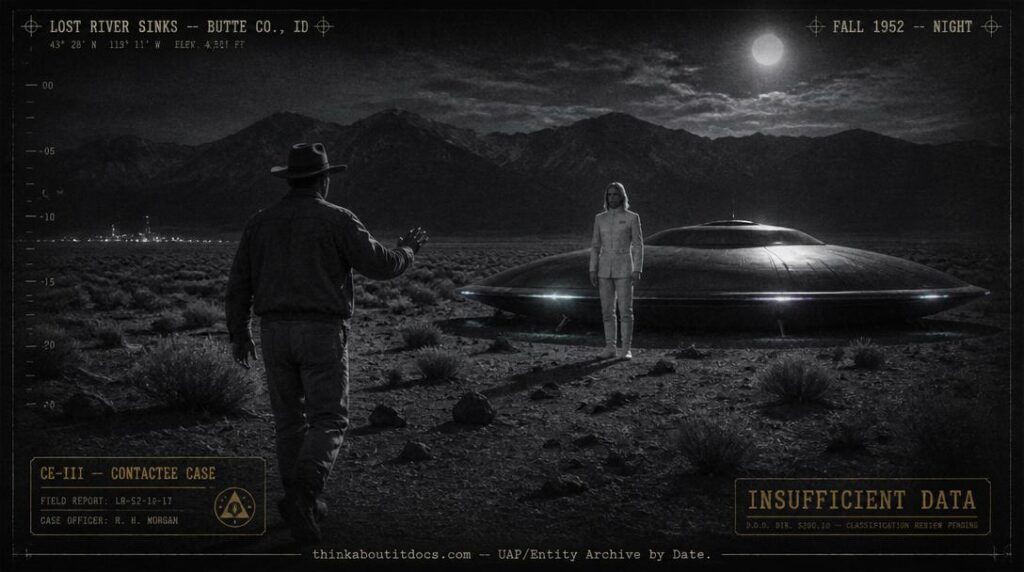
Reconstruction — Paul Solem approaches a landed disc at the Lost River Sinks near Howe, Idaho, fall 1952, where he claimed contact with a Venusian being.
THINK ABOUTIT UFO|UAP SIGHTING REPORT
1952: Lost River Sinks, Idaho Sighting
In the fall of 1952, Idaho rancher Paul Solem claimed he followed a multi-colored light three miles across his property to the Lost River Sinks, where it landed and resolved into a metallic disc-shaped craft. Standing beside it, he said, was a long-haired figure in a white uniform who identified himself as a Venusian named “Paul 2,” holding the rank of “angel,” who informed Solem he had been a spiritual teacher on Venus in a past life and was now assigned a mission to work with Indigenous peoples across the Americas in preparation for a post-apocalyptic utopian society.
⚠ CONTACTEE CASE:
Paul Solem of Howe, Idaho became one of the more prominent figures in the 1950s–1970s contactee movement. His claims escalated over nearly two decades, culminating in organized sky watches with Shoshone Chief Don Ingop and Hopi Chief Dan Katchongva at the Hopi Reservation in Arizona in 1969–1970. The narrative framework — Nordic humanoid, Venusian origin, past-life revelation, spiritual mission, utopian prophecy — is textbook contactee material, closely paralleling the claims of George Adamski, Howard Menger, and other figures of the era. Jerome Clark documented the case in Fate magazine (April 1971). This page preserves the account as reported but applies appropriate contactee framing throughout.
Date: Fall 1952
Sighting Time: Night (exact time not recorded)
Day/Night: Night
Location: Lost River Sinks, near Howe, Butte County, Idaho
Urban or Rural: Rural — remote high-desert ranchland
No. of Entity(‘s): 1
Entity Type: Humanoid — Nordic type (contactee taxonomy)
Entity Description: Human-appearing figure with long blond hair, dressed in a white uniform. Initially mistaken for a woman due to the hair length. Claimed to be male. Identified himself as “Paul 2,” stated he was from Venus and held the rank of “angel.”
Hynek Classification: CE-III (Close Encounter III) — Animate being observed in association with a craft. ⚠ CONTACTEE FRAMING applies — see notes below.
Duration: Not recorded
No. of Object(s): 1
Description of the Object(s): Initially appeared as a multi-colored light that moved across the landscape. Upon landing, the lights dimmed and the object resolved by moonlight into a metallic disc-shaped craft. No further structural details recorded.
Shape of Object(s): Disc-shaped
Size of Object(s): Not recorded
Color of Object(s): Multi-colored light (in flight); metallic (on ground, by moonlight)
Distance to Object(s): Solem followed the light on foot for approximately three miles before reaching the landed craft
Height & Speed: Light was airborne over the ranch at unspecified altitude; landed in the Lost River Sinks
Number of Witnesses: 1 (Paul Solem, sole witness)
Special Features/Characteristics: Landing. Entity communication (verbal, in English). Contactee narrative elements: Venusian origin claim, past-life revelation, assigned spiritual mission, utopian prophecy. This was the initiating event of a contactee career spanning nearly two decades.
Source: Jerome Clark, Fate magazine, April 1971
Summary: Paul Solem of Howe, Idaho reported following a multi-colored light three miles from his ranch to the Lost River Sinks, where it landed and proved to be a metallic disc. A blond-haired humanoid in a white uniform identified himself as “Paul 2” from Venus, informed Solem of a past life as a Venusian teacher, and assigned him a mission to work with Native American peoples. The encounter initiated a two-decade contactee career.
Case Status: Insufficient Data — Contactee narrative; single witness; no physical evidence; no independent corroboration
Related Cases: 1957: Blackfoot, Idaho Sighting | 1950–1959 UFO/Entity Sightings by Date
Detailed Report
Paul Solem was a rancher in Howe, Idaho — a tiny community in Butte County on the edge of the Lost River Range in central Idaho. The Lost River Sinks is a geological feature where the Big Lost River disappears underground into porous volcanic rock, creating a stark, flat expanse of high desert at approximately 5,000 feet elevation. The area is remote and sparsely populated. Notably, Howe sits approximately 20 miles northwest of what was then the National Reactor Testing Station (NRTS, now Idaho National Laboratory), one of the most significant nuclear research facilities in the United States, which had been operating since 1949.
According to the account documented by Jerome Clark in Fate magazine in April 1971, Solem reported that one night in the fall of 1952 he observed a mysterious multi-colored light over his ranch. He followed it on foot for approximately three miles until it descended and landed in the Lost River Sinks. As the object settled to the ground, its lights dimmed, and by moonlight Solem could see that it was a metallic, disc-shaped craft.
Standing beside the craft was a figure Solem initially mistook for a woman because of long blond hair. The figure proved to be male, dressed in a white uniform. According to Solem, the being introduced himself as “Paul 2,” stated he was from Venus, and claimed to hold the rank of “angel.” He told Solem that in a former life, Solem himself had been a spiritual teacher on Venus. “Paul 2” then outlined what he described as Solem’s earthly mission: to work with Indigenous peoples from North to South America in preparation for a post-apocalyptic utopian society — one that would outlaw money and operate on communal principles.
This 1952 encounter was, by Solem’s own account, the initiating event of a contactee career that extended through the late 1960s and into the 1970s. Solem later claimed ongoing clandestine contacts with Venusians and other celestial beings. His public activity peaked in August 1969 and 1970, when he traveled to the Hopi Reservation in Hotevilla, Arizona, accompanied by Shoshone Chief Don Ingop from the Fort Hall Indian Reservation (located between Pocatello and Blackfoot, Idaho, approximately 90 miles southeast of Howe). There, Solem met with the traditionalist Hopi leader Chief Dan Katchongva and organized sky watches that he claimed would produce UFO sightings on demand. His Venusian-Mormon-Indigenous synthesis drew on Latter-day Saint theology — specifically the Book of Mormon prophecy that “the Lamanites shall blossom as the rose” — to frame his contactee mission as a continuation of the work of Joseph Smith Jr.
Researcher’s Notes
The Solem Contact — Lost River Sinks 1952 and the Anatomy of a Cold War Contactee
- Source Chain: The sole documented source for this encounter is Jerome Clark’s article in Fate magazine, April 1971. Clark — later the editor of Fate and author of the multi-volume UFO Encyclopedia — was a serious researcher who documented contactee cases critically. No original field investigation of the 1952 event exists; by the time Clark wrote about Solem, the encounter was nearly two decades old and rested entirely on Solem’s own testimony. More recent coverage by Raymond Keller (“Cosmic Ray”) in the Venus Rising book series treats Solem’s claims credulously and adds extensive New Age embellishment; Keller is not a critical source. The current page’s citation of Clark is accurate and appropriate.
- Contactee Pattern Recognition: The Solem narrative follows the classic 1950s contactee template with textbook precision. The Nordic humanoid with flowing hair in a uniform; the claim of Venusian origin; the past-life revelation linking the contactee to the alien civilization; the assignment of a spiritual/prophetic mission; the utopian social program — all of these elements appear across the contactee literature of the period, from George Adamski (1952) to Howard Menger (1956) to Daniel Fry. Solem’s Mormon theological overlay is a distinctive regional variation but does not alter the structural pattern. The “angel” rank claimed by “Paul 2” directly maps celestial hierarchy from LDS theology onto the contactee framework. The archive does not assert deliberate fabrication — Solem may have had a genuinely anomalous experience that he interpreted through his existing belief system — but the narrative as reported is indistinguishable from the broader contactee phenomenon of the era.
- Geographic Context — NRTS Proximity: The Lost River Sinks are approximately 20 miles northwest of what was, in 1952, the National Reactor Testing Station — the nation’s premier nuclear reactor development site, home to EBR-I (the first reactor to generate usable electricity, December 1951) and dozens of experimental reactors under construction or in planning. The NRTS was a high-security military-industrial installation in an extremely remote area. Whether the proximity of cutting-edge nuclear technology to Solem’s claimed encounter site is coincidental, contextually relevant (heightened local awareness of advanced technology), or simply a geographic fact without causal significance is an open question — but it is worth noting for the record.
- Classification and Disposition: CE-III is technically correct: the account describes a being in association with a craft. However, the contactee framing, single-witness status, absence of any physical evidence, two-decade reporting delay, and the subsequent escalation into organized public contactee activity collectively place this case outside the evidential threshold for “Unexplained.” The Hynek classification is retained for structural accuracy but should not be read as an endorsement of the narrative’s factual claims. Case status is Insufficient Data, which in a contactee context effectively means the case cannot be evaluated on conventional evidentiary grounds.
The Solem case is archived as a documented example of the Cold War contactee phenomenon as it manifested in rural Idaho — one that later intersected with Native American spiritual traditions and became a significant thread in the UFO-Indigenous-prophecy subculture. The 1952 initiating event at the Lost River Sinks is preserved as reported, with full contactee flagging, as part of the historical record of what people claimed to experience during the most active period of the flying saucer era.