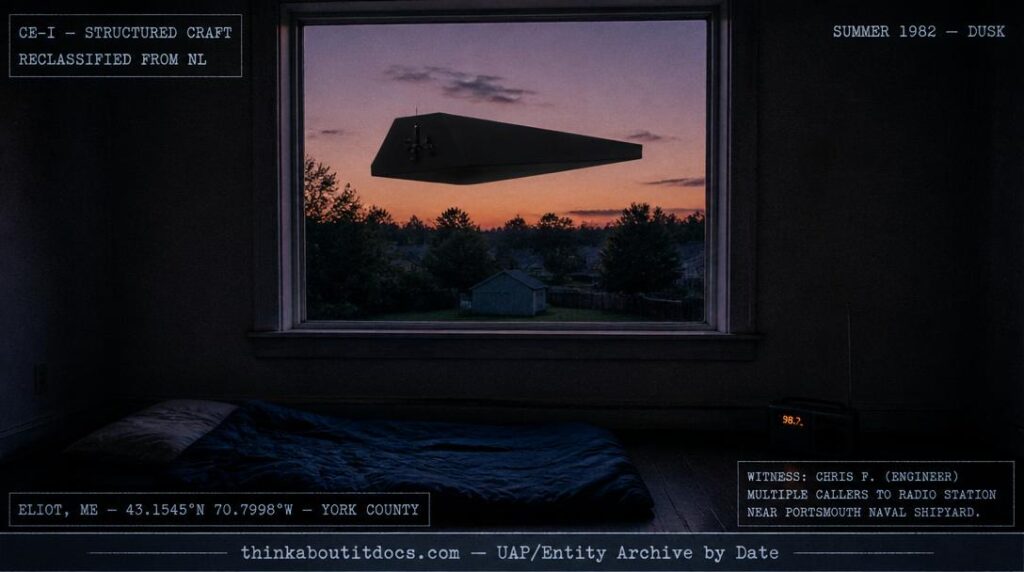
A car-sized, seamless black wedge hovered thirty feet from a teenager's bedroom window — then departed instantaneously in reverse. The radio station was flooded with calls.
THINK ABOUTIT UFO|UAP SIGHTINGS REPORT
1982: The Eliot, Maine Encounter — The Trapezoidal Craft
On a summer evening in 1982, a fourteen-year-old boy lying in a sleeping bag in his empty house in Eliot, Maine — his family was moving to Alaska that week and the movers had already taken everything — looked out his curtainless window and watched a black, geometric object zig-zagging above the treeline like an air hockey puck, making instantaneous changes in direction at a distance of roughly 150 yards. When he knelt at the window to track it, the object had vanished. Then, without warning, it was hovering thirty to forty feet from his second-story window — perfectly still, perfectly silent, a dull gun-metal black machine the size of a car, shaped like a blunted wedge or truncated pyramid, with small protrusions that looked like instrumentation. No windows. No lights. No doors. No seams. He watched it for four seconds before it departed instantaneously in the direction opposite its arrival — without turning around. Moments later, the local radio DJ came on the air saying the station was being flooded with calls about something in the sky.
Date: Summer 1982 (exact date not specified)
Sighting Time: Dusk
Day/Night: Dusk (transitioning to night)
Location: Eliot, Maine, York County (across the Piscataqua River from Portsmouth, New Hampshire)
Urban or Rural: Small town / suburban
No. of Entity(‘s): None reported
Entity Type: N/A
Entity Description: N/A
Hynek Classification: CE-I (Close Encounter I) — object observed hovering at approximately 30–40 feet from the witness with detailed structural features clearly visible; NL classification on the original page is incorrect as the witness described a defined solid object with specific shape, surface characteristics, and instrumentation-like protrusions at close range
Duration: Several minutes total (distant zig-zagging observation plus approximately 4 seconds of close hover)
No. of Object(s): 1
Description of the Object(s): Solid, machine-like object the approximate size of an automobile. Dull gun-metal black surface with no windows, lights, doors, or seams. Small protrusions resembling instrumentation. Shape: geometric trapezoid — narrower square/rectangle at the front, larger at the back, tapering from rear to front. Described as a blunted wedge or a pyramid tipped on its side with the pointed end removed.
Shape of Object(s): Trapezoidal / blunted wedge
Size of Object(s): Approximately the size of an automobile
Color of Object(s): Dull gun-metal black
Distance to Object(s): Approximately 30–40 feet during close hover; approximately 1.5 football fields (~150 yards) during initial zig-zagging phase
Height & Speed: 5–10 feet above treetops during zig-zagging; second-story window height (~20 feet) during close hover; capable of instantaneous speed changes and direction reversals
Number of Witnesses: 1 primary (Chris F.); multiple additional witnesses reportedly called local radio station
Special Features/Characteristics: Instantaneous direction changes — movement compared to an air hockey puck. Completely silent throughout. No wings, control surfaces, propulsion system, or aerodynamic features. Hovered motionlessly. Departed instantaneously in reverse direction without turning around. No electromagnetic effects on nearby radio. Multiple witnesses reported to local radio station. Military installations nearby — witness’s father was a career Naval officer. Witness is now an engineer and assesses the flight characteristics as defying known physics.
Case Status: Unexplained
Source: UFO Casebook (ufocasebook.com), submitted by witness “Chris F.”
Summary/Description: In the summer of 1982, a fourteen-year-old witness in Eliot, Maine, observed a dull gun-metal black trapezoidal object zig-zagging above the treeline before it appeared hovering silently 30–40 feet from his second-story window. The car-sized craft displayed no lights, windows, doors, or seams, but had small instrumentation-like protrusions. It departed instantaneously without turning. The local radio station received numerous calls about the object. The witness, now an engineer, could not identify any conventional explanation.
Related Cases: 2007: Triangle Over Bowdoinham, Maine | 1975: David Stephens, Oxford, Maine
Detailed Report
In the summer of 1982, Chris F. was fourteen years old and living in Eliot, Maine — a small town in York County, situated across the Piscataqua River from Portsmouth, New Hampshire. His family was preparing to relocate to Alaska, and the moving company had already taken their belongings. The house was empty except for the sleeping bag in which the boy lay in his upstairs bedroom, listening to the radio and looking out the now-curtainless window as dusk settled over the tree-lined property.
Looking out the window, the witness suddenly saw a black, geometric object zig-zagging rapidly above the treeline of the woods behind his house, at a distance of approximately one and a half football fields. The object’s motion was unlike anything he had seen — it moved with seemingly instantaneous changes in direction, comparable in his description to an air hockey puck. Despite the rapid, angular movement, the object maintained a constant altitude approximately five to ten feet above the trees. At this distance, the object appeared coffin-shaped, oriented flat relative to the ground with the wider end leading in the direction of travel — toward the witness.
The witness knelt at the window to get a better look but could no longer see the object. He waited for several minutes. Then, without any transitional movement, the object was hovering in his backyard approximately thirty to forty feet from his second-story window, at roughly the same height as the window. It had not been there a moment before. It was perfectly still and perfectly silent.
At this range, the witness could observe the object in detail. It appeared to be made of metal with a dull gun-metal black finish. There were no windows, lights, doors, or seams of any kind visible on its surface. However, it did have a few small protrusions that resembled instrumentation, giving the witness the impression that the object was some kind of machinery. It was approximately the size of an automobile. Its shape was trapezoidal — a narrower square or rectangular front tapering from a larger back, like a pyramid laid on its side with the pointed end removed, or a blunted wedge.
The witness reported no fear during the close observation — only curiosity. After approximately four seconds of hovering, the object departed instantaneously. The departure was so fast that the witness could barely perceive its direction of travel — it left in the opposite direction from which it had approached, and did so without rotating or turning around. It simply accelerated to a speed beyond his ability to track in the direction its rear was facing.
When the song on the radio ended, the disc jockey came on the air stating that the station was being inundated with calls about an object seen in the sky. The witness called the station and confirmed he had also seen it. No further investigation is documented. The witness, who grew up to become an engineer, noted that the craft displayed flight characteristics — instantaneous direction changes, motionless hovering, silent operation, and the absence of any wings, control surfaces, or visible propulsion — that defy known physics. His father was a career Naval officer, and military bases were nearby, but no military explanation was offered.
Researcher’s Notes
The Black Wedge — Eliot 1982 and a Morphological Outlier in the Maine UFO Record
- Hynek Reclassification: The original page classified this sighting as NL (Nocturnal Light). This is strikingly incorrect. The witness observed a structured, solid, metallic object at a distance of 30–40 feet with sufficient clarity to describe its material finish, the absence of seams or windows, and the presence of instrumentation-like protrusions. This is a textbook CE-I observation — close proximity, structured craft, detailed morphological description. The sighting occurred at dusk, not full darkness, and the object was completely unlit, further disqualifying the NL category, which refers specifically to luminous sources. Of all the NL misclassifications in this batch, this one is the most egregious, given the extreme proximity and level of detail.
- Morphological Distinctiveness: The trapezoidal or blunted-wedge shape described by Chris F. is genuinely unusual in the UFO literature. As the witness himself noted, he has never seen another report describing a craft of this shape. The dominant morphologies in the sighting databases — discs, triangles, spheres, cigars, ovals — do not encompass a geometric trapezoid with a tapered front and wider rear. This distinctiveness cuts both ways: it suggests the witness is not drawing from stock UFO imagery or cultural templates, but it also means no pattern-matching against other cases is currently possible. The object’s instrumentation protrusions and seamless metallic surface, combined with the trapezoidal shape, give it a distinctly machine-like character that differs from the typically smooth, featureless surfaces described in most CE-I reports.
- Multi-Witness Corroboration — Radio Station Calls: The witness reports that the local radio DJ announced being flooded with calls about an object in the sky. This is significant corroboration that shifts the case from a single-witness account to one with an implied multi-witness base, even though the other witnesses are not individually identified. The radio station’s call-in response suggests the object was visible to multiple observers over a wide enough area to generate a spontaneous public reaction. Unfortunately, the specific radio station is not named and no archival recording or log from the broadcast has been identified, which limits the verifiability of this corroboration.
- Flight Characteristics and Engineering Assessment: The witness’s self-identification as an engineer lends a degree of technical vocabulary and analytical framework to his description of the object’s flight characteristics. His assessment that the craft’s capabilities — instantaneous direction changes, motionless hovering, silent operation without visible propulsion or aerodynamic surfaces, and instantaneous departure in reverse without rotation — defy known physics is consistent with the observations as described and aligns with the performance envelope reported across thousands of UFO cases. The air-hockey-puck comparison for the zig-zagging phase is a particularly vivid and analytically useful description of the step-function acceleration profile reported in many cases. The proximity of military installations (Portsmouth Naval Shipyard and, at the time, Pease AFB) is noted but does not suggest any known military platform with these capabilities.
A fourteen-year-old boy watched a machine hover outside his bedroom window for four seconds, then disappear. The local radio station lit up with calls. The boy became an engineer and still couldn’t explain what he saw. The record stands on a single detailed firsthand account, partially corroborated by an implied multi-witness radio response, describing a morphological outlier that has no match elsewhere in the literature.