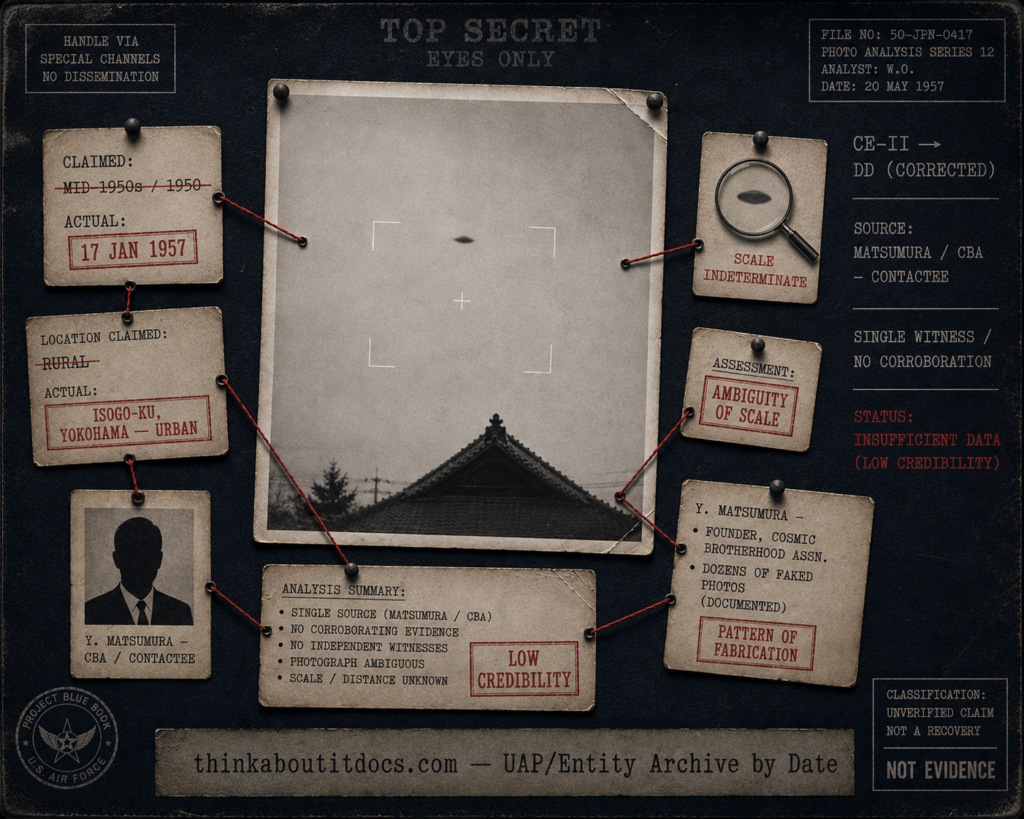
The uncaptioned "mid-1950s" Yokohama disc, reattributed: Yusuke Matsumura's January 17, 1957 photo — taken by the founder of a contactee cult later documented for faking dozens of UFO images. Date, location, and classification all corrected; logged Insufficient Data.
THINK ABOUTIT UFO | UAP SIGHTING REPORT
1957: Yokohama, Japan UFO|UAP Sighting
The uncaptioned “Picture” on this page is almost certainly one of the most famous — and least trustworthy — photographs in Japanese UFO history, and almost everything the page says about it is wrong. It is the Yokohama disc photograph attributed to Yusuke Matsumura, and its real date is not “mid-1950s” or 1950 but January 17, 1957. The man who took it was not a neutral witness but an aviation journalist who, within a year, founded the Cosmic Brotherhood Association — an Adamski-style contactee cult whose members chanted “Bentra, Bentra” to summon Space Brothers, awaited an apocalyptic tilting of the Earth’s axis, and built a pyramid in Hokkaido as a landing station. Serious investigators document that Matsumura went on to release dozens of faked “spaceship” photographs and to take money from followers he promised the aliens would rescue. A single dark disc over a rooftop, shot by that man, against a blank sky that makes scale impossible to judge, is the textbook form of the manipulable contactee photo — and the archive should label it as exactly that, not as an anonymous “rural” mystery.
Date: January 17, 1957 (corrected — the page’s “mid-1950s / 1950” framing and its filing under 1955 are all erroneous; see notes)
Sighting Time: Approximately 9:47 a.m. (as claimed)
Day/Night: Day (morning)
Location: Isogo-ku, Yokohama, Japan (the photographer’s residence, given as 1687 Hama, Isogo-ku — an urban/residential district of a major port city, not “rural”)
Urban or Rural: Urban / residential (corrected from “Rural”)
No. of Entity(‘s): 0
Entity Type: None
Entity Description: N/A — no occupants reported
Hynek Classification: DD (Daylight Disc). [Page previously listed CE-II; corrected — there were no physical traces or effects, only a daylight photograph. See notes.]
Duration: Claimed 1–2 minutes
No. of Object(s): 1
Description of the Object(s): As pictured, a single dark, roughly circular/slightly oblate object high in a pale, featureless sky above a rooftop silhouette; claimed by the photographer to be a metallic disc reflecting the morning sun
Shape of Object(s): Disc (as pictured/claimed)
Size of Object(s): Claimed approximately 20–30 feet in diameter (uncorroborated; scale is indeterminable from the photograph)
Color of Object(s): Dark in the photograph; described by the photographer as metallic
Distance to Object(s): Claimed roughly 60–70 feet overhead (uncorroborated)
Height & Speed: Claimed to hover, then depart at the physically nonsensical figure of “Mach 152” toward Tokyo Bay (the absurd speed claim is itself a credibility flag)
Number of Witnesses: 1 (the photographer alone; no independent witnesses)
Special Features/Characteristics: Single daylight photograph; no independent witness; no investigation by a neutral body; photographer is a documented contactee and serial producer of faked UFO photographs; classic “ambiguity of scale” composition (small dark object against blank sky)
Case Status: Insufficient Data (single uncorroborated photograph by a documented contactee fraud; not authenticable; balance of provenance points toward probable hoax — see notes)
Source: Yusuke J. Matsumura, via the Flying Saucer Research Group / Cosmic Brotherhood Association (CBA), Yokohama; reproduced in CBA’s Flying Saucer News and subsequently across UFO literature and websites. Critical context: Italian researcher Giuseppe Stilo (1997) and Patrick Gross’s ACUFO catalog document Matsumura as a contactee who released dozens of fabricated “spaceship” photographs and operated a fraudulent apocalyptic group
Summary/Description: A daylight photograph showing a single dark disc-like object above a rooftop, taken in Yokohama and almost certainly the image attributed to Yusuke Matsumura on January 17, 1957. Matsumura claimed a metallic disc hovered over his residence and departed at impossible speed. He was the founder of the contactee-oriented Cosmic Brotherhood Association and is documented by serious researchers as a producer of faked UFO photographs and the operator of a fraudulent apocalyptic sect. The photograph is a single, uncorroborated image from a deeply compromised source.
Related Cases: Contactee photographic claims — George Adamski (the CBA’s direct inspiration) and Howard Menger (contactee; photographs widely regarded as hoaxes even among believers) | other CBA/Japanese Flying Saucer Research Group images of the same period | the broader 1950s contactee-photo genre
Full Report
The page as it stood presented this image with almost no information — a one-word summary (“Picture”), a blank source line, a vague “mid-1950s” date, and a “rural” location — and it filed the entry under 1955. Identifying the photograph corrects nearly all of that at once. By location, composition, and reputation, this is the Yokohama disc photograph associated with Yusuke J. Matsumura, and its established date is January 17, 1957. The photographer’s account, as circulated, is that around 9:47 on a winter morning, leaving his Isogo-ku home for Tokyo, he saw a metallic flash above the house, grabbed a Primoflex twin-lens camera, and photographed a disc some twenty to thirty feet across hovering sixty to seventy feet up, which then shot away toward Tokyo Bay. The departure speed attached to the story — “Mach 152” — is not a real velocity so much as a tell: it is the kind of number that decorates a tall tale rather than measures an event.
Everything turns on who Matsumura was, and here the record is unambiguous. He was an aviation journalist swept up in the 1950s saucer enthusiasm who took his inspiration directly from the American contactees, especially George Adamski and George Van Tassel. In 1957 he founded what became the Cosmic Brotherhood Association in Yokohama, in partnership with Adamski’s Japanese representative; the group taught that extraterrestrials could be reached telepathically by chanting “Bentra, Bentra,” staged contact events, and prophesied a global cataclysm from a coming shift in the Earth’s axis, offering members rescue by the Space Brothers. When that prophecy failed, the CBA pivoted to ancient-astronaut claims and built the Hayopira “UFO station” platform in Hokkaido. The organization was ostracized by the rest of Japanese ufology — which at the time was largely oriented toward debunking and identification — precisely because of these contactee and apocalyptic claims.
The photographic record that came out of this milieu is regarded by serious investigators as worthless to fraudulent. The Italian ufologist Giuseppe Stilo, reviewing Matsumura’s output in 1997, and Patrick Gross’s catalog summarizing it, document that from 1957 onward Matsumura released dozens of photographs of unusual clouds and spots which he declared to be spacecraft he had personally photographed, and that he ultimately ran an apocalyptic sect that extracted money from followers on the promise of alien salvation. The same sources describe how CBA members assembled some of their “historical” UFO evidence by combing World War II–era photographs in history books for bright or dark spots and reinterpreting them as flying saucers, with no associated sighting report at all — a method Gross summarizes bluntly as carrying no credibility. Against that backdrop, the lone reassuring claim attached to the 1957 photo — that “experts found no evidence of manipulation” — is worth little: it appears only in credulous UFO blogs, with no identifiable analyst, methodology, or original negative behind it.
As an image, the photograph is the archetype of the unverifiable saucer picture. It shows a small dark form against a bright, near-featureless sky with only a rooftop for foreground. As students of UFO photography have long noted, that combination — lack of focus and absence of scale cues — is exactly what makes such images impossible to evaluate and trivially easy to fake, whether by photographing a small thrown or suspended object, a model, or by retouching the print. A dark disc against blank sky carries no information that can distinguish a thirty-foot craft at sixty feet from a hubcap-sized object a few yards from the lens.
None of this requires asserting, as a proven fact, that this specific frame was faked; no confession or model identification for this exact image is on record. But the evidentiary weight is near zero. It is a single photograph, with a single self-interested witness, no independent corroboration, no neutral investigation, and a photographer subsequently documented as a serial fabricator of UFO imagery and the operator of a fraud. The corrections the page needs are therefore substantial: the date moves to January 17, 1957; the location is urban Yokohama, not rural; the classification falls from CE-II to DD; the source is named as Matsumura and the CBA; and the credibility is marked, honestly, as very low.
Researcher’s Notes
The Yokohama Disc — Matsumura 1957 and the Contactee Photograph
- Classification — CE-II is wrong; correct to DD: A Close Encounter of the Second Kind requires an object at close range that leaves physical traces or measurable effects. Nothing of the sort is claimed here — there is only a daylight photograph of a distant disc. The correct Hynek label for a daytime photographic disc with no traces is DD (Daylight Disc), and the CE-II should be corrected accordingly. (Given the source’s documented fraud history, a case could be made for no classification at all; DD is retained as the conservative claim-type label, with the credibility problem carried in the status rather than the class.)
- Source chain — from blank line to documented contactee fraud: The page’s source field was empty and its date wrong, which is how a compromised image passes as an anonymous mystery. Correctly sourced, the photo traces to Yusuke Matsumura and the Cosmic Brotherhood Association, and the date to January 17, 1957. The decisive context is the photographer’s documented history: per Stilo and Gross, Matsumura produced dozens of fabricated “spaceship” photographs and ran a fraudulent apocalyptic group. A source that compromised does not merely weaken the photo; it reframes it as a contactee artifact rather than a sighting record. The entry should carry a CONTACTEE flag, as the archive applies to Adamski- and Menger-type material.
- Pattern context — the contactee photo genre: This image belongs to a well-defined family: the 1950s contactee photograph, of which Adamski’s and Howard Menger’s are the archetypes (Menger’s, notably, were considered hoaxes even by many believers). These pictures functioned less as evidence than as devotional objects for contactee movements, and Matsumura’s CBA was an explicit offshoot of that American current. The CBA’s separately documented habit of mining WWII history books for dark spots to relabel as UFOs is the same impulse in another form: imagery generated to serve a belief system, not to record an observation. Placing this photo in that lineage is the single most clarifying thing the archive can do with it.
- Evidentiary weight — the unverifiable archetype: Beyond provenance, the photograph fails on its own terms. A small dark object against a blank sky with a single foreground cue is the textbook “ambiguity of scale” image: nothing in it can establish size, distance, or speed, and the claimed figures (20–30 feet, 60–70 feet up, “Mach 152”) are unsupported assertions, the last of them physically absurd. One photographer, one frame, no corroboration, no neutral analysis, a compromised source. That is not enough to call anything Unexplained, and there is no specific debunk of this exact frame to call it cleanly Explained. The honest disposition is Insufficient Data, logged with low credibility and a contactee flag, with the explicit note that the balance of provenance points toward probable hoax.
 The record’s honest final position is that this is a contactee photograph, not a sighting — and a badly mislabeled one. Stripped of the wrong date, the wrong location, and the wrong classification, what remains is a single dark blob over a Yokohama rooftop, photographed by a man who would spend the following years manufacturing such images and selling salvation to a doomsday club.
The archive keeps it because it is part of the real history of the period — the Japanese branch of the 1950s contactee movement is a genuine subject — but it keeps it labeled for what it is: an unverifiable image from a documented fabricator, dated correctly to 1957, classed as a daylight disc, and logged Insufficient Data with the credibility flag flying.
The mystery here is not what hovered over Isogo-ku; it is how long an uncaptioned picture can drift through the literature before someone asks who took it, and when.