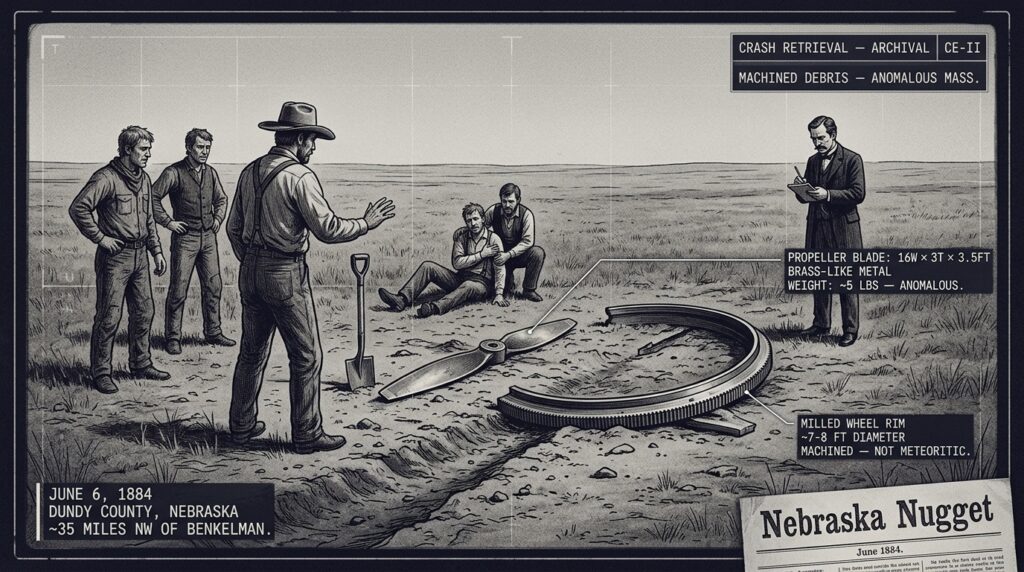
Dundy County, Nebraska — June 6, 1884. Rancher John Ellis, herdsmen including the burned Alf Williamson, and district brand inspector E.W. Rawlins examine debris from a blazing body that fell during a cattle roundup: a propeller blade of brass-like metal 16 inches wide and 3.5 feet long weighing no more than 5 pounds, and a milled wheel rim approximately 7–8 feet in original diameter of the same anomalously light material. Reported in the Nebraska Nugget, June 1884, and the Nebraska State Journal, 1887. America's earliest documented crash-retrieval case with official on-site investigation — 63 years before Roswell.
THINK ABOUTIT CRASH REPORT
1884: Nebraska May Have Had Its Own Roswell
On June 6, 1884, rancher John W. Ellis and his herdsmen were thirty-five miles northwest of Benkelman in Dundy County, Nebraska — flat, dry, cattle country — when a terrific whirring noise overhead made them look up. A blazing body was falling fast. It struck beyond a bank in the ground and they could not immediately see the impact point. When they approached, herdsman Alf Williamson got close enough to be burned before being pulled back and taken to Ellis’s house. What they found at the impact site was machinery: a propeller blade of brass-like metal sixteen inches wide, three inches thick and three and a half feet long that weighed no more than five pounds despite its size — far lighter than any known metal of comparable dimensions. A fragment of a wheel with a milled rim, apparently seven or eight feet in diameter, of the same anomalous material. The debris was glowing red-hot. The Nebraska Nugget ran the story. The Nebraska State Journal ran it again in 1887. This is Roswell minus sixty-three years, on the open Nebraska prairie, with named witnesses, named investigators, and a brand inspector from the district who came out and personally documented what he found. The archive does not need to call it Roswell. It only needs to record what was there.
Date: June 6, 1884
Sighting Time: Afternoon — during a cattle roundup; exact time not recorded
Day/Night: Day — afternoon
Location: Approximately 35 miles northwest of Benkelman, Dundy County, Nebraska (near Max, Nebraska)
Urban or Rural: Rural — open prairie
No. of Entity(‘s): 0 — no entities observed
Entity Type: None observed
Entity Description: None observed
Hynek Classification: CE-II (Close Encounter II) — object at close range with physical traces (debris field, glowing machinery) and physiological effect (burns to witness Alf Williamson).
Reclassification note: Existing CE-III tag is incorrect — no animate beings were associated with or observed near the object. CE-II is the correct classification given the physical debris, physical trace (split in ground), and documented physiological effect on a witness.
Duration: Aerial phase — seconds (falling body); ground phase — object present long enough for multiple witnesses to approach and be burned; debris examined over subsequent period
No. of Object(s): 1 — impact site with distributed debris field
Description of the Object(s): Blazing body observed falling; struck ground beyond a bank creating a split or furrow in the earth; at impact site: a propeller blade of brass-like metal 16 inches wide, 3 inches thick, 3.5 feet long, weighing no more than 5 pounds — anomalously light for its size and apparent solidity; a fragment of a wheel with a milled rim approximately 7–8 feet apparent original diameter, same anomalous lightweight material; all debris glowing red-hot at time of discovery; no conventional meteorite morphology — machined components with milled rim and propeller blade profile
Shape of Object(s): Not recorded for the primary body — debris components were a propeller blade and a milled wheel fragment
Size of Object(s): Primary body size not recorded; debris components measured and documented (see above)
Color of Object(s): Blazing/glowing during fall; debris glowing red-hot at discovery; material described as brass-like in appearance
Distance to Object(s): Impact beyond a bank from initial witness position; Williamson approached close enough to be burned
Height & Speed: Falling body observed descending rapidly; speed described as like a shot
Number of Witnesses: Multiple — John W. Ellis (rancher), Alf Williamson (herdsman, burned), three additional herdsmen named; E.W. Rawlins (brand inspector for the district) investigated on site; additional cowboys present during roundup
Special Features/Characteristics: Anomalously light metal — propeller blade components weighing 5 pounds despite dimensions implying far greater mass in any known metal; milled wheel rim — precision manufactured component, not meteoritic material; ground split/furrow at impact — consistent with dragging to a stop rather than simple vertical impact; witness sustained burn injuries from proximity to debris; brand inspector E.W. Rawlins officially investigated and documented findings; reported in Nebraska Nugget (June 1884) and Nebraska State Journal (1887); debris reportedly crumbled or vanished in subsequent days — not confirmed in all sources; MUFON Nebraska researcher John Buder investigated the case in modern era; people of Dundy County described as reluctant to discuss the event
Case Status: Insufficient Data — contemporaneous newspaper documentation in two publications; named witnesses including official brand inspector; physical debris examined but not preserved; subsequent disappearance of debris unconfirmed; no known surviving physical evidence
Source: Nebraska Nugget, June 1884; Nebraska State Journal, 1887; Daily Nebraskan, Lincoln, Nebraska
Summary/Description: During a cattle roundup 35 miles northwest of Benkelman, Dundy County, Nebraska, rancher John Ellis and multiple herdsmen observe a blazing body fall from the sky. Approaching the impact site, herdsman Alf Williamson is burned. The debris field contains a propeller blade and milled wheel fragment of anomalously lightweight brass-like metal — machined components inconsistent with any known meteorite morphology. Brand inspector E.W. Rawlins officially investigates. Reported in the Nebraska Nugget (June 1884) and Nebraska State Journal (1887). The earliest documented American crash-retrieval case with official on-site investigation.
Related Cases: 1865 Cadotte Pass Montana — compartmented craft with hieroglyphics, also pre-Roswell crash | 1897 Aurora Texas crash — downed craft, recovered body, hieroglyphics | 1891 Dublin Texas crash — metallic debris, newspaper account | 1947 Roswell New Mexico — the case this predates by 63 years
DETAILED REPORT
Dundy County in June 1884 was as remote as the American frontier got. The Republican River valley in southwestern Nebraska was cattle country — vast, flat, windswept, connected to the outside world by the railroad at Benkelman and by the telegraph. The men working the roundup on June 6 were experienced range hands who knew what was normal on the Nebraska prairie and what was not. The whirring noise overhead was not normal. The blazing body descending like a shot was not normal.
The impact occurred beyond a bank that initially hid the exact site from the witnesses. When they moved to investigate, the first man to get close enough paid for it — Alf Williamson was burned, apparently by radiant heat from the debris field, and had to be carried back to Ellis’s homestead for treatment. This is the first documented case of a witness sustaining physical injury from proximity to anomalous aerial debris in the American record.
What E.W. Rawlins, the district brand inspector, found and documented when he investigated the site is where the case becomes analytically extraordinary. The Nebraska State Journal published his findings in 1887, three years after the event. Two components of the debris are described with precise measurements:
A propeller blade of metal with the appearance of brass — sixteen inches wide, three inches thick, three and a half feet long — that could be picked up with a spade and weighed no more than five pounds. Any brass or brass-like alloy at those dimensions would weigh approximately forty to sixty pounds. Five pounds is not a measurement error or an approximation. It is a precise observation by a district official who was trying to understand what he was documenting. The material was as strong and compact as any known metal. It simply weighed almost nothing.
A fragment of a wheel with a milled rim — milled meaning machined, precision-manufactured, not naturally formed — with an apparent original diameter of seven or eight feet, of the same anomalous lightweight material. A wheel with a milled rim is a manufactured component. Meteorites do not have milled rims. Whatever made this debris had been built.
The ground at the impact site showed a split or furrow consistent with the object dragging to a stop rather than a purely vertical impact — which implies the object was traveling at an angle and retained some horizontal velocity at the moment of ground contact.
The debris was glowing red-hot when first discovered. In some accounts the debris is described as subsequently crumbling or vanishing — though this detail is not consistently documented across all sources and the archive notes it without treating it as confirmed.
The case was reported in the Nebraska Nugget shortly after it occurred and in the Nebraska State Journal in 1887. Both are contemporaneous newspaper sources with named investigators. MUFON Nebraska researcher John Buder later conducted field investigation, finding the people of Dundy County reluctant to discuss the event and determining through multiple sources that the case had not been identified as a hoax by any serious researcher who had examined it.
The 1884 Nebraska case predates the 1897 Aurora Texas crash by thirteen years and the 1947 Roswell incident by sixty-three years. It shares key features with both: a falling body observed by multiple witnesses, physical debris of anomalous material properties, official on-site investigation, and subsequent disappearance of the physical evidence. The archive does not require it to be called a Roswell. It only requires it to be recorded accurately — and the record is: named witnesses, named investigator, two newspaper publications, anomalous machined debris, a burned witness, and sixty-three years of historical precedence.
RESEARCHER’S NOTES
The First Roswell — Dundy County 1884 and the Anomalous Debris That Weighed Five Pounds
Hynek Reclassification: The existing CE-III classification is wrong — no entities were observed or described in any source. The correct classification is CE-II: object at close range with physical traces (debris field, ground furrow) and physiological effects (Williamson’s burns). CE-II is retained with the burn injury and machined debris noted as the primary evidentiary features.
The Five-Pound Propeller Blade: The single most analytically distinctive feature of the Nebraska 1884 case is the weight anomaly. A propeller blade 16 inches wide, 3 inches thick, and 3.5 feet long in any known metal — brass, steel, aluminum (not commercially available in 1884), iron — would weigh between 40 and 100 pounds depending on the alloy. Five pounds is physically impossible for those dimensions in any known conventional material. The Nebraska State Journal‘s report of this detail, from an official brand inspector who physically handled the object with a spade, is not a casual observation. It is a measured finding that has never been explained.
Milled Rim as Manufacturing Indicator: The “milled rim” description of the wheel fragment is the most specific piece of evidence for manufactured rather than natural origin. A milled rim requires a lathe or similar precision machining — it cannot result from meteoritic impact or natural geological processes. In 1884 Nebraska, this description would have been immediately recognizable to any mechanic or engineer as denoting precision manufacturing. The brand inspector’s use of the term indicates he was making a deliberate distinction between machined and naturally formed material.
Day/Night Correction: The existing page lists Day/Night as Night. The Nebraska Nugget account describes a cattle roundup — an activity conducted during daylight hours. The fall was observed in the afternoon. Night is incorrect and has been corrected to Day in this treatment.
Disappearing Debris — Unconfirmed Detail: Some secondary sources describe the debris as subsequently crumbling or vanishing. This detail appears in some accounts of the case but is not present in the Nebraska Nugget or Nebraska State Journal primary sources as currently available. The archive notes it as a reported secondary detail without confirming it.
E.W. Rawlins was the brand inspector for Dundy County — a practical man with a practical job — and he picked up a metal propeller blade with a spade that looked like brass, felt like steel, and weighed five pounds at dimensions that should have put it at fifty. He documented what he found. The Nebraska Nugget ran it in June and the Nebraska State Journal ran it again three years later. The people of Dundy County have been reluctant to talk about it ever since. The debris is gone — wherever it went, however it went. What remains is the record: a terrific whirring noise, a blazing body, a burned herdsman, machined components of impossible weight, and an official investigation that put it all in print sixty-three years before anyone had heard of Roswell, New Mexico.