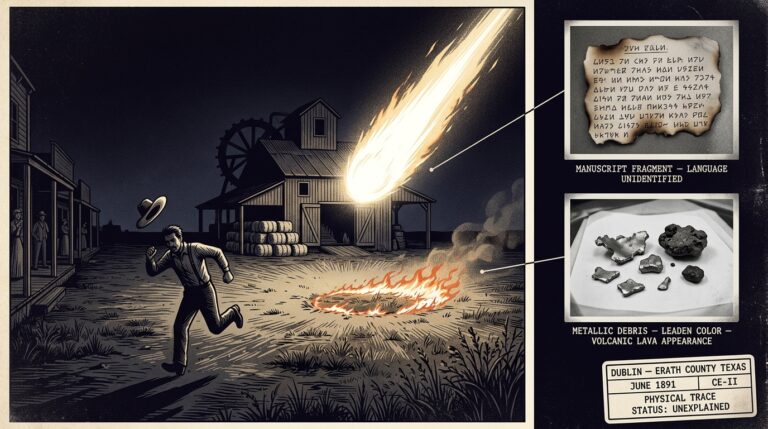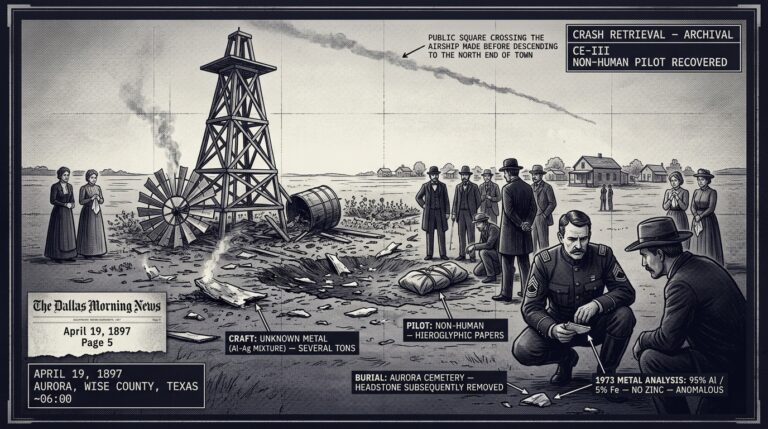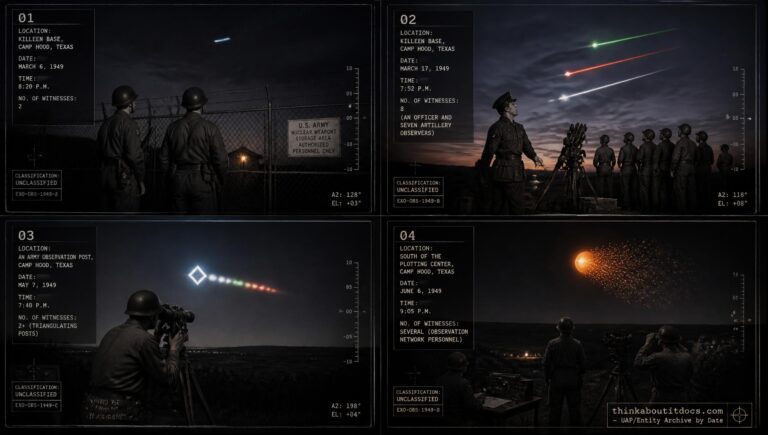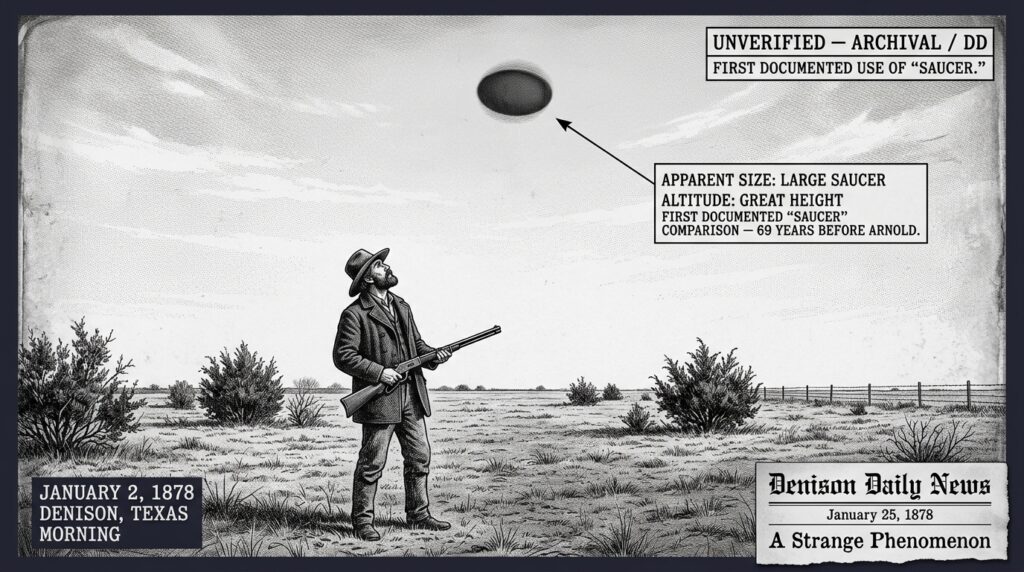
January 2, 1878, six miles south of Denison, Grayson County, Texas. Farmer John Martin watches a dark circular object approach from the south, grow from the apparent size of an orange to the apparent size of a large saucer directly overhead, and depart at wonderful speed. Reported in the Denison Daily News, January 25, 1878. The first documented use of "saucer" to describe an anomalous aerial object — 69 years before Kenneth Arnold made the term famous.
THINK ABOUTIT UFO|UAP SIGHTING REPORT
1878: Denison, Texas Daylight UFO
On the morning of January 2, 1878, farmer John Martin left his homestead six miles south of Denison, Texas for a hunting trip and came back with a story that the local newspaper considered worth printing on January 25. He had been out in the open country when his attention was drawn to a dark object high in the southern sky. He watched it. It appeared to be about the size of an orange — and it was getting larger. He strained his eyes until he had to look away and rest them. When he looked back, it was almost overhead and moving at what he described as wonderful speed. When it passed directly above him it was about the size of a large saucer. It was evidently at a great height. Then it was gone. The Denison Daily News called Mr. Martin a gentleman of undoubted veracity, suggested the sighting deserved the attention of scientists, and filed the article under the headline “A Strange Phenomenon.” Sixty-nine years later, in June 1947, a journalist covering Kenneth Arnold’s sighting over Washington State would reach for the same word — saucer — and give the modern UFO era its name. John Martin got there first.
Date: January 2, 1878
Sighting Time: Morning — Martin was on a hunting expedition; time not precisely recorded
Day/Night: Day
Location: Rural farmland approximately six miles south of Denison, Grayson County, Texas
Urban or Rural: Rural
No. of Entity(‘s): 0
Entity Type: None observed
Entity Description: None observed
Hynek Classification: DD (Daylight Disc) — dark object of disc-like apparent shape observed in clear daytime sky with apparent approach and overhead transit
Duration: Several minutes — long enough for Martin to observe initial approach, rest his eyes, resume observation, and watch the object pass overhead and depart
No. of Object(s): 1
Description of the Object(s): Dark object observed high in the southern sky; appeared initially about the size of an orange at distance; grew in apparent size as it approached; when directly overhead appeared about the size of a large saucer; evidently at great height; moving at wonderful speed; departed rapidly and was soon lost from sight; shape described as resembling a balloon — though the witness was comparing shape, not asserting it was a balloon
Shape of Object(s): Circular — described as resembling a balloon in shape; apparent disc profile when overhead
Size of Object(s): Apparent diameter of a large saucer when directly overhead at great altitude — implying considerable actual size
Color of Object(s): Dark
Distance to Object(s): Great height — altitude not quantified; Martin observed it from directly below at closest approach
Height & Speed: Great height throughout; speed described as wonderful — notably fast; approached from the south and departed after overhead transit
Number of Witnesses: 1 — John Martin, farmer; described by the Denison Daily News as a gentleman of undoubted veracity
Special Features/Characteristics: First documented use of the word “saucer” to describe an anomalous aerial object — 69 years before the term entered popular usage after Kenneth Arnold’s 1947 sighting; apparent size increase during approach consistent with genuine aerial transit toward the observer rather than atmospheric optical effect; witness credibility vouched for by the newspaper of record; object’s dark coloration against the sky suggests a solid object rather than a luminous phenomenon; sustained observation interrupted by eye strain then resumed — implying the object was in sight for several minutes minimum; reported in the Denison Daily News, January 25, 1878, under the headline “A Strange Phenomenon”; cited by Major Donald Keyhoe in The Flying Saucers Are Real, 1950
Case Status: Unexplained
Source: Denison Daily News, January 25, 1878; Major Donald E. Keyhoe, The Flying Saucers Are Real, 1950
Summary/Description: Texas farmer John Martin observes a dark circular object approach from the south at great altitude on January 2, 1878, growing from the apparent size of an orange to the apparent size of a large saucer as it passes overhead at wonderful speed before departing. Reported in the Denison Daily News as a strange phenomenon deserving scientific attention. The first documented use of the word “saucer” to describe an anomalous aerial object — 69 years before the term became the defining label of the modern UFO era.
Related Cases: 1883 Zacatecas Observatory Mexico — José Bonilla photographs 300+ objects crossing the solar disc | 1882 Great Saucer — Royal Observatory Greenwich formal report | 1870 Lady of the Lake Atlantic disc | 1947 Kenneth Arnold Washington State — popularization of “flying saucer” term
DETAILED REPORT
Denison, Texas in January 1878 was a railroad town — the southern terminus of the Missouri-Kansas-Texas Railroad, established only six years earlier in 1872 and already one of the most significant rail junctions in North Texas. Six miles south of town, John Martin farmed land in the flat, open country of Grayson County where the sky is wide and unobstructed in every direction. He was an ideal witness for an aerial phenomenon: outdoors, attentive, in open terrain, with nothing to obstruct his view from horizon to zenith.
The object appeared in the south. Martin’s attention was drawn to it by what the newspaper describes as its peculiar shape and velocity — two features distinct enough to be immediately noticed even at the distance where the object appeared about the size of an orange. This is the first analytically significant detail: Martin did not see a bright light or a flare or a meteor. He saw something whose shape and speed of approach were unusual enough to arrest a working farmer’s attention while he was outdoors on a hunting expedition with other things on his mind.
He watched it approach. It grew in apparent size — which is consistent with either genuine approach toward the observer or an object expanding in size, but Martin’s account implies the former: it was getting closer. The observation continued until the strain of looking caused him to rest his eyes, which tells us the observation had already extended for a meaningful period of time before the object reached closest approach.
When he looked back, it was almost overhead and had increased considerably in size. It was going through space at wonderful speed. When it was directly above him it appeared about the size of a large saucer — his own word, used to convey a specific apparent angular diameter at a great altitude. Then it was gone, rapidly, in the direction it had been traveling.
The newspaper’s account is notable for what the editor added. The Denison Daily News vouched for Martin personally — a gentleman of undoubted veracity — and then stated plainly: if it was not a balloon, this strange occurrence deserves the attention of our scientists. The conditional framing is honest. The newspaper was not claiming it was a balloon; it was acknowledging the balloon as the most convenient conventional explanation while simultaneously flagging that the object’s behavior did not clearly support that explanation.
The word saucer is the detail that places this case in the history of the entire UFO era. In June 1947, when Kenneth Arnold observed nine objects flying in formation over the Cascade Mountains of Washington State, he described their motion — not their shape — as like a saucer skipped across water. A journalist misread or simplified this and reported that Arnold had seen flying saucers. The term entered popular culture and defined the modern era of UFO reporting. But John Martin, a Texas farmer on a January hunting trip in 1878, had already reached for the same word when trying to convey the apparent size of what he had seen directly overhead. He was not describing a shape. He was describing a proportion. The word he chose happened to be the one that would define the phenomenon for the next century. He got there first, in the empty sky over Grayson County, sixty-nine years ahead of the curve.
Major Donald Keyhoe cited the Martin case in his 1950 book The Flying Saucers Are Real — one of the earliest major post-Arnold publications to establish that the “flying saucer” phenomenon had a pre-1947 history. The Denison 1878 case is his earliest American example, and it remains one of the best-sourced pre-aviation DD cases in the entire 19th-century American record: named witness, named newspaper, specific date, editor’s credibility vouching, contemporaneous publication.
RESEARCHER’S NOTES
The First Saucer — John Martin’s 1878 Denison Sighting and the Word That Defined an Era
- Linguistic Priority: John Martin’s use of the word “saucer” on January 2, 1878 to describe an aerial anomaly predates Kenneth Arnold’s famous 1947 sighting by 69 years and 5 months. This is not merely a historical curiosity — it is evidence that the circular disc shape and the saucer comparison were independently available to American observers separated by seven decades. Martin was not drawing on UFO literature or science fiction; he was a Texas farmer in 1878 reaching for the closest comparison in his domestic vocabulary for the apparent size and shape of what he had seen directly overhead. The fact that Arnold’s 1947 observer independently reached for the same word — and that the journalist who misquoted Arnold built the entire modern UFO nomenclature on it — is one of the more remarkable coincidences in the archive’s terminological history.
- Size vs. Shape Distinction: Both Martin (1878) and Arnold (1947) used the saucer comparison in the context of size or motion rather than shape. Martin said the object was about the size of a large saucer — an apparent diameter comparison. Arnold said the objects flew like a saucer skipped on water — a motion comparison. The journalist covering Arnold converted this into a shape description (flying saucers). The archive notes this distinction because it matters analytically: Martin’s object was described as resembling a balloon in shape, not a saucer. The saucer was his size reference, not his shape reference.
- Blank Template Fields — Now Filled: The existing page had blank fields for Sighting Time, Duration, and Size of Object(s). These have been filled from the source text: morning, several minutes (multiple observation phases with eye rest), and apparent saucer-diameter when overhead at great altitude.
- Keyhoe Citation Significance: Major Donald Keyhoe’s 1950 citation of the Martin case in The Flying Saucers Are Real established it as a pre-modern anchor case in the first wave of serious post-Arnold UFO literature. Keyhoe’s book was the first major popular treatment of the UFO phenomenon to argue that the phenomenon predated 1947 and had a documented historical record. The Martin case was his 1878 exhibit.
John Martin looked up from his hunting, watched something dark come at him from the southern sky until his eyes gave out, looked again when it was almost overhead, and watched it pass at wonderful speed above Grayson County, Texas on the second day of January 1878. He told the Denison Daily News it had been about the size of a large saucer when it was directly above him. The paper called him a gentleman of undoubted veracity and said the thing deserved scientific attention. Nobody gave it scientific attention. Sixty-nine years later, a different word association — same word, different context — launched the modern UFO era and gave the phenomenon its popular name. Martin had been there first, alone in the flat Texas country with a hunting rifle and an open sky, watching something he couldn’t name get bigger and then go away. The archive records him as the first person in documented American history to call it a saucer. He had no idea what he was starting.