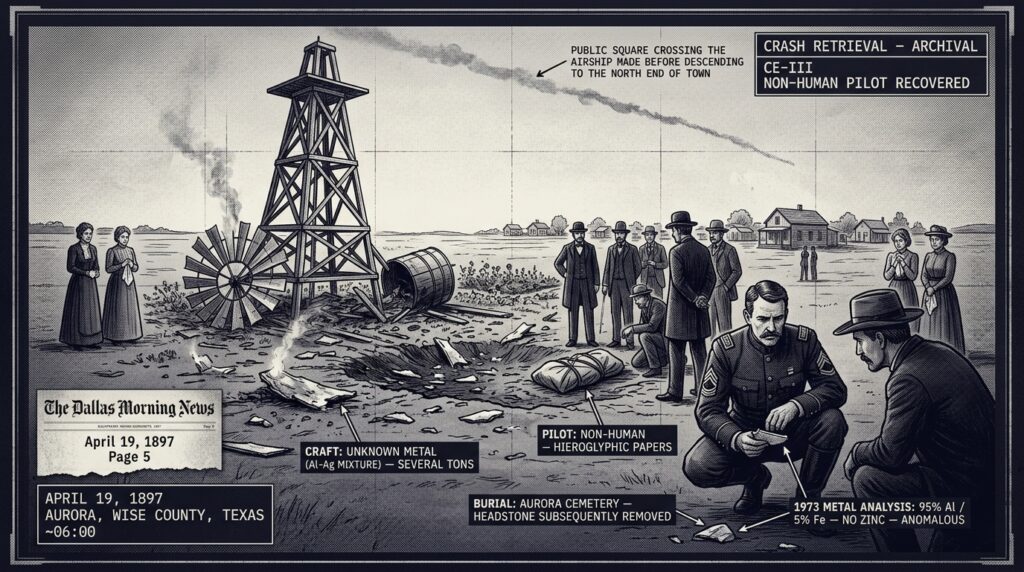
Aurora, Wise County, Texas — morning of April 19, 1897. An airship traveling at reduced speed collides with Judge Proctor's windmill, exploding and scattering anomalous aluminum-silver metal debris over several acres. The non-human pilot — described as not an inhabitant of this world by U.S. Army Signal Service officer T.J. Weems — is recovered, examined, and buried in the Aurora Cemetery the following day. Hieroglyphic papers found on the body cannot be deciphered. Reported in the Dallas Morning News, April 19, 1897. A 1973 metal analysis returned an anomalous composition. The grave's contents were removed before investigators could return.
THINK ABOUTIT CRASH REPORT
1897: Aurora, Texas Crash
At approximately six o’clock on the morning of April 19, 1897, the early risers of Aurora, Texas watched an airship that had been sailing the country for months come in low and slow over their town — traveling due north, evidently in some mechanical difficulty, making only ten to twelve miles an hour and settling gradually toward the earth. It crossed the public square. It struck the tower of Judge Proctor’s windmill at the north end of town and went to pieces with a terrific explosion, scattering debris over several acres, wrecking the windmill and water tank, and destroying the judge’s flower garden. The pilot — the only occupant — was found in the wreckage. His remains were badly disfigured but enough had been gathered to establish, in the opinion of the witnesses and the U.S. Army Signal Service officer present, that he was not an inhabitant of this world. Papers found on his person were written in unknown hieroglyphics. The craft was built of an unknown metal resembling a mixture of aluminum and silver. The pilot was buried the following day in the Aurora Cemetery. The Dallas Morning News ran the story on page five, between twelve other airship sighting accounts. Fifty years later, a man who drank from the well into which the debris had been thrown developed severe arthritis in his left hand and sealed it with concrete. Seventy-six years later, metal detectors found anomalous material in the grave. The headstone was removed before investigators could return. The archive holds all of it — the crash, the burial, the metal, the missing headstone — and documents the hoax hypothesis alongside, because honest record-keeping requires both.
Date: April 19, 1897
Sighting Time: ~06:00
Day/Night: Day — early morning
Location: Aurora, Wise County, Texas
Urban or Rural: Rural — small town, north Texas
No. of Entity(‘s): 1
Entity Type: Non-human pilot — described as not an inhabitant of this world
Entity Description: Remains badly disfigured in the explosion; enough recovered to determine non-human origin in witnesses’ assessment; described as a small man in survivor testimony; U.S. Army Signal Service officer T.J. Weems opined the pilot was a native of Mars; papers found on the body written in unknown hieroglyphics; buried in Aurora Cemetery the following day
Hynek Classification: CE-III (Close Encounter III) — animate non-human being recovered in association with a crashed craft; physical remains examined by multiple witnesses
Duration: Aerial approach — minutes; crash event — instantaneous; aftermath and examination — extended over multiple days
No. of Object(s): 1
Description of the Object(s): Airship traveling due north at reduced speed (10–12 mph) and gradually descending — apparently mechanically impaired; struck Judge Proctor’s windmill tower; exploded with terrific force; debris scattered over several acres; built of an unknown metal resembling a mixture of aluminum and silver; too badly wrecked for construction details to be determined; debris reportedly thrown into a well on the Proctor property; some debris hauled away to unknown location; 1973 metal fragment analysis at Anastas Technical Services Laboratories showed 95% aluminum / 5% iron composition — iron without zinc or other typical alloying elements, non-magnetic; consistent with an origin requiring ultra-pure refining techniques not available in 1897
Shape of Object(s): Airship — cigar-shaped implied by wave context; specific shape not recorded for this craft in the available account
Size of Object(s): Not recorded; described as weighing several tons
Color of Object(s): Unknown metal resembling aluminum-silver mixture
Distance to Object(s): Impact on Judge Proctor’s property; townspeople viewed wreckage directly
Height & Speed: Traveling at 10–12 mph, descending gradually at time of impact; normal operating speed not recorded for this craft
Number of Witnesses: Multiple — early risers of Aurora described as astonished; town reported full of people viewing wreckage day of crash; three surviving witnesses interviewed in 1973: Mary Evans (15 at the time), Charlie Stevens (10 at the time), and Robbie Hansen (skeptical; father thought it a hoax)
Special Features/Characteristics: Hieroglyphic papers found on pilot; non-human identification by Army Signal Service officer T.J. Weems; Christian burial in Aurora Cemetery; anomalous metal fragment found 1973 near former Proctor farm — tested twice, showing 95% Al / 5% Fe without zinc, non-magnetic, consistent with ultra-pure industrial process not available in 1897; metal detectors detected metal in the grave site consistent with crash debris; headstone subsequently removed and metal removed from grave before MUFON could return — pipe driven into ground to extract debris; well containing debris sealed with concrete in 1957 by Rolley Oats after developing severe arthritis in hand used to draw water; Texas State Historical Marker erected at Aurora Cemetery; S.E. Hayden, author of original Dallas Morning News article, had reputation as a practical joker — hoax hypothesis based primarily on this; no follow-up funeral coverage by Hayden; Jim Marrs found no confirmed Hayden hoax articles
Case Status: Insufficient Data — contemporaneous newspaper documentation; surviving eyewitness testimony; anomalous metal analysis; grave site interference; hoax hypothesis plausible but not confirmed; genuine crash hypothesis supported by physical evidence but not definitively proven
Source: Dallas Morning News, April 19, 1897; UPI, 1973; International UFO Bureau; MUFON investigation
Summary/Description: An airship traveling at reduced speed collides with Judge Proctor’s windmill in Aurora, Texas at dawn on April 19, 1897, exploding and scattering debris over several acres. The non-human pilot is buried in the Aurora Cemetery. The craft is built of anomalous metal. Papers on the pilot are written in hieroglyphics. Debris is thrown into a well that is later sealed with concrete. A 1973 metal fragment analysis shows an anomalous aluminum-iron composition inconsistent with 1897 manufacturing capability. The grave’s headstone and metallic contents are removed before investigators can return. The hoax hypothesis centers on the reputation of the original journalist but has not been confirmed.
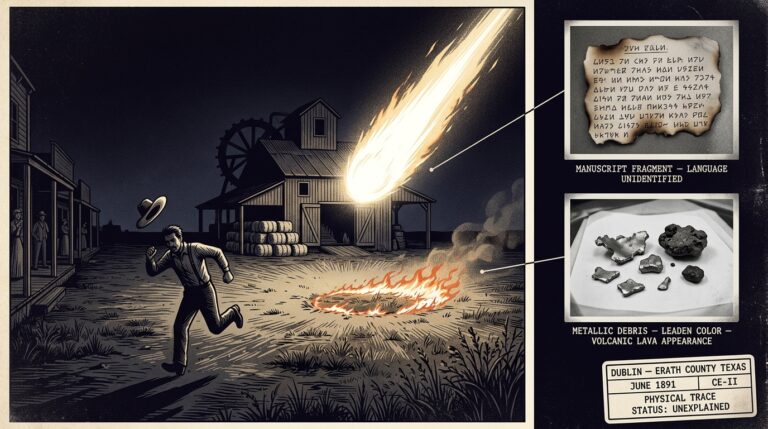
Related Cases: 1865 Cadotte Pass Montana crash — hieroglyphic craft | 1884 Dundy County Nebraska crash — anomalous lightweight machined debris | 1891 Dublin Texas crash — metallic debris, newspaper | 1947 Roswell New Mexico — the case this predates by 50 years | 1897 Alexander Hamilton Leroy Kansas affidavit — same wave
DETAILED REPORT
Aurora, Texas in April 1897 was a town in decline. The spotted fever outbreak of the late 1880s had devastated the population. The railroad that was supposed to revitalize the town had stopped twenty-seven miles short. Boll weevils had destroyed the cotton crop. A fire had burned buildings and killed citizens. The population that had approached 3,000 was in freefall. This context is important because it forms the foundation of the strongest conventional argument against the Aurora crash: that S.E. Hayden, the Dallas Morning News correspondent, fabricated the story to generate interest in a dying town.
The archive documents the hoax hypothesis honestly. Hayden had a reputation as a practical joker. The story ran on page five among twelve other airship accounts — not as a headline — which either indicates the editors thought it credible enough to run but not extraordinary enough to feature, or that Hayden slipped it past distracted editors during a wave of legitimate airship coverage when one more account would not seem anomalous. Hayden never wrote a follow-up account of the funeral — which investigators have noted as a gap in what a genuine reporter would have produced. Jim Marrs, who investigated the case thoroughly for his work Alien Agenda, found no confirmed Hayden hoax article in the record — but the absence of a confirmed prior hoax does not eliminate the possibility of a first.
Against the hoax hypothesis: the physical evidence. Three lines of it.
First, the metal. In 1973, a small fragment was found near the former Proctor farm by an investigator from Corpus Christi. It was tested twice — at a specialized aeronautics failure analysis laboratory and at Anastas Technical Services Laboratories in Houston. Both tests returned the same result: 95% aluminum, 5% iron, without the zinc or other alloying elements that normally accompany iron in any known industrial process of either 1897 or 1973. The material had been molten and air-cooled — it had been at a temperature high enough to liquefy and had then solidified on the ground. The metallurgical report concluded that producing this material would have required ultra-pure refining techniques available only in specialized modern industrial facilities. It could not have been manufactured in Aurora, Texas in 1897.
Second, the grave. Metal detectors used by investigators in 1973 detected metallic material in the grave site consistent with crash debris — the same decibel reading obtained from the location where the anomalous fragment was found. A certified letter was sent to the Aurora Cemetery Association requesting exhumation. The association refused. The Wise County Sheriff posted deputies at the cemetery. In the two-week delay while legal proceedings were filed, someone drove a three-inch pipe into the ground at the grave site and removed the metallic material. The headstone — previously photographed and identified as a possible original marker — disappeared simultaneously. Whatever was in that grave, someone with knowledge of the situation and physical access to the cemetery removed it before investigators could legally examine it.
Third, the well. Rolley Oats moved to Aurora in 1945 and, needing water, cleaned out the well on the former Proctor property into which crash debris had been thrown. He drew water from that well for more than twelve years. He sealed it with a six-inch concrete slab in 1957, reportedly because he had developed severe arthritis in the hand he used to draw the water and attributed it to contamination from the well contents. The archive does not claim this proves anything. It notes that it is a specific, documented behavioral response by a named individual to a specific water source associated with the crash site.
The surviving witnesses interviewed in 1973 add human texture without resolving the case. Mary Evans, who had been fifteen at the time, confirmed that something had crashed and that her parents had gone to see it but would not take her. Charlie Stevens, who had been ten, said he saw a smoke-trailing airship fly overhead, heard an explosion, and saw the smoke plume — and that his father, returning from town the following day, described scattered wreckage. Robbie Hansen was skeptical, based primarily on her father’s dismissive attitude — which is itself evidence neither for nor against the crash.
The Texas State Historical Commission erected a marker at the Aurora Cemetery acknowledging the crash story. It reads in measured, careful language. The state of Texas considered the story sufficiently historically significant to mark it without committing to its truth. The archive takes the same position.
RESEARCHER’S NOTES
The Aurora Cemetery and the Missing Headstone — Fifty Years Before Roswell, the Evidence Was Removed
- Hoax Hypothesis Assessment: The case against Aurora rests primarily on S.E. Hayden’s character rather than on any direct evidence that the story was fabricated. No witness has been found who said Hayden told them he invented it. No draft or prior version showing fabrication exists. No retraction was ever published. Hayden died without confessing. The hoax hypothesis is circumstantial — plausible but unconfirmed — and the archive treats it as such rather than as established fact.
- The Metal Composition Problem: The 95% aluminum / 5% iron composition with no zinc is the most analytically specific physical evidence in the Aurora case. In standard industrial processes of both 1897 and 1973, iron is almost never found without zinc and other alloying elements because they are present as natural contaminants in iron ore and cannot be economically removed by conventional processing. The production of iron this pure requires vacuum induction melting or similar ultra-clean techniques that did not exist commercially until the late 20th century. The 1973 test result cannot be easily dismissed as a contaminated sample or a misidentification.
- The Grave Interference Pattern: The removal of the headstone and metallic grave contents in the two-week window between the certified letter to the Aurora Cemetery Association and the planned return of investigators is one of the most analytically troubling elements of the modern case history. It requires that someone with knowledge of the situation, physical access to the cemetery, and the equipment to drive a three-inch pipe into the ground and extract metallic material, acted deliberately in that specific window. This is not random vandalism. This is targeted removal of physical evidence in response to a documented investigation.
The townspeople of Aurora gave the pilot a Christian burial. They made him a headstone. They treated what they found in Judge Proctor’s flower garden with more dignity than the record ultimately received. Seventy-six years later the headstone was gone and the metal was gone and someone with a three-inch pipe had made sure it would stay that way. The well is sealed with concrete. The debris that wasn’t thrown into the well was hauled to a currently unknown location. The metal that was tested came back with a composition that 1897 Texas couldn’t have produced. The case sits in the archive where it has always sat — between the honest acknowledgment that S.E. Hayden may have invented it and the honest acknowledgment that if he did, somebody went to a great deal of trouble to make sure the physical evidence couldn’t prove it either way.