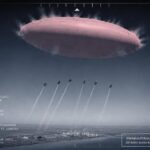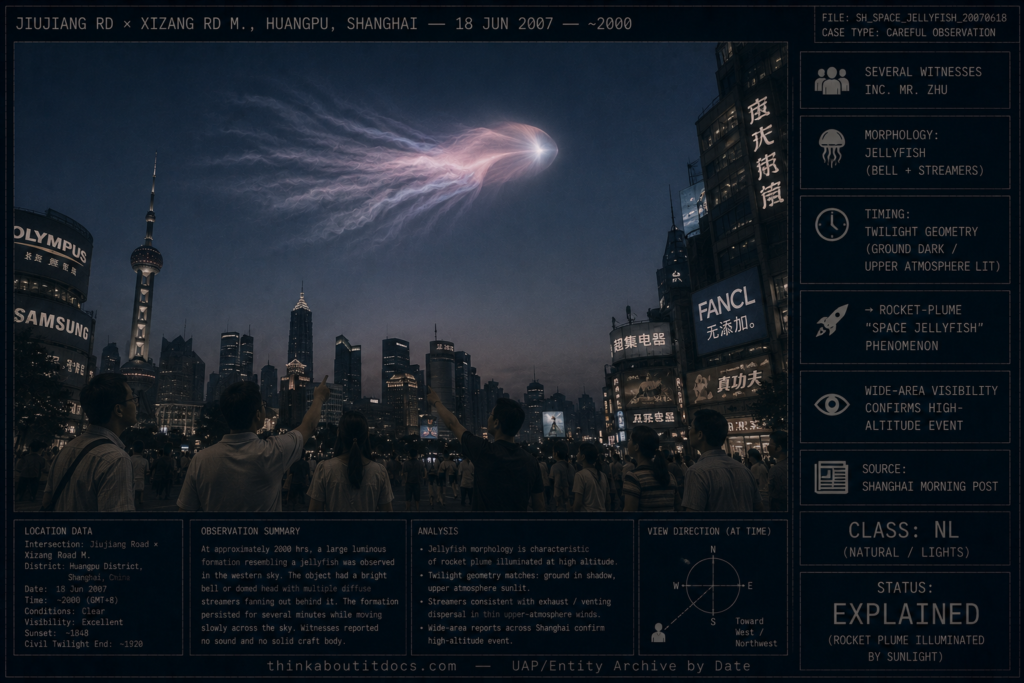
The June 18, 2007 Shanghai jellyfish UFO — several witnesses in central Huangpu District saw a jellyfish-shaped luminous formation at twilight. Morphology, timing, and wide-area visibility identify it as a "space jellyfish": sunlight illuminating a high-altitude rocket exhaust plume while the ground is dark. Logged Explained. (thinkaboutitdocs.com — UAP/Entity Archive by Date)
THINK ABOUTIT UFO|UAP SIGHTINGS REPORT
2007: Jellyfish-Shaped Object Over Huangpu District, Shanghai (Space-Jellyfish Phenomenon)
On the evening of June 18, 2007, around 8 p.m., several people in central Shanghai — including a witness surnamed Zhu, who spoke to the Shanghai Morning Post — looked up over the intersection of Jiujiang Road and Xizang Road M. in the city’s Huangpu District and saw what they described as a jellyfish-shaped object in the sky. The report has all three of the diagnostic features of one of the most thoroughly recognized misidentified-UFO categories in the modern record: the description (literally jellyfish-shaped), the timing (around 8 p.m. local in mid-June — twilight, with the sun still illuminating the upper atmosphere while the ground is dark), and the configuration (multiple witnesses simultaneously across a wide area). What they saw is what space agencies, meteorologists, and aviation authorities around the world now formally label a “space jellyfish” — sunlight illuminating the high-altitude exhaust plume of a launching or venting rocket while observers on the ground remain in darkness. The phenomenon is unambiguous; the case is logged as Explained.
Date: June 18, 2007 (a Monday)
Sighting Time: About 8:00 p.m. local time (the witnesses say “Monday” evening; the article ran the following day, identifying that night as the event)
Day/Night: Twilight (early night) — this timing is itself a diagnostic detail for the phenomenon (see Researcher’s Notes)
Location: Huangpu District, Shanghai — specifically the intersection of Jiujiang Road and Xizang Road M. (西藏中路 / Middle Tibet Road), in central downtown Shanghai
Urban or Rural: Urban (the prior page’s “Rural” is incorrect — Huangpu is the historic central business district of Shanghai, one of the densest urban environments in the world)
No. of Entity(‘s): None reported
Entity Type: Not applicable
Entity Description: Not applicable
Hynek Classification: NL (Nocturnal Light) — an extended luminous source observed at twilight; classification retained from the prior page
Duration: Not specified in the surviving summary; rocket-plume jellyfish phenomena typically remain visible for 5 to 30 minutes as the plume expands and dissipates in the thin upper atmosphere
No. of Object(s): 1 (an extended, jellyfish-shaped luminous formation)
Description of the Object(s): A jellyfish-shaped object in the sky — a luminous formation with a bright “head” or bell and trailing “tentacles” or streamers, the characteristic morphology of an expanding rocket exhaust plume scattering sunlight in the upper atmosphere during twilight
Shape of Object(s): Jellyfish (a bright domed or bell-shaped head with trailing diffuse streamers)
Size of Object(s): Not estimated in the surviving summary; space-jellyfish formations typically appear very large in the sky, often spanning a substantial arc
Color of Object(s): Not specified; typical space-jellyfish plumes appear pale white to bluish, sometimes with a pinkish tinge as sunlight passes through the upper atmosphere at glancing angles
Distance to Object(s): Apparent overhead position; space-jellyfish formations occur at altitudes of roughly 100 to 300 kilometers and are visible across hundreds of miles of ground area simultaneously
Height & Speed: Very high altitude (upper atmosphere); apparent slow expansion and dissipation rather than discrete flight motion
Number of Witnesses: Several — a multi-witness sighting across central Shanghai, including a named witness, Mr. Zhu, who spoke to the Shanghai Morning Post; consistent with the wide-area visibility characteristic of space-jellyfish events
Special Features/Characteristics: The jellyfish morphology itself (the definitional signature of an illuminated rocket exhaust plume); twilight timing (the diagnostic time of day when ground observers are in darkness but upper-atmospheric plumes are still in sunlight); multiple simultaneous witnesses over a substantial urban area; press coverage by a major local newspaper (Shanghai Morning Post) — all consistent with a real but mundane upper-atmospheric event rather than an anomalous craft
Case Status: Explained (space-jellyfish phenomenon — sunlight illuminating a high-altitude rocket exhaust plume during twilight)
Source: Shanghai Morning Post (新闻晨报) — a major Shanghai Chinese-language daily newspaper; report by an unnamed staff writer citing witness Mr. Zhu (zh: 朱先生)
Summary/Description: Around 8 p.m. on Monday, June 18, 2007, several witnesses in central Shanghai including Mr. Zhu reported seeing a jellyfish-shaped unidentified flying object at the intersection of Jiujiang Road and Xizang Road M. in the Huangpu District, as carried by the Shanghai Morning Post. The combination of the jellyfish morphology, the twilight timing, and the multi-witness wide-area visibility is the textbook signature of the “space jellyfish” phenomenon — sunlight illuminating the high-altitude exhaust plume of a launching or venting rocket while ground observers remain in darkness. The phenomenon is a recognized category of misidentified UFO and is documented globally with each launch that produces the right twilight geometry. The case is logged as Explained.
Related Cases: the broader corpus of “space jellyfish” / rocket-plume UFO sightings worldwide (notably the 2017 SpaceX, 2018 Russian Soyuz, 2025 Long March 7 Tianzhou-9, and 2026 Long March 6A Qianfan events) | 2004: Tianhe TEEM Plaza, Guangzhou Overhead Disc (another Chinese sighting with a strong upper-atmospheric mundane candidate)
DETAILED REPORT
The summary, as carried by the Shanghai Morning Post and preserved here, is brief but unusually clear in its details. On the evening of June 18, 2007 — a Monday — at approximately 8 p.m. local time, several people in central Shanghai reported seeing a jellyfish-shaped unidentified flying object in the sky. A man surnamed Zhu told the Shanghai Morning Post the following day that he had observed the object at the crossroads of Jiujiang Road and Xizang Road M. in Huangpu District. The Shanghai Morning Post — a major Chinese-language daily — carried the report as a local-color UFO item, which is how it entered the broader Chinese and then English-language UFO record.
The honest reading of this report is that it documents a real but mundane upper-atmospheric event, and every diagnostic feature points to the same explanation.
The first and most important detail is the shape. “Jellyfish” is not a generic UFO description. In the lexicon of misidentified upper-atmospheric phenomena, it is a specific and recognized morphology: a bright luminous head or bell with trailing diffuse streamers or tentacles, sometimes with a curling or twisting motion as the formation expands. This is exactly the appearance of a rocket exhaust plume venting in the thin upper atmosphere, where the gases fan out rapidly in the near-vacuum and the light from sunlight passing through scatters in a way that produces the bell-and-streamers form. Space agencies and meteorological authorities around the world — the Philippine Space Agency, Russia’s Roscosmos, China’s CASC, NASA, and others — now formally use the term “space jellyfish” for the phenomenon, and reports of jellyfish-shaped UFOs around the time of known launches occur with predictable regularity worldwide.
The second diagnostic detail is the timing. 8 p.m. local time in mid-June in Shanghai is twilight — the sun has set below the horizon for ground observers, leaving the city in darkness, but the upper atmosphere from roughly 100 to 300 kilometers in altitude is still in direct sunlight. This is the precise geometry that makes space-jellyfish phenomena visible: a rocket plume vented at altitude is brightly illuminated from above by the still-shining sun, while observers on the dark ground see it as a glowing formation against the night sky. Outside this narrow twilight window, the same plume would either be lost in daylight (during the day) or invisible because the upper atmosphere is also in Earth’s shadow (in the middle of the night). The 8 p.m. Shanghai timing in June is essentially the canonical window for the effect.
The third diagnostic detail is the multi-witness, multi-vantage character of the report. “Several people” saw the object simultaneously from central Shanghai, and the Morning Post evidently received enough independent reports to make it a news item the following day. This is consistent with the wide-area visibility space-jellyfish formations always exhibit — a rocket plume at 200 km altitude is geometrically visible to anyone within roughly 1,000 km whose sky is clear and whose horizon faces the right direction. A truly anomalous overhead object, by contrast, would not produce this footprint without producing other corroborating signatures (radar tracks, photographs from many sites, regional press attention) that a jellyfish-at-twilight does not.
The pieces fit cleanly. China was, by 2007, an active spacefaring nation with multiple annual launches from its Jiuquan, Xichang, and Taiyuan launch centers, and routine upper-stage venting events occur both immediately after orbital insertion and on later orbital passes as residual propellants are dumped. Russian and other-nation launches and orbital events are also visible from Chinese airspace under the right conditions. Without a launch-record cross-reference to that specific date, the precise originating event cannot be pinned, but the category of phenomenon is not in doubt.
None of this calls Mr. Zhu and the other witnesses’ honesty into question. They saw a real, dramatic, unusual luminous formation in the sky over Shanghai that evening, and they reported it accurately. What they did not know — what very few people knew in 2007, and what the Shanghai Morning Post evidently did not investigate — is that “jellyfish at twilight” has a specific and well-documented mundane cause. Naming it plainly is the honest service to the witnesses and to the archive.
RESEARCHER’S NOTES
The Shanghai Jellyfish — Why “Jellyfish at Twilight” Is the Phenomenon’s Own Signature
- The space-jellyfish phenomenon, plainly stated: When a rocket launches or vents in the upper atmosphere during morning or evening twilight, the exhaust gases fan out rapidly in the near-vacuum at altitude. Because the sun is still above the horizon at 100–300 km altitude even when it has set for ground observers, the plume is directly illuminated by sunlight from above. The illuminated, expanding plume scatters the light back to ground observers in darkness, producing the characteristic shape of a bright bell or head with trailing diffuse streamers — the “jellyfish.” The phenomenon is now formally documented by space agencies including the Philippine Space Agency (PhilSA), Roscosmos, China’s CASC, and NASA, and it occurs with predictable regularity around known launches. Reports of jellyfish-shaped UFOs at twilight are one of the most reliably mundane categories of “UFO” in the modern record.
- All three diagnostic features are present in this report: First, the morphology — explicitly jellyfish-shaped, the definitional signature. Second, the time of day — approximately 8 p.m. in mid-June in Shanghai is the exact twilight window required for the geometry to work, when ground is dark but the upper atmosphere is still sunlit. Third, the wide-area multi-witness visibility — “several” people saw it across central Shanghai, consistent with a high-altitude formation visible across a wide ground footprint. Any one of these alone would be suggestive; all three together is the diagnostic signature.
- The originating event: Without a specific cross-reference to a Chinese, Russian, or other-nation launch on or near June 18, 2007 in the publicly available record I could pin down, the specific rocket is not identified here. The category of event is unambiguous; the particular launch is not. This does not change the case classification — the morphology and timing make the explanation clear regardless of which launch produced the plume.
- Why Explained rather than Insufficient Data: The space-jellyfish phenomenon is so thoroughly documented, and the diagnostic features in this report so cleanly aligned, that the archive can name the cause confidently even without identifying the specific rocket. This is the same standard applied to the Hong Kong Millennium V-formations: when a witness’s own description identifies a well-documented mundane phenomenon, the case is Explained rather than Insufficient Data, even if particular details (which launch? which species of bird?) are not pinned. The archive’s chronological commitment to keeping the entry is preserved; the verdict is sized to what the evidence actually shows.
The Shanghai jellyfish is a small, clean example of how the archive’s “stop the lie” discipline actually works in the witnesses’ favor. The Shanghai Morning Post readers and the people who saw the object on Jiujiang Road that night were not mistaken about seeing something genuinely strange and beautiful in the sky. They were mistaken only about what category of thing it was. Naming the space-jellyfish phenomenon plainly credits their accurate observation, places the entry in honest company with the global corpus of recognized rocket-plume sightings, and protects the harder cases in the archive from being lumped together with a well-understood twilight optical effect. Logged Explained.