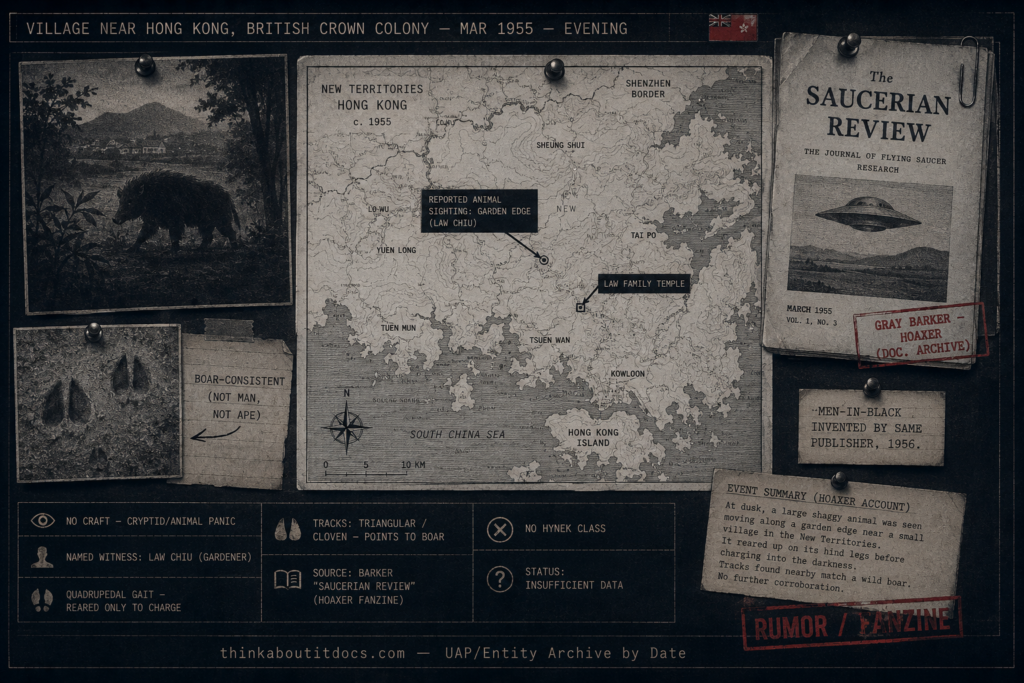
The 1955 Hong Kong "hairy beast" — a village panic, a gardener grappled with a shaggy four-legged animal, triangular tracks unlike a man's or ape's. No craft. Carried by Gray Barker's fanzine; the details point to a wild boar. Logged Insufficient Data. (thinkaboutitdocs.com — UAP/Entity Archive by Date)
THINK ABOUTIT ENTITY SIGHTINGS REPORT
1955: The Hong Kong “Hairy Beast” Panic (New Territories)
CRYPTID / MASS-PANIC REPORT — no craft, no UFO, no light. A community animal-panic story, carried in a fanzine published by a self-acknowledged hoaxer, with a strong mundane candidate (a wild boar or large feral animal).
No Hynek classification applies.
For a short stretch in March 1955, residents in a village outside the urban core of Hong Kong barred their doors and the police searched the streets for a shaggy beast said to be over six feet tall. A gardener named Law Chiu told of grappling with the thing fifty yards from a family temple — it stood up to come at him, fell on him after he punched it in the stomach, and finally loped off on all fours. Days later a woman said something galloped past her vegetable garden on four legs and left large triangular footprints unlike any man’s or any ape’s. As cryptid stories go it is a vivid one. But it is not a UFO case — there is no craft, no light, nothing aerial — and it reaches the record only through the mimeographed fanzine of Gray Barker, the West Virginia writer the page itself, accurately, calls a hoaxer. The four-legged gait and triangular tracks point strongly toward a real but ordinary animal panic — most likely a wild boar in the New Territories — inflated in the retelling and run by a publisher famous for blurring fact with fiction. The archive keeps the entry as cryptid folklore and labels it honestly.
Date: March 1955 (no specific day given)
Sighting Time: Evening (the Law Chiu attack); subsequent sightings within the following days
Day/Night: Evening / night
Location: A village near Hong Kong (British Crown Colony) — the family-temple and vegetable-garden setting places the incidents in the rural New Territories, not urban Hong Kong Island
Urban or Rural: Rural (the prior “Urban” is incorrect; the report describes a village setting with a family temple and vegetable gardens)
No. of Entity(‘s): 1 (a hairy quadruped, reported in two separate encounters and possibly seen by others during the panic)
Entity Type: Unidentified hairy animal — described as a “beast” or “wild man”; functionally a cryptid / wild-animal panic report (no craft associated)
Entity Description: Said to be over 6 feet (about 2 meters) tall, covered with long shaggy gray hair; reportedly stood upright when charging the first witness, fell on him during a brief struggle, and then moved away on all fours; in the second sighting, seen galloping on four legs and leaving large triangular footprints that the witness said were unlike those of a man or an ape
Hynek Classification: None — no craft or object is involved; this is an unassociated cryptid / wild-animal report, not a close encounter of the third kind (CE-III requires beings associated with a craft)
Duration: The Law Chiu encounter is described as a brief grapple; the wider community panic lasted at least several days
No. of Object(s): None — no object, craft, light, or aerial phenomenon is reported anywhere in the account
Description of the Object(s): Not applicable
Shape of Object(s): Not applicable
Size of Object(s): Not applicable (the creature was about 2 meters / over 6 ft)
Color of Object(s): Not applicable (the creature was gray-haired)
Distance to Object(s): Direct physical contact (Law Chiu); the second witness saw it pass through her garden at close range
Height & Speed: Not applicable (a quadrupedal ground animal seen briefly, then “galloping”)
Number of Witnesses: A named primary witness (Law Chiu, village gardener) and an anonymous female witness who saw the creature pass her garden and noted the footprints; the wider community responded with door-barring and a police search, indicating a real local panic regardless of the cause
Special Features/Characteristics: A community panic with door-barring and police search; a named gardener attacked at close range fifty yards from a family temple; a second witness with reported physical-trace evidence (large triangular footprints); the creature consistently described as quadrupedal in motion, briefly bipedal only when charging; no craft, light, sound, or aerial element; carried into UFO literature only via a fanzine published by a known hoaxer
Case Status: Insufficient Data
Source: “The Saucerian Review: A Report on Flying Saucers,” edited by Gray Barker, Saucerian Publications, Clarksburg, West Virginia, 1956 — a mimeographed UFO fanzine. Barker is documented in his own archival collection (Clarksburg-Harrison Public Library) as a “UFO writer, teller of tall tales, and hoaxer” who “blurr[ed] fact with fiction.” Inclusion records the rumor, not corroboration of it
Summary/Description: In March 1955, residents of a village in the Hong Kong area reportedly barred their doors as police searched for a shaggy, gray-haired “beast” said to be more than six feet tall. A village gardener, Law Chiu, said he fought the creature 50 yards from a family temple — it stood upright as it charged him, fell on him during the struggle, and then moved away on all fours. A woman later said it galloped past her vegetable garden on four legs and left large triangular footprints unlike a man’s or an ape’s. The account reaches the record through Gray Barker’s “Saucerian Review” (1956) — a fanzine published by a self-acknowledged hoaxer — and contains no craft, light, or aerial element. The four-legged gait and triangular tracks point toward a real wild-animal panic (most likely a boar) inflated in retelling. The case is logged as Insufficient Data.
Related Cases: 1952: 7 ft. Hairy Creature near Seeley Lake, Montana (cryptid report previously misclassified as a UFO case) | the Chinese “yeren” wild-man folklore tradition | the broader corpus of Asian and Pacific hairy-hominid panic reports
DETAILED REPORT
As carried in Gray Barker’s “Saucerian Review” in 1956, reporting an incident said to have taken place in March 1955, the story runs as follows. In a village in the Hong Kong area, residents barred their doors one evening as the police searched the streets for what terrified locals were calling a hairy beast — a shaggy, gray-haired animal said to stand over six feet tall. A village gardener named Law Chiu said the thing had attacked him about fifty yards from his family temple. It stood upright when it came at him; he punched it in the stomach, and the creature fell on him; they grappled for some time, and then it moved away on all fours. Some days later, a woman said a strange animal galloped past her vegetable garden on four legs, leaving — as proof, she said — large triangular footprints in the soft earth, unlike anything a man or an ape would leave.
The first thing to set right is the category, and the same standard the archive applies to other “monster” reports applies here. There is no craft anywhere in this account. There is no light, no aerial object, no sound from the sky, no landed disc, nothing that could be called a UFO of any kind. There is only a hairy animal in a village, frightening the residents and grappling with a gardener. By the archive’s own rule, an entity report with no associated craft is not a close encounter of the third kind; it is an unassociated cryptid or wild-animal report, and it carries no Hynek classification. The prior page placed this in the UFO archive by topical proximity, not by content, and the reclassification corrects that. The case is retained as the high-strangeness folklore it is.
The second correction is the source, which is the load-bearing problem and which the page already half-states. The story comes from “The Saucerian Review: A Report on Flying Saucers,” edited by Gray Barker and published in 1956 out of Clarksburg, West Virginia. The page itself, correctly, calls Barker “a whimsical UFO buff and UFO hoaxer,” and the documentary record sharpens that description further. Barker’s own archival collection at the Clarksburg-Harrison Public Library describes him as “a noted UFO writer, teller of tall tales, and hoaxer from the early 1950’s until his death in 1984,” “noted for his dramatic style blurring fact with fiction.” This is the same Gray Barker who in 1956 — the same year as the Hong Kong report — published “They Knew Too Much About Flying Saucers,” the book that invented the Men in Black mythology through the Albert Bender hoax. The “Saucerian Review” was a mimeographed fanzine that printed rumors and sighting letters from a global network of correspondents. Inclusion in it documents that a story was passed along, not that the events occurred as described, and a hoaxer-edited fanzine is the bottom of the source-reliability scale.
The third observation is the one that points to what most likely happened, and it sits in plain view in the report’s own details. The creature is described as moving on four legs in both encounters. It “stood upright” only briefly, to charge Law Chiu, then fell on him during the struggle and “went away on all fours.” The second witness saw it “galloping past on four legs.” And the only physical-trace evidence is “large triangular footprints” that the woman said were unlike a man’s or an ape’s prints. A quadrupedal animal that briefly rears up to charge, knocks a man down, and leaves roughly triangular two-toed tracks unlike a man’s or an ape’s is an excellent description of a wild boar — Sus scrofa — which was, and remains, abundant in the New Territories of Hong Kong. Boars rear when they charge, can easily knock a grown man down, are heavily built and shaggy-haired, can look very large at night to a frightened observer, and leave a cloven-hoof print that is recognizably triangular and obviously not human or simian. A large feral dog, a wild dog, or some other large mammal would also fit several of the same details, though less neatly than a boar for the rearing-and-falling behavior and the cloven prints.
None of this requires calling Law Chiu or the woman with the footprints liars. A real, frightening, perhaps painful encounter with a large wild animal in 1955 rural Hong Kong is entirely consistent with the report, and a community panic in which doors are barred and the police are called out is a real social event — there is plainly something underneath this story. What it is not, on its own internal evidence, is an upright “wild man.” Read in the cultural setting it also picks up another layer: southern Chinese folklore has a long-established “wild man” tradition — the yeren — and a community panic over a large unknown animal would naturally tend, in the telling, toward the wild-man category, especially as the story was repeated and grew. By the time it reached a West Virginia fanzine editor known for embellishment, two more feet of height and a great deal of “shaggy gray hair” had become part of the standard account.
Between a known-hoaxer source, no craft, no aerial element, a clearly quadrupedal animal, triangular prints, and a setting full of wild boar, the honest verdict is that something ordinary happened, was understandably frightening, was culturally framed as a wild man, and was further inflated by the time it was put into print. That is not a documented anomaly. The case is logged as Insufficient Data, with the source flagged and the mundane candidate stated plainly.
RESEARCHER’S NOTES
The Hong Kong “Beast” — A Wild-Animal Panic in a Hoaxer’s Fanzine
- Classification correction (none applies): This is not a UFO case in any sense of the term. The account contains no craft, no light, no aerial object, no sound from the sky, and no landed vehicle — only a hairy quadrupedal animal frightening a village. Under the archive’s standard, an entity or creature report with no associated craft is an unassociated cryptid / wild-animal report and carries no Hynek class. The same correction has been applied to other cryptid entries the archive holds (notably the 1952 Seeley Lake Montana case), and consistency requires it here.
- Source-chain assessment: The provenance is the case’s most serious weakness, and the prior page deserves credit for naming it. Gray Barker is documented by his own library archive as a “UFO writer, teller of tall tales, and hoaxer” whose work blurred fact with fiction; his “Saucerian Review” was a mimeographed Clarksburg, West Virginia fanzine that printed rumors and correspondents’ letters with little or no investigation. He is the same writer who in the same year — 1956 — published the book that invented the Men in Black mythology through the Bender hoax. A report appearing in Barker’s fanzine documents that a story was circulated, not that any of its details are accurate, and the inflation typical of his treatment of such stories should be assumed.
- The mundane candidate, named plainly: The strongest analytical point is that the report’s own details point to a real but ordinary animal. The creature moves on four legs in both encounters; it rears only briefly, to charge; it knocks a man down and is described as falling on him; and the only physical trace is “large triangular footprints” the witness specifically described as not a man’s and not an ape’s. A wild boar — abundant in the New Territories of Hong Kong then and now — fits this profile precisely: heavy-bodied, shaggy, rearing when charging, capable of knocking down a man, and leaving a cloven hoofprint that is unmistakably triangular and obviously non-human. A large feral or wild dog is a secondary candidate. The “over six feet tall, shaggy gray hair” framing is panic-amplification of a frightening, partly-seen, nighttime animal.
- The cultural overlay (yeren): Southern Chinese folklore has a long tradition of the yeren — the “wild man” of the mountains — a Bigfoot-type figure reported across central and southern China. A real wild-animal panic in a 1955 Hong Kong village, narrated within that cultural inheritance, naturally tends toward “hairy beast / wild man” rather than “wild boar,” and the story will lean that way as it spreads. This is context, not evidence — but it explains why a probably-mundane event takes the shape it does in the telling.
- Minor record corrections: The page’s location field said “Urban,” but the body text describes a family temple and vegetable gardens — the New Territories setting is rural. The “Bodaiji” tag is a category error: bodaiji (菩提寺) is a Japanese-Buddhist term for a family temple, mistakenly read as a place name; Hong Kong is not in Japan and there is no place called Bodaiji here. The tag has been dropped.
- Why Insufficient Data: Pulling toward seriousness: a named victim, a real community response (doors barred, police search), a second witness, and reported physical-trace evidence. Pulling against it: a known-hoaxer source, decades-old fanzine reporting at second hand, and details that point cleanly to an ordinary wild-animal cause. The archive cannot autopsy the original event from a 1956 mimeograph, but the honest reading is that something real but mundane happened and was inflated in the telling. That is Insufficient Data — not a documented anomaly to call Unexplained, and not a demonstrated hoax or solved misperception to call Explained — with the source and the candidate both stated plainly.
The Hong Kong “beast” is cryptid folklore wearing a UFO-archive label, recorded for a Western audience by a man who made his living blurring fact with fiction. Its own internal details — a four-legged gait, triangular non-human, non-ape tracks, a rearing charge, a community panic — point cleanly to a real animal encounter that frightened a village and grew in the retelling. Reclassified out of CE-III with no Hynek class, the source named for exactly what it is, and the most economical mundane explanation set down beside it, it stands as Insufficient Data — kept as folklore, not endorsed as evidence.