Six color photographs captured a capsule-shaped metallic object during the 1967 UFO wave — but the location has been misattributed to Kansas for decades.
THINK ABOUTIT UFO|UAP SIGHTING REPORT
1967: Capsule-shaped Object Photographed by Jefferson Villar
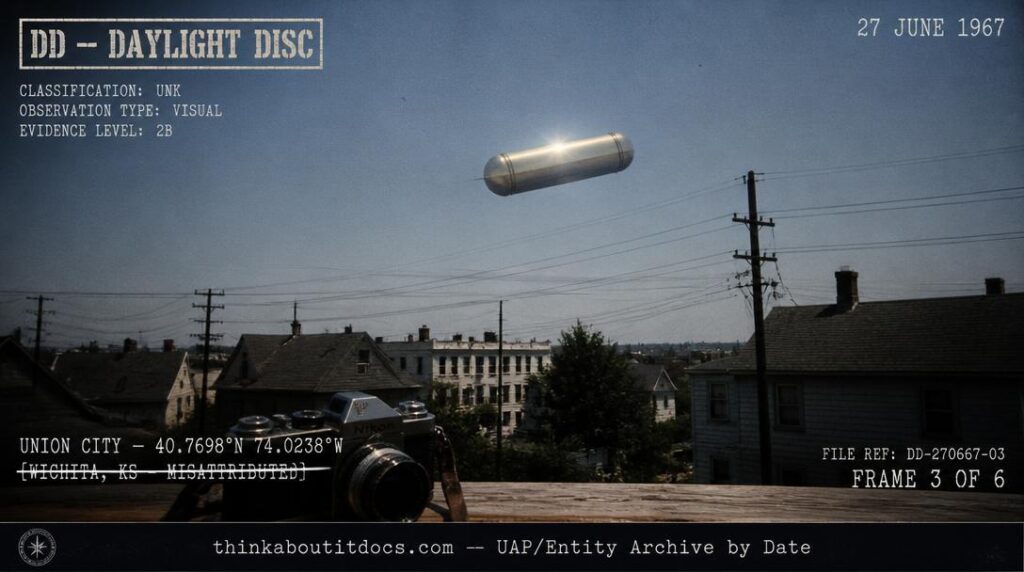
In the summer of 1967, at the height of one of the decade’s most prolific UFO waves, a man named Jefferson Villar managed to do what most witnesses only wish they could — he captured six color photographs of a clearly defined, capsule-shaped metallic object passing at low altitude over rooftops and telephone wires. The photographs, showing a brilliantly reflective cylindrical structure with rounded ends, represent one of the more intriguing photographic cases of the era. Yet the record surrounding these images is haunted by a significant problem: the case has been filed under Wichita, Kansas for years, but no independent source connects either the witness or the sighting location to Kansas at all.
⚠ GEOGRAPHIC MISATTRIBUTION FLAG: This case has circulated under the title “Wichita, Kansas” across multiple databases, but the only location associated with the witness in any source is “Union City” — almost certainly Union City, New Jersey. No corroborating source places this event in Kansas. The original attribution appears to be a cataloging error that has propagated uncorrected through the UFO literature. This page is retained in the Kansas archive for reference continuity, with this correction noted.
Date: June 27, 1967
Sighting Time: Daytime (sun position confirms)
Day/Night: Day
Location: Union City (likely New Jersey) — misattributed to Wichita, Kansas in prior catalogs
Urban or Rural: Urban (residential area with houses and telephone wires)
No. of Entity(‘s): None reported
Entity Type: N/A
Entity Description: N/A
Hynek Classification: DD (Daylight Disc) — object at 1,500–2,000 feet altitude, well outside CE-I’s 500-foot threshold
Duration: Several minutes (sufficient time to take six photographs)
No. of Object(s): 1
Description of the Object(s): Clearly defined cylindrical structure with rounded ends, described as capsule-shaped. Brilliantly reflective metallic surface. Produced a strange audible noise during flight.
Shape of Object(s): Capsule / Cylinder with rounded ends
Size of Object(s): Not specified
Color of Object(s): Bright silver, metallic
Distance to Object(s): Estimated 1,500–2,000 feet altitude
Height & Speed: Low altitude pass; speed not specified but object traversed visible sky during photo sequence
Number of Witnesses: 1 (Jefferson Villar)
Special Features/Characteristics: Six color photographs obtained. Object produced a strange audible noise. Brilliant solar reflectivity consistent with polished metal surface.
Case Status: Insufficient Data
Source: Paul Devereux, Earth Lights Revelation; UFO Evidence database
Summary/Description: On June 27, 1967, during the widespread 1967 UFO wave, Jefferson Villar of Union City photographed a bright silver capsule-shaped object passing at low altitude overhead. He obtained six color photographs of the cylindrical structure with rounded ends as it flew above houses and telephone wires, reflecting sunlight brilliantly and emitting a strange noise.
Related Cases: 1950: Cylindrical UFO Photographed Over New York City | 2002: Photograph of Small, Spherical Object Over Water
Detailed Report
On June 27, 1967, Jefferson Villar of Union City observed a bright, silver-colored object passing over his location at relatively low altitude. The sighting occurred during the major 1967 UFO wave, a period of heightened aerial anomaly reports across the United States and internationally. The object was capsule-shaped — a clearly defined cylindrical body with rounded ends — and was brilliantly reflecting sunlight in a manner consistent with a polished metallic surface. Villar also reported that the object produced a strange, unidentified noise as it moved through the air.
Villar reacted quickly enough to retrieve his camera and photograph the object during its passage. He obtained six color photographs showing the capsule-shaped structure at low altitude, framed against a house and telephone wires in the foreground. These foreground reference objects provide some basis for scale estimation, and Villar judged the object to be flying at an altitude between 1,500 and 2,000 feet at the point of closest observation. The object appeared solid and three-dimensional in the photographs.
The case entered the UFO literature through Paul Devereux’s work and was subsequently cataloged by the UFO Evidence database and other repositories. However, at some point during its circulation through catalogs, the location was attributed to Wichita, Kansas — a designation that appears nowhere in the original source material. Every version of the primary account identifies the witness as “Jefferson Villar of Union City,” and the most probable Union City in the context of 1960s UFO reporting is Union City, New Jersey, a densely populated municipality in Hudson County directly across the Hudson River from Manhattan. There is no Union City in Kansas.
The photographs themselves have not been subjected to any publicly documented forensic analysis. The source chain is thin — Devereux cited the case but detailed provenance of the images, chain of custody, and independent verification are absent from the available literature. The six photographs have circulated in UFO publications but without the kind of negative analysis or optical study applied to better-documented photographic cases of the same era, such as the McMinnville or Rex Heflin photographs.
Researcher’s Notes
The Misplaced Capsule — Union City 1967 and the Problem of Cataloging Errors in UFO Archives
- Geographic Misattribution: This case has been filed under “Wichita, Kansas” across multiple databases and archive sites for years, but no primary source connects the sighting to Kansas. The witness, Jefferson Villar, is consistently identified as being “of Union City” — almost certainly Union City, New Jersey. There is no municipality named Union City in Kansas. The misattribution likely originated from a cataloging error at some point in the case’s circulation through secondary and tertiary UFO databases, and was then propagated without correction. This is a textbook example of how geographic errors can embed themselves permanently in the UFO literature when downstream compilers copy upstream entries without verification.
- Hynek Classification Correction: The existing page classified this case as CE-I (Close Encounter I), which requires the object to be observed within approximately 500 feet of the witness. Villar himself estimated the object at 1,500 to 2,000 feet altitude — three to four times the CE-I threshold. The correct Hynek classification is DD (Daylight Disc), as the sighting involved a structured object observed during daytime at distance, with the sun clearly illuminating its surface. The original page also listed the sighting as occurring at “Night,” directly contradicted by the witness description of the object “brilliantly reflecting the sun’s rays like metal.”
- Source Chain and Evidentiary Weight: The case rests on a single primary source (Devereux) and a single witness. Six photographs were reportedly taken, but no forensic analysis, negative examination, or independent photographic evaluation appears in the literature. The 1967 wave produced hundreds of reports and dozens of photographic claims, and the better-documented cases from that period — such as the Jaroslaw Lake St. Clair photographs or the Heflin series — underwent significant scientific scrutiny. The Villar photographs have not received comparable treatment, leaving their evidentiary weight substantially lower than their visual clarity might suggest.
- Wave Context and Pattern Placement: The 1967 UFO wave was one of the most intense in American ufological history, producing cases across every region of the United States and internationally. Capsule and cylindrical morphologies, while less commonly reported than disc or oval shapes, appear with enough regularity in the photographic record to constitute a recognized subtype. The Villar photographs, if authentic, would represent one of the clearer examples of this morphology from the wave period. However, without provenance documentation and with the geographic attribution demonstrably wrong, the case cannot be reliably placed in any regional pattern analysis.
The record stands as a cautionary example: compelling photographs paired with thin documentation and compounded cataloging errors, leaving a case that looks strong on the surface but cannot support analytical weight.