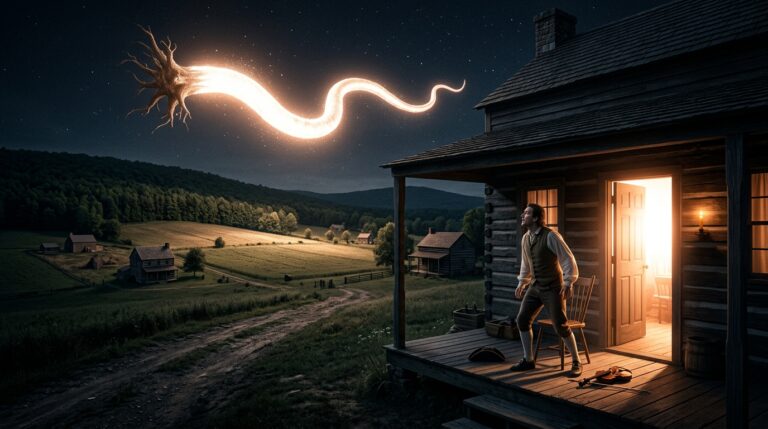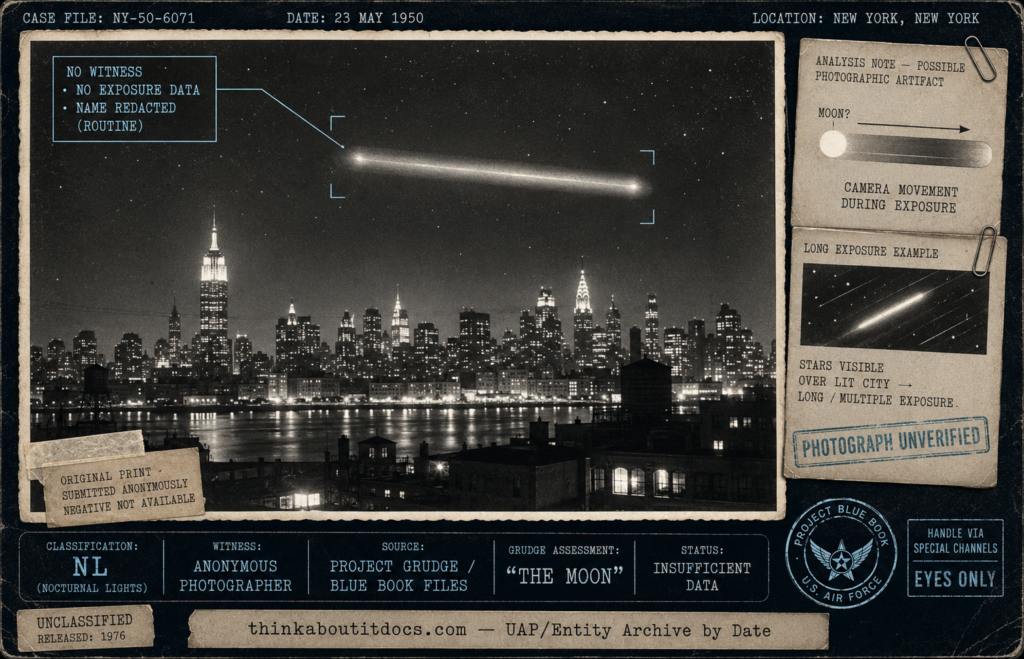
The New York cylinder, photographed March 20, 1950 — an anonymous, witnessless image Project Grudge assessed as "the moon"; classified NL, status Insufficient Data.
THINK ABOUTIT UFO | UAP SIGHTING REPORT
1950: The Cylindrical UFO Photographed Over New York City
It is one of the more striking images in the old Project Blue Book photographic file: a long, glowing, tubular shape hanging in a night sky over New York City, dated March 20, 1950, with stars scattered around it. For decades it has been reproduced in UFO picture books and, more recently, recycled online as a candidate “mothership.” Yet almost everything that would let anyone evaluate it is missing. There is no witness account, no time of night, no exposure data, and no photographer’s name — that was stripped from the file before release. The Air Force’s Project Grudge looked at it and wrote a one-word verdict that ufologists have mocked ever since: “the moon.” The irony is that the mockery may be misplaced. The single most telling feature of the picture — stars shining through over a city that should have washed them out — points straight at the kind of long exposure in which a bright Moon smears into exactly this sort of luminous cylinder. It is a famous photograph resting on almost no evidence, and it is preserved here as precisely that.
Date: March 20, 1950
Sighting Time: Not recorded
Day/Night: Night
Location: New York City, New York
Urban or Rural: Urban
Hynek Classification: NL (Nocturnal Lights) — Hynek catalogued it as a nocturnal light
Duration: Not recorded
No. of Object(s): 1 (as imaged)
Description of Object(s): A single elongated, cylindrical or tubular luminous shape photographed against a night sky in which stars are visible; no structural detail, motion, or behavior was recorded — the case is a photograph, not an observed event
Shape: Cylindrical / tubular
Size: Not established
Color: Bright / luminous (light-toned in the print)
Distance: Not established
Height & Speed: Not established (no recorded motion)
No. of Witnesses: Effectively one — an anonymous photographer; no corroborating ground observers are documented
Special Features/Characteristics: Photographer’s name redacted from the Blue Book file on release; stars visible in the frame despite the bright-city setting, suggesting a long or multiple exposure; Project Grudge’s stated assessment was “the moon”; no accompanying public sighting of a cylinder over Manhattan is on record
Case Status: Insufficient Data
Source: Project Blue Book / Project Grudge files (photographer’s name redacted); the image was subsequently reproduced in UFO photographic compilations (e.g., UFOs 1945–1995)
Summary/Description: A photograph dated March 20, 1950 shows a cylindrical, tubular-looking luminous object in the night sky over New York City. The image entered the Project Blue Book record; when the files were declassified in the 1970s, the photographer’s name had been removed, as were witness names throughout the collection. Project Grudge, investigating, assessed the object as “the moon.” No witness statement, time, or exposure information accompanies the surviving image, and there is no record of New Yorkers reporting a large cylinder over the city that night. Some ufologists have since speculated that tubular images of this kind represent “motherships” that carry and release smaller craft, and the photo has more recently been recirculated online in that vein. The picture’s most diagnostic feature — visible stars over a brightly lit city — is consistent with a long or multiple exposure.
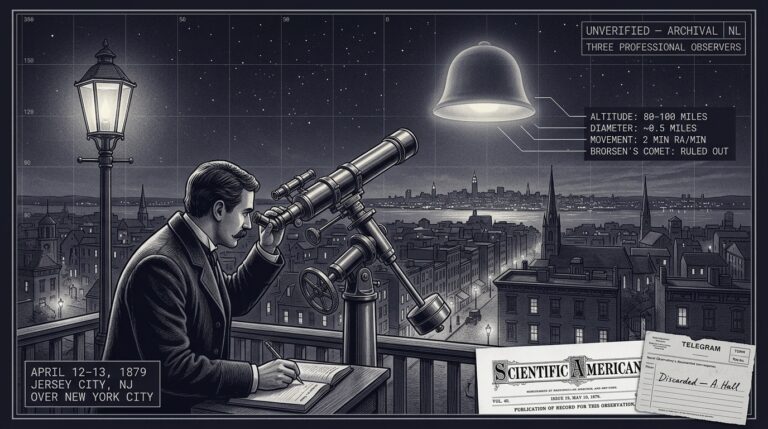
Related Cases: 1879 — “mothership” reported over New York City (regional cylinder/mothership lore) | 1967 — capsule-shaped object photographed, Wichita, Kansas (comparable lone-photo cylinder case) | the broader genre of single-photo “cylinder/mothership” images of uncertain provenance
Full Report
This case is best treated as a photograph to be evaluated rather than an event to be narrated, because an event is exactly what it lacks. There is no witness who described seeing a cylinder over Manhattan, no recorded time, no duration, no motion, and no second observer — only an image and a date. Everything else that has accreted to it, from the Grudge label to the modern “mothership” framing, is interpretation laid over a picture whose origins are largely unknown.
What can be said about the image is limited but pointed. It shows an elongated, glowing, tubular form against a night sky in which stars are visible. That last detail is the analytical key. Over a city as brightly lit as New York, a normal night photograph does not show stars — the ambient light swamps them. For stars to register, the film almost certainly received a long exposure, or the frame is a multiple exposure. And a long night exposure is precisely the condition under which a bright point or disc of light, such as the Moon, is drawn out by camera movement, a pan, or a bumped tripod into a smooth luminous streak — a cylinder. Seen in that light, Project Grudge’s much-ridiculed “the moon” is not an absurd brush-off but a coherent hypothesis: a motion-blurred lunar image in a time exposure. A simple film or emulsion defect is a second mundane candidate.
The provenance does nothing to rescue the object interpretation. The photographer is anonymous; the name was redacted from the Blue Book file. It is worth stating plainly that this redaction was routine rather than sinister — when the Air Force released the Blue Book collection to the National Archives in the 1970s, witness and photographer names were stripped throughout the files under privacy practice, not specially censored for this case. The image then passed into the UFO literature through photographic compilations, where it has been reproduced for decades detached from any documentation. A recent attribution to the noted architectural photographer Irving Underhill — along with a claim that he said the object was not visible to his eye when he shot the frame — circulates only in late, low-quality online articles, is absent from the original record, and should be treated as unverified at best.
The “mothership” reading deserves the same caution. The notion that tubular objects are carrier craft that disgorge smaller saucers “poker-chip fashion” is a long-standing piece of ufological speculation, recently given fresh circulation by association with mainstream discussion of hypothetical interstellar “probes.” None of that bears on what this 1950 frame actually shows. Speculation about what a cylinder might be is not evidence about what this cylinder was.
Set against all of this is the simple absence that matters most: if a large luminous cylinder had genuinely hung over New York City on a March night in 1950, it would have been one of the most-witnessed objects in the country, and the press and Blue Book would be thick with corroborating reports. There are none. A photographic artifact produces an image without witnesses; a real object over Manhattan does not. That asymmetry is the strongest single indicator in the case, and it points away from a physical craft.
RESEARCHER’S NOTES
The New York Cylinder — 1950 and the Long-Exposure Problem
- Classification. Hynek catalogued the image as NL (Nocturnal Lights), and that is the correct and only defensible label: a luminous form recorded against a night sky, with no resolved structure, no occupants, and no observed behavior. It is worth stressing that the classification describes the image, not a confirmed object — a nocturnal-light category entry can be satisfied by a genuine light or by a photographic rendering of one. No close-encounter or daylight-disc designation could apply.
- Source chain. The provenance is thin and degraded. The root is a Project Grudge/Blue Book file entry with the photographer’s name routinely redacted, after which the image survived mainly as a reproduction in UFO picture books. There is no witness statement, no negative analysis, no exposure data, and no contemporaneous press report in hand. The modern “Irving Underhill” attribution and the “mothership/probe” framing are late additions from unreliable sources and add nothing evidentially. This is a photograph in search of a context.
- Pattern context. The image belongs to the durable sub-genre of single, witnessless “cylinder” or “mothership” photographs that recur across the decades and across cities — New York itself has a much older “mothership” entry in the 1879 telescope report, and comparable lone-photo cylinder cases appear later, such as the 1967 Wichita capsule image. These pictures share a common weakness: they are evaluated as objects when they are really images, and images of luminous elongated forms are among the easiest to produce inadvertently through long exposure, lens flare, or film defect.
- Physical / evidentiary weight. Very low, and tilted toward a mundane reading. There is no witness, no corroboration, no provenance worth the name, and no recorded behavior — while the one hard internal clue, stars visible over a bright city, actively supports a long-exposure artifact, of which a motion-blurred Moon (Grudge’s own answer) is a plausible specific case. None of this can be confirmed without the original negative and its exposure data, which are not available. The honest disposition is Insufficient Data: the object interpretation is unsupported, a photographic explanation is the most likely, and the surviving material cannot settle it conclusively.

The New York cylinder is famous chiefly because it is a good-looking picture, not because it is a well-supported case. Strip it back and what remains is an undated-by-hour, witness less, anonymous photograph whose most distinctive feature — stars over a glowing city — argues for a long exposure in which an ordinary bright object could smear into a luminous tube.
Project Grudge’s “the moon” has been treated as a punchline for seventy years; on the evidence, it may simply have been right, or close to it. The picture belongs in the chronological record as exactly what it is: a striking but unsubstantiated image, most plausibly a photographic artifact, and honestly catalogued as Insufficient Data rather than dressed up as a mothership.