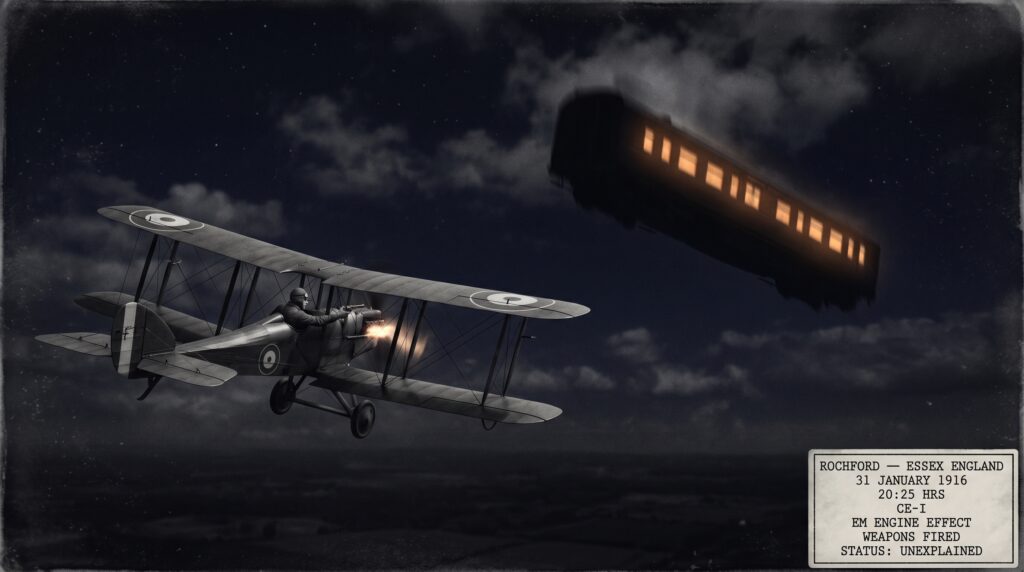
Rochford, Essex, England, January 31, 1916, 8:25 PM — Royal Flying Corps Lt. Morgan on Zeppelin patrol encountered a dark object with railway carriage window lights at 5,000 feet. His engine malfunctioned on approach. He fired his pistol. The object rose rapidly and vanished. First entry in the NICAP aircraft sighting database. Source: Fran Ridge/NICAP; Mike Swords/UFODNA; NARCAP. Case status: Unexplained.
THINK ABOUTIT UFO | UAP | SIGHTING REPORT
1916: British Aircraft Encounters Object
At 8:25 on the night of January 31st, 1916, Royal Flying Corps Lieutenant Morgan was at 5,000 feet over Rochford, Essex scanning the skies for German Zeppelins when he found something else entirely. A dark object hung in the night air ahead of him showing a row of lights exactly like the illuminated windows of a railway carriage with the blinds drawn. He pushed toward it for a closer look. His engine began to malfunction. He drew his pistol and fired at the lights. They rose rapidly into the heavens and disappeared. The encounter lasted twenty minutes. It is the first entry in the NICAP aircraft sighting database and one of the three oldest known pilot UAP sightings on record. A Royal Flying Corps officer on active Zeppelin patrol in wartime England fired a pistol at an unidentified object and watched it leave the atmosphere. The archive opens the military pilot UAP record here.
Date: January 31, 1916
Sighting Time: 8:25 PM
Day/Night: Night
Location: Rochford, Essex, England — airspace at 5,000 feet altitude
Urban or Rural: Rural — wartime airspace over Essex countryside
No. of Entity(‘s): None observed
Entity Type: None
Entity Description: None
Hynek Classification: CE-I (Close Encounter I) — unusual object observed at close range with attempted intercept by witness and documented electromagnetic effect on the witness’s aircraft engine. Note: the existing post lists NL (Nocturnal Light) which applies to a distant observed light source with no interaction. This case involves an attempted intercept, engine malfunction on approach, and rapid departure in response to weapons fire — all of which exceed the NL classification threshold. CE-I is the correct classification: a close encounter with an unusual object at relatively close range producing a physical EM effect on the witness’s vehicle.
Duration: 20 minutes
No. of Object(s): 1
Description of the Object(s): Dark object visible at night at 5,000 feet altitude displaying a row of illuminated lights described as identical in appearance to the windows on a railway carriage with the blinds drawn — multiple evenly spaced rectangular light sources arranged in a linear horizontal row along the object’s body; dark structure visible behind the lights; no propulsion, exhaust, or identification lights consistent with any known 1916 aircraft
Shape of Object(s): Linear — elongated dark object with a row of lights along its length
Size of Object(s): Large enough to display a row of multiple window-like lights visible from aircraft at close range; exact dimensions not recorded
Color of Object(s): Dark structure; warm interior light visible through window-like apertures
Distance to Object(s): Close enough for Lt. Morgan to attempt an intercept and fire a pistol at the object; exact closest distance not recorded
Height & Speed: Observed at 5,000 feet altitude; rose rapidly into the heavens upon weapons fire — vertical ascent at speed sufficient to disappear from sight almost immediately; exceeded the ceiling and speed of any known 1916 aircraft
Number of Witnesses: 1 — Lieutenant Morgan, Royal Flying Corps, on active Zeppelin patrol duty over Rochford, Essex
Special Features/Characteristics: Electromagnetic effect on aircraft engine — Morgan’s engine began malfunctioning when he attempted to close on the object, marking the first documented EM effect on a human vehicle in the UAP record; weapons fire directed at the object — Morgan drew his service pistol and fired at the lights, making this among the earliest documented instances of a military pilot firing on a UAP; vertical departure at extreme speed — the object rose rapidly into the heavens and disappeared from sight upon being fired on; the object was described with the specific railway carriage comparison suggesting structured interior illumination rather than a simple luminous source; NICAP lists this as the first entry in Category 11 Sightings From Aircraft; NARCAP lists it as one of the three oldest known pilot UAP sightings in their catalog of 1,305 cases
Case Status: Unexplained
Source: Fran Ridge / NICAP; Mike Swords / UFODNA; NARCAP catalog
Summary/Description: On January 31st, 1916 at 8:25 PM, Royal Flying Corps Lieutenant Morgan flying at 5,000 feet over Rochford, Essex on active Zeppelin patrol observed a dark elongated object displaying a row of illuminated rectangular lights resembling railway carriage windows. When he attempted to close on the object his aircraft engine began malfunctioning. He fired his pistol at the lights. The object rose rapidly and disappeared. The encounter lasted twenty minutes. It is the first entry in the NICAP Category 11 aircraft sightings database and one of the three oldest known pilot UAP cases in the NARCAP catalog of 1,305 cases. The EM engine effect on approach is the earliest documented electromagnetic effect on a human vehicle in the UAP record. Case status: Unexplained.
Related Cases: 1904: USS Supply — Three Circular UFOs in Echelon Formation | 1933: Norrköping Sweden CE-III | 1942: Battle of Los Angeles | WWI-Era European UAP Archive
Detailed Report
Lt. Morgan Over Rochford — Royal Flying Corps, January 31, 1916 Sources: Fran Ridge / NICAP; Mike Swords / UFODNA; NARCAP
On the night of January 31st, 1916, Royal Flying Corps Lieutenant Morgan was flying a patrol at 5,000 feet over Rochford, Essex, England. His mission was to watch for German Zeppelins — the airships that had been conducting bombing raids over England since the start of the war. At 8:25 PM he encountered something that was not a Zeppelin.
Ahead of him in the night sky was a dark object displaying a row of lights that he described as looking exactly like the windows on a railway carriage with the blinds drawn — multiple rectangular light sources arranged horizontally along the object’s body, evenly spaced, warm and interior in quality.
He pushed his aircraft toward the object to get a closer look. As he closed in his engine began to malfunction — a documented electromagnetic interference effect on his aircraft systems, the earliest recorded instance of EM effect on a human vehicle in the UAP record.
He drew his service pistol and fired at the lights. The object responded immediately — rising rapidly into the heavens and disappearing from sight. The entire encounter lasted twenty minutes.
Fran Ridge of NICAP identified this case as the very first entry in the NICAP database Category 11: Sightings From Aircraft. NARCAP — the National Aviation Reporting Center on Anomalous Phenomena — lists the Rochford encounter as one of the three oldest known pilot UAP sightings in their catalog of 1,305 cataloged cases. Mike Swords confirmed the case through the UFODNA database.
RESEARCHER’S NOTES
Lt. Morgan Over Rochford — January 1916 and the Opening Entry in the Military Pilot UAP Record
- First EM Effect on a Human Vehicle — Evidentiary Significance: The engine malfunction experienced by Lt. Morgan when he attempted to close on the object at Rochford is not a minor detail. It is a watershed moment in the UAP record — the first documented case in which an unidentified aerial object produced an electromagnetic effect on a human vehicle by proximity. This specific pattern — aircraft engine interference or failure when closing on a UAP — became one of the most consistently reported technical signatures in the pilot UAP record across the following century, appearing in cases from 1916 through to the PURSUE-released files of 2025. Its first appearance is here, over Rochford, Essex, in January 1916, in the logbook of a Royal Flying Corps lieutenant looking for Zeppelins.
- Classification Correction — CE-I Not NL: The existing post applies NL — Nocturnal Light — which is the appropriate classification for a distant luminous object observed passively with no interaction. The Rochford case involves three interactions that exceed NL parameters: Morgan attempted to intercept the object by closing his aircraft toward it, his engine malfunctioned as a direct result of that approach, and he discharged a weapon at the object which responded with a rapid vertical departure. NL requires none of these. CE-I — a close encounter with an unusual object at relatively close range producing physical effects on the witness or witness’s vehicle — is the correct classification. The archive makes this correction.
- Wartime Context and the Zeppelin Confusion Factor: The January 1916 date places this encounter in the middle of Germany’s first strategic bombing campaign against England — Zeppelin raids had been occurring since January 1915 and British pilots were actively patrolling for them. This context is analytically important in two directions. First, it establishes Lt. Morgan as a trained, experienced military observer on active duty whose entire purpose that night was aerial threat identification — he was not a civilian startled by an unfamiliar sight, he was a professional doing exactly the job of identifying things in the sky. Second, it means the Zeppelin explanation was the first thing he would have considered and clearly rejected — he would have known a Zeppelin’s profile, sound, and lighting pattern intimately. What he saw was not a Zeppelin.
- NICAP Category 11 Opening Entry — Institutional Weight: The fact that NICAP designated this case as the first entry in their aircraft sightings category is not a coincidence of filing order. It reflects a deliberate judgment that the Rochford encounter is the earliest reliably documented case meeting the criteria for an aerial vehicle-based UAP observation. NARCAP’s independent confirmation — placing it among the three oldest of 1,305 cataloged pilot cases — reinforces that judgment across two separate research organizations working from different databases. The archive holds the Rochford case as the institutional opening of the military pilot UAP record with the weight of both NICAP and NARCAP behind that designation.
A Royal Flying Corps pilot fired a service pistol at an unidentified object over Essex in January 1916 and watched it climb out of the sky and disappear. His engine told him he was getting close before his eyes did. The object told him it had noticed by leaving. One hundred and ten years later it is still the first entry in the record. The archive holds it there.