A dossier-style reconstruction of the 2003 Gulf of Mexico Daylight Disc encounter, where a silver, banjo-shaped metallic craft with vibrational surface distortions paced a commercial aircraft before departing upward.
THINK ABOUTIT UFO|UAP SIGHTING REPORT
2003 Gulf of Mexico UFO Sighting: Metallic Banjo-Shaped Craft Analysis
On August 4, 2003, an engineer flying from Cancún toward New Orleans was watching cloud formations through his airplane window when he noticed a large metallic object pacing the aircraft at nearly the same speed. The object — silver with ultra-white and red lights, roughly 100 to 150 feet long, and shaped like a banjo — appeared to vibrate or shimmer with rapid wave-like distortions across its surface. The witness raised his camera and captured a photograph before the object suddenly accelerated upward and vanished from sight. This case is technically significant not for its duration (10 to 15 seconds of direct observation) but for the convergence of three high-credibility indicators: a trained technical professional as the witness, a photograph captured during the encounter, and a description of surface vibrational effects that may represent a propulsion-related atmospheric distortion observed at close range from an airborne platform.
Date: August 4, 2003
Sighting Time: 2:42 p.m.
Day/Night: Day
Location: Gulf of Mexico, approaching New Orleans, Louisiana
Urban or Rural: Aerial (over open water, entering U.S. airspace near New Orleans)
No. of Entity(‘s): None observed
Entity Type: Not Applicable
Entity Description: Not Applicable
Hynek Classification: DD (Daylight Disc) Metallic or whitish object seen in the day
Duration: 10 to 15 seconds
No. of Object(s): 1
Description of the Object(s): A large, silver metallic craft with ultra-white and red lights. The surface displayed rapid vibrational or wave-like distortions. Shaped like a banjo — an elongated body with a wider circular section at one end.
Shape of Object(s): Banjo-shaped (elongated with a wider circular section)
Size of Object(s): Estimated 100 to 150 feet long
Color of Object(s): Silver metallic with ultra-white and red lights
Distance to Object(s): Estimated 50 to 600 feet from the aircraft
Height & Speed: Initially pacing the commercial aircraft at nearly the same speed; departed by accelerating upward and out of sight
Number of Witnesses: 1 (engineer)
Special Features/Characteristics: Surface vibrational effect — the witness described the object as appearing to “vibrate or wave very fast,” suggesting either a high-frequency oscillation of the craft’s surface, a propulsion-related atmospheric distortion field, or an optical effect caused by heat or electromagnetic emissions. The object paced the commercial aircraft before departing upward — a “pacing” behavior documented in other aviation UFO encounters. A photograph was captured during the encounter.
Case Status: Unexplained
Source: J.S. / UFOEvidence.org
Summary/Description: An engineer flying from Cancún observed a large silver metallic object with ultra-white and red lights pacing his commercial aircraft over the Gulf of Mexico as it approached New Orleans. The object was estimated at 100 to 150 feet in length with a banjo-like shape and displayed rapid vibrational or wave-like surface distortions. The witness photographed the object before it suddenly accelerated upward and disappeared. Total observation time was 10 to 15 seconds.
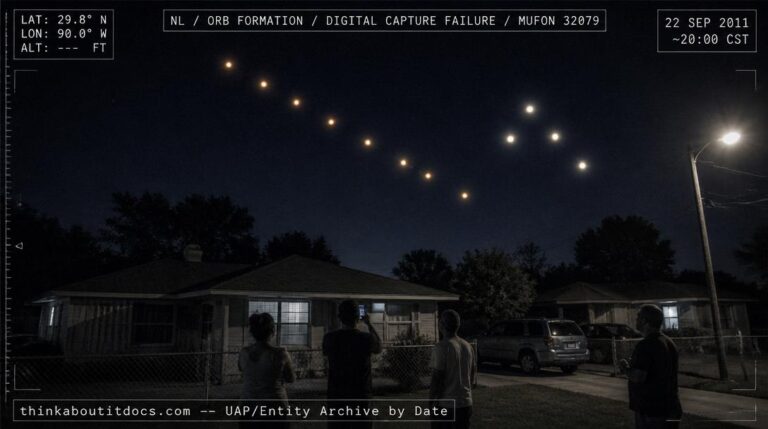
Related Cases: 1967: Baton Rouge — Old River Photographic Encounters | 2011: Louisiana Orb Formation
Detailed Report
The 2003 Gulf of Mexico sighting is a compact but analytically valuable Daylight Disc encounter distinguished by its airborne observation platform, the technical background of the witness, and the capture of photographic evidence.
The witness, identified only as J.S. and described as a 45-year-old engineer based in Cancún, was a passenger on a commercial flight approaching New Orleans. At 2:42 p.m. on August 4, 2003, while observing cloud formations through the airplane window — a habitual activity — he noticed a large object moving alongside the aircraft at nearly the same speed.
The object was silver and metallic, with ultra-white and red lights visible on or near its surface. Its shape was unusual: the witness described it as resembling a banjo — an elongated body with a wider circular section at one end. He estimated its length at 100 to 150 feet. Its distance from the aircraft ranged from an estimated 50 to 600 feet during the observation window.
The most technically interesting detail in the report is the witness’s description of the object’s surface behavior. He noted that it appeared to “vibrate or wave very fast” — a rapid oscillation or distortion effect visible across the surface of the craft. This description is consistent with several phenomena documented in other high-quality UAP reports: heat-shimmer effects from intense thermal emissions, atmospheric distortion caused by a localized electromagnetic or gravitational field, or a high-frequency mechanical vibration of the craft’s hull material. The effect was distinct enough for the engineer to note it specifically, suggesting it was not a simple artifact of viewing through an airplane window.
The witness raised his camera and captured a photograph. Almost immediately after the photograph was taken, the object accelerated upward and departed, vanishing from the visual field. Total direct observation time was approximately 10 to 15 seconds.
The pacing behavior — an unidentified object matching speed and course with a commercial aircraft before departing — is a well-documented pattern in aviation UFO encounters, with examples ranging from the 1986 Japan Air Lines Flight 1628 incident to the 2004 USS Nimitz encounters. Pacing suggests either deliberate observation of the aircraft by the UAP, use of the aircraft’s flight corridor as a navigation reference, or coincidental parallel trajectory — though the latter is statistically unlikely for a 10-to-15-second sustained match.
The witness did not formally report the sighting to aviation authorities and submitted the account to UFOEvidence.org, an online reporting database.
Researcher’s Notes
The Gulf of Mexico Pacing Event — Louisiana 2003 and the Vibrational Surface Problem
- Classification — DD Confirmed: As a daytime observation of a metallic object with defined shape and reflective surface, the DD (Daylight Disc) classification is correct. No physical effects on the aircraft, the witness, or the surrounding environment were reported, precluding CE-I or CE-II classification despite the relatively close proximity. The airborne observation platform and the object’s speed-matching behavior fall within the DD category as defined by Hynek.
- Source Chain Assessment — Anonymous Online Report with Photograph: The primary limitation of this case is its sourcing. The witness self-reported through UFOEvidence.org without providing a full name or professional credentials beyond the descriptor “engineer.” No formal aviation report was filed, and no civilian or military investigation is documented. However, the photograph provides a physical evidence component that most anonymous reports lack. The internal consistency of the report — a technical professional providing a precise time stamp (2:42 p.m.), a specific flight route (Cancún to New Orleans), a size estimate in feet, and a nuanced description of surface optical effects — is consistent with an engineering-trained observer rather than a casual or sensation-seeking reporter. The case occupies a middle tier in the credibility hierarchy: below named-witness and institutionally investigated events, but above unsubstantiated anonymous narratives.
- Surface Vibrational Effect — Propulsion Signature Hypothesis: The witness’s description of rapid vibrational or wave-like distortions across the object’s surface is the most analytically significant element of this report. This effect has been described in a small but growing number of high-quality UAP encounters, including military pilot observations from the 2004 Nimitz events and the 2014–2015 East Coast encounters documented in the U.S. Navy’s UAP Task Force reporting. Possible explanations include: (1) a localized atmospheric distortion field generated by the object’s propulsion system, bending light around the craft’s surface; (2) a high-frequency mechanical oscillation of the hull material as part of the propulsion mechanism; (3) a plasma sheath or ionization layer surrounding the craft, creating optical turbulence. All three explanations imply an active energy system operating at the surface level — consistent with the hypothesis that the effect is a propulsion signature rather than a passive surface characteristic.
- Pattern Context — Aviation Pacing Encounters: The Gulf of Mexico pacing event fits a documented pattern of UAP-aircraft interactions spanning decades and continents. The pacing behavior — matching speed and course with a commercial or military aircraft before departing abruptly — has been reported in cases ranging from the 1950s through the present day. The departure mode described here (upward acceleration and disappearance) is the most commonly reported exit behavior in pacing encounters, and its consistency across independent reports from different eras, witnesses, and geographic locations strengthens the case for a genuine, recurrent phenomenon rather than a series of independent misidentifications.
The Gulf of Mexico sighting of August 4, 2003, is a 15-second case that punches above its weight. An engineer with a trained eye for structural detail observed a 100-to-150-foot metallic object pacing his aircraft, noted a surface vibrational effect consistent with an active energy system, photographed it, and watched it depart vertically. The anonymous sourcing is a limitation that cannot be overlooked, but the photograph, the technical precision of the description, and the behavioral fit with the broader aviation pacing pattern give the case analytical value. The vibrational surface observation, in particular, places this report within a growing body of evidence suggesting that UAP propulsion systems produce visible atmospheric or optical distortion effects — a hypothesis with implications that extend well beyond a single photograph over the Gulf.
Media