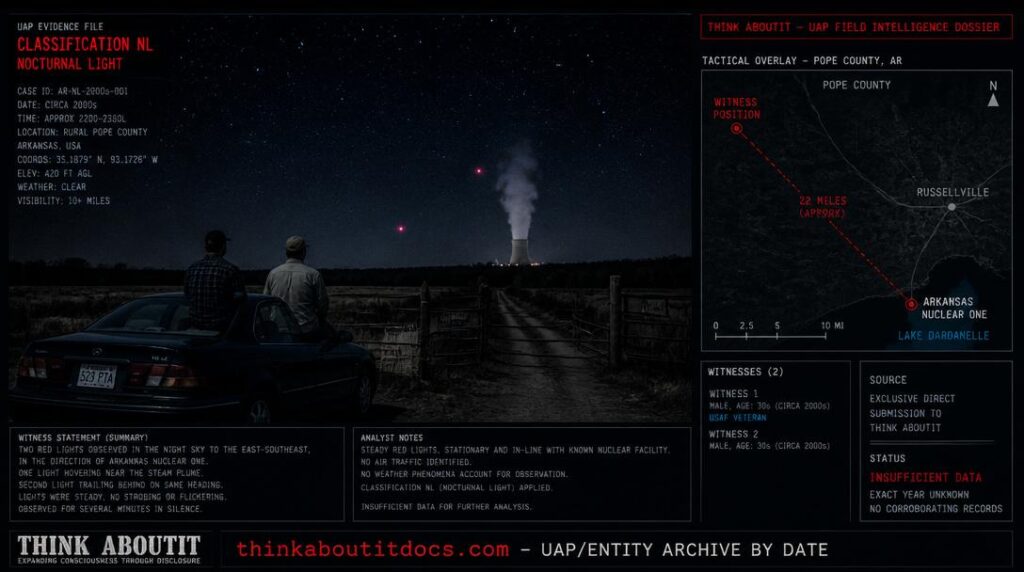
Rural Pope County, Arkansas, circa 2000s — Two steady red lights executed coordinated maneuvers near the Arkansas Nuclear One cooling tower plume, observed by a USAF veteran and friend.
THINK ABOUTIT UFO|UAP SIGHTING REPORT
200?: Russellville, Arkansas: UFOs Over Nuclear One Power Plant
A USAF veteran and his friend, lost on a dirt road somewhere in rural Pope County, Arkansas, spent the better part of an hour watching two red lights execute maneuvers that no conventional aircraft could survive. The lights appeared, paced each other, winked out independently, swapped positions at impossible speed, loitered near the steam plume of the Arkansas Nuclear One power plant cooling tower, and ultimately departed with an acceleration the veteran compared to watching a bullet leave a barrel. He never posted the account anywhere else — only here — and asked for no attention. He just wanted to know if anyone else had seen what he saw.
Date: 200? (exact year unknown; 2000s decade, fall season)
Sighting Time: 10:00 PM – 11:00 PM
Day/Night: Night
Location: Rural Pope County, Arkansas, within view of Arkansas Nuclear One power plant, Russellville
Urban or Rural: Rural
No. of Entity(‘s): None reported
Entity Type: N/A
Entity Description: N/A
Hynek Classification: NL (Nocturnal Light) — Point or extended luminous source observed at night.
Duration: Approximately one hour
No. of Object(s): 2
Description of the Object(s): Two steady, non-fluctuating red point-source lights observed at approximately 22–25 miles distance. No structural detail discernible. Objects demonstrated coordinated behavior: pacing, independent vanishing and reappearing, instantaneous position-swapping, loitering near cooling tower steam, and synchronized departure flash.
Size of Object(s): Not determinable (point-source lights at distance)
Distance to Object(s): Estimated 22–25 miles (near the Nuclear One facility)
Shape of Object(s): Not determinable (observed as lights only)
Color of Object(s): Steady red
Height & Speed: Not determinable at distance. Speed ranged from stationary hover to instantaneous acceleration described by the USAF veteran witness as comparable to “watching a bullet leave the barrel of a gun.”
Number of Witnesses: 2
Special Features/Characteristics: Instantaneous acceleration from dead hover; extreme angular course changes; one light vanishing and the other instantly occupying its position; loitering near nuclear power plant cooling tower steam plume; coordinated behavior between two objects; simultaneous subtle flash before final departure
Source: Reported directly to Think AboutIt (exclusive; not posted elsewhere per witness statement)
Case Status: Insufficient Data
Summary/Description: On a clear fall night during the 2000s decade, a U.S. Air Force veteran and a friend observed two steady red lights from a rural location in Pope County, Arkansas. The lights executed coordinated maneuvers — pacing, independent vanishing, instantaneous position-swapping, and loitering near the steam plume of the Arkansas Nuclear One power plant cooling tower approximately 22–25 miles away. One light departed at extreme velocity with radical angular course changes. Both lights subsequently reappeared in their original positions, produced a synchronized subtle flash, and vanished simultaneously. The veteran, who had extensive experience with military and civilian aircraft, stated the maneuvers involved speed and angular changes that would be fatal to any human pilot. The account was submitted exclusively to Think AboutIt and has not been posted elsewhere.
Related Cases: Arkansas Sightings Archive
Detailed Report
The primary witness, a U.S. Air Force veteran, and a friend were driving on unpaved rural roads in Pope County, Arkansas and had become lost. They stopped at a farm entrance to take a restroom break. On a clear fall night with excellent star visibility and identifiable commercial airline traffic en route to Little Rock, the friend noticed a red light in the sky. The veteran initially dismissed it as a conventional aircraft anti-collision light.
Upon closer observation, the light stopped in mid-course and then resumed its heading — behavior inconsistent with any conventional aircraft. The two men sat on the hood of the veteran’s car and watched the light for approximately ten minutes. A second red light then appeared at a significant distance behind the first. Both lights maintained steady luminosity (no fluctuation, no strobing) and traveled on a common heading for approximately ten minutes.
One light then extinguished completely. The second light appeared to accelerate instantaneously and occupy the exact position where the first light had last been observed. The friend identified the steam plume from the cooling tower of the Arkansas Nuclear One power plant in Russellville, approximately 22–25 miles away. The remaining light loitered near the steam plume for approximately five minutes, then transitioned from a dead hover to a diagonal upward trajectory at a speed the veteran described as comparable to watching a bullet leave a gun barrel. The angular course changes were described as physically impossible for any piloted aircraft due to the G-forces involved.
After the second light departed, both witnesses remained silent for some time. Then the first light reappeared in its original position, and the second light returned to its original trailing distance. Both lights produced a subtle synchronized flash — the first fluctuation observed during the entire hour — and then both vanished simultaneously. The witnesses remained at the location for another thirty minutes. The lights did not return.
Researcher’s Notes
“Red Lights and the Reactor”
- Source Assessment: The witness explicitly states this account was not posted anywhere else on the internet and that he does not wish to be identified publicly. The report was submitted directly to Think AboutIt as a private, exclusive account. No exact year is provided — only “200?” — which places it somewhere in the 2000s decade during fall. This imprecision makes cross-referencing with any NRC (Nuclear Regulatory Commission) incident reports, FAA records, or other sighting databases effectively impossible.
- Witness Credibility Indicators: The witness identifies himself as a USAF veteran with experience observing varied military and civilian aircraft. His initial reaction — dismissing the first light as a standard aircraft anti-collision beacon — is consistent with that background. The account is detailed, internally consistent, and delivered without embellishment or interpretive claims. The witness does not speculate about origins or nature, and explicitly requests feedback rather than attention.
- Nuclear Facility Proximity: Arkansas Nuclear One, located on the shore of Lake Dardanelle near Russellville, is the only nuclear power plant in Arkansas. It operates two pressurized water reactor units. The UAP-nuclear correlation is one of the most persistent patterns in the UAP literature, documented extensively by researcher Robert Hastings in his survey of UAP incidents at nuclear weapons storage facilities, ICBM sites, and nuclear power plants. The described loitering near the cooling tower steam plume fits this pattern, though the observation distance (22–25 miles) means the precise proximity of the lights to the facility itself is uncertain.
- Behavioral Description: The described maneuvers — instantaneous acceleration from hover, extreme angular direction changes, coordinated behavior between two objects operating at distance, and simultaneous departure — are consistent with the “five observables” framework used in contemporary UAP analysis: instantaneous acceleration, hypersonic velocity, low observability, trans-medium travel, and positive lift without apparent propulsion. This case involves the first three of those five.
- Classification Rationale: NL (Nocturnal Light) is the correct Hynek classification. The objects were observed at approximately 22–25 miles distance as point-source red lights without discernible structure. Case Status is Insufficient Data due to anonymous submission, absent precise date, and no corroborating records.
This is a clean, restrained report from a witness with relevant observational training — a USAF veteran who initially dismissed the first light as a routine aircraft beacon and only reconsidered when it stopped in mid-flight. The behavioral description is detailed and internally consistent, and the witness’s refusal to speculate about origins or seek attention suggests genuine uncertainty rather than agenda. The nuclear facility proximity places this account in a well-documented pattern, but the anonymous submission and absent date make it impossible to cross-reference against NRC security logs, FAA radar records, or contemporary sighting databases. It reads credibly, but credibility without corroboration is not evidence. Status remains Insufficient Data.