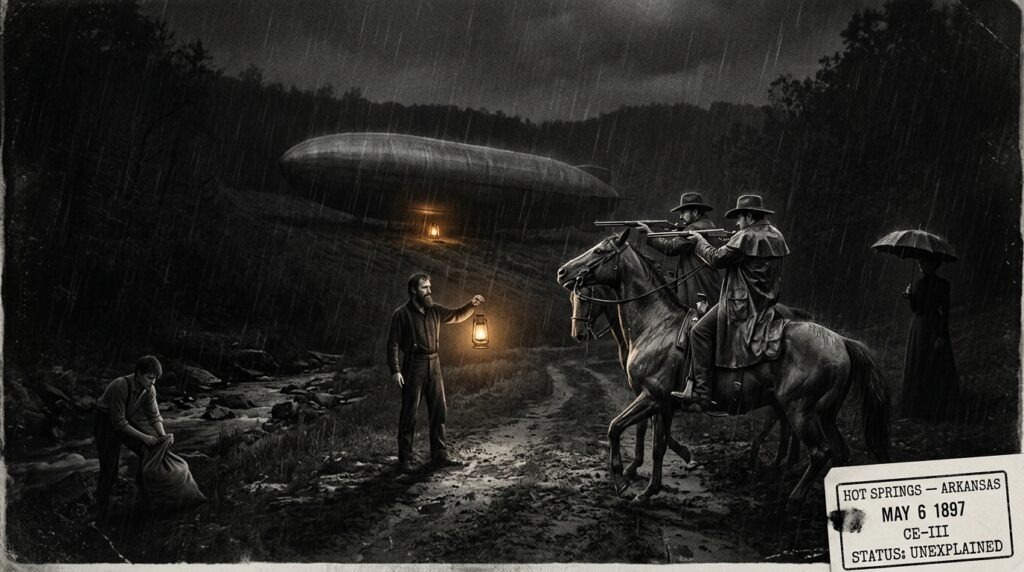
Hot Springs, Arkansas, May 6, 1897 — Constable Sumpter and Deputy Sheriff McLemore drew their Winchesters on a landed cigar-shaped airship crew in the rain-soaked hill country. The bearded captain explained the ship and invited them aboard. They declined. Source: Jacques Vallee, Passport to Magonia, pp. 142–143, 1969. Case status: Unexplained.
THINK ABOUTIT UFO|UAP|ENTITY ENCOUNTER REPORT
1897: Hot Springs, Arkansas Sighting
On a dark rainy night in May 1897, Constable Sumpter and Deputy Sheriff McLemore were riding the hills northwest of Hot Springs, Arkansas — armed, on official business, looking for fugitives — when their horses locked up and refused to move another step. A hundred yards ahead two figures moved around with lights. The lawmen drew their Winchesters and demanded to know who was there. A man with a long dark beard stepped out of the dark carrying a lantern and told them, without apparent concern for the loaded rifles pointed at him, that he and his companions were travelling through the country in an airship. Sixty feet of cigar-shaped craft sat in the Arkansas hills behind him. A young man was filling a large sack with water thirty yards away. A woman stayed back in the dark, holding an umbrella over her head, and never let herself be seen clearly. The bearded man invited the constables aboard. He mentioned he had wanted to stop in Hot Springs for the baths but his schedule would not allow it. He said they were headed to Nashville. Forty minutes later when the lawmen rode back through, there was nothing there.
Date: May 6, 1897
Sighting Time: Night — exact hour not recorded
Day/Night: Night
Location: Hills northwest of Hot Springs, Garland County, Arkansas, USA
Urban or Rural: Rural — wooded hill country northwest of the city
No. of Entity(‘s): 3
Entity Type: Humanoid — human in appearance; self-described as aerial travellers
Entity Description: Three individuals associated with the craft. (1) A man with a long dark beard, carrying a lantern; served as spokesman; invited witnesses aboard; described the ship’s power system; discussed his travel itinerary casually; showed no alarm at being confronted by armed law enforcement officers. (2) A young man, approximately thirty yards from the craft, filling a large sack with water at the time of the encounter — implies the craft required water for operation. (3) A woman who remained deliberately in the shadows throughout the encounter, holding an umbrella over her head in the rain; was particular to keep back in the dark and was never clearly observed by either witness. All three were human in general appearance. None displayed concern, aggression, or urgency at being confronted by armed officers.
Hynek Classification: CE-III (Close Encounter III) — close observation with animate beings associated with a landed object; extended verbal interaction; witnesses approached to within approximately one hundred yards; invitation to board the craft extended
Duration: Approximately forty minutes from first approach to departure — the witnesses left the scene and returned forty minutes later to find the craft and crew gone; individual interaction duration not recorded
No. of Object(s): 1
Description of the Object(s): Cigar-shaped vessel approximately sixty feet in length, resting on the ground in the Arkansas hills; described by witness as looking just like the cuts that have appeared in the papers recently — a reference to the widely circulated 1897 Mystery Airship Wave newspaper illustrations; a brilliant light on the craft had been observed from a distance, described as consuming a great deal of motive power when operated at full intensity; the operator stated the motive power was electrical in nature
Shape of Object(s): Cigar
Size of Object(s): Approximately sixty feet in length
Color of Object(s): Not recorded — dark conditions, raining
Distance to Object(s): Approximately one hundred yards at closest witness approach on foot; witnesses did not board
Height & Speed: Ground level at time of encounter; departed within forty minutes of the witnesses leaving; no departure was heard or seen on return
Number of Witnesses: 2 — Constable Sumpter and Deputy Sheriff McLemore, Hot Springs, Arkansas; both named law enforcement officers on official duty at time of encounter
Special Features/Characteristics: Witnesses’ horses refused to advance approximately one hundred yards from the craft — animal paralysis or refusal behavior consistent with multiple other 1897 wave accounts and broader close encounter cases; crew showed no alarm at confrontation by armed law enforcement; water collection by the young man implies operational requirement for water — consistent with the Josserand, Texas account of the same wave; the woman’s deliberate concealment in shadow is one of the most analytically specific behavioral details in the entire 1897 wave record; operator mentioned a desire to stop in Hot Springs for the thermal baths but stated his schedule was limited — a casual, socially normal conversational detail inconsistent with a fabrication designed to impress; crew stated destination as Nashville, Tennessee; craft departed silently and invisibly within forty minutes with no audible or visible sign of departure
Case Status: Unexplained
Source: Passport to Magonia by Jacques Vallee, pp. 142–143, 1969
Summary/Description: On the night of May 6th, 1897, two named Arkansas law enforcement officers — Constable Sumpter and Deputy Sheriff McLemore — encountered a landed sixty-foot cigar-shaped craft in the hills northwest of Hot Springs. Their horses refused to advance approximately one hundred yards from the object. Three crew members were present: a bearded man who served as spokesman, a young man collecting water in a large sack, and a woman who remained deliberately concealed in shadow. The bearded man engaged the armed officers in casual conversation, explained the craft’s electrical motive power, declined their curiosity about the powerful light, stated a desire to visit Hot Springs for the thermal baths but said his schedule did not permit it, and indicated the craft was destined for Nashville, Tennessee. The officers declined an invitation to board. Forty minutes later the craft and crew were gone without sound or trace. Documented by Jacques Vallee in Passport to Magonia.
Related Cases: 1897: Josserand, Texas — Airship Crew Lands in Cornfield | 1897: Aurora, Texas Crash | 1896: Saw The Mystic Flying Light, Sacramento | 1896–1897 U.S. Mystery Airship Wave
Detailed Report
The Deputies Draw Their Winchesters — Hot Springs, Arkansas, May 6, 1897 Source: Passport to Magonia — Jacques Vallee, pp. 142–143, 1969 Testimony of Constable Sumpter and Deputy Sheriff McLemore, Hot Springs, Arkansas
While riding north-west from this city on the night of May 6, 1897, we noticed a brilliant light high in the heavens. Suddenly it disappeared and we said nothing about it, as we were looking for parties and did not want to make any noise. After riding four or five miles around through the hills we again saw the light, which now appeared to be much nearer the earth.
We stopped our horses and watched it coming down, until all at once it disappeared behind another hill. We rode on about half a mile further, when our horses refused to go further. About a hundred yards distant we saw two persons moving around with lights. Drawing our Winchesters — for we were now thoroughly aroused to the importance of the situation — we demanded: Who is that, and what are you doing?
A man with a long dark beard came forth with a lantern in his hand, and on being informed who we were proceeded to tell us that he and the others — a young man and a woman — were travelling through the country in an airship. We could plainly distinguish the outlines of the vessel, which was cigar-shaped and about sixty feet long, and looking just like the cuts that have appeared in the papers recently.
It was dark and raining and the young man was filling a big sack with water about thirty yards away, and the woman was particular to keep back in the dark. She was holding an umbrella over her head. The man with the whiskers invited us to take a ride,
saying that he could take us where it was not raining. We told him we believed we preferred to get wet.
Asking the man why the brilliant light was turned on and off so much, he replied that the light was so powerful that it consumed a great deal of his motive power. He said he would like to stop off in Hot Springs for a few days and take the hot baths, but his time was limited and he could not. He said they were going to wind up at Nashville, Tennessee, after thoroughly seeing the country.
Being in a hurry we left and upon our return, about forty minutes later, nothing was to be seen. We did not hear or see the airship when it departed.
RESEARCHER’S NOTES
The Deputies Draw Their Winchesters — Hot Springs 1897 and the Law Enforcement CE-III in the Mystery Airship Wave
- Named Law Enforcement Witnesses as Evidentiary Standard: Constable Sumpter and Deputy Sheriff McLemore are not anonymous witnesses. They are named, badged, sworn law enforcement officers of Hot Springs, Arkansas who submitted their account in their own names. In 1897 a constable and a deputy sheriff had everything to lose and nothing to gain by filing a public account of an encounter with an airship crew in the hills. Their professional reputations, their standing in the community, and their credibility as officers of the law were all on the line. They filed the account anyway. The witness credibility structure here is among the strongest in the entire 1897 wave — named, sworn, professional observers with strong social disincentives to fabricate.
- The Woman in the Dark — The Most Analytically Significant Detail: Of all the elements in the Hot Springs account the one that receives the least attention and deserves the most is the woman’s behavior. She did not simply stay back. She was particular to keep back in the dark. She held an umbrella over her head in the rain specifically to remain unseen. This is deliberate concealment by a crew member who was otherwise comfortable enough with the encounter to allow two armed law officers to approach the ship, converse at length, and examine the vessel’s outline. The bearded man was forthcoming. The young man went about his work. The woman specifically and actively avoided being seen. Whatever the reason — and the archive does not speculate — the behavior is operationally specific and has no natural innocent explanation that accounts for its deliberateness.
- The Water Request Pattern Across the 1897 Wave: The Hot Springs account is the second documented water request in the 1897 Mystery Airship Wave — the first being the Josserand, Texas case of the same month where two crew members approached Frank Nichols’s farmhouse well with buckets. In both cases the water collection is incidental to the main encounter, performed without drama, and described matter-of-factly by witnesses. A pattern of water collection across independent accounts in the same wave suggests either a genuine operational requirement of the propulsion or cooling system, a coordinated cover narrative rehearsed across multiple contacts, or a genuine commonality in what these craft needed. The archive notes the pattern without resolving it.
- Silent Departure as Operational Signature: The officers heard and saw nothing of the airship’s departure despite returning to the site within forty minutes. In 1897 every known method of atmospheric flight — balloon, steam engine, any proposed airship technology — produced noise, required preparation time, and left some evidence of launch. A sixty-foot cigar-shaped vessel carrying three people and sixty feet of structure departed from a rural Arkansas hillside in the rain, in darkness, in under forty minutes, in complete silence. The silent departure is not a minor detail. It is a fundamental incompatibility with every known 1897 propulsion technology and it is documented by two named law enforcement officers who were specifically trained to observe and report accurately.
Two Arkansas lawmen drew their Winchesters in a rainy hill country dark and found a sixty-foot ship and a crew of three who offered them a ride to somewhere dry. They declined, rode on, and came back to nothing — no ship, no crew, no sound, no mark. Jacques Vallee put it in Passport to Magonia in 1969. The archive puts it here. The Winchesters were holstered. The questions were not.