Josserand, Trinity County, Texas, April 1897 — Frank Nichols, a man of unquestioned veracity, was awakened near midnight by machinery sounds to find a brilliantly lit craft in his cornfield. The crew asked for water, invited him aboard, and briefed him on the ship's construction. Reported by the Houston Post, April 26th, 1897. Case status: Unexplained.
THINK ABOUTIT UFO|UAP|ENTITY ENCOUNTER REPORT
1897: Josserand Texas Encounter
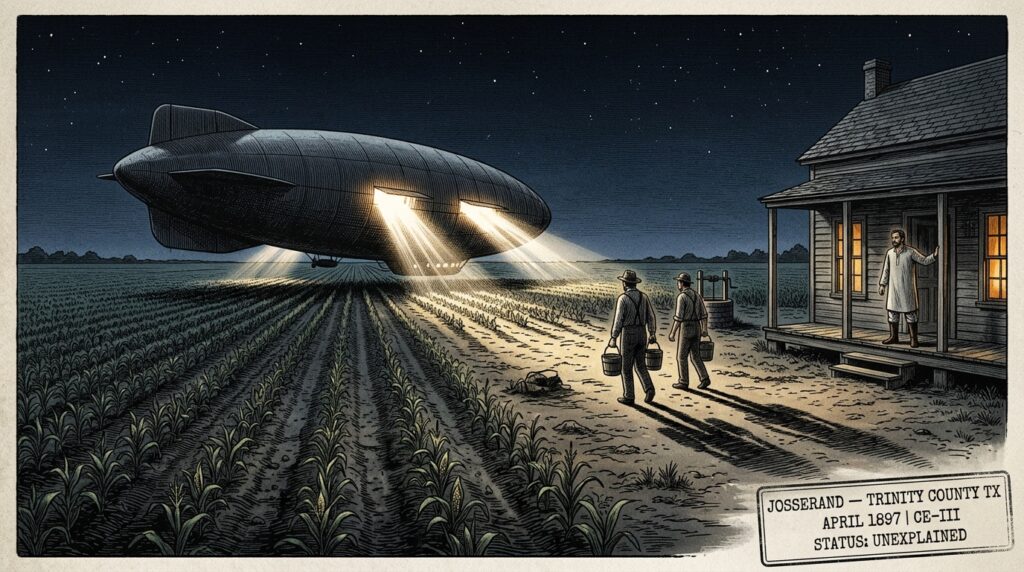
Near the hour of midnight on a spring night in 1897, Frank Nichols — a prominent farmer of unquestioned veracity in Trinity County, Texas — was awakened by a whirring sound like machinery running in his cornfield. When he looked out he saw brilliant lights streaming from a ponderous vessel of strange proportions resting on the ground among his crops. He did not run. He went out to investigate. Before he reached the ship two men with buckets intercepted him and asked permission to draw water from his well. He granted it. They invited him aboard. He went. The crew told him the problem of aerial navigation had been solved, that five such ships had been built in a small town in Iowa, and that the invention would soon be given to the public. The Houston Post reported it on April 26th, 1897. Frank Nichols told anyone who doubted him to come to Josserand and he would show them exactly where the ship had rested.
Date: April 1897 — published Houston Post April 26, 1897; event described as night before last
Sighting Time: Near the hour of twelve — midnight
Day/Night: Night
Location: Josserand, Trinity County, Texas, USA — approximately two miles east of the village center, cornfield on the farm of Frank Nichols
Urban or Rural: Rural
No. of Entity(‘s): Six or eight
Entity Type: Human in appearance — self-described as aerial navigators and crew of the vessel
Entity Description: Six to eight individuals encountered aboard and around the craft; two crew members approached the witness on the ground carrying buckets, requesting permission to draw water from his well; described as conversing freely and explaining the ship’s construction and origin; no physical description of height, build, or clothing recorded in the source beyond their human appearance and articulate manner
Hynek Classification: CE-III (Close Encounter III) — close observation with animate beings associated with a landed object; witness invited aboard and conversed at length with crew
Duration: Extended — long enough for the witness to walk from his house to the craft, be intercepted by crew, draw water, be invited aboard, tour the ship, and hold a substantial conversation about its construction and origin; exact time not recorded
No. of Object(s): 1
Description of the Object(s): A ponderous vessel of strange proportions resting on the ground; brilliant lights streaming from it; built of a newly discovered material described as having the property of self-sustenance in the air; motive power described by crew as highly condensed electricity; machinery of such complexity the witness could gain no knowledge of its workings in his short interview
Shape of Object(s): Vessel — elongated craft implied by airship wave context; exact shape not recorded in source
Size of Object(s): Strange proportions — described as ponderous; large enough to accommodate a crew of six to eight with room to move and show the witness around
Color of Object(s): Not recorded — brilliant lights streaming from the vessel noted
Distance to Object(s): Ground level — landed in cornfield; witness approached on foot and boarded
Height & Speed: Ground level at time of encounter; departed after the visit; no speed recorded
Number of Witnesses: 1 primary — Frank Nichols, farmer, Josserand, Trinity County, Texas; described by the Houston Post correspondent as a man of unquestioned veracity
Special Features/Characteristics: Crew members approached witness proactively on the ground before he reached the craft; requested water — suggesting the vessel required water for operation or cooling; witness invited aboard and given a verbal briefing on the craft’s construction and origin; crew claimed five such ships were built at a small town in Iowa; crew stated an immense stock company was being formed and the machines would be in general use within a year; witness offered to show any doubters the location where the ship rested — physical ground evidence implied; case is part of the documented 1897 Mystery Airship Wave across the United States
Case Status: Unexplained
Source: Houston Post — April 26, 1897
Summary/Description: Farmer Frank Nichols of Josserand, Trinity County, Texas was awakened near midnight by machinery sounds and observed a brilliantly lit craft of strange proportions resting in his cornfield. Two crew members intercepted him before he reached the craft and requested water from his well. He was then invited aboard, conversed with a crew of six to eight, and was briefed on the craft’s construction — a newly discovered self-sustaining material powered by highly condensed electricity — and its origin in a small Iowa town. The crew stated five such ships existed and that public disclosure and commercial availability were imminent. Nichols offered physical ground evidence at the landing site. Reported by the Houston Post on April 26th, 1897, as part of the broader national Mystery Airship Wave.
Related Cases: 1897: Aurora, Texas Crash | 1896: Saw The Mystic Flying Light, Sacramento | 1896: An Apparition Wandering Through The Atmosphere | 1891: UFO Crash in North Texas | 1896–1897 U.S. Mystery Airship Wave
Detailed Report
The Crew Came Down for Water — Josserand, Texas, April 1897 Houston Post — April 26, 1897
Considerable excitement prevails at this writing in this usually quiet village of Josserand, caused by a visit of the noted airship, which has been at so many points of late.
Mr. Frank Nichols, a prominent farmer living about two miles east of here, and a man of unquestioned veracity, was awakened night before last near the hour of twelve by a whirring noise similar to that made by machinery. Upon looking out he was startled to behold brilliant lights streaming from a ponderous vessel of strange proportions, which rested upon the ground in his cornfield.
Having read the dispatches published in the Post of the noted aerial navigators, the truth at once flashed over him that he was one of the fortunate ones and — with all the bravery of Priam at the siege of Troy — Mr. Nichols started out to investigate.
Before reaching the strange midnight visitor he was accosted by two men with buckets who asked permission to draw water from his well. Thinking he might be entertaining heavenly visitors instead of earthly mortals, permission was readily granted. Mr. Nichols was kindly invited to accompany them to the ship. He conversed freely with the crew, composed of six or eight individuals about the ship. The machinery was so complicated that in his short interview he could gain no knowledge of its workings.
However, one of the crew told him the problem of aerial navigation had been solved. The ship or car is built of a newly discovered material that has the property of self-sustenance in the air, and the motive power is highly condensed electricity. He was informed that five of these ships were built at a small town in Iowa. Soon the invention will be given to the public. An immense stock company is now being formed and within the next year the machines will be in general use.
Mr. Nichols lives at Josserand, Trinity County, Texas, and will convince any incredulous one by showing the place where the ship rested.
RESEARCHER’S NOTES
The Crew Came Down for Water — Josserand 1897 and the Close Contact Dimension of the Mystery Airship Wave
- Why the Water Request Is the Most Significant Detail: Of all the elements in this account the request for water is the one that most resists conventional explanation. A hoax or newspaper fabrication of the era would naturally emphasize the dramatic — the lights, the ship, the crew’s grand claims about Iowa factories and stock companies. The detail of two men with buckets walking to a farmhouse well at midnight is prosaic, operationally specific, and not the kind of flourish a fabricator reaches for. It implies the craft required water — for cooling, for ballast, for a propulsion process — and that the crew was comfortable enough in the situation to approach a stranger’s property and ask for it by name.
- Crew Claims in Context of the 1897 Wave: The crew’s stated explanation — five ships built in Iowa, condensed electricity as motive power, imminent public disclosure via stock company — exactly mirrors the cover story circulating through multiple 1897 airship wave accounts across the central United States. The same Iowa origin, the same electricity narrative, the same imminent commercialization appear in other documented cases of the wave. Whether this represents a coordinated deception by human inventors, a rehearsed script by non-human intelligences adopting period-plausible cover, or genuine information about a suppressed technological program has not been determined. The consistency across unconnected accounts is the data point the archive flags.
- Frank Nichols as Witness — Credibility Structure: The Houston Post correspondent took deliberate care to establish Nichols’s standing before publishing — prominent farmer, man of unquestioned veracity, willing to show doubters the physical landing site. This is not boilerplate. In 1897 newspaper reporting, a correspondent who vouched for a witness’s character was putting his own professional credibility behind the account. Nichols additionally offered physical corroboration — the ground impression in his cornfield — which no follow-up investigation is recorded as having examined. The offer stands in the record unchallenged.
- Position Within the 1897 Wave: The Josserand account was published April 26th, 1897 — the same month as the Aurora, Texas crash report and part of the densest cluster of the national Mystery Airship Wave. Unlike many wave accounts which describe lights at a distance, the Josserand case is a full CE-III: landed craft, crew contact, boarding, extended conversation, and physical ground evidence. It is one of the most operationally detailed close contact accounts of the entire 1897 wave and sits in the archive alongside Aurora as a Texas cornerstone of that record.
Frank Nichols went back to bed after the ship left his cornfield and the crew departed with their water. The Houston Post printed his account four days later. The stock company was never formed. The Iowa factory was never identified. The five ships were never publicly disclosed. What landed in his cornfield near midnight and what the men with the buckets actually needed the water for — that remains, one hundred and twenty-eight years later, an open question in the record.