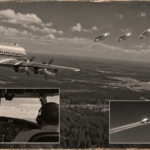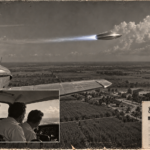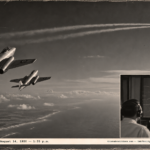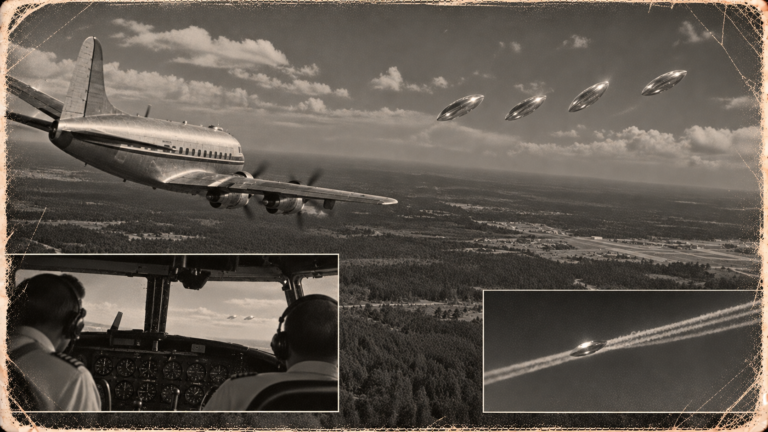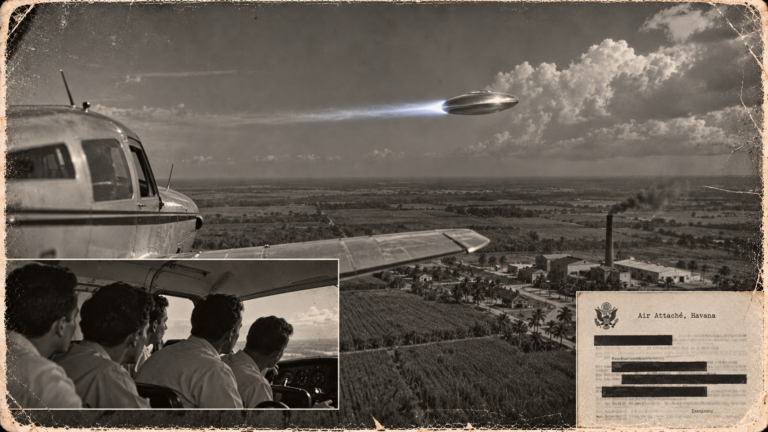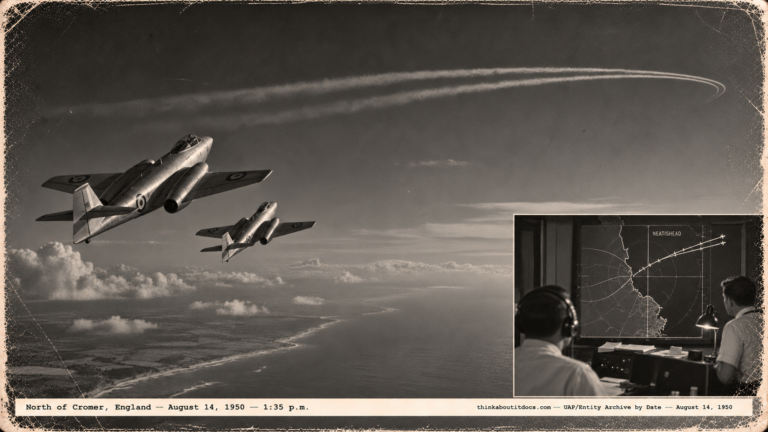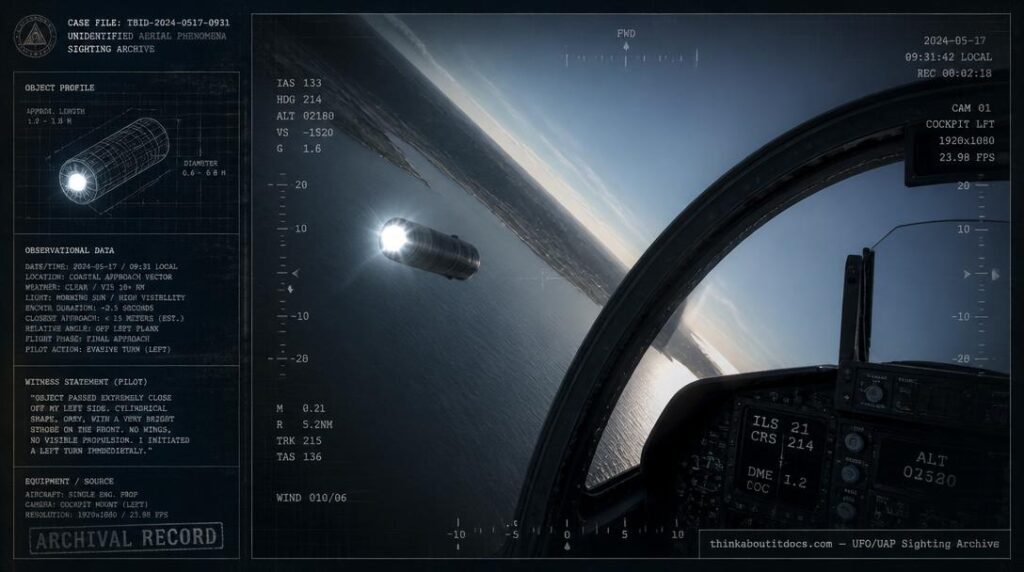
A De Havilland DHC-8 narrowly avoided collision with an unidentified cylindrical object on approach to Perth Airport, March 19, 2014.
THINK ABOUTIT UFO SIGHTING REPORT
The 2014 Perth Airport Near-Collision:
An ATSB-Investigated UFO/Drone Incident
On approach to Perth Airport on the morning of March 19, 2014, the crew of a De Havilland DHC-8 saw a bright strobe light appear directly ahead of their aircraft — and realized, with seconds to react, that it was tracking toward them. The pilot threw the aircraft into an evasive turn. The object, cylindrical and grey, passed within about 20 metres horizontally and 100 feet vertically of the plane — a genuine near mid-air collision, formally investigated by the Australian Transport Safety Bureau (ATSB), which was unable to identify the object or locate any operator responsible for it.
Date: March 19, 2014
Sighting Time: Approximately 0913 Western Standard Time (9:13 a.m.)
Day/Night: Day — corrected from the source material’s original “Night,” which contradicts the officially reported 9:13 a.m. time
Location: In-flight, approximately 23 km north-northeast of Perth Airport, Western Australia, Australia; aircraft was on approach from Kambalda, WA
Urban or Rural: In air, over controlled airspace
No. of Entity(‘s): None documented
Entity Type: None documented
Entity Description: None documented
Hynek Classification: CE-I (Close Encounter I) — corrected from the source material’s original NL. At approximately 20 metres horizontal and 100 feet vertical separation, this is an extremely close-range encounter with directly observed structural detail (shape and color), far exceeding the CE-I proximity threshold
Duration: Not documented precisely; a brief encounter consistent with the seconds available for evasive action during final approach
No. of Object(s): 1
Description of the Object(s): First observed as a bright strobe light directly ahead of the aircraft, which appeared to track toward it; the pilot subsequently reported the object itself was cylindrical in shape and grey in color
Shape of Object(s): Cylindrical
Size of Object(s): Not documented
Color of Object(s): Grey
Distance to Object(s): Passed approximately 20 metres horizontally and 100 feet vertically from the aircraft at closest approach
Height & Speed: Aircraft was at approximately 3,800 feet AMSL when the light was first sighted, and at approximately 3,700 feet AMSL at the time of closest approach; the airspace below 3,500 feet AMSL in this location was military restricted airspace, meaning the object was operating just above that restricted zone, within controlled civil airspace
Number of Witnesses: Flight crew of the De Havilland DHC-8 (registration VH-XFX); the ATSB report refers to the witnesses collectively as “the crew” without specifying an exact number beyond the aircraft’s standard flight crew complement
Special Features/Characteristics: The crew initially suspected the object might be an unmanned aerial vehicle (UAV) given its behavior and appearance; the pilot took evasive action, turning west to avoid collision; the aircraft’s Traffic Collision Avoidance System (TCAS) did not generate an alert for the object, consistent with an object lacking a transponder, as most recreational or unauthorized drones would; the Australian Defence Force confirmed it was not operating any UAVs in the area and had no awareness of any UAV activity there at the time; the ATSB was unable to confirm the object’s specific identity or locate any responsible operator
Case Status: Unresolved (probable UAV incursion, officially unconfirmed) — formally investigated by the Australian Transport Safety Bureau, which was unable to identify the object or any operator, but whose broader framing situates the incident within the context of growing aviation safety risk from unauthorized recreational drone operations, rather than as an anomalous or unexplained phenomenon
Source: Australian Transport Safety Bureau (ATSB), Investigation Report AO-2014-052
Summary/Description: On March 19, 2014, the crew of a De Havilland DHC-8 on approach to Perth Airport reported a near mid-air collision with an unidentified cylindrical, grey object, initially seen as a bright strobe light tracking toward the aircraft. Evasive action brought the object to within approximately 20 metres horizontally and 100 feet vertically of the plane. The ATSB investigated the incident, ruling out Australian Defence Force UAV activity but unable to identify the object or any responsible operator, framing the case within the broader safety risk posed by unauthorized drone operations near controlled airspace.
Related Cases: None documented
Detailed Report
On March 19, 2014, at approximately 0913 Western Standard Time, a De Havilland DHC-8 aircraft, registration VH-XFX, was on approach to Perth Airport, Western Australia, having departed from Kambalda. Approximately 23 kilometres north-northeast of Perth, at about 3,800 feet above mean sea level, the crew sighted a bright strobe light directly ahead of the aircraft.
The light appeared to track toward the aircraft, and the crew came to suspect it was mounted on an unidentified object, possibly an unmanned aerial vehicle. The pilot took evasive action, turning the aircraft west to avoid a collision. The object passed approximately 20 metres horizontally and 100 feet vertically from the aircraft — an extremely close margin for two objects in controlled airspace.
The pilot reported the object as cylindrical in shape and grey in color, observed at approximately 3,700 feet above mean sea level, within controlled airspace. The aircraft’s Traffic Collision Avoidance System did not register any alert for the object. The airspace below 3,500 feet AMSL in that location was designated military restricted airspace, placing the object’s altitude just above that restricted zone.
The ATSB’s investigation confirmed with the Australian Defence Force that it was not operating any UAVs in the area and had no knowledge of any UAV activity there at the time of the incident. Despite this, the investigation was unable to confirm the specific details of the object or identify any UAV operator who might have been responsible. The ATSB’s report specifically noted that UAVs are increasingly accessible to recreational operators, and that their use outside of applicable regulations may pose a significant risk to aviation safety — framing this incident as an example of that broader, documented concern rather than as an unexplained aerial phenomenon.
Researcher’s Notes
The Perth Airport Near-Collision — 2014 and a Genuine Government Safety Investigation
- This is a CE-I case, not NL, and the daytime timing is a clear factual correction. A near-collision at 20 metres horizontal and 100 feet vertical separation is about as close-range an encounter as exists in this archive, and it occurred at 9:13 in the morning — broad daylight — not at night as originally recorded.
- This case differs from most others in this archive in one important respect: it comes from a real national transportation safety investigation, not a UFO research organization. The Australian Transport Safety Bureau is a government body responsible for investigating aviation, marine, and rail safety incidents, and its report carries the weight of an official aircraft registration number, a formal investigation reference (AO-2014-052), and a specific, safety-oriented conclusion.
- The ATSB’s own framing treats this as a probable drone incursion, not an anomalous phenomenon, and this page follows that lead. The report’s closing language about UAV accessibility to recreational operators and the safety risk of unregulated drone use makes clear the investigating body’s working assumption — even though it could not confirm the object’s specific identity or find a responsible operator.
- The absence of a TCAS alert is a specific, technically meaningful detail supporting the drone hypothesis. TCAS relies on transponder signals from other aircraft; a consumer or unauthorized drone would typically lack a transponder entirely, explaining why the system gave no warning despite the object’s proximity.
- The Australian Defence Force’s explicit denial of any UAV operations in the area is a genuine, checkable negative result, not an evasion. Ruling out the most likely authorized source (military UAV activity) while still being unable to identify the object leaves a real, if probably mundane, mystery: an unauthorized drone operating in controlled airspace near a major international airport, whose operator was never identified.
The Perth Airport near-collision stands apart from most cases in this archive as a formally documented aviation safety incident, investigated by a national government body with the specific tools and authority to rule out military involvement — leaving behind not a case of the unexplained in the traditional sense, but an unresolved, likely drone-related near-miss that highlights a real and growing risk to commercial aviation.
“The object passed about 20 m horizontally and 100 ft vertically from the aircraft.”
— Australian Transport Safety Bureau, Investigation Report AO-2014-052