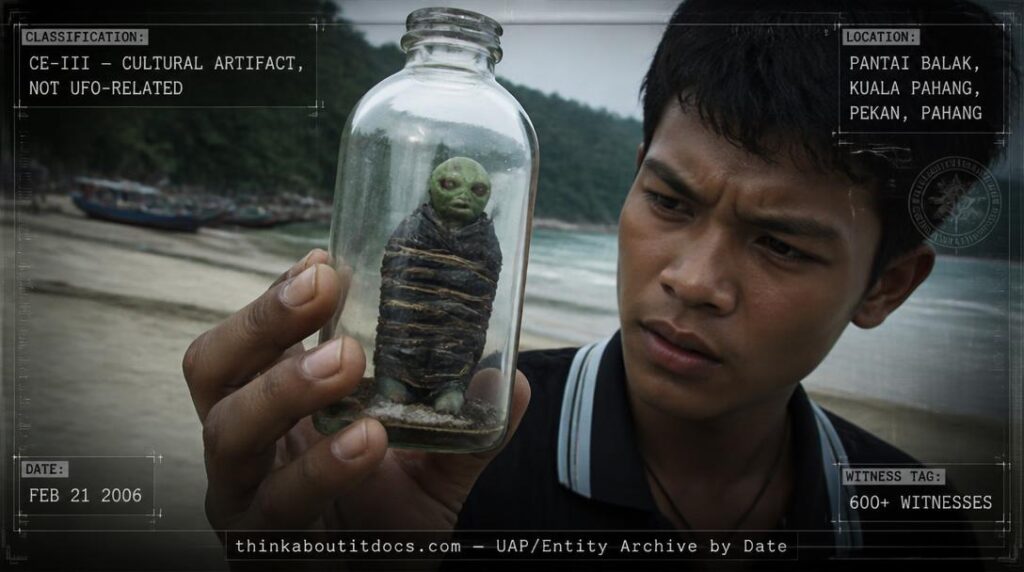
Recreation of the February 2006 Kuala Pahang discovery, in which a fisherman found a bottled, 15-centimeter greenish figure locally identified as a "toyol," later displayed at the Pahang State Museum before being returned to the sea.
THINK ABOUTIT ENTITY ENCOUNTER REPORT
2006: The Bottled “Toyol” of Kuala Pahang, Pahang, Malaysia
In February 2006, a 22-year-old fisherman on a beach in Kuala Pahang, Pekan district, shook a small bottle he’d found washed ashore and discovered a motionless, 15-centimeter, greenish, red-eyed figure inside, wrapped in black cloth and bound with string — a find that drew thousands to the Pahang State Museum over the following days before it was quietly returned to the sea, at local insistence, as a “toyol,” a figure from Malay folk belief rather than anything extraterrestrial.
This case sits outside the standard alien/UFO framework that most of this archive covers — there is no craft, no space-alien framing, and no claim of extraterrestrial origin anywhere in the original reporting. It is preserved here as a documented Malaysian high-strangeness/cultural-artifact case, consistent with similar non-alien entity entries elsewhere on this site, not as a UFO encounter.
Date: February 21, 2006 (date of discovery). Corrected from the original field’s February 20 — contemporaneous Malaysian press (The Star) dates the find to February 21.
Sighting Time: Undocumented
Day/Night: Day
Location: Pantai Balak beach, Kampung Kuala Pahang, Pekan district, Pahang, Malaysia; later displayed at the Pahang State Museum (Muzium Negeri Pahang) in Kuantan
Urban or Rural: Rural — a coastal fishing village beach, with the object later moved to an urban museum setting for public display
No. of Entity(‘s): 1
Entity Type: Described locally as a “toyol” — a figure from Malay folk belief, generally described as a small, mischievous child-spirit associated with theft, traditionally said to be invoked by a bomoh (traditional healer/shaman) through folk-magic ritual
Entity Description: About 15 centimeters in height, roughly the size of an adult fist. The figure was greenish in color with a pair of red eyes and did not move. It was wrapped in black cloth and bound with string (described as white in this site’s original filing; other contemporaneous sources describe the string as yellow — see Researcher’s Notes). The bottle also reportedly contained sand and onion slices, per other contemporaneous accounts not included in the original filing here.
Hynek Classification: CE-III (Close Encounter III) as originally filed. This does not fit standard Hynek usage at all — there is no craft, no aerial phenomenon, and no claim of extraterrestrial origin in any source for this case. It is retained only for archive-category consistency with other non-alien “entity” cases on this site; see Researcher’s Notes.
Duration: Undocumented for the initial discovery. The object remained in public possession from discovery until it was returned to the sea approximately five days later (see Special Features/Characteristics) — considerably longer than the “less than 24 hours” stated in the original filing.
No. of Object(s): Not Applicable in the UFO sense — the “object” in this case is the bottle and its contents, not a craft
Height & Speed: Not Applicable
Size of Object(s): Not Applicable to a craft. The containing bottle is described in other contemporaneous sources as roughly a 980-gram drink-powder bottle; the figure itself was about 15 cm tall.
Distance to Object(s): Not Applicable — the bottle was recovered directly by hand
Color of Object(s): Not Applicable to a craft; the figure itself was greenish with red eyes, as described above
Number of Witnesses: Over 600 people, per this site’s original figure; other contemporaneous Malay-language press accounts describe the museum crowd as being in the thousands, drawn from multiple surrounding districts
Special Features/Characteristics: A local elderly man who opened the bottle claimed the figure inside was still alive, though this was never verified by any medical or scientific authority. The fisherman took the find to a police station and was advised to hand it to the Pahang State Museum, which he did the same night. The museum publicly displayed the figure for several days, drawing large crowds, before it was returned to the sea around February 26, 2006 — roughly five days after discovery, not “less than 24 hours” as stated in the original filing — reportedly at the direction of a bomoh (traditional healer) consulted due to local superstitious concerns about keeping such an object. Photography was restricted at the museum, though a news photographer managed one blurred photo through the bottle’s glass and the figure’s partial black-cloth wrapping.
Case Status: Insufficient Data — a well-publicized, multi-witness, press-documented event, but the physical object was returned to the sea before any scientific or medical examination could occur, and the “still alive” claim was never independently verified
Source: The Star (Malaysia), “Bomoh returns ‘toyol’ to sea,” February 26, 2006, and related contemporaneous Malaysian press coverage; original filing on this site had no source listed
Summary/Description: A fisherman, Ahmad Affandi (also given in other sources as Ahmad Affandi Abdul Rahim), 22, and a few friends found a small bottle by the beach. After shaking the bottle, he realized there was a small figure inside, measuring about 15 cm in height. The tiny figure, greenish in color with a pair of red eyes, did not move. It was wrapped in black cloth and tied with a white string. Ahmad Affandi took it to an elderly man, who then opened the bottle and claimed the being was still alive. The witness then took it to the police station but was advised to hand it to the museum. While at the museum, over 600 people had a look at the strange figure, but due to superstitious beliefs, it was thrown back into the sea within days. It is a common belief in Malaysia that such a creature carries bad spiritual effects and should not be kept.
The specimen was in the museum, so no one was allowed to photograph it directly. A news reporter did manage to take a photo, though it was not clear, due to reflection off the bottle’s glass and the figure being partially wrapped in black cloth.
Related Cases: Undocumented on this site, though this case is frequently discussed in Malaysian folklore sources alongside broader “toyol” belief traditions generally, rather than alongside this site’s other UFO/entity cases specifically
Detailed Report
This is one of the most publicly documented cases in this archive’s Malaysia coverage, precisely because it involved a physical object examined, however briefly, by hundreds or thousands of people and covered by national press — and one of the least “UFO-like,” since nothing about it involves a craft or an extraterrestrial claim. According to contemporaneous Malaysian press, a fisherman identified as Ahmad Affandi Abdul Rahim, 22, of Kampung Marhum, found a small bottle on Pantai Balak beach in Kuala Pahang, in the Pekan district of Pahang state, in late February 2006. Shaking it revealed a motionless, roughly 15-centimeter figure inside — greenish, red-eyed, wrapped in black cloth and bound with string, with sand and onion slices also reportedly inside the bottle per other contemporaneous accounts. Affandi brought the find to an elderly local man who opened the bottle and claimed the figure was still alive, though no medical or scientific professional is cited as having examined it. After the police directed him to the Pahang State Museum, the museum displayed the object publicly, drawing large crowds from Pekan and surrounding districts including Bera, Rompin, Kuantan, and Bentong. Photography was restricted, though one blurred press photograph survives. Within about five days, reportedly at the direction of a bomoh — a traditional Malay spiritual practitioner — consulted over local superstitious concerns about the risks of keeping such an object, the figure was returned to the sea, permanently foreclosing any opportunity for forensic or biological examination. Local and regional belief identifies the object as a “toyol,” a folkloric child-spirit figure in Malay tradition said to be created and controlled by a bomoh for petty theft or mischief — a well-established cultural category distinct from anything in UFO or alien-contact literature.
RESEARCHER’S NOTES
The Bottled Figure — Kuala Pahang 2006 and a Case Outside the UFO Framework
- Classification Assessment: CE-III is retained from the original filing but does not meaningfully apply — there is no UFO, no craft, and no claim of extraterrestrial origin anywhere in the sourcing for this case. This is fundamentally a Malay folk-belief/cultural-artifact case, not a close encounter in the Hynek sense, and its inclusion here reflects this archive’s broader coverage of anomalous “entity” reports rather than a genuine UFO classification match.
- Source Chain Assessment: This case is unusually well-documented by Malaysian standards — covered by The Star (a major national English-language paper) and multiple Malay-language outlets, with a named primary witness. The original filing on this site had no source listed at all; it has been corrected here with named press coverage. Two minor factual corrections were made: the discovery date (February 21, not February 20) and the object’s disposal timeline (roughly five days in public custody, not “less than 24 hours”), both based on dated contemporaneous press coverage.
- Evidentiary Weight: A physical object was recovered, publicly displayed, and photographed (albeit blurrily) by press — stronger physical presence than most cases in this archive. However, its disposal into the sea before any scientific or medical examination permanently forecloses forensic analysis. The claim that the figure was “still alive” rests entirely on one unqualified individual’s assertion and was never independently tested.
- Pattern and Comparative Context: Constructed or carved figurines representing folk-magic entities — analogous in kind to hoax “mermaid” or similar composite curiosities documented elsewhere in the world — are a well-established genre in Southeast Asian material folk culture, distinct from UFO or alien-encounter reports. The “toyol” belief specifically describes a child-spirit invoked by a bomoh through ritual, often from folklore involving a deceased fetus or stillborn child, and is a widely recognized figure in Malay, Indonesian, and broader Southeast Asian folk religion.
- Geographic and Historical Context: Kuala Pahang sits within the Pekan district of Pahang state, on Malaysia’s east coast. The case drew visitors from multiple neighboring districts to the Pahang State Museum in Kuantan, indicating substantial regional public interest at the time, consistent with “toyol” belief’s deep cultural roots in the area rather than being an isolated invention.
This case belongs to this archive as a record of genuine, well-documented Malaysian high strangeness — but it belongs there as a cultural and folkloric event, not a UFO encounter. A real object was found, displayed, photographed, and disposed of, all within days, driven by belief rather than by any claim of alien or extraterrestrial origin. With the object now permanently lost to the sea, its true nature — almost certainly a constructed folk-magic effigy consistent with established “toyol” tradition, though never scientifically confirmed as such — will likely never be resolved. The case stands as Insufficient Data.
“It is a common belief in Malaysia that such creature has bad spiritual effects and should not be kept.”