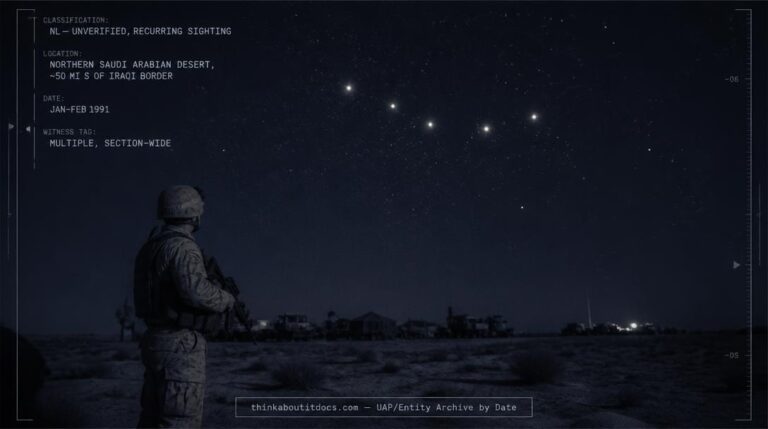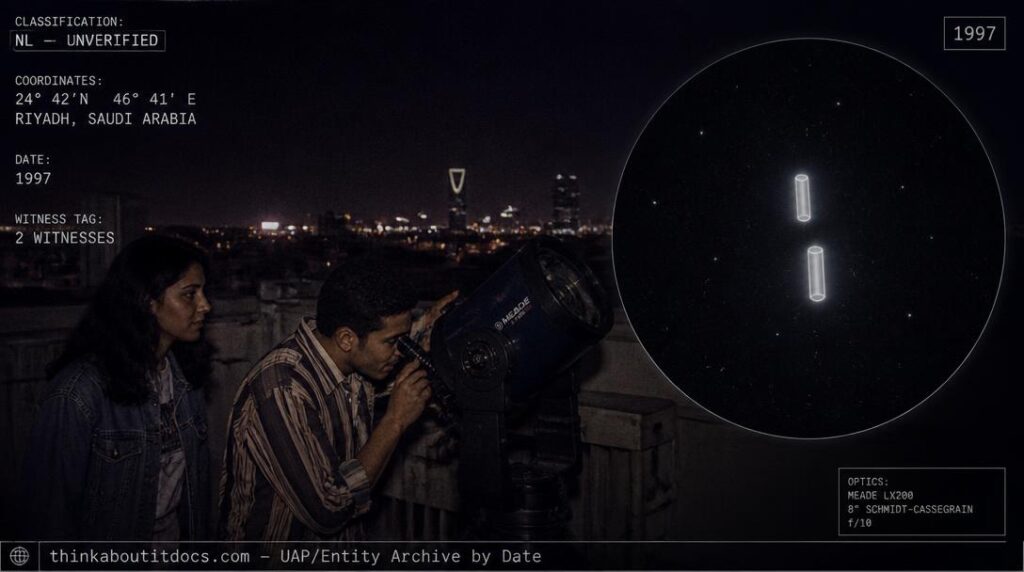
Recreation of the 1997 Riyadh sighting, in which two stacked, neon-white cylindrical objects were resolved only through an 8-inch Meade telescope.
THINK ABOUTIT UFO|UAP SIGHTINGS REPORT
1997: Riyadh UFO Sighting: Telescope-Resolved Cylinders Over Saudi Arabia
In 1997, a 21-year-old astronomy student on a Riyadh rooftop swung his 8-inch Meade telescope away from the moon and onto two neon-white cylinders, stacked one above the other, drifting slowly east at what he judged to be the edge of Earth’s atmosphere — objects that vanished the instant he pulled his eye from the eyepiece and looked at the naked sky.
This case is preserved as a single, uncorroborated witness submission. No independent verification, photographic record, or second source beyond the reporting family has been located.
Date: 1997
Sighting Time: 01:00 AM (as recorded in the original report field; witness narrative separately states roughly 8:00 PM — see Researcher’s Notes)
Day/Night: Nighttime
Location: Riyadh, Saudi Arabia
Urban or Rural: Urban — Riyadh residential area near an air base, close to the Rawda neighborhood; observation conducted from a rooftop
No. of Entity(‘s): Undocumented
Entity Type: Not Applicable — no entity described
Entity Description: Not Applicable
Hynek Classification: NL (Nocturnal Light) — point or extended luminous source observed at night
Duration: About three minutes
No. of Object(s): 2
Description of the Object(s): Two cigar-like objects, glowing entirely neon-white, stacked one atop the other with the lower object slightly ahead of the upper. No smoke trail, wings, or tail structures observed.
Shape of Object(s): Cigar/cylindrical
Size of Object(s): Undocumented
Color of Object(s): Neon-white
Distance to Object(s): Witness estimate only — “at the edge of Earth’s atmosphere”; no instrumented range was taken
Height & Speed: Undocumented — witness describes only “slowly moving,” no altitude or velocity figures given
Number of Witnesses: 2 (witness and his sister)
Special Features/Characteristics: Objects were resolvable only through an 8-inch telescope; invisible to the unaided eye when the witness looked directly at the sky during the sighting
Case Status: Insufficient Data — single-family report, no independent corroboration located
Source: Reported to Think AboutIt
Summary/Description: My name is ////// Al-////er. I was 21 years old at the time. I was studying at the Technical Institute of Electronics. I am an astronomy enthusiast, so I used to go out to the desert areas to observe the sky during the holidays, but during the school days I went up to the roof of the house for observations. One day in 1997, I don’t remember it exactly. At about the hour eight o’clock in the evening I was observing the moon with an 8-inch Meade telescope. My sister went up and asked to look at the moon with the help of the telescope, and when she looked at it, she was fascinated, and she was describing its surface to me. Then suddenly I stopped talking and assumed that the moon had moved away from the telescope’s field due to the rotation of the earth. Suddenly she said to me, come and look at the satellites, and when I looked through the telescope, I saw two bright cylinders on top of each other, slowly moving towards the east, and the lower was slightly ahead of the upper. So I turned away from the telescope and looked straight at the sky but I didn’t see anything, and when I looked again through the telescope I saw the cylindrical things moving slowly until they moved away. They were two bright cylinders that were all white, and my sister and I still remember that day.
Related Cases: Undocumented — no confirmed related case identified in the archive at this time
Detailed Report
The witness’s account is anchored by a detail that separates it from most nocturnal-light reports: the observation was made through an 8-inch Meade telescope rather than the unaided eye. He was a 21-year-old electronics student and self-described astronomy enthusiast, already engaged in routine lunar observation from his rooftop in a Riyadh residential district near a military air base, when his sister — looking through the same eyepiece — redirected his attention to what she described as “satellites.” Through the telescope, the witness resolved two cylindrical, neon-white objects stacked vertically, the lower object positioned slightly ahead of the upper, moving slowly toward the east. Critically, when he broke from the eyepiece to look at the sky directly, he could see nothing at all; only through the telescope’s magnification did the objects reappear, continuing their slow eastward drift for roughly three minutes before moving out of view. No smoke, wings, tail structures, or sound were reported. The account carries no photographic or instrumented distance/speed data — the “edge of the atmosphere” distance estimate and the object’s apparent slowness are the witness’s own visual judgment, not measured values. The report was submitted directly to Think AboutIt and has not been cross-referenced against any independent sighting log, military record, or contemporaneous news account from the Riyadh area in 1997.
RESEARCHER’S NOTES
The Telescope-Resolved Cylinders — Riyadh 1997 and the Limits of Naked-Eye Classification
- Classification Assessment: The case is filed as NL (Nocturnal Light) consistent with the objects’ luminous, unstructured presentation to the unaided eye. However, the witness resolved a specific cylindrical, stacked configuration only through telescopic magnification — a detail standard Hynek classification, built around naked-eye observation, doesn’t cleanly account for. The NL label is retained here as the best available fit, but the instrument-dependent nature of the shape resolution is a meaningful qualifier that should travel with the classification, not be dropped from it.
- Source Chain Assessment: This is a single, anonymized, decades-later family report submitted directly to Think AboutIt, with no independent witness, agency record, or press account to test it against. The report itself contains an internal inconsistency worth noting: the structured time field lists 01:00 AM, while the witness’s own narrative places the observation at roughly 8:00 PM. Both are preserved here rather than silently reconciled, since either could be a transcription slip and neither can be verified against an external record at this remove.
- Physical Evidence and Evidentiary Weight: No photograph, video, or radar data accompanies this report. Its evidentiary weight rests entirely on the witness’s stated technical background (an electronics student comfortable with a telescope and familiar with satellite and lunar appearance) and the presence of a second, corroborating witness — his sister — who independently registered the objects through the same eyepiece. That corroboration is meaningful but limited: it establishes that two people saw the same thing through the same instrument, not that the objects were anything beyond a misidentified conventional phenomenon.
- Pattern and Comparative Context: Cigar/cylinder-shaped nocturnal lights are a recurring, if uncommon, report type worldwide — the 2007 Alderney UFO sighting off the UK’s Channel Islands, in which a commercial pilot and passengers separately reported a stationary cigar-shaped white light, is one well-documented comparison point, though that case involved close-range, unaided-eye observation rather than telescope-mediated viewing at extreme distance. The Riyadh case’s combination of instrument-only visibility and total invisibility to the naked eye is less typical and narrows the range of comparable reports.
- Geographic and Historical Context: The witness notes the observation site’s proximity to a Riyadh air base, which raises routine possibilities — high-altitude military transport, refueling operations, or satellite reentry/flare events consistent with the “edge of the atmosphere” impression — that cannot be ruled in or out without flight-log or satellite-catalog cross-referencing, which hasn’t been done for this case. No corroborating 1997 Middle East press or defense-ministry report has been located to date.
This record stands as a single, internally sound but externally unverified account: two witnesses, one telescope, and an object that existed only at the edge of magnified vision. Absent corroboration, radar data, or a matching contemporaneous report, the case is preserved as Insufficient Data — a documented observation, not a resolved one.
“They were two bright cylinders that were all white, and my sister and I still remember that day.”