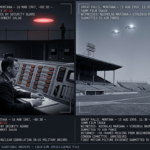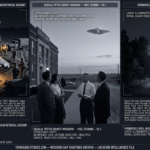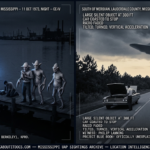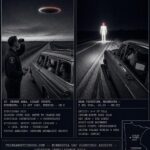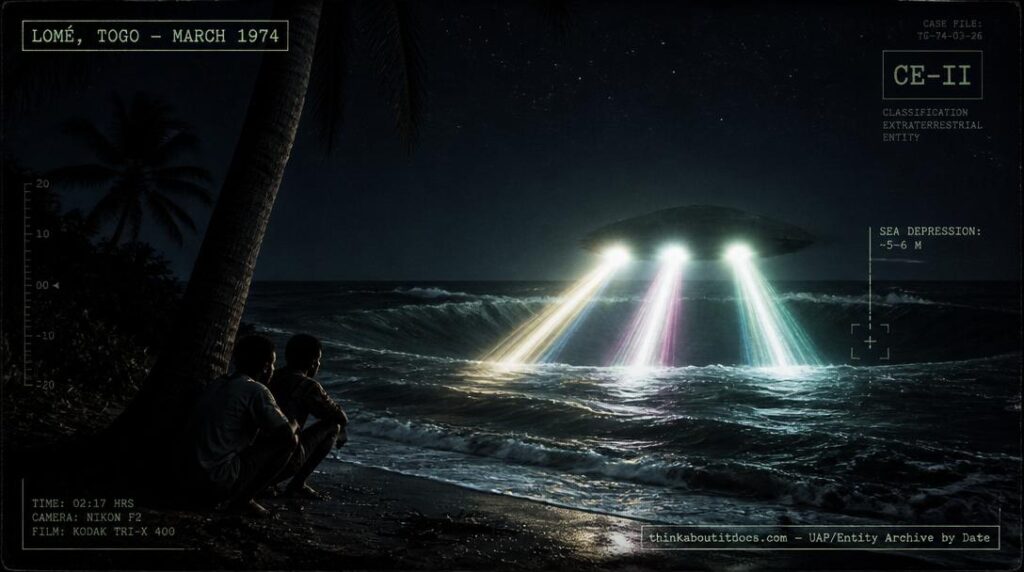
Dossier reconstruction of the object reported hovering over the sea near Lomé, Togo, March 29, 1974.
THINK ABOUTIT UFO|UAP ENCOUNTER REPORT
1974: Lomé, Togo Beach UFO Encounter | CE-II Case Archive
Just before 2 AM on March 29, 1974, a French worker vacationing near Lomé, Togo, and a Togolese woman he’d met that evening were leaving a beach east of the Tropicana hotel when a sharp whistle rose from the sea — and a dark mass came gliding toward them across the water, stopping some 200 to 300 meters offshore. The ocean beneath it, they said, wasn’t flat but visibly dug into a depression several meters deep. Then three blinding lights snapped on, pinning them in place for a fully-timed twenty minutes of heat, sweat, and a paralysis neither of them could explain as simple fear.
The witness, identified only as A.W., didn’t report what happened for almost two years — not until friends talked him into writing to the French research group GEPA, and researcher Joel Mesnard sat down with him in person. Mesnard, an experienced investigator, came away describing A.W.’s testimony as sincere and disinterested: a man who made no attempt to explain what he’d seen, and simply tried to describe it as plainly as he could.
Date: March 29, 1974
Sighting Time: 1:45 AM to approximately 2:05 AM
Day/Night: Night
Location: A beach a few kilometers east of Lomé, Togo, near the Tropicana hotel
Urban or Rural: Rural — an undeveloped dune area with coconut trees, outside the city
Hynek Classification: CE-II (Close Encounter II) — close-range observation with documented physiological effects and a physical trace in the environment (the depression in the sea surface); no entity is described at any point
Duration: About 20 minutes, timed by the witness’s diving watch
No. of Object(s): 1
Description of the Object(s): A dark mass that approached silently over the water, preceded by a sharp whistling sound; produced a visible depression in the sea surface beneath it (estimated 5–6 meters deep); emitted three blinding beams of light toward the witnesses plus additional beams from its sides and possibly top; departed rapidly toward open sea without gaining altitude
Shape of Object(s): Undocumented — witness described it only as a “dark mass” without specifying a precise geometric shape
Size of Object(s): Approximately 25–30 meters in length, based on the witness’s comparison to the diameter of the depression it created in the sea beneath it
Color of Object(s): Dark mass before illumination; when lit, the beams were predominantly white, with yellow, pink, and blue-green also present
Distance to Object(s): 200–300 meters
Height & Speed: Remained at a constant low height throughout, including during departure, which the witness described as “without gaining altitude”; no numeric speed given, though the departure itself was described as very rapid
Number of Witnesses: 2 — A.W. (a French worker, identified only by initials) and an unnamed Togolese woman he had recently met; only A.W.’s testimony was directly recorded and investigated
Special Features/Characteristics: Sharp, annoying whistling sound preceding the sighting, which persisted as a lingering auditory sensation in both witnesses even after the object departed; a “mini-tidal wave” pushed water toward the dune where the witnesses sheltered; intense, described-as-terrifying heat radiated from the object’s lights, with both witnesses sweating profusely; the witnesses were paralyzed in place during the encounter, which A.W. stated was not simply fear or astonishment; sudden coolness and silence marked the object’s departure; A.W. later suffered deafness episodes, fainting spells, headaches, and persistent anxiety over the following months and years; A.W. asked his companion not to tell anyone, fearing he would be thought crazy or face legal trouble
Case Status: Unexplained
Source: Waterufo.net / Joel Mesnard, Phénomènes Spatiaux, March 1976
Summary/Description: In the early hours of March 29, 1974, a French worker and a Togolese woman on a beach near Lomé, Togo, encountered a dark mass that emerged from the sea, produced a depression in the water beneath it, and emitted blinding, multicolored beams of light that paralyzed both witnesses with intense heat for about 20 minutes. The male witness, A.W., suffered lasting physiological effects afterward and did not formally report the incident until nearly two years later, when researcher Joel Mesnard interviewed him for Phénomènes Spatiaux.
Related Cases: The source notes that A.W. separately observed a blue fireball with a red trail near Thionville, in northeastern France, some months after the Togo incident. This is a distinct, unrelated sighting by the same witness and is not part of this entry.
Detailed Report
The account reaches this archive through Joel Mesnard, a French ufologist with a long career in the field (later the longtime editor of Lumières dans la Nuit), who published it in the March 1976 issue of Phénomènes Spatiaux following a personal interview with the witness. The witness, identified only by the initials A.W., was a French worker vacationing on the Togolese coast in late March 1974.
On the evening of March 28, A.W. had met a Togolese woman, and the two spent from 11 PM to 1 AM swimming two to three kilometers east of the Tropicana, a large tourist hotel built beside the sea a few kilometers east of Lomé. Afterward they rested on the beach near a dune where coconut trees grew, under a dark, exceptionally clear, star-filled sky. At 1:45 AM, as they were preparing to leave, both of them heard a sharp, unpleasant whistling sound coming from the sea. Turning toward the water, they saw a dark mass approaching and coming to a stop some 200 to 300 meters in front of them. Moments later, a large wave washed over the dry sand where they stood.
Fearing they might be pulled into the water, A.W. grabbed the trunk of a coconut palm with one arm and held onto his companion with the other as a continuous barrage of strong waves built at their feet — at one point coming within 50 meters of the dune itself. Then three bright lights appeared on the object, aimed directly at the pair and blinding enough that A.W. could not make out much beyond them, though he sensed additional beams coming from the object’s sides and possibly its top, some seemingly angled upward. The light was predominantly white, mixed with yellow, pink, and blue-green; through his lightly tinted glasses, A.W. was especially struck by how the waves themselves seemed lit blue and green. Most striking to him was the sea’s surface directly beneath the object: rather than flat, it was visibly dug into a depression he estimated at five or six meters deep, with a diameter comparable to the object’s own length — on the order of 25 to 30 meters.
Crouched by the coconut tree with their legs still in the water, neither witness moved. A.W. was clear that it was not fear or astonishment holding them in place — the lights themselves, he believed, were doing something to them. Although the night had been mild beforehand, the light now carried a heat he described as terrifying, and both he and the woman were sweating heavily. Then, just as suddenly, a relative coolness returned: the object moved off rapidly toward open sea, without ever gaining altitude, its lights going dark as it vanished. The night went quiet and dark again, and the water settled. By A.W.’s diving watch, it was 2:05 AM — the whole episode had lasted about twenty minutes.
The two walked back to the Tropicana, where they parted ways. Though the whistling sound had stopped when the object left, both of them were left with a lingering, irritating sensation in their ears. A.W. asked the woman not to speak of what they’d seen, afraid of being thought crazy or even facing legal trouble. The next morning he woke feeling completely deaf, with a strange sense of lightness or emptiness. The following day, an inexplicable exhaustion overtook him and he collapsed into bed, sleeping three hours before waking with a severe headache that a hotel receptionist’s pills eventually eased. Fainting spells followed over the next several days. A.W., who described himself as normally quite calm, found himself persistently nervous afterward, with recurring deaf spells and bouts of suffocating anxiety — a condition that was easing only gradually by the time Mesnard met him, nearly two years later.
A.W. himself showed little interest in UFOs as a subject. It was only sometime after a separate, later sighting of his own — a blue fireball trailing red light, observed one evening near Thionville in northeastern France — that friends in whom he’d confided both experiences urged him to write to GEPA. That letter eventually led to Mesnard’s interview with him in February 1976. Mesnard’s own assessment, published alongside the account, was that A.W.’s testimony “appeared sincere and disinterested,” noting that the witness made no attempt to explain what he had experienced and limited himself to describing it as objectively as he could.
RESEARCHER’S NOTES
The Lomé Beach Encounter — Togo 1974 and a Two-Year Silence
- Classification Notes: CE-II is correctly applied — the case involves close-range observation with documented physiological effects (heat, paralysis, later health effects) and a physical trace in the environment itself (the depression in the sea surface), with no entity described at any point.
- Filling the Blanks: Several structured fields left blank in the original data are answered directly by the full report: object size can be estimated at 25–30 meters, based on the witness’s own comparison to the diameter of the depression beneath it, and the object maintained a constant low altitude throughout, including during its rapid departure, per the witness’s explicit statement that it left “without gaining altitude.”
- Witness Count Precision: Two people experienced the event together — A.W. and an unnamed Togolese woman — but only A.W.’s testimony was ever formally recorded and investigated by Mesnard; the woman’s account, and any lasting effects on her, remain unknown to the record.
- Source Chain Assessment: The case reached publication through Joel Mesnard, a long-tenured French ufologist who personally interviewed A.W. in February 1976, nearly two years after the event. Mesnard’s own assessment was that the testimony “appeared sincere and disinterested,” noting the witness made no attempt to explain the phenomenon and simply described it as objectively as possible.
- Delayed Reporting: A.W. did not report the incident for close to two years, motivated initially by fear of being thought crazy or facing legal trouble; this delay ruled out any possibility of contemporaneous physical investigation of the beach site itself.
- Unrelated Second Sighting: The source notes that A.W. separately observed a blue fireball with a red trail near Thionville, in northeastern France, some months after the Togo incident. This is a distinct, unrelated sighting by the same witness and is not part of this entry.
The Lomé beach encounter endures less because of any single striking detail than because of the whole shape of it: a whistle from the sea, a wound in the water itself, a heat that pinned two people in place for twenty measured minutes, and years of quiet suffering afterward from a man who never wanted the attention this story eventually brought him. It remains Unexplained, resting on the word of a witness his own investigator found convincing precisely because he never tried to convince anyone of anything.
“It was not astonishment or fear that paralyzed them.”