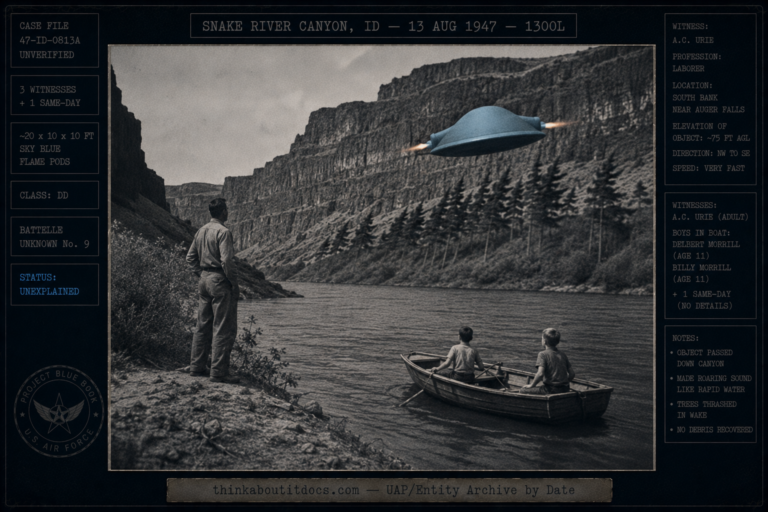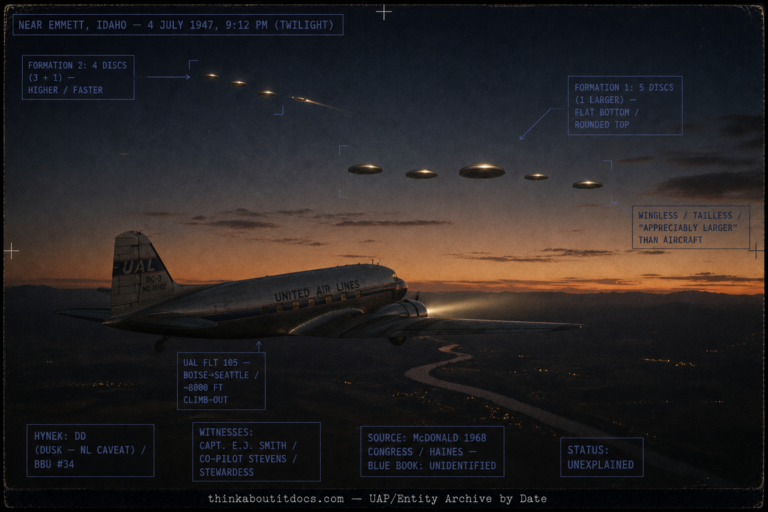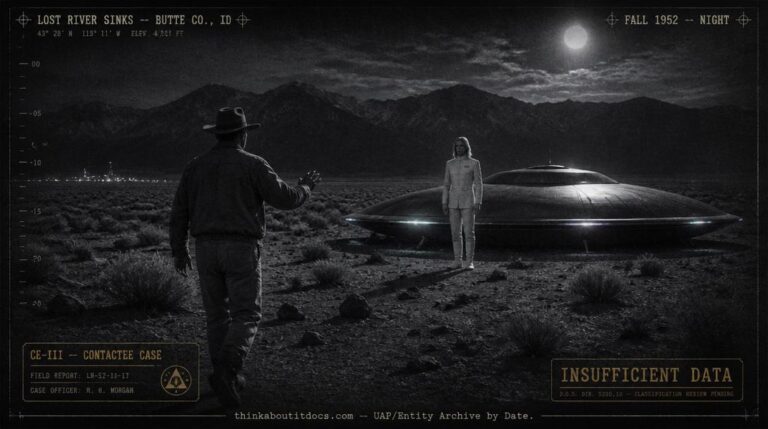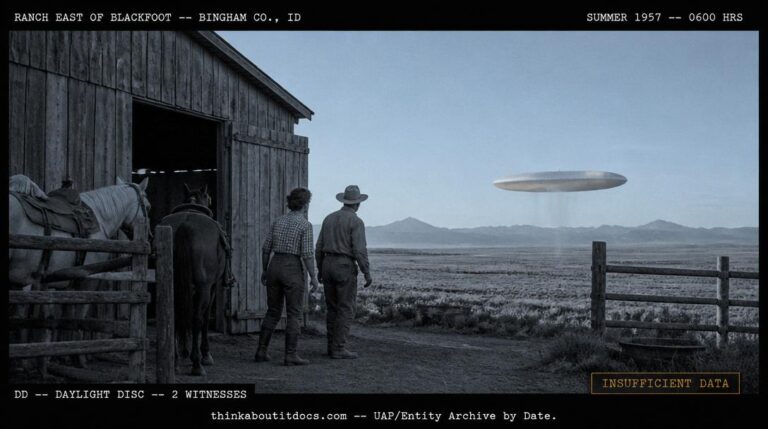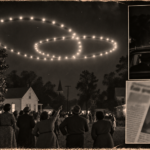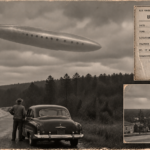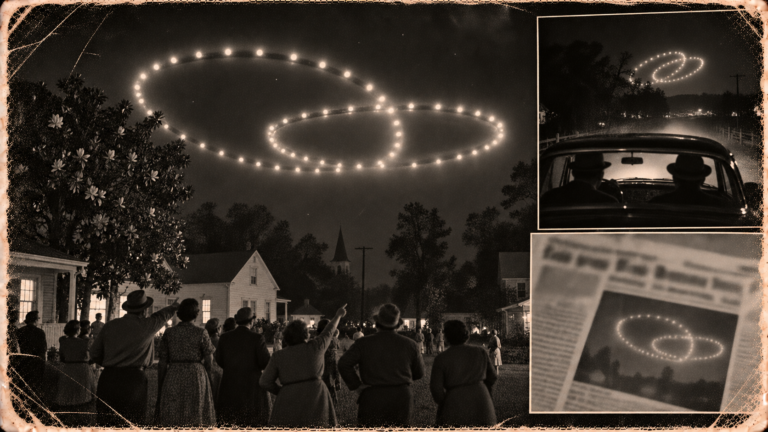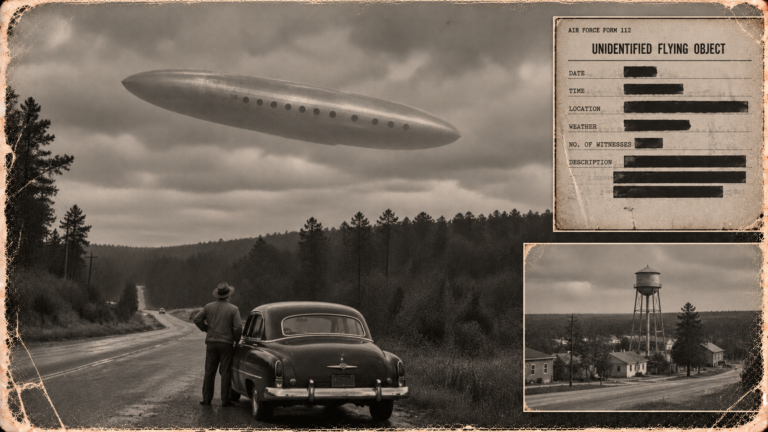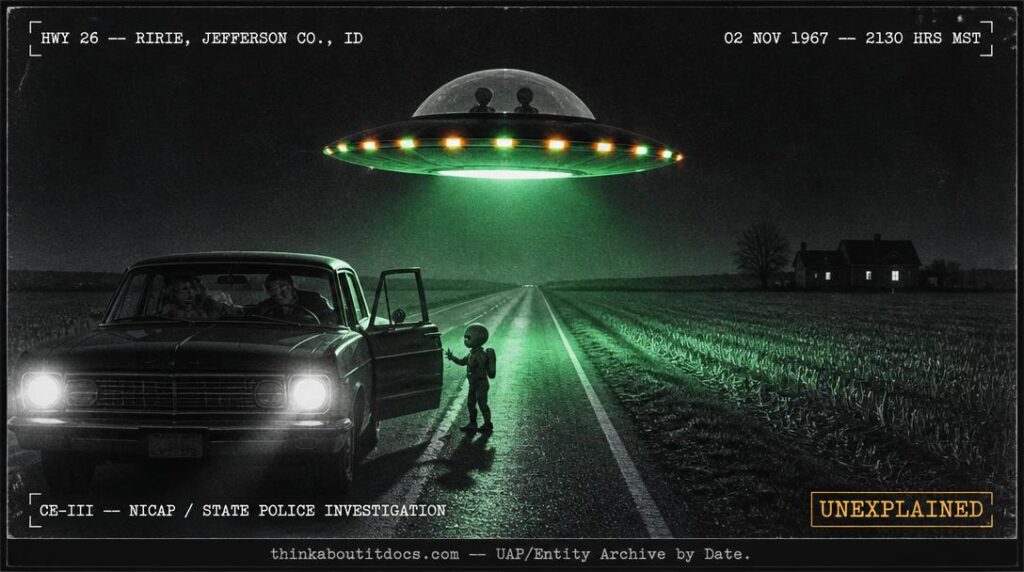
Reconstruction — A small entity approaches the driver's door of Guy Tossie and Will Begay's car as a domed craft hovers on Highway 26 near Ririe, Idaho, November 2, 1967.
THINK ABOUTIT SIGHTING UFO|UAP|ENTITY REPORT
1967: Three-1/2 Foot Tall Creature Floats to Ground in Ririe, Idaho
On the night of November 2, 1967, two young Shoshone-Bannock men — Guy Tossie and Will Begay — were driving south on Highway 26 just outside Ririe, Idaho when a blinding flash stopped their car and a small, domed UFO appeared hovering five feet above the road. Inside its transparent dome, two small occupants were visible. One being exited the craft — apparently floating to the ground — walked to the car, opened the driver’s door, slid behind the wheel, and the vehicle began moving into an adjacent wheat field. Tossie bolted for a nearby farmhouse; Begay was left in the car with the entity, which jabbered at him in rapid, bird-like sounds. The beings eventually returned to their craft, which departed in a zigzag ascent. A farmer found Begay sitting in the running car with his eyes clenched shut. State Police investigated. Local farmers reported cattle bolting that evening. A NICAP field investigator confirmed a third witness — anonymous — who reported a similar encounter the same night.
The Ririe incident is one of the most detailed and best-corroborated CE-III events in the American record of the late 1960s. It features two named witnesses who voluntarily gave statements to a deputy sheriff, a named civilian corroborator (farmer Willard Hammon), a State Police investigation, circumstantial animal-behavior evidence, and a professional NICAP field investigation by C.R. Ricks that surfaced an independent third witness. It anchors the southeastern Idaho CE-III cluster of November–December 1967.
Date: November 2, 1967
Sighting Time: Approximately 9:30 PM (MST)
Day/Night: Night
Location: Highway 26, just south of Ririe, Jefferson County, Idaho
Urban or Rural: Rural — two-lane highway through agricultural land
No. of Entity(‘s): 2
Entity Type: Small humanoid — non-human features
Entity Description: Approximately 3.5 feet tall. Oval, heavily pitted and creased face. Two small, round eyes. Straight, slit-like mouth. Large ears set high on a hairless head. A pack on its back protruded above and behind its head. The entity that exited the craft appeared to float to the ground rather than climb or jump. It opened the car door, slid behind the steering wheel, and made rapid, high-pitched vocalizations described as sounding “like a bird.” The second entity remained in the dome initially, then apparently pursued Tossie with a bright light before returning to the car.
Hynek Classification: CE-III (Close Encounter III) — Animate beings observed in direct association with and emerging from a structured craft. Note: The encounter has CE-IV characteristics — the witnesses’ vehicle was commandeered and relocated against their will — but no transport aboard the craft occurred.
Duration: Approximately 15 minutes (from initial flash to Hammon reaching the car)
No. of Object(s): 1
Description of the Object(s): A small, domed craft approximately eight feet wide. The dome was transparent, revealing two small occupants. Green and orange lights flashed around the rim. The craft bathed the area in vivid green light. The dome opened as if hinged to allow the entity to exit. The craft maintained a fixed position a few feet in front of and above the car while the vehicle was moved into the field. Departed in a zigzag ascending path.
Shape of Object(s): Domed disc — small, compact
Size of Object(s): Approximately 8 feet wide
Color of Object(s): Green and orange rim lights; vivid green illumination of surrounding area
Distance to Object(s): Directly ahead of the car on the highway — within feet
Height & Speed: Hovered approximately 5 feet above the highway. Maintained position just ahead of and above the car while it was moved into the field. Departed in a zigzag ascending pattern.
Number of Witnesses: Multiple — Guy Tossie and Will Begay (primary, in the car); Willard Hammon (farmer, found Begay in car, heard full account immediately after); county deputy sheriff (received voluntary statements from both witnesses); additional anonymous witness confirmed by NICAP investigator C.R. Ricks on the same night
Special Features/Characteristics: Vehicle interference — car stopped without brakes being applied. Entity entered vehicle and apparently operated or directed it into a field. Possible vehicle “towing” by craft. Entity vocalization (rapid, high-pitched, bird-like). Entity locomotion — floated rather than walked to ground from dome. Bright light possibly carried by second entity during pursuit of fleeing witness. Area bathed in vivid green illumination. Local cattle bolting reported by multiple farmers same evening. Anonymous third witness confirmed by NICAP investigator.
Source: NICAP (National Investigations Committee on Aerial Phenomena), Section VII; field investigation by C.R. Ricks, Idaho Falls; published at nicap.org/newlook/section_VII.htm
Summary: Two young Shoshone-Bannock men driving near Ririe, Idaho had their car stopped by a blinding flash. A small domed craft hovered on the highway with two visible occupants. One 3.5-foot entity exited, entered the driver’s side, and moved the car into a field. Tossie fled to a farmhouse; Begay was left with the entity. Both beings eventually returned to the craft, which departed in a zigzag ascent. State Police investigated; NICAP confirmed a third witness the same night.
Case Status: Unexplained
Related Cases: 1967: Circular Object with Dome and Two Figures — Idaho Falls | 1965: Idaho ‘Mining UFOs’ | 1960–1969 UFO/Entity Sightings by Date
Detailed Report
On the evening of November 2, 1967, Guy Tossie and Will Begay — two young men from the Fort Hall Indian Reservation (Shoshone-Bannock Tribes) — were driving south on Highway 26 just outside Ririe, a small community in Jefferson County, Idaho, approximately 25 miles west of Idaho Falls. At roughly 9:30 PM, a sudden blinding flash of light appeared directly in front of the car. Begay was driving. The car came to a stop without Begay applying the brakes.
Immediately ahead of them, hovering approximately five feet above the highway, was a small, domed object roughly eight feet wide. Green and orange lights flashed around its rim, and the area was flooded with vivid green light. The dome was transparent, and through it the two men could see two small, unusual-looking occupants.
The dome opened as if on a hinge. One of the occupants emerged and appeared to float — not jump or climb — to the ground. It stood approximately three and a half feet tall. On its back was a pack of some kind that protruded above and behind its head. Its face was oval-shaped, heavily pitted and creased. Two small, round eyes, a straight slit-like mouth, and large ears set high on a hairless head completed the visible features.
The being walked to the driver’s side of the car, opened the door, and slid behind the steering wheel. The horrified witnesses pushed over to the passenger side. The car then began to move — whether driven by the entity or somehow towed by the hovering craft was unclear to the witnesses. The UFO maintained a fixed position a few feet ahead of and above the vehicle as it was guided into an adjacent field of stubble wheat.
When the car stopped in the field, Tossie — sitting nearest the passenger door — suddenly threw it open and bolted, running approximately a quarter mile to the farmhouse of Willard Hammon. He later reported being followed by a bright light, presumably carried or projected by the second occupant. At the farmhouse, Tossie was so agitated he could barely make himself understood. Hammon and his family calmed him down, then accompanied him back to the field.
Meanwhile, in the car, Begay had remained cowering in the front seat while the first entity sat beside him, making rapid, high-pitched sounds described as being “like a bird” — unintelligible vocalizations. The second being, having apparently abandoned the pursuit of Tossie, returned to the car. The first entity then exited. Both beings rose up and into the UFO, which ascended in a zigzag path and disappeared.
Hammon found Begay sitting in the car with the engine still running and headlights on. Begay was nearly speechless with fright, his eyes tightly shut. Approximately fifteen minutes had elapsed since the initial flash. Hammon listened to the two men’s account and then followed them home in his own car.
Later that evening, Hammon stopped at a local establishment to see if anyone else had information. A county deputy sheriff happened to come in, and Hammon relayed the story. Both Tossie and Begay subsequently came to the deputy of their own volition and gave statements in their own words. The Idaho State Police were summoned and began an investigation. During this process, it was discovered that a number of local farmers had reported their cattle bolting that evening for unexplained reasons, and others claimed to have seen lights in the area.
The case was investigated for NICAP by C.R. Ricks, based in Idaho Falls. During his investigation, Ricks learned of an additional man in the area who claimed to have had a similar encounter on the same night. Ricks located this individual and confirmed the account, though the witness insisted on anonymity and was reluctant to discuss details.
Researcher’s Notes
The Ririe Encounter — Highway 26, November 1967, and the Anatomy of a Well-Corroborated CE-III
- Source Chain and Corroboration Depth: The Ririe case has an unusually strong evidentiary structure for a CE-III. The two primary witnesses are named (Guy Tossie and Will Begay). They voluntarily gave statements to a deputy sheriff — independently and in their own words. Farmer Willard Hammon is a named civilian who found Begay in the car, heard the full account within minutes of the event, and followed the witnesses home. State Police conducted a formal investigation. NICAP field investigator C.R. Ricks conducted a separate civilian inquiry and confirmed a third, anonymous witness who reported a similar encounter the same night. Cattle disturbances reported by local farmers provide circumstantial environmental corroboration. The source is NICAP’s own files, Section VII, archived at nicap.org. This is one of the most thoroughly documented CE-III events in NICAP’s late-1960s case files.
- Classification — CE-III with CE-IV Elements: The standard CE-III classification applies: animate beings were observed in direct association with a craft. However, the encounter has significant CE-IV characteristics. The witnesses’ vehicle was commandeered — an entity entered the car, and the vehicle was relocated to a field against the occupants’ will. By strict definitions of abduction (forced relocation of witnesses by non-human entities), this qualifies. The reason it is not typically classified as CE-IV in the literature is that the witnesses were not taken aboard the craft, were not subjected to examination, and did not experience missing time. The classification boundary is genuinely ambiguous here and should be noted.
- The Southeastern Idaho Cluster: The Ririe incident is the anchor event in a tight geographic and temporal cluster. Five weeks later, on December 8, 1967, fifteen-year-old Marilyn Wilding in Idaho Falls (25 miles east) observed a domed craft with two figures in a transparent dome hovering near her home — investigated by the same C.R. Ricks. Ricks’s anonymous third Ririe-night witness represents a third data point. Three CE-III events within 25 miles over five weeks, all featuring domed craft with visible occupants, all investigated by the same field representative — this is among the tightest documented CE-III clusters in the American record. Whether it represents a genuine localized phenomenon, social contagion amplified by the Ririe case’s local notoriety, or coincidence cannot be determined at this remove.
- Witness Context and Credibility: Tossie and Begay were young men from the Fort Hall Indian Reservation — Shoshone-Bannock Tribal members. Their behavior during and after the event is consistent with genuine terror rather than fabrication: Tossie’s panicked flight to a farmhouse, his near-incoherent state upon arrival, Begay’s catatonic posture in the car with eyes shut. Both men voluntarily approached law enforcement to give statements — an action that carries social risk, particularly for Indigenous witnesses in rural 1960s Idaho. The entity description is specific and unusual: the pitted, creased face, the slit mouth, the high-set ears, and the backpack-like protrusion are not standard “gray alien” features from the popular culture of the period, suggesting the account is not derived from media imagery. The bird-like vocalization is an uncommon detail in the CE-III literature.
 The Ririe encounter is the kind of case that earns the archive’s Unexplained classification on multiple axes simultaneously: named witnesses who voluntarily approached authorities, immediate civilian corroboration, law enforcement investigation, professional civilian research, environmental evidence, and a confirmed independent witness.
The entity description is detailed, internally consistent, and does not map neatly onto the popular alien imagery of 1967.
The case’s most analytically significant feature may be the vehicle-commandeering element — a forced relocation of the witnesses that sits on the CE-III/CE-IV boundary and remains one of the more disturbing physical interactions in the record.