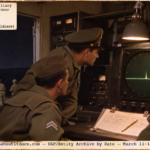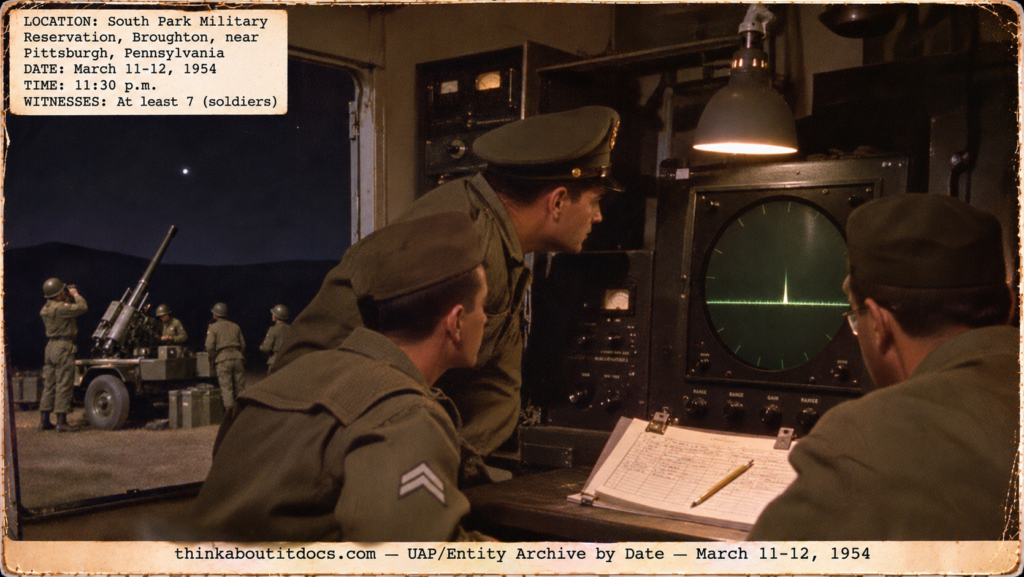
March 11-12, 1954: Army radars near Pittsburgh track a target that does not move in a 40 mph wind.
THINK ABOUTIT UFO|UAP SIGHTINGS REPORT
1954: The Pittsburgh, Pennsylvania Anti-Aircraft Radar Stationary Target
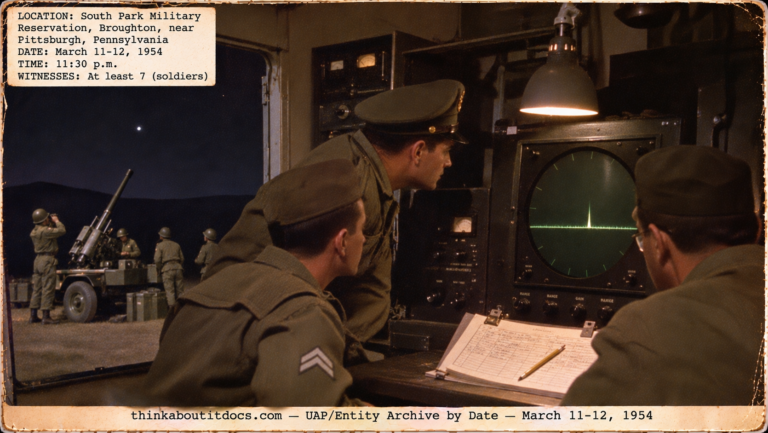
Beginning late on the night of March 11, 1954, the radars of the 74th Antiaircraft Artillery Battalion at South Park Military Reservation, near Pittsburgh, picked up a target that did not move. It sat at 16,000 to 20,000 ft in the air over southwestern Pennsylvania for hours, in a 40 mph wind that should have carried anything free-floating away.
Gun batteries tracked it with fire-control radars, and one battery’s soldiers also reported a tiny white object overhead that slowly brightened and dimmed. Air Force Reserve aircraft sent up from Greater Pittsburgh Airport passed through the position of the target without any effect on it.
Date: March 11-12, 1954
Sighting Time: About 11:26 p.m. EST on March 11 (Battery B radar lock at 0426Z March 12) until about 8:20 a.m. EST (released at 1320Z); one battery’s log totals 6 hours 5 minutes
Day/Night: Night and dawn
Location: South Park Military Reservation, Broughton, near Pittsburgh, Pennsylvania
Urban or Rural: Suburban/rural
No. of Entity(‘s): Not Applicable
Entity Type: Not Applicable
Entity Description: Not Applicable
Hynek Classification: RV (Radar-Visual)
Duration: Radar lock lasted several hours on each battery; a visual sighting by Battery B personnel is dated about 0620Z
No. of Object(s): 1
Description of the Object(s): A stationary radar target; a visual object about the size of a pinhead, white, slightly oscillating, with ill-defined edges and no trail or exhaust
Shape/Size/Color of Object(s): White; pinhead size to the naked eye and binoculars; brightness gradually rose and fell
Distance to Object(s): Radar elevation about 770 mils and range about 9,500 yds, altitude about 19,000 ft (one battery); another battery about 16,000 ft
Height & Speed: Stationary at about 16,000-20,000 ft in a 40 mph wind from azimuth 4900 mils
Number of Witnesses: Several battery crews: officers, radar chiefs and operators (names legible only in part); at least seven soldiers were named for the visual sighting
Special Features/Characteristics: The target stayed in place in a 40 mph wind; Air Force Reserve aircraft flying in the area passed through its position; A-scope sketches were kept as the only physical evidence; a corporal claimed to have seen it through the optics of the M33 radar
Case Status: Unidentified in the file; Blue Book record card not seen (BBU per McDonald/Sparks)
Source: Army antiaircraft battery reports (74th AAA Battalion and others); Dan Wilson; Brad Sparks; McDonald list (BBU)
Summary/Description: Antiaircraft radars near Pittsburgh locked onto a stationary target at about 16,000-20,000 ft for hours on March 11-12, 1954, despite a 40 mph wind. Air Force Reserve aircraft passed through the position, and Battery B personnel also saw a tiny white object.
Related Cases: Other 1954 military radar cases on the monthly pages (Kelly AFB, Savannah River, Nouasseur).
Detailed Report
The reports come from several batteries of the 74th Antiaircraft Artillery Battalion at South Park Military Reservation in Broughton, Pennsylvania, forwarded to the Eastern Army Antiaircraft Command at Stewart Air Force Base, New York, as unidentified flying object reports. Each battery filed its own account, with the radar equipment, the personnel and the weather.
In the Battery B report dated March 12, no visual sighting was established. At 0426Z, the battery sighted a target echo and locked on with its FCS-M-33 track radar; it remained on the target until released by the AAOC at 1320Z. The echo was observed on A scopes by the battery commander, a corporal who was radar chief and a private first class radar operator. The weather message gave a 40 mph wind from 4900 mils at the time, air density 99, and 40° temperature. The report states that no unusual conditions existed to account for the sighting. A sketch of the A-scope presentation during the period “on target” is the only physical evidence. The only identification action was correlation of plot information with other units, and intercept aircraft were flying in the general vicinity.
Other batteries in the battalion logged the same target at different positions and times: one battery recorded elevation 770 mils, range 9,500 yds and an altitude of about 19,000 ft, while another recorded electronic observation at 16,000 to 20,000 ft and a position at about 16,000 ft. One battery’s log totals six hours and five minutes on the target. The wind was blowing at about 40 miles an hour from an azimuth of 4900 mils, and the target did not move with it. A battery log says aircraft dispatched by the Air Force Reserve from Greater Pittsburgh Airport were tracked passing through the same location.
A separate Battery D report notes that on March 11 the unit went on stand-by surveillance and that a target eventually took about two hours to locate, with prompting from another unit. The target “looked like an ordinary target” once locked. A report from the battery’s range officer describes a visual and radar sighting: the object remained in the area in which it was sighted and appeared to be slightly oscillating, approximately the size of a pinhead with ill-defined edges, white, gradually becoming bright and dim, with no trail or exhaust. Visual contact, by the unaided eye and M17A1 binoculars, was lost at 0620Z and could not be re-established. One corporal claimed to have seen it through the optics of the M33, but no one else could verify that. Seven soldiers, led by a first lieutenant who was the range officer, are named as having maintained visual contact.
RESEARCHER’S NOTES
A Radar Target That Ignored the Wind
- Stationary in a 40 mph wind: The central problem is what stays put at 16,000-20,000 ft in a 40 mph wind: a free balloon would drift, and an aircraft would move.
- Several independent radars: The batteries tracked it with their own radars, correlated plots with other units, and logged it at consistent altitudes, which weakens an equipment-fault explanation.
- The Reserve aircraft: Aircraft from Greater Pittsburgh Airport were tracked passing through the target’s position with no apparent effect on it, which suggests the return was not a physical object at that spot, or that it was too small or too different to be the same thing; the file draws no conclusion.
- The visual sighting: A pinhead-sized, oscillating white object seen by eye and binoculars by a group of soldiers lines up with the target’s position and brightness changes, but the match is in the unit’s report, not independently confirmed.
- The missing card: The Blue Book record card was not in the files, so the BBU status rests on McDonald and Sparks.
Pittsburgh is a long-duration military radar case with a consistent altitude, a wind that should have moved the target, and a visual sighting that lines up with it. The record is incomplete, since the card is missing and several battery reports are only partly legible, and this page says so.