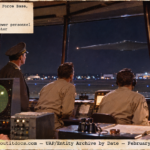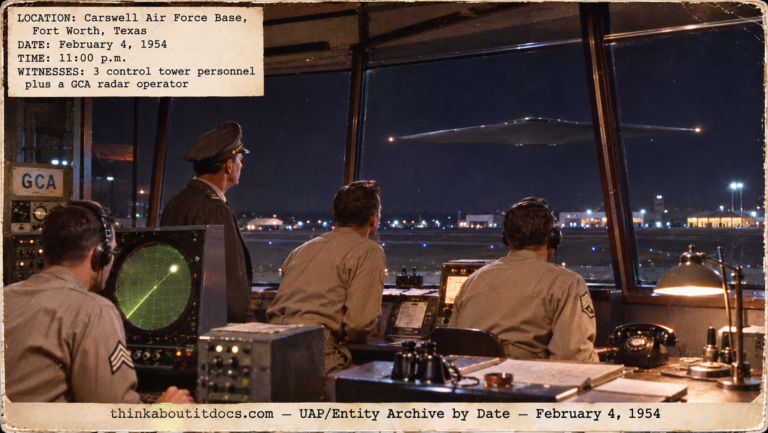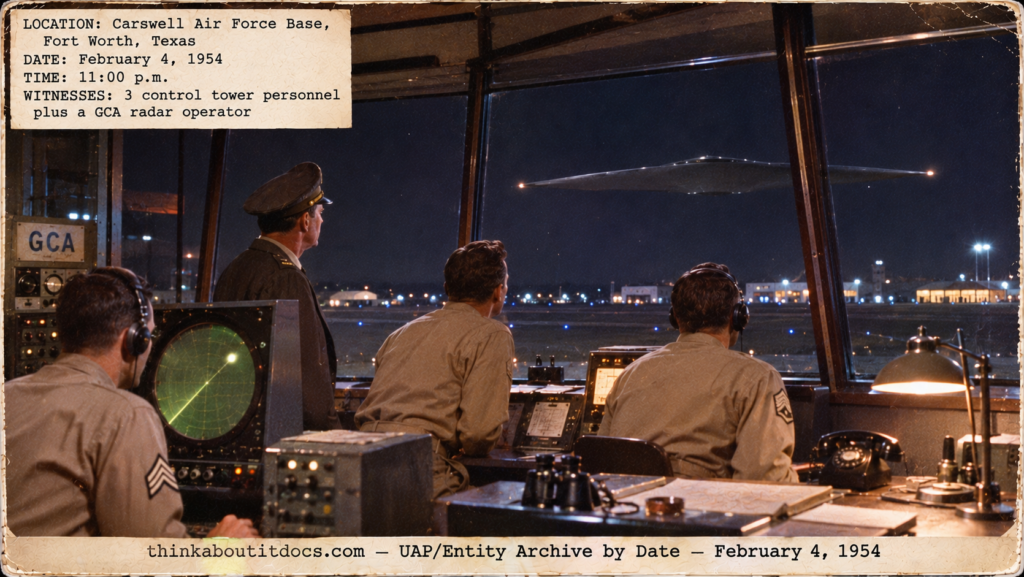
February 4, 1954: Carswell tower and GCA radar track a silent object.
THINK ABOUTIT UFO|UAP SIGHTINGS REPORT
1954: The Carswell AFB, Texas Silent “Giant Aircraft” and Radar Targets
On the night of February 4, 1954, Carswell Air Force Base tower personnel watched a dark gray, B-36-sized shape with a long fuselage and elliptical wings glide in from the southwest over their control tower, in total silence, with no exhaust and no trail. Their GCA radar had been tracking it in, and half an hour later the radar scope showed two more targets flying in formation that merged, separated and reversed course.
The reporting officer and observers were experienced and the sighting looked simultaneous on radar and by eye, so ATIC sent Project Blue Book and a radar specialist to Texas. What they found is one of the cleaner explanations in the Blue Book files, and the record card spells it out: “Was Aircraft.”
Date: February 4, 1954
Sighting Time: 11:00-11:06 p.m. CST (first object); about 11:29 p.m. CST (second, radar-only)
Day/Night: Night
Location: Carswell AFB, Fort Worth, Texas
Urban or Rural: Urban (military base)
No. of Entity(‘s): Not Applicable
Entity Type: Not Applicable
Entity Description: Not Applicable
Hynek Classification: RV (Radar-Visual)
Duration: About 5 minutes visual (2301-2306); radar tracking of the first object from 2300
No. of Object(s): 1 visual and radar object; 2 radar-only targets later
Description of the Object(s): A dark gray, aircraft-shaped object with a long fuselage, elliptical wings and stabilizer; later two radar targets in formation
Shape/Size/Color of Object(s): Larger than a B-36; dark gray; no sound, exhaust, trail or visible means of propulsion
Distance to Object(s): First detected by GCA radar 13-15 miles to the southwest, heading directly toward the base; second pair first seen 17 miles southwest
Height & Speed: Straight course at about 3,000-4,000 ft; the later targets flew at an estimated 5,000 ft and 200 knots, with Duncanville radar tracking aircraft at about 240 knots
Number of Witnesses: Carswell control tower personnel, the GCA radar operator and the officer of the day (names blacked out in the file)
Special Features/Characteristics: Carswell Weather independently confirmed the radar contact (per Wilson); ATIC found a C-124 that changed its flight plan near the tower and 3627th Wing B-25 radar-observer trainer flights operating in the same hours; one target reversed course for about 2 miles in 3.3 seconds
Case Status: Explained (Blue Book card: “Was Aircraft”) — first object identified as a C-124, second as probable B-25 training flights; the explanation of the radar reversal is inferred, not proven
Source: Project Blue Book record card and ATIC investigation summary; Dan Wilson
Summary/Description: Carswell tower and GCA radar tracked a silent, dark aircraft-shaped object over the base; later, two radar targets merged, separated and reversed course. ATIC identified the first as a descending C-124 and the second as probable B-25 radar-trainer flights.
Related Cases: See the other 1954 military radar cases on the February page, including Savannah River.
Detailed Report
Two reports of unidentified objects reached ATIC from the 19th Air Division at Carswell on the night of February 4. ATIC considered them significant because the reporting officer and observers were experienced and reliable, the objects’ behavior seemed unusual, and the first looked like a simultaneous visual and radar sighting.
The first object was described as aircraft-shaped, dark gray and as large as or larger than a B-36, with a long fuselage, elliptical wings and a stabilizer. Everything about it matched an aircraft except that it showed no means of propulsion or exhaust, left no trail and, most strikingly, made no sound. The Carswell GCA radar first picked it up at 2300, 13 to 15 miles to the southwest and heading straight for the base. The GCA operator notified the tower and the officer of the day, and tower personnel sighted the object at 2301 and watched it for five minutes until 2306, when it passed out of sight to the northwest. Its altitude was estimated at 3,000 to 4,000 ft and it held a straight course throughout the visual and radar sighting.
About twenty minutes later came the second incident, radar-only, logged by Carswell GCA at 2329: two targets 17 miles southwest of the base, flying in formation at an estimated 5,000 ft and 200 knots. They merged into one, and at 12 miles from Carswell separated again on a southerly heading. At about 14 miles, the rear target suddenly reversed course, flew for two miles, reversed again and gradually overtook the lead target. Both left GCA coverage in formation to the south-southeast.
ATIC asked Air Defense Command to send the nearest 4602d AISS unit, and Capt. Charles A. Wardin, project monitor for Blue Book, traveled to Carswell with a radar specialist. A routine recheck turned up a C-124 en route from Travis AFB to Turner AFB that had reported to Fort Worth radio and changed its flight plan, descending from 13,000 to 7,000 ft on a track that would carry it very near the Carswell control tower. The radar trace and timing matched the flight plan and the visual observation, so ATIC concluded the tower personnel had seen the C-124; the lack of sound was attributed to the C-124’s descent, together with the observers’ misjudged time and altitude.
For the second incident, the specialist who interviewed the GCA operator judged the returns to be aircraft, apart from the sudden reversal. Duncanville radar, alerted when the target reversed, recorded tracks of normal aircraft at about 240 knots. A check of flight plans and nearby fields found that the 3627th Wing’s radar-observer training school at James Connally AFB was flying pairs of B-25s on missions against each other in the area during those hours, and the maneuvers the operator described closely resembled them.
RESEARCHER’S NOTES
A Case the File Actually Resolves
- The card: Blue Book’s card concludes “Was Aircraft” with the comment “Object was definitely aircraft.”
- The silence: The no-sound detail that made the first object look strange was explained by a descending C-124, not left hanging.
- The second incident: The B-25 explanation fits the tracks and the hours, though the exact B-25 positions could not be established.
- Card time: The card lists GMT 04/2329Z, which is the second incident’s local time (2329 CST); converted properly it would be 05/0529Z.
- Earlier entry: The earlier page entry left the case open and gave a 240-250 mph and binocular description from a secondary source; the file does not repeat either.
Carswell is a rare case where the file shows its work: two radar-visual and radar-only events with ordinary aircraft behind both. It stays in the archive as a well-documented explanation of what looked, to experienced observers, like something else.
“Larger than B-36. No trail or means of propulsion.”
— Carswell AFB, Project Blue Book record card, February 4, 1954