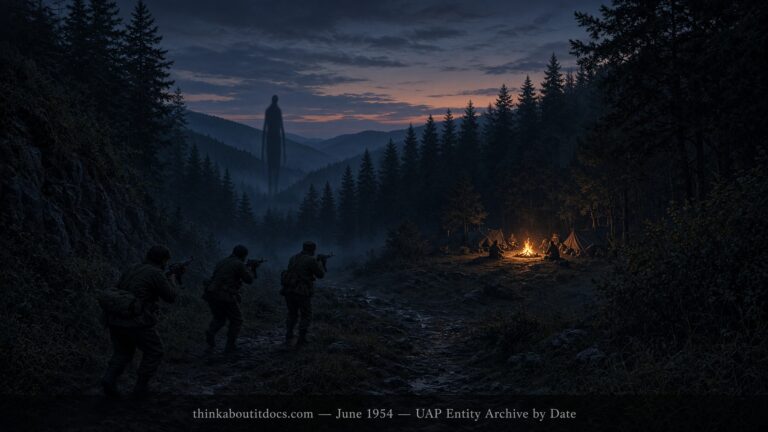
The wooded clearing near Cold Blow, Lydden, Kent where Harold Carpenter watched five entities collecting samples, July 1954.
THINK ABOUTIT
UFO|UAP & ENTITY ENCOUNTER REPORT
1954: The Cold Blow, Lydden, Kent Encounter — Harold Carpenter
Weeks of a strange predawn humming finally got the better of Harold Carpenter’s curiosity, and he followed the sound down a wooded slope near Lydden, Kent — straight to a gray, stemless mushroom-shaped craft hovering just above the ground, with five suited figures beneath it, calmly collecting twigs and leaves into glass jars with a pair of tweezers each. He crept closer than he meant to. One of them noticed.
Date: July 1954 (exact date not recorded)
Sighting Time: 05:00 (5:00 a.m.)
Day/Night: Early morning (dawn)
Location: Cold Blow, near Lydden, Kent, England (a wooded area locally known as Sunny Calvert)
Urban or Rural: Rural
No. of Entity(‘s): 5
Entity Type: Humanoid
Entity Description: Approximately 4-5 ft tall; human-like but entirely expressionless faces, with normal human-like eyes; ears not visible, possibly concealed by their suits; a snout-like, “pig”-like nose; human-like mouths; human-like hands lacking visible thumbs; wore matching one-piece gray, flexible suits covering the entire body including the feet and head in a balaclava-like fashion
Hynek Classification: CE-III (Close Encounter, Third Kind — entity present and observed at close range, no direct communication)
Duration: Approximately 10-15 minutes, from the witness’s discovery of the craft to its departure
No. of Object(s): 1
Description of the Object(s): Shaped like a mushroom without a stem, with a “lip” structure around the underside base through which the entities entered and exited, and an internal “gate” mechanism housed within that lip
Shape/Size/Color of Object(s): Mushroom-shaped without a stem; gray; approximately 15-20 ft in diameter at the base
Distance to Object(s): The witness approached to within 10 ft at closest range
Height & Speed: Initially hovered 8-10 ft above the ground; descended to approximately 2 ft before departure; climbed and gained speed before emitting a flash of light and departing at incredible speed
Number of Witnesses: 1 (Harold Carpenter)
Special Features/Characteristics: A loud, deep humming noise had been heard by the witness on multiple mornings over several weeks prior, always between 4:00 and 5:00 a.m., which led him to investigate its source; the entities used small glass, jam-jar-like containers with handles and tweezers-like implements to collect samples of twigs and leaves from the ground, remaining close to the craft throughout; the humming stopped once the craft landed and resumed only as it prepared to depart; one entity noticed the witness and, without any apparent verbal or visible signal, alerted the others, who calmly retreated beneath the craft via its underside “lip”; the craft descended further before the entities boarded, one seen climbing through an internal “gate” mechanism which then closed
Case Status: Unresolved — a detailed single-witness account with an unusually specific, mechanically plausible description of the craft’s boarding process
Source: Chris Rolfe, UFOMEK
Summary/Description: After weeks of hearing an unexplained, loud humming noise between 4:00 and 5:00 a.m., Harold Carpenter followed the sound one morning in July 1954 to a wooded area known locally as Sunny Calvert, near Cold Blow, Lydden, Kent, England. Descending a slope, he found a gray, stemless, mushroom-shaped craft, 15-20 ft in diameter, hovering 8-10 ft above the ground, with five humanoid entities beneath it collecting twigs and leaves into small glass containers using tweezers-like tools. The entities, 4-5 ft tall, wore matching gray one-piece suits and had expressionless, human-like but pig-snouted faces and thumbless hands. Approaching to within 10 ft, Carpenter was noticed by one of the entities, which silently alerted the others; they retreated beneath the craft through an underside “lip,” which then descended further before the craft rose, gained speed, flashed light, and departed rapidly.
Related Cases: None known
Detailed Report
Harold Carpenter, an employee at a local establishment near Lydden, Kent, had spent several weeks in the summer of 1954 hearing something he couldn’t explain: a very loud, deep humming noise, lasting two or three minutes at a time, always occurring sometime between four and five in the morning. Curiosity eventually won out. One morning, he got dressed and stepped outside to track the sound to its source.
The humming seemed to come from the southwest, and Carpenter set off toward a local wooded area known as Sunny Calvert. Determined to find the cause, he clambered down a deep slope toward where the sound seemed strongest — and there, in a clearing, found something he clearly hadn’t expected: a strange gray device, shaped like a mushroom without a stem, hovering silently eight to ten feet above the ground.
Finding a vantage point among the trees, Carpenter could make out the underside of the craft clearly. It measured roughly fifteen to twenty feet across at its base, which featured what looked like a lip structure along its inner edge. And gathered beneath it, on the ground, were five figures — four to five feet tall, going about what looked like a methodical task. Each carried a small glass container, something like a pound jam jar with a handle, in one hand, and a pair of tweezers-like implements in the other, using them to collect bits of twigs and leaves from the forest floor and deposit them carefully into their jars.
The humming had stopped entirely once the craft landed. The entities worked in near silence, staying close to their craft the whole time. Carpenter had a clear enough view to note their clothing — matching, gray, one-piece suits, flexible enough to stretch over their feet, with a balaclava-like hood covering the head. Their faces were exposed, and unmistakably strange: human-like in basic structure, but completely without expression, their eyes ordinary enough, but their noses distinctly snout-like, almost porcine. If they had ears, the suit concealed them. Their mouths looked human. Their hands, too — until Carpenter noticed they seemed to lack thumbs entirely.
Fascinated, Carpenter found himself inching closer and closer without quite registering how near he’d gotten — until he realized he was now within ten feet of the hovering craft. That was close enough. One of the entities looked up, its expression as blank as ever, and stared directly at him. No sound passed, no visible signal — and yet somehow the rest of the group reacted instantly, abandoning their collection and retreating calmly toward the craft, which had descended further, now hovering barely two feet above the ground.
One by one, the entities disappeared beneath the craft through its underside lip. Carpenter watched the vessel begin to rise, catching sight of one final figure climbing through what looked like a gated opening inside the lip structure, which then closed behind it. The craft continued climbing, drifting slightly to one side toward a nearby clearing in the trees, gaining both altitude and speed as it went — before it suddenly flashed with light and vanished at what Carpenter could only describe as incredible speed.
RESEARCHER’S NOTES
Cold Blow — 1954 and a Craft Described With Mechanical Precision
- An unusually specific boarding sequence: Most entity encounters in this archive describe entities simply “entering” a craft. Here, Carpenter describes a distinct lip structure, an internal gate mechanism, and a sequence of the craft descending further before boarding began — a level of functional, almost engineering-minded detail that suggests sustained, careful observation rather than a fleeting impression.
- A repeated, predictable phenomenon before the sighting itself: The weeks of consistent, similarly-timed humming noise preceding Carpenter’s investigation is a pattern distinct from most one-off sightings in this archive — it suggests either a recurring visitor to the same location or a natural phenomenon Carpenter simply misattributed once he found something unusual to explain it.
- Sample collection without apparent urgency: Like several other 1954 entries in this archive (Lermarken, Sweden; Kensington Lake, Michigan), the entities’ apparent purpose here reads as routine environmental sampling rather than any hostile or communicative intent.
- Detection without an obvious signal: The moment one entity noticed Carpenter and the entire group responded without any visible cue between them is a specific, somewhat unsettling detail that implies either an unusually sharp collective awareness or some form of communication Carpenter simply couldn’t perceive.
- No physical trace or second witness: Despite the encounter’s length and detail, this remains a single-witness account with no corroborating observer and no mention of any physical trace examined afterward at the site.
This case stands out for the mechanical specificity of its craft description — a level of functional detail (the lip, the internal gate, the staged descent before boarding) that goes well beyond a simple “it flew away” account. It remains, ultimately, a single witness’s uncorroborated testimony, offered with unusual descriptive precision.
“It suddenly emitted a flash of light and departed at incredible speed.”
— Chris Rolfe, UFOMEK, on Harold Carpenter’s account, July 1954