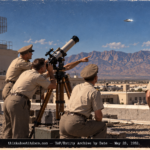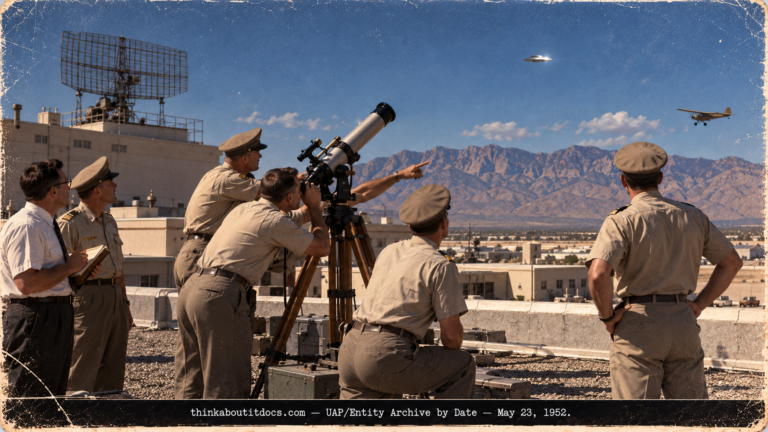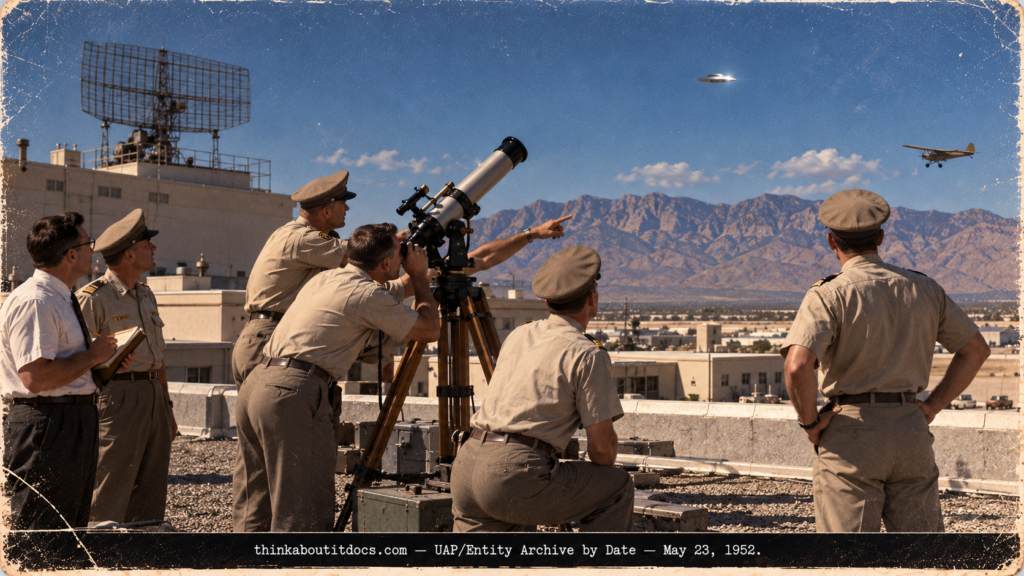
Kirtland AFB, New Mexico, May 23, 1952: the 135th AC&W Squadron.
THINK ABOUTIT UFO|UAP SIGHTINGS REPORT
Kirtland AFB, New Mexico:
A Radar Squadron Watches an Object Radar Cannot See
At about 4:00 on the afternoon of May 23, 1952, a door guard at Kirtland Air Force Base called the radar operators of the 135th Aircraft Control and Warning Squadron to the window to look at a shining object in the western sky. Within minutes the squadron’s commanding officer, Lt. Col. Orlando W. Stephenson Jr., and his senior staff were on the roof and at a transit telescope, watching it flash silver against the Albuquerque sky while their radar scopes showed nothing at all.
This Kirtland AFB UFO sighting was reported under oath by officers who spent their days tracking aircraft, and it ended with an F-86D intercept that found nothing. Blue Book called it a possible piece of paper in an updraft; the men who watched it for 45 minutes were not convinced.
Date: May 23, 1952
Sighting Time: 4:00 p.m. to 4:45 p.m. MST
Day/Night: Day
Location: Kirtland Air Force Base, Albuquerque, New Mexico (135th Aircraft Control and Warning Squadron radar site)
Urban or Rural: Rural air base on the edge of a city
No. of Entity(‘s): Not Applicable
Entity Type: Not Applicable
Entity Description: Not Applicable
Hynek Classification: Daylight Disc (DD)
Duration: About 45 minutes
No. of Object(s): 1
Description of the Object(s): Silvery or aluminum-colored, flat on the bottom and slightly rounded on top; reflected sunlight at irregular intervals; slow circling motion, no trail, no sound reported
Shape/Size/Color of Object(s): Circular with a dome / unknown / silver or aluminum
Distance to Object(s): About 10–20 miles, bearing about 260°–271° (west)
Height & Speed: About 1,000–3,000 feet altitude, drifting slowly, no rapid motion
Number of Witnesses: At least six: the squadron commander, the senior director, two officers, a Philco radar tech rep and a door guard (names per Jan Aldrich)
Special Features/Characteristics: Brightness varied between bright (3 seconds to 2 or 3 minutes) and dim or invisible for similar periods. Observed through a transit telescope, theodolite and binoculars. Radar showed no contact; an Idaho F-86D was vectored but saw nothing.
Case Status: Blue Book: Other (possible paper or debris in the updraft); a later reviewer noted a balloon without a radar reflector would explain the negative radar
Source: Project Blue Book record card; Kirtland AFB sworn statements and Air Intelligence Information Reports; Jan Aldrich
Summary/Description: The commander and staff of the 135th AC&W Squadron radar site watched a silvery, flat-bottomed object for 45 minutes through a transit telescope; radar and an F-86D intercept found nothing.
Related Cases: Albuquerque, May 10 and May 28, 1952; Tierra Amarilla radar, May 25, 1952
Detailed Report
The Air Intelligence Information Report records that the observation began about 1600 MST and lasted about 45 minutes, from Kirtland’s radar maintenance section. A door guard first noticed a shining object low in the western sky and called the director’s attention to it. The senior director, who had already received instructions from the Chief Controller to investigate, ordered a search while the radar operators saw three tracks at 20, 25 and 20 miles heading outbound, which the Identification Section identified as a Piper Cub and a C-47.
One observer used the telescope of a transit in the Radar Maintenance Section and later swore that the object was “plainly visible to the naked eye,” but could not be identified through the telescope because of the distance. It first appeared about two degrees above the horizon, bearing about 271 degrees, and its elevation decreased steadily as its brilliance faded until it became invisible near the horizon. Brilliance “changed continuously during observation, being bright for periods of two seconds to two minutes, and very dim, sometimes invisible, for like periods,” as though the object were slowly circling. That observer suggested a floating piece of paper caught in a whirlwind could explain the motion and changing brilliance.
A second sworn statement describes a silvery object “flat on the bottom and slightly rounded on top,” under constant surveillance from 1605 to 1625 MST. A third calls it a shiny airborne object about 260 degrees from the base at roughly 2,000 feet, whose reflections were continuous and whose surface could have been aluminum. A senior officer described random motion only, the right portion of the rounded section offset to the left, and added that he had seen earlier reports later decided to be large pieces of paper, but this time could not convince himself that it was an airplane outbound or a paper object.
An Idaho F-86D on a test flight over Kirtland was diverted: vectored to 350 degrees and 11,000 feet, then 23,000 feet, it came within 15 miles of the field without sighting anything, though the object was still in view from the ground. Visibility was excellent, with the only clouds 50 miles west. The commanding officer rated the captain and one lieutenant “thoroughly reliable,” a civilian “reliable” but a late observer, and another lieutenant reliable but convinced the object was an outbound plane even though there was no evidence that a Constellation would have been in that area at that time.
RESEARCHER’S NOTES
A Radar Squadron That Could See It, But Radar Could Not
- Blue Book evaluation: The card reads Other: possible paper in the updraft. A later reviewer wrote that the description, duration and motion are consistent with a balloon, and that without wind data a definitive evaluation is impossible; if the balloon had no radar reflector, it would explain the lack of radar contact.
- Witness quality: Radar-site personnel, including the commander, had the training to identify aircraft; their sworn statements are consistent on brightness cycling, slow circling and drift below the horizon.
- Dissent in the file: One lieutenant believed it was an outbound aircraft; the sworn statements of others rejected that. The disagreement is part of the record.
- Radar negative: No radar contact despite visual observation at 10–20 miles and 1,000–3,000 feet is typical of a small, low-reflectivity object; it neither proves nor disproves an unusual cause.
- Names: The names of the squadron officers and the Philco representative come from Jan Aldrich’s listing; they are redacted in the Blue Book file.
The Kirtland sighting is a competent, sworn, multi-witness observation with a plausible mundane explanation and no proof of it. A balloon or drifting debris fits the brightness cycling and the lack of a radar return, but nothing in the file establishes which; it stands as a well-documented case that Blue Book resolved by inference.
“Brilliance of this object changed continuously during observation, being bright for periods of two seconds to two minutes, and very dim, sometimes invisible, for like periods.”
— Sworn statement, 135th Aircraft Control and Warning Squadron, Kirtland AFB, May 23, 1952