Caribou, Maine, November 4, 1952
THINK ABOUTIT UFO|UAP SIGHTINGS REPORT
1952: Caribou and Presque Isle, Maine, the T-6 Crew’s Color-Changing Light
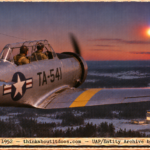
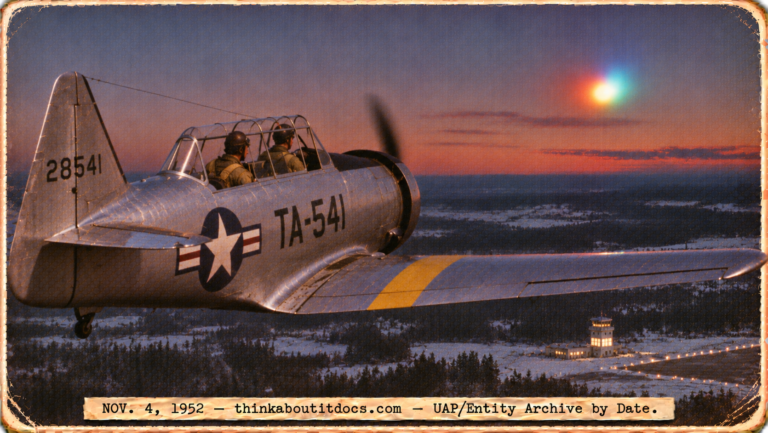
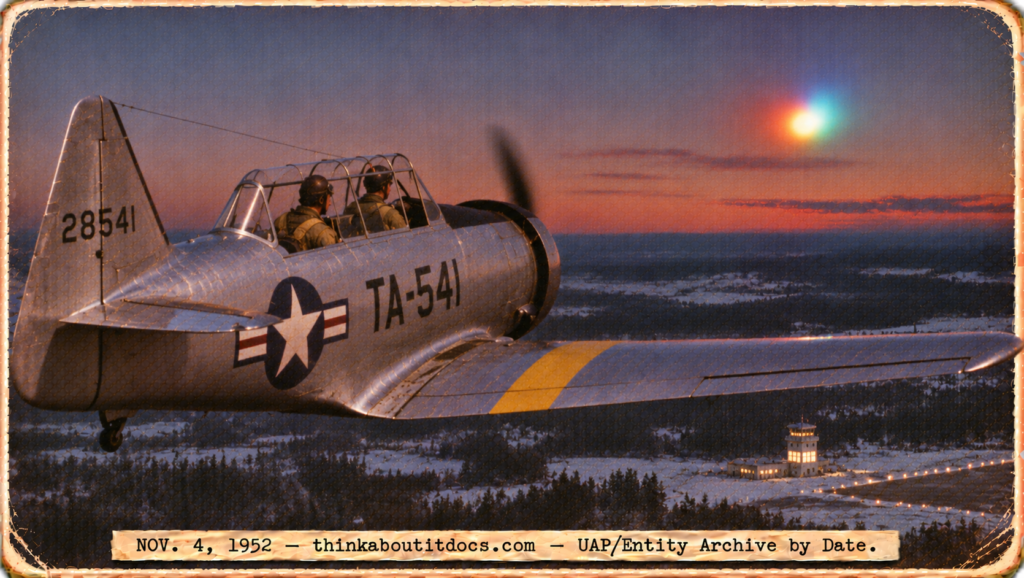
At about 5:28 p.m. on November 4, 1952, the crew of a T-6 flying at about 2,500 feet near Caribou, Maine saw a light low in the west that shifted between red, orange, blue-green and white. They watched it for about 35 minutes. A second pilot flew roughly 40 miles toward it, and the Presque Isle tower operator logged it too.
The pilot concluded it was a star or planet refracted through the atmosphere, and Blue Book agreed. The tower operator at first called it too large for a star.
Date: November 4, 1952
Sighting Time: About 5:28 p.m. EST (1728)
Day/Night: Night
Location: Caribou, Maine, with observations at Presque Isle AFB
Urban or Rural: Rural
No. of Entity(‘s): None reported
Entity Type: Not applicable
Entity Description: Not applicable
Hynek Classification: NL (Nocturnal Light)
Duration: About 35 minutes
No. of Object(s): 1
Shape of Object(s): A light
Size of Object(s): Called too large for a star by the tower operator
Color of Object(s): Red, orange, blue-green and white
Distance to Object(s): Not recorded
Height & Speed: Observer at about 2,500 feet; the light was 10–25 degrees above the horizon to the west, roughly 250 degrees from Limestone
Number of Witnesses: Several (the T-6 crew, a second pilot, a tower operator, and a Northeast Airlines crew)
Special Features/Characteristics: Disappeared and reappeared several times; the GCI station at Caswell had no targets; a second pilot flew about 40 miles toward it
Case Status: Probably a star or planet (Blue Book)
Source: Blue Book file (T-6 crew statements, Presque Isle AFB tower report); Project 1947
Summary/Description: A T-6 crew near Caribou saw a red-orange-blue-green-white light low in the west for about 35 minutes on November 4, 1952. A second pilot flew toward it and the tower reported it. Blue Book concluded probably a star or planet.
Related Cases: Other early-November file cases on the November 1st–15th page
DETAILED REPORT
A T-6 crew flying at about 2,500 feet saw a light in the west, 10 to 25 degrees above the horizon, roughly 250 degrees from Limestone. It shifted through red, orange, blue-green and white. They watched it for about 35 minutes.
A second pilot flew about 40 miles toward it. The ground-control station at Caswell had no targets. At 1736 the Presque Isle tower operator reported it as too large for a star, red, amber and green, disappearing and reappearing several times and moving rapidly. A Northeast Airlines crew later said it was probably a star.
The T-6 pilot concluded it was a star or planet refracted through the atmosphere, and Blue Book agreed. The earlier listing’s four-hour duration and 8,500-foot altitude are not supported by the crew statements.
RESEARCHER’S NOTES
Caribou 1952: A Color-Changing Light and a Reasonable Answer
- Conflict with the live listing: The earlier listing gave 5:30–9:30 p.m., four hours and 8,500 feet. The statements give about 35 minutes and 2,500 feet.
- The explanation: A bright star or planet low in the west explains the color shifts and the reappearances, and the pilot reached that view himself.
- The tower report: The tower operator’s “too large for a star” shows the impression was strong before the explanation settled it.
- Chase: A 40-mile flight toward it without closing is typical of a distant celestial body.
Caribou is a well-observed case with a persuasive natural answer. It is worth keeping as an example of a crew’s changing opinion once the evidence was weighed.
“Within the time that I observed the light it disappeared and reappeared several times; this fact made me disbelieve it was a star.”
— Presque Isle AFB tower operator’s statement, Maine, November 4, 1952 (Blue Book file; OCR)