The "one-eyed little man" of St. John the Divine, framed honestly — no witnesses, no date, a cyclops out of myth, and a source who died in 1959. An early-1950s New York urban legend, logged Insufficient Data.
THINK ABOUTIT ENTITY SIGHTINGS REPORT
1952: Alien found in New York City New York
A one-eyed little man, found dead by workmen on the scaffolding of one of the world’s largest cathedrals, quietly carted off by the Army, leaving nothing behind — it is a perfect campfire story, and that is almost certainly all it is. The “1952 NYC alien” has no named witnesses, no date more precise than “summer,” no newspaper, no document, and a creature lifted straight from Greek mythology: a cyclops. Its lone cited source is the ufologist Morris K. Jessup by way of a 1993 magazine — except Jessup died in 1959, which makes the attribution as printed impossible. Strip away the gothic backdrop and the post-Roswell “the Army took the body” flourish and what remains is not a sighting report but a piece of mid-century urban folklore, and the archive’s job here is to label it as exactly that rather than dress it in a classification it cannot wear.
Date: Summer 1952 (vague; no specific date recorded)
Sighting Time: Afternoon (as stated; unverifiable)
Day/Night: Day
Location: Cathedral of St. John the Divine, Morningside Heights, Manhattan, New York City
Urban or Rural: Urban (corrected from “Rural” — the cathedral sits in upper Manhattan)
No. of Entity(‘s): 1 (claimed; found deceased)
Entity Type: Folkloric humanoid — “cyclops” type (claimed)
Entity Description: A small “little man” with a single eye in the middle of the forehead. No other anatomical detail is given. The single-central-eye motif is a classical mythological figure (the cyclops), not a described extraterrestrial morphology
Hynek Classification: None applicable — no craft, light, or object was reported, and the “being” was reportedly found dead rather than observed as an animate entity. The page’s CE-III is doubly inapplicable (see notes)
Duration: N/A (a body reportedly discovered, not an observed event)
No. of Object(s): 0 — no craft, light, or object of any kind was reported
Description of the Object(s): N/A — none
Shape of Object(s): N/A
Size of Object(s): N/A
Color of Object(s): N/A
Distance to Object(s): N/A
Height & Speed: N/A
Number of Witnesses: None named or recorded (unidentified “workers”)
Special Features/Characteristics: A “body found” claim with no craft; a folkloric one-eyed creature; the report that the Army was notified and removed the body (a standard evidence-disappears legend motif); no witnesses, no date, no documentation
Case Status: Insufficient Data — undocumented urban legend (impossible source attribution as cited; no witnesses, no record; folkloric creature — see notes)
Source: Attributed to Morris K. Jessup, cited via UFO Universe (Spring 1993). Note: Jessup died in April 1959 and could not have authored a 1993 report; at most this is a 1950s-era Jessup anecdote recycled in the 1993 magazine. No primary source, witness, or contemporaneous record has been located
Summary/Description: An undated “summer 1952” tale that unidentified workers on the scaffolding of the Cathedral of St. John the Divine in Manhattan found the body of a small man with a single central eye, and that the Army was notified and removed it. No witnesses are named, no documentation exists, and the only cited source is an attribution to Morris K. Jessup via a 1993 magazine that postdates Jessup’s death by 34 years. The account has the structure and content of an urban legend rather than a documented event.
Related Cases: Other “alien body recovered / Army took it” legends (the 1950 Albuquerque crash orphan, retained in this archive as an unsourced derivative; the Aztec hoax) | folkloric one-eyed beings in classical and medieval tradition; New York City landmark urban legends
Full Report
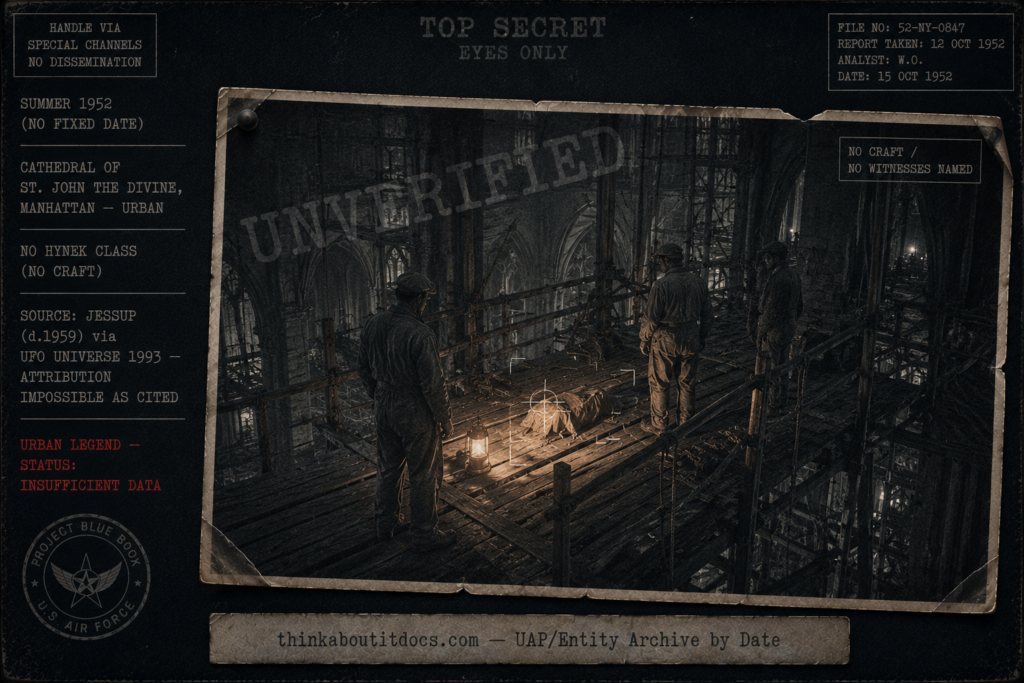
There is very little here, and the page itself concedes as much, closing the original entry with the words “no other information.” The tale is simply told: at some point in the summer of 1952, workmen on the high scaffolding of the Cathedral of St. John the Divine in Manhattan are said to have found the body of a small man with a single eye set in the middle of his forehead; the Army was reportedly notified and removed the body. No worker is named. No date is fixed. No newspaper, police blotter, or contemporaneous document is cited. There is no craft, no light, no landing — only a body, conveniently gone.
The source attribution is the first thing that collapses under examination. The case is credited to Morris K. Jessup, “reported in UFO Universe Spring 1993.” Jessup was a real and once-influential ufologist — author of The Case for the UFO (1955) and a figure entangled in the Philadelphia Experiment lore — but he died on April 20, 1959, his death ruled a suicide by carbon-monoxide poisoning in a Florida park. A man dead since 1959 cannot have reported anything in a 1993 magazine. The most charitable reconstruction is that the anecdote originated in Jessup’s 1950s writings or talks and was later recycled in the Spring 1993 issue of UFO Universe, a Timothy Green Beckley magazine that frequently revisited vintage saucer lore. Either way, the citation as printed is impossible, and the real chain — a decades-old anecdote re-surfacing in a 1990s popular magazine — is exactly the kind of provenance that should lower confidence, not lend “legendary status.”
The content points the same direction. A “little man with one eye in the middle of his forehead” is not an anatomical observation; it is a cyclops, one of the oldest monster-figures in the Western imagination, from Homer’s Polyphemus onward. When a 1952 anecdote produces not a gray, not a Nordic, not any of the described entity types of the period but a textbook figure of classical myth, the likeliest explanation is that the story is drawing on folklore rather than reporting biology. The closing beat — the Army arriving to spirit the body away — is the standard “the evidence was removed” motif that hardened into convention after Roswell, and it performs the same narrative function every time: it explains, in advance, why nothing can ever be checked.
The setting is well chosen, as good legends’ settings are. The Cathedral of St. John the Divine is real, enormous, and famously unfinished — “St. John the Unfinished,” perpetually wrapped in scaffolding — which makes “workmen high on the scaffolding” a plausible and atmospheric stage. But an evocative true setting is a feature of many tall tales, not evidence for them. The cathedral has accreted more than one piece of New York mystery-lore over the decades; this is one of them.
What this entry is not is a documented sighting. It has no witnesses to interview, no date to check, no record to pull, an impossible citation, and a creature out of myth. It is an urban legend of the early Cold War period, and it is most useful — and most honestly handled — when filed as folklore, not as a CE-III.
Researcher’s Notes
The Cyclops of St. John the Divine — New York 1952 and the Anatomy of a Legend
- Classification — the CE-III fails twice over: Hynek’s CE-III requires animate beings observed in association with a UFO. This account has no craft, light, or object of any kind, and the “being” was reportedly found dead rather than observed alive. It therefore fails the definition on both elements — no object, no animate observation — and no Hynek close-encounter class applies. The label should be removed, not reassigned. This is the same craftless-entity error corrected on the 1952 Oregon page, compounded here by the fact that there was no live entity to observe at all.
- Source chain — impossible as cited: Morris K. Jessup died in April 1959; he cannot have reported this in a Spring 1993 magazine. The citation conflates Jessup (the presumed 1950s originator of the anecdote) with UFO Universe (the 1993 venue that recycled it). The corrected source line should make that explicit and flag that no primary source, named witness, or contemporaneous document exists. An impossible attribution is not a small footnote; it is a sign the entry was assembled without checking, and it should lower the case’s standing rather than lend it “legendary” weight.
- Pattern context — folklore, not phenomenon: The case is built from recognizable legend components: a mythological creature (the cyclops), an iconic and genuinely mysterious landmark, anonymous laborers as witnesses, and the post-Roswell “Army removed the body” device that pre-explains the absence of evidence. It belongs beside the archive’s other recovery legends — the 1950 Albuquerque orphan, the Aztec hoax — as a specimen of how mid-century anxieties and older myths fuse into a “true story” with no one in it who can be found. The recently added page commentary, which speculated about “interdimensional manifestation within the cathedral,” is precisely the credulous embellishment that turns a thin legend into apparent substance and should be replaced with this sober framing.
- Evidentiary weight — essentially nil: No witnesses, no date, no document, an impossible citation, a folkloric creature, and a self-sealing “the evidence was taken” ending. There is nothing here to test. This is not a hoax in the sense of a demonstrated deliberate fabrication, so it is not logged Explained; but its evidentiary weight is effectively zero. The honest disposition is Insufficient Data, filed and labeled openly as an undocumented urban legend, retained for transparency rather than presented as a recovered “alien body.”
The record’s honest final position is that the cyclops of St. John the Divine is folklore, not a case. Everything that would make it checkable is missing, the one thing offered as a source is chronologically impossible, and the creature at its center walked out of Greek myth rather than off a flying saucer. The archive keeps it the way it keeps its other legends — visible, dated as vaguely as it deserves, the CE-III stripped, the Manhattan location corrected, and the whole thing labeled for what it is: a well-set, often-retold New York tall tale of the early 1950s. Logged Insufficient Data, flagged as urban legend, and left without the costume of a classification it was never entitled to wear. Not every entry in a sightings archive is a sighting; some are stories about sightings, and saying so plainly is the difference between a record and a rumor mill.