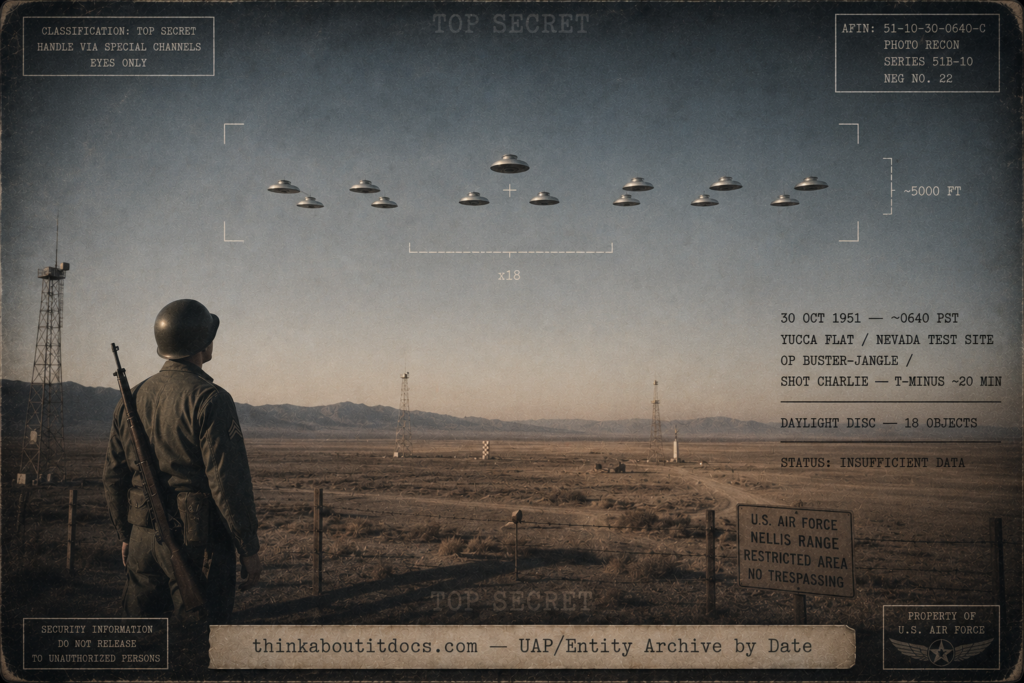
October 30, 1951 — roughly 20 minutes before Buster-Jangle Shot Charlie, a sentry counts eighteen domed discs over the target zone, arranged "like ten-pins down a bowling alley."
THINK ABOUTIT UFO | UAP SIGHTING REPORT
1951: Squadron of Discs Fly over Atomic Test Site
Fifteen or twenty minutes before an atomic bomb was scheduled to fall on Yucca Flat, a nineteen-year-old Air Force sentry standing watch on the desert perimeter — sun at his back, eyes on the target zone — saw three silvery domed discs hanging in the dawn sky where no aircraft was permitted to be. By the time the Corporal of the Guard reached him, the three had become eighteen, arrayed in six neat groups of three across the horizon “like looking down a bowling alley at ten-pins.” They held, then tilted upward and were gone in seconds. The Corporal’s only comment was that if they were smart, they would say nothing. For thirty years, the witness said nothing — until investigator Walter Webb reached him in 1981 and proved, from the man’s own recollection of the bomb’s yield, that he had indeed been standing at the Nevada Test Site on the one October morning the numbers allowed.
Date: October 30, 1951 (witness recalled “October”; investigator Walter Webb fixed the date via the Operation Buster-Jangle test schedule — Shot Charlie)
Sighting Time: Approximately 6:40–6:45 a.m. PST (roughly 15–20 minutes before the 7:00 a.m. detonation)
Day/Night: Day (early morning, shortly after sunrise)
Location: Yucca Flat, Nevada Test Site (witness stationed at Nellis Air Force Base, Las Vegas; observing post approximately 5–6 km / 3–4 miles east of Ground Zero)
Urban or Rural: Rural (remote desert test range)
No. of Entity(‘s): 0
Entity Type: None reported
Entity Description: N/A — no occupants or figures observed
Hynek Classification: DD (Daylight Disc)
Duration: Disputed — 1964 account: hovered 10–15 minutes; 1981 account: total observation roughly 30 seconds to one minute (see notes)
No. of Object(s): 18 (initial trio observed, then a full formation of 18 noted)
Description of the Object(s): Silvery, shiny objects reflecting the early morning sun, each with a flat bottom and a dome on top; no other features visible; no sound at distance
Shape of Object(s): Disc / elliptical with dome (domed disc)
Size of Object(s): Indeterminate — witness could not give a reliable angular size 30 years after the fact
Color of Object(s): Silver / metallic, sunlight-reflecting
Distance to Object(s): Estimated several kilometers toward the target zone; object altitude estimated up to ~600 meters (a few thousand feet), though geometry is uncertain (see notes)
Height & Speed: Objects hovered at altitude over the target area, then departed upward at an angle and vanished within seconds; no speed measurable
Number of Witnesses: 3 — the primary witness (“Mr. M.”), a second USAF guard, and the Corporal of the Guard
Special Features/Characteristics: Formation flight of 18 domed discs in six groups of three; appeared over an active nuclear test site minutes before a scheduled detonation; arrival of the larger formation went unobserved; no aircraft permitted over the range; instructed silence by the Corporal of the Guard
Case Status: Insufficient Data (investigator classified it “an unknown”; archive logs Insufficient Data on evidentiary grounds — see notes)
Source: NICAP / Nuclear Connection Project; investigation and report by Walter N. Webb (MUFON Consultant), March 8, 1981; web page prepared by Francis Ridge, 2003, from material submitted to MUFON by Webb, copies provided by Jan Aldrich (nicap.org/armada51.htm)
Summary/Description: An anonymous former Air Force corporal reported that, while on sentry duty at the perimeter of the Nevada Test Site shortly before a 1951 atomic detonation, he and two other guards observed a formation of 18 silvery domed discs hovering over the target zone. The objects held position briefly, then departed upward and vanished within seconds. Investigator Walter Webb used the witness’s recollection of the test sequence and yield to fix the date as October 30, 1951 (Buster-Jangle Shot Charlie), and concluded the witness had genuinely been present at the site. Webb classified the sighting as an unknown.
Related Cases: 1950 Farmington, New Mexico “saucer invasion” (mass-flight flap attributed by Ruppelt to skyhook balloon fragments — cited in the source as a cautionary comparison) | 1947 mass-formation reports catalogued in Ted Bloecher’s UFO Wave of 1947 | 1974 Rock Lake, Wyoming flyover of ~35 silvery discs (cited by Webb) | nuclear-facility overflight thread (Los Alamos/Sandia 1948–1950 green fireballs | later ICBM-site cases)
Full Report
The case rests entirely on a single primary witness, interviewed by Walter Webb across a sixteen-year gap, and its credibility is best understood as a question of how that witness was vetted. Webb first encountered “Mr. M.” not as a UFO informant but incidentally, in 1964, while investigating an unrelated creature report in a Massachusetts cemetery; the man mentioned, almost in passing, that he had seen UFOs in Nevada during his Air Force service. Webb recorded the detail and set it aside. He did not return to it until February 1981, when he reopened the file and tracked the witness to the same apartment building. The man was reluctant — he had been ridiculed over the 1964 episode and declined to meet in person — but agreed to be drawn out by telephone on the condition of strict confidentiality.
What the witness described was this. In 1951 he was a nineteen-year-old Air Force corporal at Nellis AFB who had volunteered for sentry duty at the perimeter of the Atomic Energy Commission’s new Nevada Test Site at Yucca Flat. On the morning of one of the early shots in a seven-test fall series, posted several kilometers east of Ground Zero with the rising sun behind him, he glanced toward the target zone and saw three silvery, domed, flat-bottomed objects hovering in the clear sky. They were arranged in a horizontal triangle, the nearest pointing toward him — the image he reached for was looking down a bowling lane at the pins. He and a second guard called for the Corporal of the Guard, and by the time that man arrived the original three had become eighteen, stretched across the sky in roughly six groups of three. None of the three witnesses had seen the larger formation arrive. After a brief interval the entire array tilted upward and disappeared within seconds. The Corporal’s instinct was suppression: better, he said, to keep quiet. The detonation followed some fifteen to twenty minutes later.
The investigative core of the case is Webb’s date reconstruction. Working from the witness’s recollections, Webb contacted the Union of Concerned Scientists and obtained the dates, times, burst heights, and yields of the 1951 Nevada tests from the standard reference, The Effects of Nuclear Weapons. Two test series ran that year: Operation Ranger (five shots, January–February) and Operation Buster-Jangle (seven shots, October–November). The witness independently and correctly recalled that his test was in the fall series, that it was the second or third shot, that it occurred in October, that it happened roughly half an hour after sunrise, and — critically — that the yield was between 10 and 20 kilotons. Only one shot in the entire series fit that yield bracket: Charlie, an air-drop of about 14 kilotons on October 30, 1951, detonated at 7:00 a.m. PST. The small sub-kiloton Able shot was excluded because it fired before sunrise. As Webb noted, this chain of verified detail does not prove a UFO was present, but it strongly establishes that the witness was in fact stationed at the test site when and where he claimed.
Webb addressed the conventional explanations directly. The appearance and behavior — domed discs hovering in disciplined formation, then accelerating vertically out of sight — do not match aircraft, helicopters, blimps, or balloons, and no such craft, least of all a mass flight, would have been cleared over an armed test range minutes before a drop. He also placed the report against the broader history of “mass flight” sightings, noting from Bloecher’s 1947 survey that formations of eighteen or more were not rare in the record, and candidly listing the mundane culprits that have explained some of them: high-flying bird flocks, drifting seed fibers and gossamer, radar chaff, and balloon clusters. He cited the 1950 Farmington flap — hundreds of “discs” that Ruppelt traced to the glittering fragments of a burst skyhook balloon — as a sobering example of how a dramatic mass sighting can dissolve under scrutiny.
The witness himself supplied the case’s most useful internal check by contradicting his own earlier account. In 1964 he had told Webb the discs rotated and hovered for ten to fifteen minutes; in 1981 he did not recall any rotation and put the entire observation at thirty seconds to a minute. Webb, to his credit, flagged the discrepancy rather than smoothing it over, suggesting the longer “ten to fifteen minutes” may actually have referred to the interval between the sighting and the detonation rather than the duration of the sighting. He was equally frank that the witness’s size and elevation estimates, made three decades later, were too uncertain to support any geometric reconstruction. Having weighed all of this, Webb stated his own conclusion plainly: he tended to accept the man’s account and believed the sighting should be classified as an unknown.
Researcher’s Notes
The Eighteen Over Yucca Flat — Nevada Test Site 1951 and the Single-Witness Standard
- Classification — DD is correct, with no entity or close-encounter elements: The existing DD (Daylight Disc) label holds without qualification. This is a daytime observation of multiple metallic discs at distance, with no occupants, no landing, and no physical interaction — squarely Hynek’s Daylight Disc category. No CE class applies and none should be inferred. Worth recording for cross-referencing: the source also carries two legacy catalogue codes — UFOCAT Strangeness Type 3 and Vallée Type III-B (an object that halts and hovers before resuming motion) — which describe the reported flight behavior but do not alter the Hynek classification.
- Source chain — high-quality investigator, single-thread testimony: The provenance is strong on the investigative side and thin on the evidentiary side, and both facts matter. Walter N. Webb was a serious, credentialed investigator (a Hayden Planetarium lecturer and the principal investigator on the Hill abduction case), his methodology here was sound, and the documentary trail — MUFON report, NICAP/Nuclear Connection Project hosting by Francis Ridge, distribution copies via Jan Aldrich — is clean and traceable. But the case itself is a single-thread account: one named-to-investigator-only witness, anonymous in the record, recalling the event first 13 and then 30 years after it occurred, with two further guards who are entirely unidentified and were never interviewed. The strength is the investigator; the weakness is that nothing corroborates the sighting independently of the man’s memory.
- Pattern context — the nuclear-connection thread: The case’s enduring interest is its placement in the well-populated pattern of UFO activity reported over atomic and nuclear-weapons facilities in this era — Los Alamos and Sandia, the 1948–1950 “green fireball” wave over the New Mexico labs, and the later ICBM-site reports. The witness himself drew the obvious inference, that the objects were monitoring the test. As pattern data the report fits the thread well; as evidence for it, it carries the same single-witness limitation noted above. It belongs in the nuclear-connection file as a reported instance, not as a load-bearing one.
- Physical evidence and the date-verification paradox: There is no physical trace, no photograph (the accompanying sketch is explicitly the investigator’s own interpretation, not the witness’s), no instrumented record, and no second documented observer. What the case does have is the inverse of the usual problem: the context is verifiable even though the event is not. Webb’s reconstruction genuinely narrows the date to October 30, 1951, and establishes the witness’s presence at the site — a real and unusual evidentiary asset. But that asset authenticates the man’s location, not the discs. Combined with the self-contradicted duration and rotation details and the total absence of corroboration, the honest evidentiary weight is low-to-moderate. This is why the archive logs the case as Insufficient Data rather than adopting Webb’s “unknown”: the verified facts establish that the witness was where he said he was, but the sighting itself cannot be confirmed, explained, or independently supported, and it would be misleading to file a thirty-year-old single-witness recollection under the same status as a documented multiple-witness or instrumented event. Webb’s conclusion is reported faithfully; the status reflects the evidence.
The archive’s honest final position on this case is one of respectful suspension. The man at the fence was, by the investigator’s careful reconstruction, exactly who and where he said he was — a sentry at Yucca Flat on the morning of Shot Charlie, October 30, 1951 — and that verified context lends his story a weight most thirty-year-old recollections never earn. But context is not corroboration. Eighteen domed discs over a nuclear target, seen by three men and recorded by none, surviving only in one reluctant memory revisited across decades, is a compelling report rather than a demonstrated fact. Walter Webb believed him and logged it an unknown; the record here logs it Insufficient Data, and the difference is precisely the line this archive tries to hold. If the objects were real, the witness’s own intuition may be the truest line in the file — that whatever they were, they had come to watch.
Report
This sighting; if true, may be unprecedented. It is unusual because of the large number of UFOs reportedly observed at one time in combination with the supersensitive location and timing of the event. On November 18,1964, I happened to be investigating a Boston newspaper story which found me prowling around a West Quincy (Boston suburb), Massachusetts, cemetery in search of some sort of weird nocturnal creature (see my; NICAP report, ” ‘The Watermelon Caper.’–November 13-14, 1964″). Although I later concluded the Little beast WAS probably an owl or other known animal, the uncle of the initial witness told me, during the course of the investigation, that he had sighted, UFOs in Nevada when he was in the service.
I wrote the following at the end of my 1964 report: “He (I’ll call him “Mr. M.”) thought the observation might have been made in 1951. He was with a group of servicemen at Yucca Flat and just before a nuclear test was due to go off, they all saw a formation of 18 silvery, rotating, disc-shaped objects, each one with a dome, come down over the test site, hover for 10 to 15 minutes, and then depart, at an angle, vanishing out of sight in seconds.”
At the time I was concentrating upon the investigation at hand and was more interested in securing details from Mr. M. about the creature seen by him and the. .neighborhood kids- in the cemetery. Moreover, I was somewhat skeptical about his story of a UFO armada.
UFOCAT Strangeness Class–Type 3 (UFO in trajectory with .single discontinuity)
Vallee Class–Type III-B (UFO halts in flight and hovers before resuming motion)
Recently I opened my “sightings pending” folder and attempted to contact some of the witnesses in cases that were never followed up for a number of reasons. One of these individuals was Mr. M.. Although 16 years had elapsed since my interview with him, I discovered that he still resided at the same apartment house but in a different apartment. I telephoned him on February 28, 1981, and re-introduced myself. However, he seemed reluctant to discuss the 1951 episode and, in fact, politely refused to grant a face-to-face interview. As I drew him out, it appeared he received such ridicule from the police and others during the ’64 incident that he understandably shied away from any future involvements of a similar nature. I assured him that his name would be kept confidential, that it was important such UFO sightings become part of the written record, that I had interviewed many others, and, in fact, was at UFO eyewitness myself. He seemed to loosen a bit although he still declined to see me in person. And so I began asking questions over the telephone. Under the circumstances, I felt very fortunate to have been able to extract the following account from Mr. M.
THE SIGHTING
In 1951 Mr. M. was an Air Force corporal stationed at Nellis Air Force Base, Las Vegas, Nevada. That same year the Atomic Energy Commission established the Nevada Test Site and began detonating nuclear devices at Yucca Flat (about 120 kilometers, or .75 miles, northwest of the base). He recalled that during one of the first tests — perhaps the second or third in a series of seven–he was among those at Nellis who volunteered for sentry duty at the perimeter of the AEC site. When asked if he could pin down the date, he said “October sticks in my mind” although he couldn’t be absolutely certain. The time of the sighting was early morning after sunrise and occurred perhaps 15 or 20 minutes before the detonation.
Armed with these clues, I called the Union of Concerned Scientists in Cambridge, Massachusetts, and spoke to Paul Walker. I had already learned there were 12 nuclear tests in Nevada during 1951 and now wanted to know the dates, times, and code names of each of the tests. Walker not only had that information but also the height of the burst and the yield. His source was the book, The Effects of Nuclear Weapons, edited by Samuel Glasstone and published jointly .by the Department of Defense and the AEC in April, 1962.. There were two series of tests in Nevada during 1951. The first one was called Operation Ranger and consisted of five detonations in. January and February.
The final seven-shot sequence. was Operation, Buster-Jangle in October and November. Three of those tests—Shots Able, Baker, and Charlie–occurred, respectively, on October 22 at 6:00 a.m. PST; the 28th at 7:20 a.m.;. and the 30th at 7:00 a.m. Able was a small tower burst at 30 meters (100 feet), yielding less than 0.1 kiloton. Baker and Charlie .were air-drops, exploding at 341 and 345 meters (1118 and 1132 feet) above the desert floor with a force of 3.5 and 14 kilotons, respectively. Able was ruled out immediately since the UFO sighting would have had to take place 10 or 15 minutes before sunrise. When I reached Mr. M again on March 5, I asked him if he. could remember how soon after sunrise his UFO observation had happened. He replied that it must have been a half hour or so. Both Baker and Charlie qualified. When I asked the witness about the size of the explosion, he recalled it was between 10 and 20 kilotons. This narrowed down the date to October 30. (Local sunrise on that date, 6:00.)
Mr. M., who was 19 years old at the time (on November 3), thought his post was several kilometers–perhaps five to six (three to four miles)–east of Ground Zero, which would place the sun at his back. Suddenly, as he glanced at the clear sky in front of him, he perceived three silvery, elliptical. objects hovering in the direction of the. target zone and at an estimated height of up to 600 meters (a few thousand feet). Time: approximately 6:40-45, as determined by the known time of the detonation 15 to .20 minutes later. Each object possessed a flat bottom and a dome on top. No other features were visible. The UFOs were arranged in a horizontal triangle, with one object positioned in. front toward the observer and the others in back to either side. The analogy Mr. M. used was “like looking down a bowling alley at ten-pins.” The UFOs were shiny and reflected the early morning sunlight. No sound could be detected from that distance.
The prime witness and another guard, who also saw the objects, turned to get the attention of the Corporal of the Guard. When the latter arrived, Mr. M. noticed an armada of other discs had joined the original trio. They were all arranged in about six groups of three stretched out in a horizontal row. Apparently, none of the three witnesses saw the huge formation arrive. Mr. M. remembers he had time to count a total of 18 discs.
“After perhaps “30 seconds to a minute” (total observation time), the entire UFO formation abruptly departed upward at an angle and. vanished in seconds. The Corporal of the Guard said something like “if we’re smart, we; won’t say anything about this.” Mr. M. never heard any mention of the sighting again. No conventional aircraft appeared on the scene to pursue the UFOs since aircraft weren’t permitted over the test area (he doesn’t recall seeing or hearing the aircraft that dropped the nuclear device 15 to 20 minutes later).. However, the witness believes the UFOs’ presence undoubtedly was recorded somewhere. The objects themselves, he feels, must have been monitoring the test .He hinted that, as a consequence of his sighting, he believes UFOs are of extraterrestrial origin.
When I told Mr. M. that in 1964 he said the discs rotated and hovered for 10 to 15 minutes, he answered by saying he didn’t recall any rotation and the objects definitely weren’t visible that long. (Of course, it has been 16 years since he talked with me and 30 years since the sighting itself. Perhaps the longer time actually was a reference to the interval between the sighting and the nuclear detonation.)
During my March 5 telephone call, I asked the witness if he might attempt to estimate each UFO’s apparent size and angular elevation. Of course, it was understood such estimates made 30 years after the fact would be so uncertain as to be almost useless. Farther, the observer was unable to visualize the arm’s-length size comparison (he kept coming up with a 12- inch rule or pie plate, which would make the UFOs enormous). If the objects were five to six kilometers distant and 600 meters up, the .35-degree elevation value offered by the witness should be reduced to less than 10-degrees. If, on the other hand, the original elevation figure is in the right ballpark, then the objects .were actually much higher–say, 3000 to ‘4600 meters (10.000 to 15,000 feet) at he same distance. It seems to me that in order for the domed shapes to have been visible, it is quite possible the UFOs were closer to the witness. In such case, the witness’s initial angle estimate would again be in the right ballpark. The fact of the matter is that juggling the above figures is a rather useless exercise at this point in time.
I asked Mr. M. if he would mail a sketch of the UFOs and their formation, but he declined. Therefore, the drawings that accompany this report are the investigator’s own interpretation based upon close questioning of the witness on the telephone.
MASS FLIGHTS OP UFO’S
In an effort to determine just how prevalent such mass UFO flights are, I conducted a cursory survey of some of the literature, especially Ted Bloecher’s on the UFO Wave of 1947 (private printing, 1967). During the June, 1947 peak period covered by the Bloecher study, I found 16 sighting reports alone that referred to UFO formations numbering 18 or more. An unknown portion of. these probably have mundane explanations such as flocks of high-flying birds, airborne seed fibers (milkweed, cottonwood), spider gossamer, and clusters of balloons. One group of 50 to 60 night-flying discs (Case #554) ‘was even accompanied by the suspicious sound of “goose-like honking”: Nevertheless, there appeared to be a number of fairly reliable observations in the Bloecher collection describing UFO fleets composed of Mr. M.’s total or more, as follows: 18, 19, 20, 21, 20-30, two dozen (three :reports), 25..25-30, and 30. Groups of three discs in geometrical formation weren’t uncommon in the ’47 survey.
One of the most detailed and reliable accounts of a mass flight I happened to come across was investigated by APRO Consultant (psychology) R. Leo Sprinkle. It. was reported in The APRO Bulletin, December, 1975. On September 24, 1974, at. Rock Lake in Wyoming, a. pair of fishermen witnessed the flyover of approximately 35 silvery discs arrayed in an oval formation which emitted a droning noise like a beehive. At the end of the sighting, the objects began to climb at a steep angle and the sound ceased at that point. Then they accelerated rapidly out of sight.
On occasion such items as radar chaff discharged from military aircraft and exploding balloons account for some mass-flight sightings. The famous “saucer invasion” of Farmington, New Mexico, on March 17, 1950, proved quite literally to be a bust: Many of the town’s citizens asserted they watched hundreds of discs–from 500 to “thousands” — cavorting in the sky. Blue Book chief Ed Ruppelt in The Report on Unidentified Flying Objects (Doubleday, 1956), explained that a skyhook balloon burst near Farmington on the 17th, and the drifting pieces sparkling in the sunlight at very high altitude probably were responsible for the local flap.
EVALUATION
When I first heard Mr. M”s story 16 years ago, I must admit I was dubious. His hesitation in 1981 to allow a face-to-face interview is, in my judgment, satisfactorily explained by the official ridicule he suffered during the ’64 episode. I would describe the witness as “reluctantly cooperative.” During our telephone conversations, I was impressed by a number of things. Without any prompting from me, Mr. M. immediately referred to “18” as the number of UFOs he claimed he had seen during the ’51 sighting–the precise figure he gave me 16 years ago. And, as stated elsewhere in this report, such an armada of UFOs is, by no means, a rarity.
The witness had more than simply a passing knowledge of events at the AECNevada Test. site in 1951. I was able to eventually pin down the date of the experience using the information he recalled and checked against known dates, times, etc., for the nuclear tests that year. He correctly identified the total number of tests in the fall series of nuclear tests (seven) the test he attended (second or third in the series), the month of his sighting (October), the time (half hour or so after sunrise and 15 or 20 minutes before the detonation), and yield of the test (between 10 and 20 kilotons). This last bit of in formation was enough to permit selection of the final date since the October 30 test was the only one in the entire series that fit within the bracketed lower and upper limits given by the witness; other yields were either much lower or much higher. Thus, while this doesn’t necessarily prove Mr. M. had a UFO sighting, it does go a long way toward establishing that he was present at the atomic test site when he said he was.
The appearance and behavior of the UFOs described rule out conventional objects such as aircraft, helicopters, blimps, and balloons. In addition, no such objects would have been permitted over the test site just before the detonation– especially a mass flight!
Thirty years have elapsed since Mr. M.’s observation, and until now he has never reported it officially to anyone. I tend to accept his account of what he said, happened in Nevada on that October morning in 1951. Therefore, I believe this sighting should be classified as an unknown.
NAMES AND ADDRESSES OF WITNESSES
NOTE: THE PRIMARY WITNESS’S NAME, CURRENT ADDRESS, AND TELEPHONE NUMBER ARE TO BE KEPT STRICTLY CONFIDENTIAL AND ARE NOT TO BE PUBLISHED!
XXXXXXXXXXXXXXXXXXX
Unidentified USAF guards (2).
Walter N. Webb
MUFON Consultant
3/8/81
cc: Walter Andrus (MUFON)
Richard Hall (MUFON)
David Webb (MUFON)
XXXXXXXXXXXXXX

SKETCH OF UFO FORMATION FROM TELEPHONE
CONVERSATION WITH WITNESS (INTERPRETATION
IS ONLY AN APPROXIMATION)
(This web page was produced for the NICAP web site and the Nuclear Connection Project, March 15, 2003, by Francis Ridge, with material submitted to MUFON by Walter N. Webb. Copies provided by Jan Aldrich.)