About 25 witnesses watched a cigar-shaped object loop over New Delhi on March 15, 1951
THINK ABOUTIT UFO|UAP SIGHTINGS REPORT
1951: A cigar-shaped object loops over the Delhi Flying Club airfield
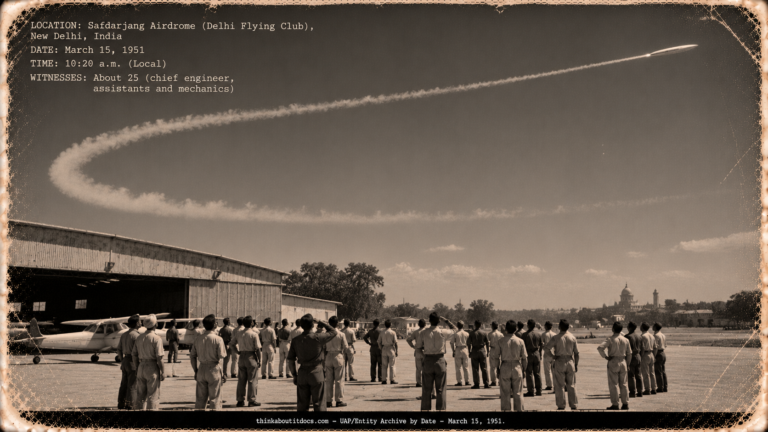
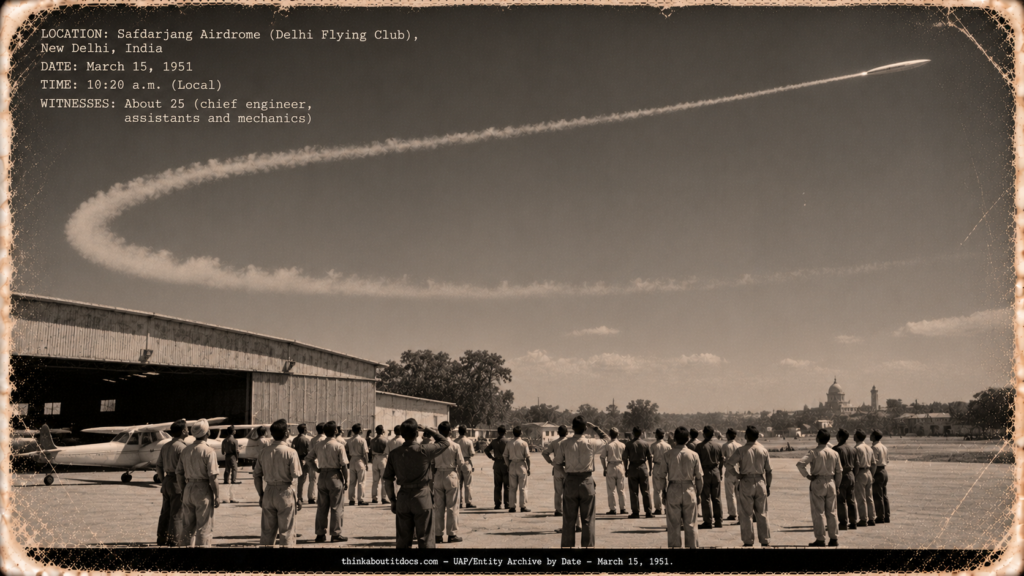
At 10:20 on the morning of March 15, 1951, about 25 mechanics and helpers at the Delhi Flying Club, working on a taxi strip at Safdarjang Airdrome in New Delhi, looked up at what began as a whitish cloud and became a pale metallic, cigar-shaped object about 100 feet long. It crossed the field from the north at 4,000 to 5,000 feet, passed to the south, came back in a very large loop, and left to the southwest at very high speed.
The club’s chief engineer, whom an Indian aviation research director called one of the best aerial engineers in India, told the same story as his helpers. Blue Book’s card says the flight was consistent with an aircraft, but that so many witnesses familiar with local planes should have recognized some feature of one. It lists the case as Unidentified.
Date: March 15, 1951
Sighting Time: 10:20 a.m. local (1020; 0450Z)
Day/Night: Day (clear, sun shining, 30-mile visibility)
Location: Safdarjang Airdrome (Delhi Flying Club), New Delhi, India
Urban or Rural: Urban airfield
No. of Entity(‘s): 0
Entity Type: None observed
Entity Description: Not Applicable
Hynek Classification: DD (Daylight Disc)
Duration: About 7 to 7.5 minutes
No. of Object(s): 1
Description of the Object(s): A cigar-shaped body of pale metallic color with no visible control surfaces. The card adds that it first looked like a whitish cloud about 700 feet long, then a bullet-shaped nose and a whitish tail about 100 feet long emerged. The exhaust was white and turned black at high speed. No sound.
Shape of Object(s): Cigar-shaped; bullet-shaped nose
Size of Object(s): About 100 feet long (report); initial cloud about 700 feet long (card)
Color of Object(s): Pale metallic; white exhaust that turned black at high speed
Distance to Object(s): Not recorded
Height & Speed: About 4,000 to 5,000 feet (card: 3,000 to 4,000 feet); speed erratic, slow with no smoke at times; top speed estimated at about three times the cruising speed of a British Vampire jet (card: about 2,000 mph)
Number of Witnesses: About 25 (the club’s chief engineer, his assistants and some twenty mechanics and helpers)
Special Features/Characteristics: Looped out of sight at the top and reappeared in its dive; exhaust trail persisted for over twenty minutes; the control appeared to be either manual or wireless, per the card
Case Status: Project Blue Book card: Other (Unidentified); the card comment says the principal witness was prone to exaggerate
Source: Project Blue Book record card; Air Intelligence Information Report from the U.S. Air Attache, New Delhi; Berliner; FUFOR Index
Summary/Description: About 25 Delhi Flying Club mechanics and helpers, including the chief engineer, watched a cigar-shaped object about 100 feet long cross their airfield, loop and leave to the southwest in about seven minutes, trailing a white exhaust that turned black when it sped up. Blue Book found the flight consistent with an aircraft but could not explain why so many aviation-familiar witnesses failed to recognize one, and carried it as Unidentified.
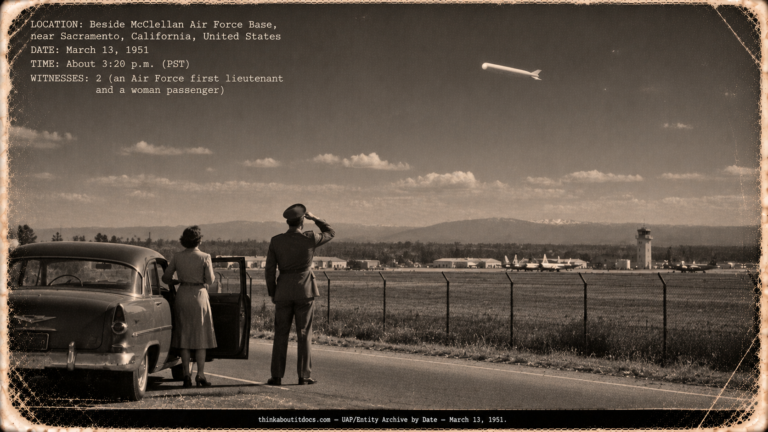
Related Cases: March 1951 UFO sightings archive | McClellan AFB, March 13, 1951
Detailed Report
The primary record is an Air Intelligence Information Report from the U.S. Air Attache in New Delhi, prepared on the instruction of the Director of Intelligence’s request for reports on unconventional aircraft, plus a Project Blue Book card. A later Air Force teletype adds that a search of the files found the India report on the sighting of a cigar-like object without surfaces over New Delhi on March 15, 1951, by the chief engineer of the Delhi Flying Club, and that no other report of a sighting in the vicinity of India was found. The witnesses’ names are redacted in the released copy.
The report says that on the morning of March 15, 1951, the chief aerial engineer of the club, along with his assistants and some twenty other mechanics and helpers, saw the object. When the reporting officer interviewed them, their stories were the same. The interviews were attended by Dr. P. Nilakantan, a California Institute of Technology graduate and director of a research and development laboratory under India’s Director General of Civil Aviation, who recommended the chief engineer as one of the best aerial engineers in India.
The object was shaped like a cigar with no visible control surfaces, about 100 feet long, of a pale metal color, and only one was seen. The exhaust was white except when speed increased, when it turned black. The engineer estimated the speed at about three times the cruising speed of a British Vampire. It came over Safdarjang Airdrome from the north at 4,000 to 5,000 feet, made one pass over the field to the south, then came back in a very large loop. At the top of the loop it was out of sight, then came into view again in its dive, and after levelling out left toward the southwest at very high speed. The exhaust smoke stayed visible for over twenty minutes.
It was sighted at 1020 local time and observed for about seven minutes while the witnesses were working on a taxi strip. The weather was clear with sun and 30-mile visibility, and the surface wind was from 300 degrees. The report describes the chief engineer as about 40 years old, licensed since 1935, with experience at the Madras Flying Club and other training and airline posts.
The Blue Book card describes an initial whitish cloud about 700 feet long that grew in length as a bullet-shaped nose and a whitish tail about 100 feet long emerged, with erratic speed, slow with no smoke and fast with black smoke, and a control that appeared manual or wireless. Its comment reads: flight and maneuvers consistent with analysis as aircraft, however the many witnesses should have been able to identify some feature of an aircraft since all were familiar with the local airplanes. The case is listed as Unidentified. The card also says the principal witness was prone to exaggerate.
Researcher’s Notes
Consistent With an Aircraft, Yet Unidentified
- Classification: DD is the closest Hynek class: a defined body seen in daylight, with no physical effects or entities.
- The Card’s Logic: The analyst says the flight looks like an aircraft, then declines to call it one because roughly 25 people who work with aircraft every day saw no wings, tail surfaces or other familiar feature. That is the reason the case stayed Unidentified; the card gives no other.
- The Witness Caveat: The same card says the principal witness was prone to exaggerate. The report, written after an interview attended by an Indian aviation research director, says all the stories were the same. The file does not show who made the exaggeration comment or why.
- Speed: The card gives a top speed of about 2,000 mph, and Berliner gives about 1,000 mph. The report itself gives only “about three times” a Vampire’s cruising speed, which is the witness’s relative estimate, with no baseline in the file.
- Size and Trail: The 100-foot length is a witness estimate. The whitish cloud of about 700 feet on the card and the trail that lasted twenty minutes are worth noting: a contrail-like persistent trail behind an aircraft at altitude is a possible ordinary explanation, though the report says no wings or surfaces were seen.
- Documentation: A card, an attache report and a later teletype confirming the file. The released copy has no sketch or witness statements.
- Official Status: Berliner lists it among March 1951’s Blue Book unknowns, with Chinnampo and McClellan.
The New Delhi case combines a large number of aviation-trained witnesses, a clear day, a signed attache report and a card whose own comment says the flight looked like an aircraft yet could not be matched to one. It is an Unidentified case with a credibility caveat attached by Blue Book itself.
“…the many witness should have been able to identify some feature of an a/c since all were familiar the local airplanes.”
Project Blue Book record card for the March 15, 1951 New Delhi sighting