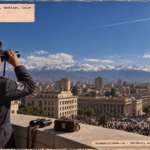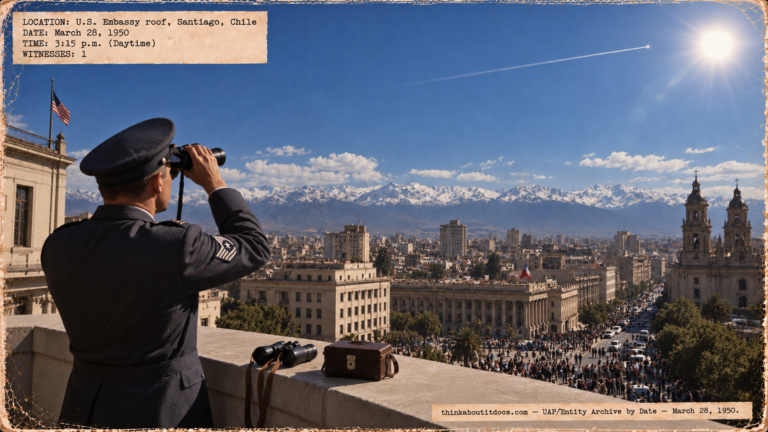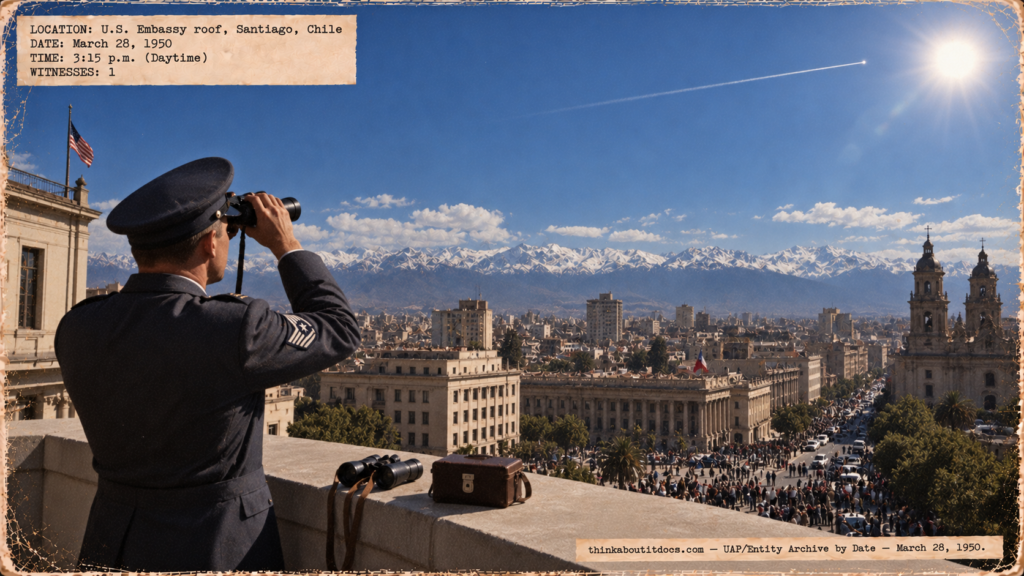
A U.S. Air Attache sergeant on the Embassy roof in Santiago saw a fast whitish object cross the sky on March 28, 1950.
THINK ABOUTIT UFO|UAP SIGHTINGS REPORT
1950: Santiago, Chile Embassy Roof UFO
On the afternoon of March 28, 1950, downtown Santiago, Chile, filled with people staring at the sky, and the U.S. Air Attaché’s office sent one of its own to look. Master Sergeant Prince Patterson, assigned to the office as a “502,” came back from his home past the crowds, went to the ninth floor of the U.S. Embassy, saw nothing, and then borrowed the Navy Attaché’s field glasses and climbed to the roof. His stated plan was to find the illusion, a cloud wisp or a reflection, and convince himself there was nothing there. He stayed an hour. At about 1515 he saw a whitish object cross from south to north at extreme altitude and speed, moving roughly 30 degrees of sky in five to ten seconds.
He ran for a telephoto camera and was back on the roof in time to see nothing. The Santiago, Chile Embassy roof sighting is the one Chilean report of the March 1950 wave that Project Blue Book left UNIDENTIFIED, and the sergeant’s own statement and diagram are in the Air Attaché’s report. His verdict on the public’s sighting the next day is in the same file: Venus.
Date: March 28, 1950
Sighting Time: About 3:15 p.m. (1515 hours per the sergeant’s statement; card time group 28/1930Z)
Day/Night: Day
Location: Roof of the U.S. Embassy building, Santiago, Chile
Urban or Rural: Urban
No. of Entity’s: Not Applicable
Entity Type: Not Applicable
Entity Description: Not Applicable
Hynek Classification: DD (Daylight Disc)
Duration: 5 to 10 seconds; the witness watched the sky for about an hour before the sighting
No. of Object(s): 1
Description of the Object(s): A small, high object moving in a straight line at extreme altitude and speed; no details could be made out, and it appeared to be more white than any other color
Shape/Size/Color of Object(s): Shape and size undetermined because of the height; more white than any other color; it was lost briefly in the sun’s glare and reappeared
Distance to Object(s): Extreme altitude; not estimated
Height & Speed: Extreme altitude and extreme speed; about 30 degrees of sky covered in 5 to 10 seconds; south to north
Number of Witnesses: 1 (M/Sgt. Prince Patterson, 6249735, assigned to the Air Attaché’s office as a 502). Crowds downtown were looking at the sky the same afternoon, but the file records no other named witness to this object.
Special Features/Characteristics: Air Attaché staff member who set out to disprove it; binoculars; an hour of continuous observation before the sighting; sun-glare diagram; camera fetched but the object was gone; public excitement across Santiago that day; the same sergeant’s next-day sighting was explained as Venus
Case Status: Unexplained. Project Blue Book’s record card concludes UNIDENTIFIED (NICAP: BBU 680).
Source: Air Intelligence Information Report IR-42-50, Air Attaché, Chile, 30 March 1950, prepared by Maj. Harry L. Mitchell, Assistant Air Attaché, approved by Lt. Col. Jay P. Thomas, Air Attaché, with the statement and diagram of M/Sgt. Prince Patterson; Project Blue Book (Project 10073) record card; NICAP 1950 UFO Chronology (Jan Aldrich; BBU 680)
Summary/Description: On March 28, 1950, M/Sgt. Prince Patterson of the U.S. Air Attaché’s office in Santiago, Chile, went to the Embassy roof with borrowed field glasses to disprove the crowds’ saucer reports. After about an hour he saw a whitish object cross from south to north at extreme altitude and speed, covering about 30 degrees of sky in 5 to 10 seconds, then went for a camera and could not find it again. Blue Book’s card concludes UNIDENTIFIED.
Related Cases: Punta Arenas, Chile (March 11, 1950); San Bernardo and Valparaiso, Chile (March 24-25, 1950); Mexico City reports (March 1950); Chile entries on the March Unknown Date page
Detailed Report
The Crowds
Flying discs were being seen across Chile that month. The Air Attaché’s report, written March 30 by the Assistant Air Attaché and approved by the Air Attaché, lists three waves. The first was at Punta Arenas on March 11 at noon, where many inhabitants saw a silver, ping-pong-ball-shaped object at extreme altitude move from northeast to southwest, and the Director of the University of Chile’s astronomical observatory, Prof. Frederico Rutland, told the press it was Venus. The second was in the Santiago area, San Bernardo and Valparaiso on March 24 and 25, reported by the public in the local press. The third was over Santiago on March 28 between 1330 and 1410, when the downtown area was crowded with people looking into the sky.
The Roof
In his statement, Master Sergeant Prince Patterson said he was returning from his home in Vitacure to the Embassy at about 1430 and noticed numerous people outside looking at the sky. He did not stop or talk to anyone until he reached the Embassy, where he went straight to the ninth floor and looked out the window. He saw nothing. He then borrowed a pair of field glasses from the U.S. Navy Attaché and went to the roof, with the sole thought in mind, in his words, of discovering some illusion, perhaps a cloud wisp or a reflection, and thereby convincing himself that nothing was in the sky. He spent about an hour on the roof scanning with his naked eyes and the field glasses. At about 1515 he detected an object traveling from south to north at extreme altitude and at an extreme rate of speed. He saw it with his naked eye and then through the glasses. The height made it impossible to determine any details beyond that it appeared to be moving in a straight line and looked more white than any other color. He watched it move about 30 degrees of sky in five to ten seconds. He decided to go back to the office for a camera with a telephoto lens to try to get a spot on film, but when he returned to the roof with it he could not find the object again. His diagram shows his position, the object’s first sighting and its reappearance after leaving the glare of the sun.
The Next Day
The Air Attaché’s comment records that on March 29 the same sergeant saw a silver, stationary object in the same relative position where the local public had seen one the day before. After careful observation he concluded it was the planet Venus and not a flying disc. Professor Rutland repeated his Venus statement to the press the same day, and the report notes that the local press headlined flying-disc dispatches from all countries reporting sightings.
The Card
The Project 10073 card lists the source as military, one object, 5 to 10 seconds of observation, ground-visual with binoculars, a south-to-north course and no photographs. It summarizes the observer’s routine and the object’s straight, extremely fast movement, and gives the conclusion as UNIDENTIFIED. A separate Chile card, covering the public reports, concludes Venus, with the director’s statement. A third card for March 24 and 25 is Insufficient Data.
RESEARCHER’S NOTES
A Debunker on the Roof, and One Thing He Couldn’t Explain
- The Witness Set Out to Debunk It: Patterson’s own statement says he went to the roof hoping to find a mundane cause. He spent an hour looking before he saw anything, and then described something he could not explain.
- A Different Object From the Crowd’s: The Air Attaché’s report separates the public’s stationary silver object, which Patterson himself judged to be Venus on March 29, from his own March 28 object, which crossed the sky in seconds. Blue Book’s cards keep them apart: the public reports are Venus and Insufficient Data, and Patterson’s is UNIDENTIFIED.
- Sun Glare: His diagram notes the object was lost in the glare of the sun and then seen again. The angles printed on the diagram (about 30 degrees) are hard to read in the scan.
- No Other Witness Named: The file records Patterson’s account alone. Nothing in it confirms that anyone else saw an object like his crossing the sky that afternoon.
- A Single Line From One Source: The ‘extreme altitude’ is inferred from his inability to see detail, and the file contains no measurement. The 30 degrees of sky in 5 to 10 seconds is the only quantitative figure.
- Report Reliability: The Air Attaché’s report bears an evaluation code that is hard to read in the scan, and it says its sources are newspaper reports and personal observations of Air Attaché staff.
The Santiago sighting is a short account by a trained military observer who went looking for an illusion and, after an hour, saw something cross the sky in seconds that he could not explain. It is filed here as Unexplained, in line with Blue Book’s UNIDENTIFIED card, with the caution that it rests on one witness, and that the same file shows the same sergeant correctly identifying the crowd’s object the next day as Venus.
“…discover some illusion, perhaps a cloud wisp or a reflection.”
From M/Sgt. Prince Patterson’s statement in the Air Attaché’s report on the March 28, 1950 Santiago sighting.