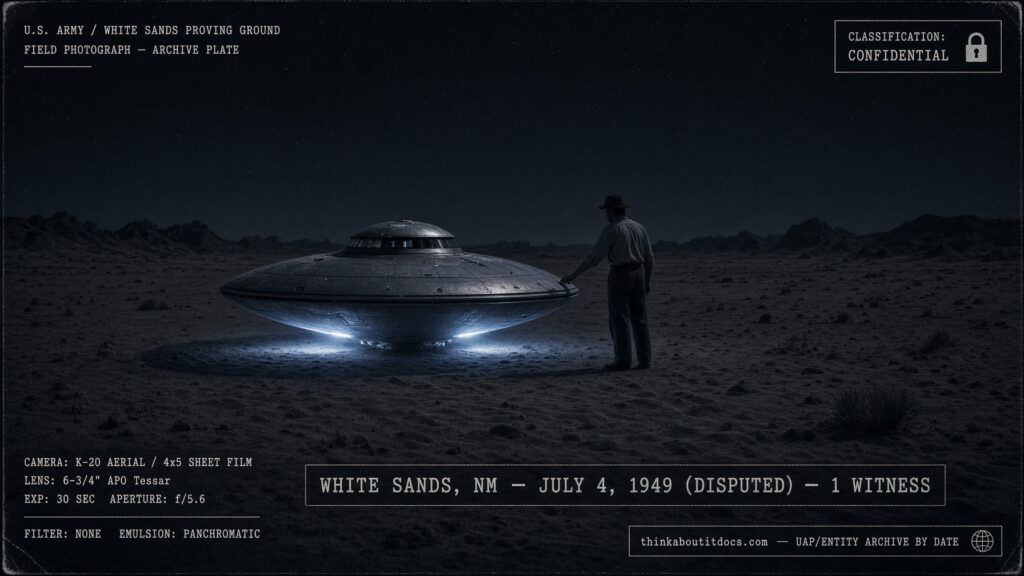
July 4, 1949 (or 1950, by Fry's own inconsistent accounts) — Daniel Fry's claimed contact at White Sands Proving Ground, New Mexico
THINK ABOUTIT UFO|UAP | ENTITY ENCOUNTER REPORT
1949: The White Sands Incident — Daniel Fry
Missing the last bus into town for Independence Day fireworks, a White Sands rocket technician says he took a walk into the desert instead — and came back claiming he had touched, entered, and ridden in a saucer-shaped craft after a lengthy conversation with its remote operator. Daniel Fry’s account would become one of the founding narratives of the 1950s contactee movement, and its date, even in Fry’s own later statements, was never fully settled.
Date: July 4, 1949 (date disputed — see Detailed Report)
Sighting Time: Evening (Fry’s account describes missing the last evening bus)
Day/Night: Night
Location: White Sands Proving Ground, near the Organ Mountains, New Mexico
Urban or Rural: Rural (desert proving ground)
No. of Entity(‘s): 1 (remote/telepresent operator, not physically present in the craft)
Entity Type: Human-appearing, claimed by Fry to be descended from a lost pre-Atlantean human civilization; identified himself as “A-Lan” (later rendered “Alan”)
Entity Description: Communicated by voice/telepathy; described by Fry as speaking English and holding an extended conversation about the craft’s propulsion and the entity’s origins; never physically seen in person by Fry, who was told the operator was controlling the craft remotely from a “mother ship”
Hynek Classification: CE-IV (Abduction/Transportation-type close encounter)
Duration: Several hours (by Fry’s account, including a round-trip flight to the New York area and back)
No. of Object(s): 1
Description of the Object(s): A landed, saucer/disc-shaped craft, silent, with no visible external openings until Fry was permitted to enter
Shape of Object(s): Disc/saucer-shaped
Size of Object(s): Approximately 30 ft in diameter, 16 ft high (per Fry’s account)
Color of Object(s): Metallic
Distance to Object(s): Landed at close range; Fry reported touching and entering the craft
Height & Speed: Fry claimed the craft flew him to the vicinity of New York City and back to White Sands within about 30 minutes total flight time, via a propulsion system he described using magnetic-field principles
Number of Witnesses: 1 (Daniel W. Fry)
Special Features/Characteristics: Contactee Narrative, Physical Contact Claimed, Round-Trip Transportation Claimed, Telepathic/Verbal Communication, Disputed Date, Later Commercial/Organizational Activity by Witness (self-published book, “Understanding” newsletter and organization)
Case Status: Insufficient Data — an unverified, single-witness contactee claim with no corroborating witness, physical evidence, or institutional investigation located in the sources consulted for this report
Source: Eberhart, George M. A Geo-Bibliography of Anomalies, Greenwood Press, Westport, 1980, ISBN:0-313-21337-2; Fry, Daniel. The White Sands Incident, 1954; Good, Timothy. Alien Base, 1998 (date controversy interview)
Summary/Description: Daniel Fry, an engineer and technician employed at White Sands Proving Ground on rocket instrumentation, said he had planned to join Independence Day festivities in nearby Las Cruces but missed the last bus. Finding his quarters uncomfortably hot, he decided to walk into an unfamiliar stretch of desert. There, he reported that a landed, saucer-shaped craft appeared to block out the stars; he touched it, and a voice — later identified to him as belonging to an entity calling itself “A-Lan” — invited him to enter, explaining that the craft was being flown remotely from a mother ship and that no physical pilot was aboard. Fry described being taken on a round trip to the vicinity of New York City and back over roughly 30 minutes of flight time, during which A-Lan discussed the craft’s propulsion, described his people as descendants of a lost pre-Atlantean human civilization that had achieved technological independence from any single planet, and urged Fry to share the experience publicly as a message of peace. Fry did not publish the account until 1954, in his self-published book The White Sands Incident, and went on to found the “Understanding” organization and newsletter around the narrative.
Related Cases: Not Applicable
Detailed Report
The date of this case is genuinely unresolved, and that dispute comes from Fry himself rather than from any error in this archive. Every edition of The White Sands Incident from its 1954 publication forward gave the date as July 4, 1950. Roughly a decade later, Fry told his publisher he wanted the date corrected to July 4, 1949, explaining in a later interview (recorded by researcher Timothy Good) that the 1950 date had been chosen deliberately as an “escape mechanism” — since Fry said he was not actually at White Sands on July 4, 1950, having not arrived there until later that month, a fact he said was verifiable by Proving Ground and Aerojet personnel. His publisher declined to change the printed date for marketing reasons. Fry continued to give both dates inconsistently in later years, including reportedly stating 1949 as late as a 1989 MUFON conference appearance. No independent employment or travel record resolving the question has been located in the sources consulted for this report.
Beyond the date question, the case is a single-witness contactee narrative with no corroborating observer, no photograph, and no physical trace evidence — Fry’s own account is the entirety of the record. He reportedly took and failed a polygraph examination at one point, which he dismissed as unreliable rather than treating as evidence against his account. The content of the narrative — a benevolent human-descended entity, message of planetary peace, propulsion by “magnetic field” principles, and a demonstration flight rather than any stated experiment or specimen collection — follows a pattern that would recur across many 1950s contactee narratives (Adamski, Bethurum, and others), of which Fry’s account is among the earliest.
Fry built a lasting organization, “Understanding,” and a monthly newsletter of the same name around the narrative, which continued in some form for over two decades and drew continued public appearances and lecture income, though he reportedly experienced financial difficulty later in life.
RESEARCHER’S NOTES
The White Sands Incident — New Mexico 1949 (or 1950) and the Contactee Genre’s Origin Point
- Classification issues/corrections: Filed as CE-IV given the claimed physical entry into the craft and round-trip transportation — a tier above simple entity observation (CE-III), since Fry reports being taken somewhere rather than merely encountering a being at the landing site. The date itself is presented here as disputed rather than resolved to either 1949 or 1950, since Fry’s own statements conflict and no independent record has been found to settle it.
- Source chain assessment: The primary source is Fry’s own self-published book, five years after the claimed event, with the date controversy documented through a later interview conducted by researcher Timothy Good. There is no independent primary source; every detail of the case traces back to Fry himself.
- Pattern context/comparative cases: Fry’s narrative predates George Adamski’s more famous 1952 contact claim and shares its core structure — a benevolent, human-appearing entity, a message of peace, and a demonstration of advanced technology — with the broader contactee genre that followed through the 1950s.
- Physical evidence/evidentiary weight: None. No photograph, physical trace, or corroborating witness exists. A reported failed polygraph test, while not conclusive of anything on its own, does not weigh in favor of the account’s reliability. This case’s evidentiary weight is the lowest tier available in this archive’s framework: a single, uncorroborated, self-published claim.
- Geographic/historical context: White Sands Proving Ground in 1949 was an active center of V-2 and guided-missile testing, and Fry’s professional access to the site lends surface plausibility to the setting even though it does nothing to corroborate the encounter itself; this is also the same general area and period covered by this archive’s Holloman AFB (Menzel) and White Sands/Moore sightings, none of which report anything resembling Fry’s account.
This archive preserves Fry’s account in full rather than omitting it, in keeping with its standing practice of documenting even claims it cannot verify — including claims Fry himself could not keep consistent. The case’s historical significance as an early contactee narrative is real regardless of its evidentiary weight, and readers should treat those two facts as separate: influential is not the same as verified.
“I had to change it… because there was now no need to hide the fact that it was 1949.”
Daniel Fry, quoted by Timothy Good, Alien Base, 1998, on the date controversy surrounding his White Sands account.