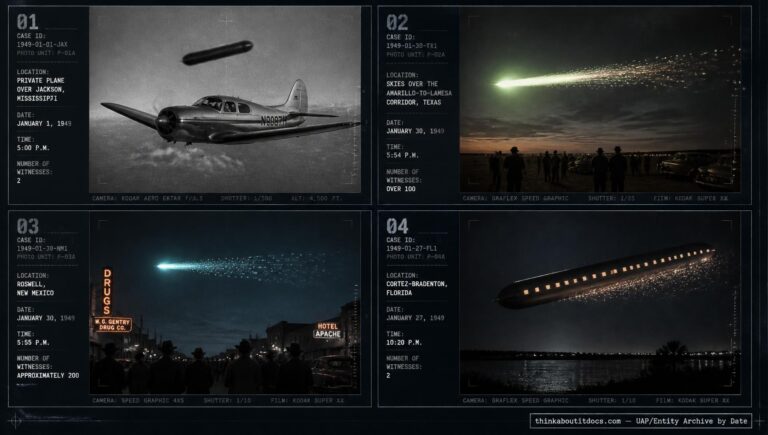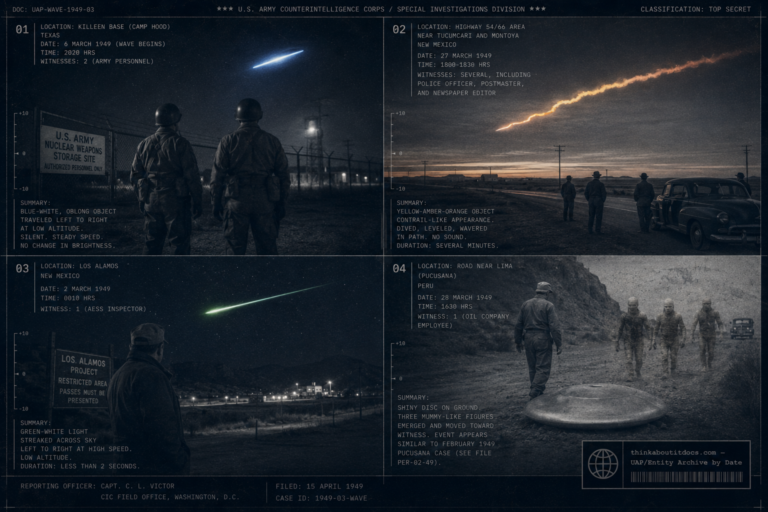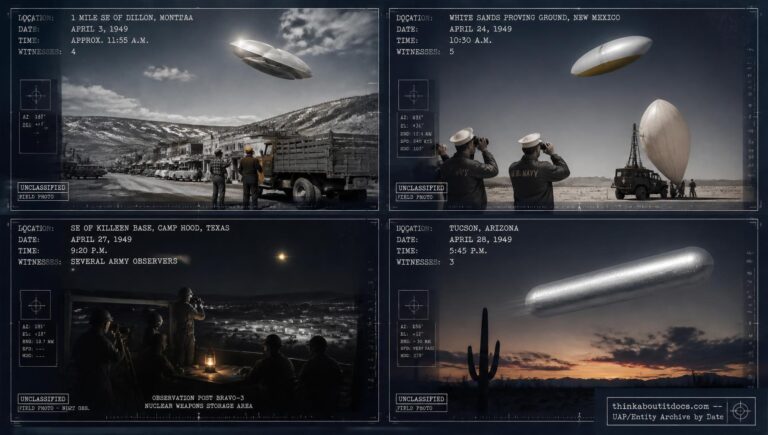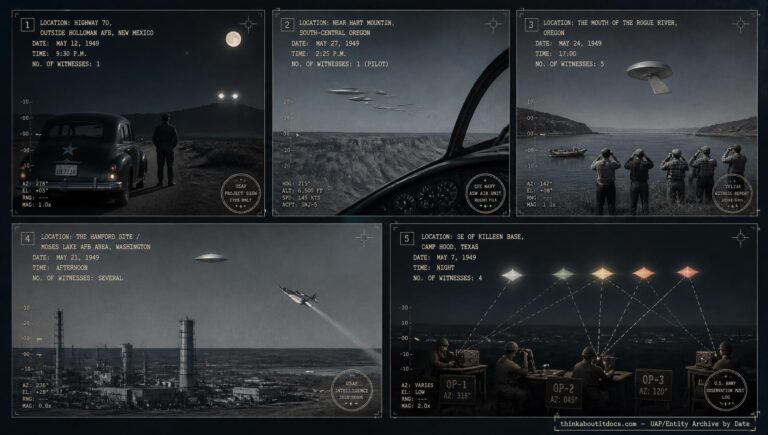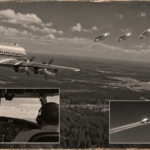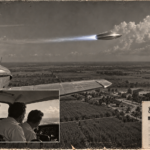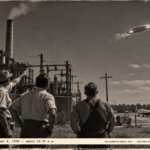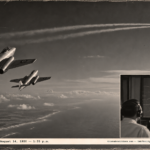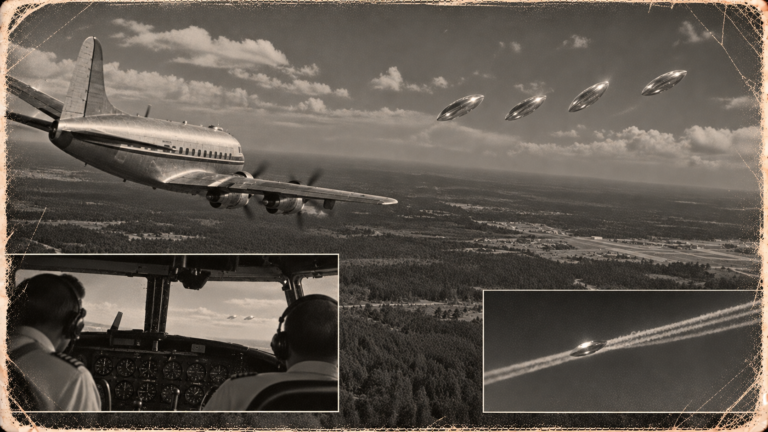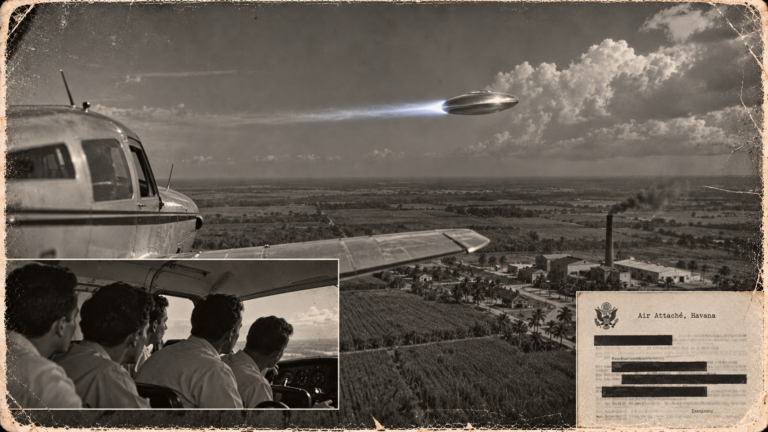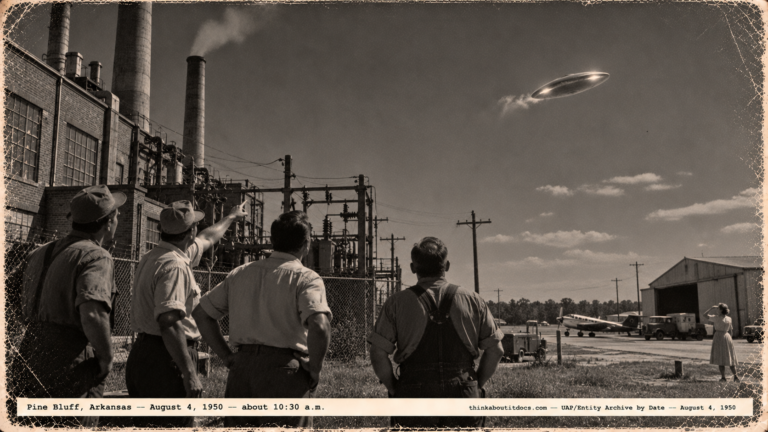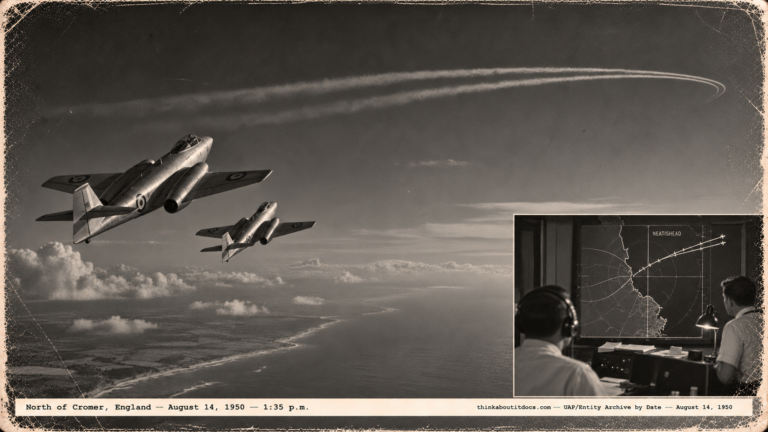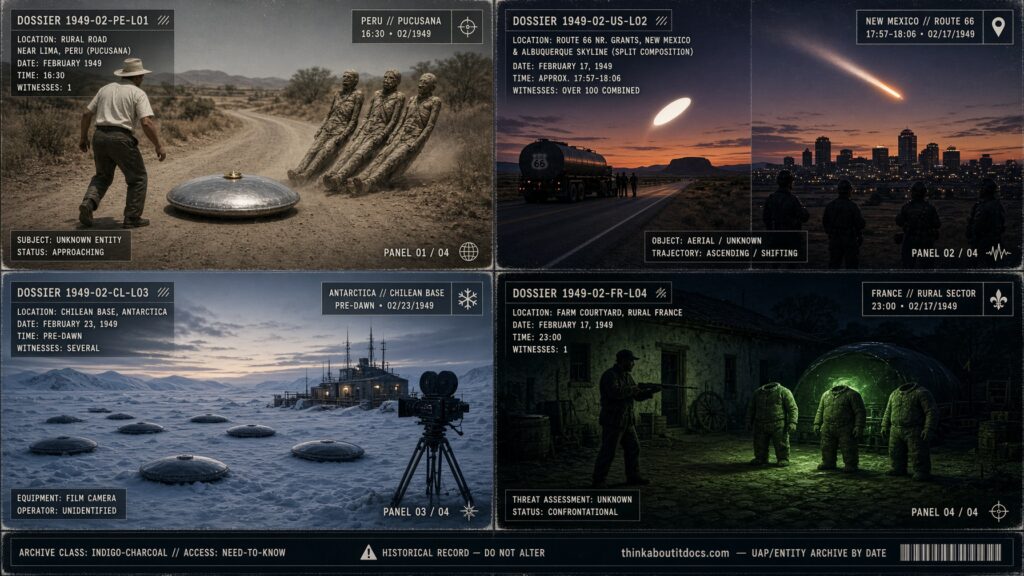
February 1949 — four cases: the Pucusana, Peru entity encounter; the Grants/Albuquerque, New Mexico green fireball; the Antarctica discs; and the France entity encounter.
1949: February UFO|UAP & Entity Sightings Archive
February 1949 is a short month in the records — fewer entries than January, and no multi-thousand-witness fireballs — but what it contains is sharply varied. The New Mexico green fireball wave continued through the month’s end, with three new AFOSI case files (22, 23, 24, 25) logging events at Canado, near Grants, Albuquerque, and Los Alamos. The February 17 Albuquerque/Grants fireball is the strongest case: an independent sighting by a University of New Mexico professor with meteorite-tracking experience, corroborated by approximately 100 Sandia Base guards, both sets of observers describing the same object at the same minute from different positions along its trajectory.
Away from New Mexico the month is more eclectic. A USAF pilot north of Dayton watched a white object with a blue glow split in two and disintegrate — almost certainly a meteor. A close-encounter report from Pucusana, Peru involves entity figures described as resembling mummies. A Chilean military base in Antarctica filed a report with film that was reportedly classified. And in Sandberg Pass, California, a USAF pilot in a T-11 watched a sausage-shaped object circle his aircraft in full-revolution turns — one of the genuinely unexplained aerial cases of the month despite its thin documentation.
Date: February 1949
Location: Pucusana, Peru
Time: 16:30
Summary: A 30-year-old oil company employee, identified only as C.A.V., was driving toward Lima when he saw a shiny disc at ground level and walked toward it for ten minutes. When he was approximately 20 meters away, three figures emerged. The figures were described as resembling mummies, with joined legs and one large foot, moving by “sliding” along the ground, and covered with an unusual textured skin. They reportedly asked the witness where they were, held a conversation with him, and then took him for a trip in their craft.
Source: Vallée, Jacques. Passport to Magonia, Magonia #68; original source: Lorenzén, Flying Saucer Occupants, vol. III, p. 122
Source Status: Single compiled source; Vallée indexes this as Magonia case 68, drawn from Lorenzén vol. III p. 122. A substantially identical account also appears in some catalogs dated March 28, 1949 — the two date variants likely reflect the same event indexed by different compilers from different sources. No independent primary document has been identified; the witness is anonymous beyond the initials C.A.V.
Date: February 1, 1949
Location: Terre Haute, Indiana
Time: Unknown
Summary: Nocturnal lights were reported. No further details in the compiled record.
Source: Eberhart, George M. A Geo-Bibliography of Anomalies, Greenwood Press, Westport, 1980
Date: February 10, 1949
Location: North of Dayton, Ohio
Time: 20:32 local
Summary: USAF Capt. Roger J. Groseclose (pilot) and 1st Lt. Ray W. Adams (student pilot) observed from the air at 7,900 ft a white object with a blue glow in a straight, gradual descent. At approximately 9,000 ft it broke into two parts and disintegrated. Visible for about five seconds.
Source: Dan Wilson; Blue Book files
Source Status: Probable meteor — five-second duration, division into fragments on descent, and blue-white glow are all consistent with bolide disintegration.
Date: February 14, 1949
Location: Canado, New Mexico
Time: 6:40 p.m.
Summary: Two observers near East Ganado Mission, Arizona (the Canado/Ganado area on the Navajo reservation near the AZ-NM border) reported a greenish-white fireball that hovered briefly then arced downward toward the west. A second, concurrent report from the same area described a stationary white/slightly green light that fell in a slight curve to the west.
Source: 17th District AFOSI Case 22
Date: February 17, 1949
Location: Unknown location, France
Time: 23:00
Summary: According to a 1958 Italian publication, a French peasant named Alain Berard saw a large object land near his farm at night with a flash of green light. Looking from his bedroom window, he took his rifle and went into the courtyard. He later claimed to have seen a large dark mass from which three headless, short, stocky figures moved toward him. He fired three shots; the figures went still, then vanished as the object departed with another green flash.
Source: Oltre il Cielo, Missili e Razzi, vol. I, p. 445; subsequently cited by Jacques Vallée
Source Status: Single source, nine-year gap to first publication, no location specified, no corroboration, no named witness. Treat as folkloric unless a primary record surfaces. Preserved as documented, per archive policy.
Date: February 17, 1949
Location: Near Grants, New Mexico (Chief’s Rancho, Hwy 66)
Time: 5:57–6:06 p.m.
Summary: Herman Wilcox, a Continental/Green Oil Co. truck driver stopped at Chief’s Rancho on Hwy 66, saw an oval luminous white light with a faint trail of white smoke to the SW, moving south in a vertical climb, then leveling off, then a gradual ascent before disappearing suddenly. No clouds obscured the view.
Source: FOIA; FUFOR Index; NICAP, Nuclear Connection Project — The New Mexico Sightings (AFOSI/OSI Case 23)
Source Status: Likely the same object seen simultaneously from Albuquerque (Case 24, below), with Wilcox at Grants providing an independent western viewpoint along the trajectory. The prior version of this page had Case 23 and Case 24 location assignments swapped; corrected here against the AFOSI/La Paz catalog.
Date: February 17, 1949
Location: Albuquerque, New Mexico (Sandia Base)
Time: 5:57–6:06 p.m.
Summary: University of New Mexico civil engineering professor Marvin May — an associate of Dr. Lincoln La Paz in meteorite tracking — saw a brilliant white object in the west at 6° elevation for over six minutes. It shifted appearance from round to elliptical to an elongated, bent-pipe shape, changed color to peach/yellow-orange, and made a sharp climbing turn before vanishing. Independently, approximately 100 Sandia Base guards, including the Officer of the Guard, observed a yellow-orange cigar-shaped object for seven minutes (5:59–6:06 p.m.). Investigators treat Cases 23 and 24 as the same object viewed from different points along its trajectory.
Source: 17th District AFOSI/OSI Cases 23 & 24; BB Maxwell Microfilm Roll 5, pp. 546-557; NARA Microfilm Roll 88 p. 401, Roll 91 p. 412; FOIA; Saunders/FUFOR Index
Date: February 20, 1949
Location: El Maitén, Chubut, Argentina
Time: Unknown
Summary: A salesman came to a police officer at his station in an excited state, claiming that about 20 km from town he had encountered a UFO. Three human-looking figures in unusual suits, with something flashing in their headgear and connected to the craft by cord-like tethers, had emerged and signaled him to stop his car. The officer, already retired by 1970, related the account years later to the press.
Source: La Razón, Buenos Aires, Argentina, March 13, 1970
Source Status: 21-year gap to first publication; secondhand account (the police officer relayed the salesman’s report). No corroboration, no primary document. Preserved as documented.
Date: February 23, 1949
Location: Chilean Base, Antarctica
Time: Pre-dawn
Summary: Several disc-shaped objects were observed on the ice (witness: Orrego). Objects were observed, motion picture film was reportedly taken, and animal reactions to the objects were noted.
Source: Keyhoe, Donald E. Flying Saucers Are Real, Fawcett, New York, 1950
Source Status: The motion picture film has not been made publicly available and is reportedly classified by the Chilean military. Single secondary source (Keyhoe, 1950). Preserved as documented.
Date: February 27, 1949
Location: Los Alamos, New Mexico
Time: 7:05 p.m.
Summary: A green-white fireball seen in horizontal flight from west to east. Duration approximately 2 seconds.
Source: FOIA (AFOSI Case 25)
Date: February 28, 1949
Location: Sandberg Pass, 40 miles S of Bakersfield, California
Time: 10:30 p.m.
Summary: A USAF pilot flying a T-11 with the 703rd Air Reserve Division saw a sausage-shaped object circle the aircraft in complete 360° and 180° turns.
Source: Project 1947; Sparks Comprehensive Catalog (BB Unknown, listed as “Feb. 23, 1949” in some versions of the catalog)
Source Status: The Sparks catalog lists this event as February 23; the date February 28 comes from other compiled sources. The discrepancy is unresolved in available records — kept here at February 28 per the prior correction on this page but flagged for verification against the original Blue Book file.
EXECUTIVE SUMMARY
100 Guards, Two Observers, One Object
The February 1949 record is defined by its New Mexico cluster. The February 17 Albuquerque/Grants sighting is one of the better-corroborated green fireball events of the entire wave: a specialist in meteorite tracking at the University of New Mexico, positioned to evaluate exactly this kind of phenomenon, watched an object change shape and color across six minutes while approximately 100 Sandia Base guards — including the Officer of the Guard — simultaneously logged the same yellow-orange cigar from a different angle. The two perspectives together constitute the multi-point corroboration that single-witness fireball reports almost never achieve. AFOSI Cases 23 and 24, which had their locations swapped on this page’s prior version, are corrected here against the AFOSI/La Paz catalog: Case 23 is Wilcox near Grants, Case 24 is May’s Albuquerque/Sandia observation.
The month’s remaining entries span a wide range of source quality. The Pucusana, Peru entity encounter is a Vallée database record with a secondary date variant (also appears as March 28 in some catalogs) and no primary source — kept as documented. The Antarctic disc report is a single secondhand claim via Keyhoe 1950 with film that was reportedly classified. The February 10 Dayton case is almost certainly a meteor. The Sandberg Pass saucer is a Project 1947 record with an unresolved one-week date discrepancy against Sparks. The French peasant/green flash entity report, first published in Italian in 1958, has no location, no corroboration, and a nine-year gap to first disclosure — it stays as documented, flagged folklore.
“…a brilliant white object in the west at 6° elevation…it shifted from round to elliptical to an elongated, bent-pipe shape…”
Professor Marvin May, University of New Mexico, describing the February 17, 1949 Albuquerque/Sandia object — corroborated independently by approximately 100 Sandia Base guards the same evening.