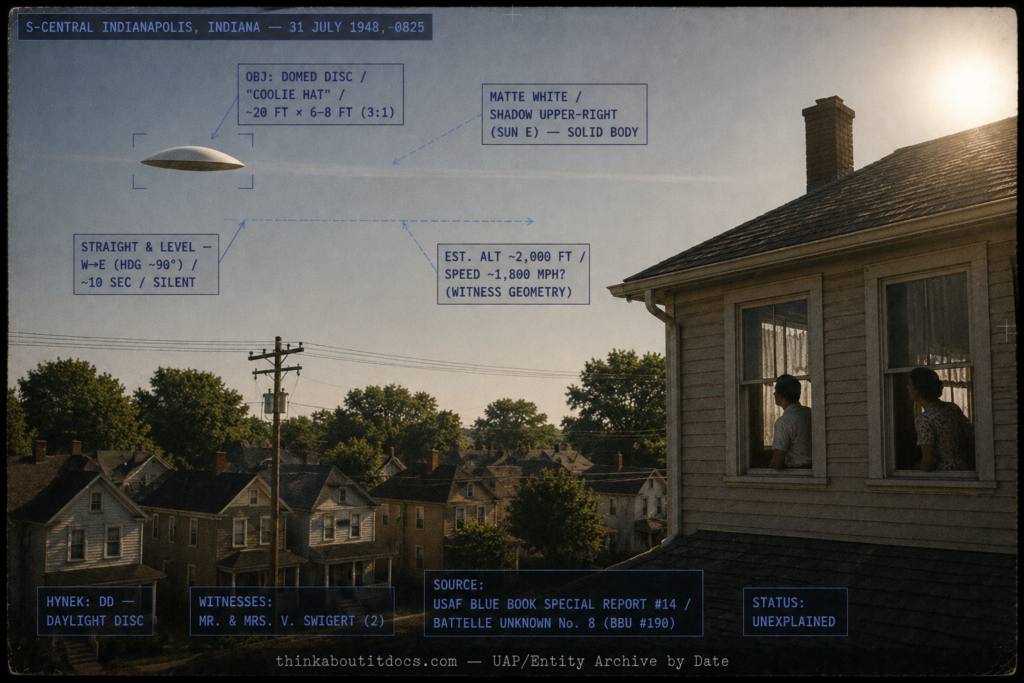
The Swigerts watch a white "coolie-hat" disc cross Indianapolis in silence, July 31, 1948 — retained as Battelle Unknown No. 8 in the Air Force's own statistical study.
THINK ABOUTIT UFO | UAP SIGHTING REPORT
1948 Indianapolis UFO:
The Vernon Swigert Domed Disc Sighting
At twenty-five past eight on the morning of July 31, 1948, an Indianapolis electrician standing at his bathroom window saw something cross the western sky and bolted for the kitchen to pull his wife to the glass. Together the Swigerts watched a white, cymbal-shaped disc — a rounded “coolie hat,” about twenty feet across and six to eight thick — fly dead straight and level from horizon to horizon, west to east, in roughly ten seconds. It shimmered as though spinning, threw a curious shadow on its upper right against a sun that was off to the east, and made no sound and left no trail. The geometry the witnesses gave implied a speed that, if the numbers held, ran near twice the speed of sound at low altitude — and when the Air Force handed the era’s sighting data to the Battelle Memorial Institute for cold statistical analysis, this one survived every attempt to explain it away. It is logged, to this day, as a Project Blue Book Unknown.
Date: July 31, 1948 (BBU #190; Battelle Unknown No. 8)
Sighting Time: 8:25 a.m.
Day/Night: Day (morning)
Location: South-central Indianapolis, Indiana
Urban or Rural: Urban
No. of Entity(‘s): None reported
Entity Type: Not applicable — no occupants or entities observed
Entity Description: Not applicable
Hynek Classification: DD (Daylight Disc) — a metallic/whitish structured object observed in daytime flight
Duration: ~10 seconds
No. of Object(s): 1
Description of the Object(s): A cymbal-shaped or domed disc — a rounded “coolie hat” — about 20 ft across and 6–8 ft thick (a roughly 3:1 ratio). White, without shine, with a distinct shadowing on the upper right; it shimmered as if spinning. It flew a straight, level course from horizon to horizon, west to east (heading ~90°), with no sound and no trail.
Shape of Object(s): Domed disc / cymbal (“coolie hat”)
Size of Object(s): ~20 ft across, 6–8 ft thick (≈3:1 ratio)
Color of Object(s): White (no sheen; shadowed on the upper right; shimmering in the sun)
Distance to Object(s): Roughly 2 miles (estimated)
Height & Speed: Estimated altitude ~2,000 ft; witness-geometry estimate of speed on the order of ~1,800 mph (≈Mach 2.3) based on distance covered in the observed time — the underlying distance, elevation, and speed figures are estimates flagged with uncertainty in the original data
Number of Witnesses: 2 (Mr. and Mrs. Vernon Swigert)
Special Features/Characteristics: Domed-disc “coolie hat” profile with a noted 3:1 ratio; shadowing on the upper right despite the sun being to the east, read as evidence of a solid three-dimensional, non-reflective (matte) body rather than a light phenomenon; shimmering/spinning appearance; straight-and-level horizon-to-horizon transit; silent, no exhaust or trail; two witnesses moving between two windows to keep it in view; case retained as an “Unknown” through the Battelle statistical study
Case Status: Unexplained
Source: U.S. Air Force Project Blue Book Special Report #14 (Battelle Memorial Institute study), 1955 — listed as Battelle Unknown No. 8; also catalogued as BBU #190 in Brad Sparks’ “Catalog of Project Blue Book Unknowns” (FOIA)
Summary/Description: At 8:25 a.m. on July 31, 1948, Indianapolis electrician Vernon Swigert, standing at his west-facing bathroom window, sighted a white, cymbal-shaped domed disc and called his wife to the kitchen to watch with him. The object — about 20 ft across and 6–8 ft thick, a roughly 3:1 ratio, white without sheen but shadowed on its upper right, shimmering as if spinning — flew straight and level from horizon to horizon, west to east, in about 10 seconds at an estimated 2,000 ft, making no sound and leaving no trail. The witness-derived geometry implied a very high speed (on the order of 1,800 mph). The case was analyzed in the Air Force’s Project Blue Book Special Report #14 by the Battelle Memorial Institute and retained as an “Unknown” (Battelle Unknown No. 8).
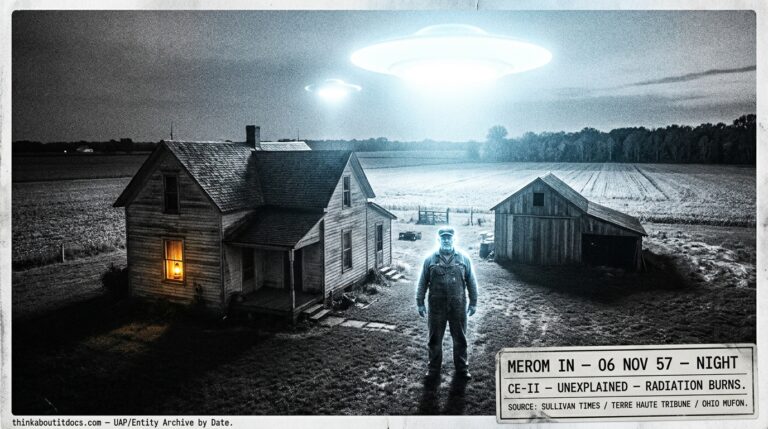
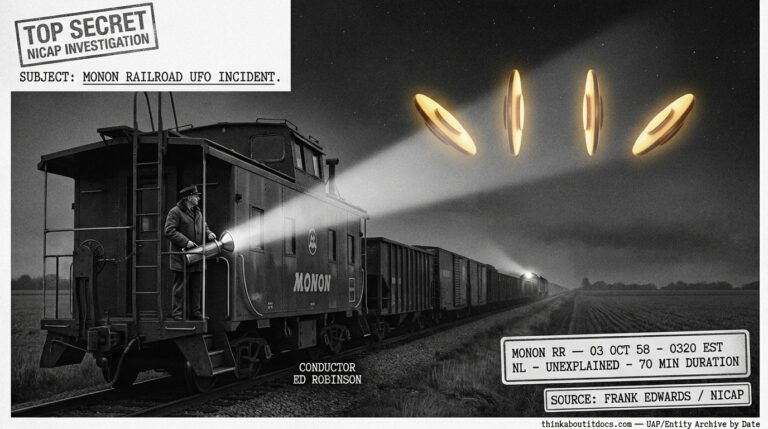
Related Cases: 1947 United Air Lines Flight 105 (Idaho — DD formation, Blue Book Unknown) | 1947 Kenneth Arnold sighting (DD wave origin) | later Indiana cases (1957 Merom, 1958 Monon Railroad)
DETAILED REPORT
The Indianapolis domed-disc sighting is one of the early daylight cases that the U.S. Air Force could not resolve, and its standing rests on official documentation rather than later testimony. The primary witness, Vernon Swigert, was an electrician. At 8:25 on the morning of July 31, 1948, he was standing at the west-facing window of his bathroom in south-central Indianapolis when an object came into view. Recognizing it as something unusual, he ran to the kitchen and called his wife to the glass, so that the sighting became a two-witness observation. Over roughly ten seconds the couple watched the object cross the sky on a straight, level course from horizon to horizon, traveling west to east on a heading of about ninety degrees, tracking it first through the west-facing window and then through a south-facing one as it passed.
The Swigerts’ description, preserved in the Blue Book data and digested in Brad Sparks’ catalog of Blue Book Unknowns, is unusually specific. They saw a cymbal-shaped or domed disc — likened to a rounded “coolie hat” — about twenty feet across and six to eight feet thick, a roughly 3:1 ratio that the analysts later singled out as inconsistent with conventional aircraft profiles of the era. It was white, but notably “without any shine,” and carried a distinct shadowing on its upper right side even though the sun was off to the east (the witness’s left). It shimmered as if spinning. They estimated an altitude of about 2,000 feet and a distance of perhaps two miles, and the object made no sound and left no trail. From the distance the object appeared to cover in the observed time, a speed on the order of 1,800 mph was derived — though the original record marks the distance, elevation, and resulting speed with explicit question marks, signaling that these are witness-geometry estimates rather than instrument measurements.
What lifts the case above an ordinary daylight report is its inclusion in the Air Force’s most rigorous statistical effort. In 1955 the Battelle Memorial Institute completed Project Blue Book Special Report #14, a large-scale statistical analysis of accumulated sighting data, cross-referencing reports against known weather balloons, astronomical phenomena, and conventional aircraft. The Indianapolis sighting was carried in that study as Battelle Unknown No. 8 (and is catalogued as BBU #190): it survived the cross-referencing and was retained in the residual “Unknown” category, meaning the data the Swigerts provided was specific enough that the analysts could not assign it a conventional explanation. The witnesses’ note of shadowing on a non-reflective white surface, against a sun on the opposite side, is the kind of detail later cited as suggesting a solid, three-dimensional body rather than a light reflection or optical illusion.
The honest limits of the case are the limits of any brief, naked-eye daylight sighting. The altitude, distance, and therefore speed are estimates, and the headline “1,800 mph / Mach 2.3” figure should be read as the upper end of a geometry the witnesses themselves could only approximate — a sonic-boom-less Mach 2.3 craft at 2,000 feet is more naturally read as a sign that one or more of those estimates is off than as established performance data. There is no photograph and no instrument trace. But the core facts are solid: two witnesses, a clear morning, a structured object with a specific and consistent description, a straight horizon-to-horizon path, and — decisively — an official “Unknown” determination that has stood since 1955.
RESEARCHER’S NOTES
The Coolie Hat Over Indianapolis — 1948 and a Battelle “Unknown” That Held
- Classification Basis: DD (Daylight Disc) is correct: a structured, whitish object observed in daylight on a clear morning, with no occupants, no landing, and no close-approach effects. The domed “coolie hat” profile and the 3:1 ratio are descriptive details within the DD category. No Close Encounter classification applies.
- Source Chain Assessment: This is among the stronger source chains of the early period. The case is documented in U.S. Air Force Project Blue Book Special Report #14 (the Battelle Memorial Institute study, 1955) and is independently catalogued by researcher Brad Sparks (BBU #190) from FOIA-released Blue Book material. That places it firmly in the primary/official tier: the sighting is not a later recollection but a contemporaneously reported case that entered the Air Force’s own statistical analysis and was retained as an unidentified. The witnesses are named (Mr. and Mrs. Vernon Swigert), and the descriptive data is preserved in the official record.
- The “Unknown” Determination — What It Does and Doesn’t Mean: Being retained as Battelle Unknown No. 8 means the analysts could not match the reported data to weather balloons, astronomical phenomena, or known aircraft — a meaningful result, given how aggressively Special Report #14 sought conventional explanations. It does not, by itself, certify the high-speed figures. The value of the “Unknown” status is that a structured daylight object with a specific, internally consistent description resisted prosaic identification, not that the ~1,800 mph estimate is verified. Both can be held honestly at once.
- The Shadowing Detail: The witnesses’ observation of shadowing on the object’s upper right while the sun was to the east is the report’s most analytically interesting element. It argues that the object was a solid, three-dimensional, non-reflective body interacting with ambient light — i.e., a physical craft rather than a glint, balloon, or light-based illusion. It is a genuinely useful observational detail, though, like the rest, it rests on the witnesses’ account rather than on any recovered measurement.
- Physical Evidence and Evidentiary Weight: There is no physical evidence — no photograph, no radar, no recovered trace. The weight rests on two contemporaneous witnesses, a clear daylight observation with consistent specific detail, and the official “Unknown” determination from the era’s most rigorous statistical study. The chief caveat is the estimated nature of the altitude/distance/speed figures, which the original data itself flags. On balance — credible witnesses, official retention as an Unknown, no conventional explanation on record — Unexplained is the appropriate and well-supported status, with the speed presented as an estimate rather than a measured value.
The 1948 Indianapolis domed-disc sighting earns its place on the strength of documentation and method: two named witnesses on a clear morning, a specific and internally consistent description of a white, matte, “coolie-hat” disc crossing the sky in silence, and — most importantly — an official “Unknown” determination that survived the Air Force’s own Battelle statistical analysis in Special Report #14. The headline 1,800 mph figure is best understood as the upper edge of a witness-estimated geometry rather than a measured speed, and the case carries the usual limits of a brief naked-eye daylight report. But the core record is solid and the verdict is the Air Force’s own. The standing here is DD (Daylight Disc), Case Status Unexplained — Battelle Unknown No. 8, one of the more credible early daylight-disc cases the official study could not explain away.