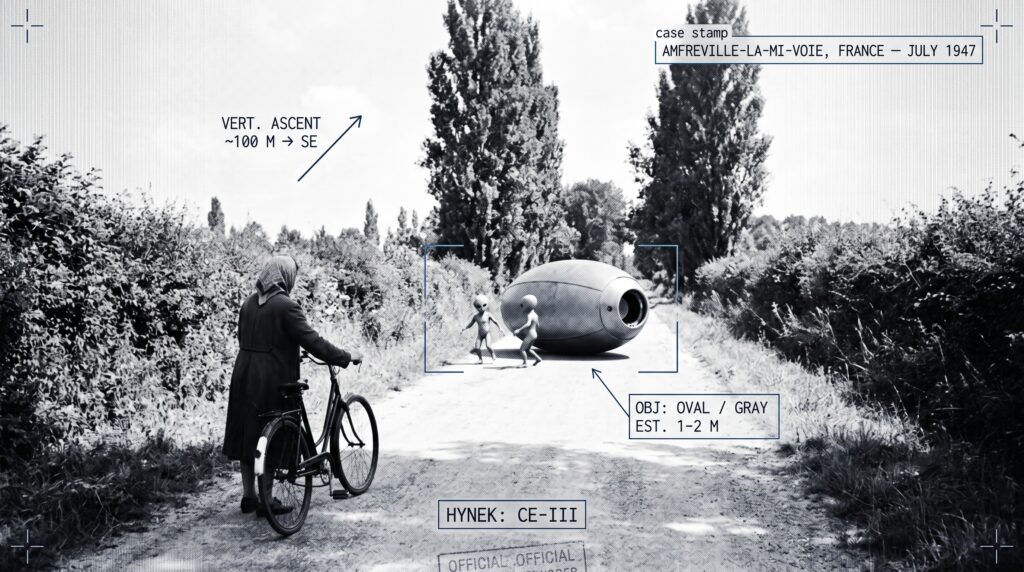
A woman's bicycle bell ends the encounter — two small beings board a gray oval craft near Amfreville-la-Mi-Voie, July 1947, in possibly France's earliest occupant case.
THINK ABOUTIT UFO|UAP | ENTITY ENCOUNTER REPORT
1947: Encounter near Amfreville la mi-Voie, France
She rang her bicycle bell — and that small, ordinary sound may be the most extraordinary detail in the entire French record for 1947. Two beings barely a meter tall, busy at some unknown task beside a small gray oval craft resting on a rural road outside Amfreville-la-Mi-Voie, spun around as if the bell had startled them, scrambled through an aperture in the object’s rear, and lifted off in silence. The craft rose vertically, hung oscillating at a hundred meters, then shot southeast at speed. If the date holds, this is very likely the earliest close encounter with occupants on French soil — falling within days of Kenneth Arnold’s sighting that gave the world the phrase “flying saucer.” It is also a case that arrived a quarter-century late, from a single witness who never gave her name.
Date: July, 1947 (reported as within the first two weeks)
Sighting Time: Unknown
Day/Night: Not stated on record (daylight implied — color and detail perception, witness cycling)
Location: Approximately 2 km from Amfreville-la-Mi-Voie, on the road to Rouen running parallel to the river Seine, Normandy, France
Urban or Rural: Rural
No. of Entity(‘s): Two
Entity Type: Humanoid (small humanoid / dwarf-type)
Entity Description: Two beings of probably not more than 1 meter in height, observed near the object and appearing occupied with some task the witness could not identify
Hynek Classification: CE-III (Close Encounter of the Third Kind) — close observation of animate beings associated with the object
Duration: Unknown
No. of Object(s): 1
Description of the Object(s): An oval, gray object already resting on the road, with no visible legs, crutches, or landing gear, and a circular aperture set slightly to the rear of center. The object took off silently and vertically to about 100 meters, remained motionless while oscillating for a short time, then departed at high speed toward the south-east.
Shape of Object(s): Oval
Size of Object(s): Estimated 1 to 2 meters in height
Color of Object(s): Gray
Distance to Object(s): 100 meters
Height & Speed: Rose vertically to roughly 100 meters altitude; hovered while oscillating; then accelerated away rapidly (“à grande vitesse”) to the south-east. No engine sound reported.
Number of Witnesses: Single (Mrs. S., anonymous, aged 57)
Special Features/Characteristics: Silent vertical takeoff; oscillating hover; small craft proportional to small occupants; circular rear aperture used for entry; beings reacted to the witness’s presence (bicycle bell) before boarding; no landing-gear structures observed
Case Status: Insufficient Data
Source: Report collected May 30, 1972 by M.B. Delabroye in Rouen; published in “Phénomènes Inconnus” #4 (1972); subsequently in Garreau and Lavier, “Face aux Extraterrestres” (1975, pp. 85–86) and Figuet and Ruchon, “OVNI: le premier dossier des rencontres rapprochées en France” (1979, pp. 50–51)
Summary/Description: A woman cycling on the Rouen road near Amfreville-la-Mi-Voie came upon a small gray oval object resting on the road about 100 meters ahead, with two roughly one-meter-tall beings nearby who appeared busy at some task. She dismounted and rang her bicycle bell; the beings turned as if noticing her for the first time, rushed to the object, and entered through a rear aperture. The craft rose silently and vertically to about 100 meters, hovered while oscillating, then sped off to the south-east.
Related Cases: Kenneth Arnold sighting, June 24, 1947 (wave context) | 1954 French humanoid wave (comparative CE-III pattern) | other early French close-encounter reports in the Figuet & Ruchon / HUMCAT catalogs
DETAILED REPORT
The account describes a daylight roadside encounter on a rural stretch near Amfreville-la-Mi-Voie, in Normandy, along the Rouen road that parallels the Seine. The single witness, identified only as Mrs. S., aged 57, was traveling by bicycle when she came upon a small object already at rest on the road roughly 100 meters ahead of her. She described it as oval and gray, lacking any visible landing gear or supporting structures, and noted a circular aperture positioned slightly behind the object’s center. Her size estimate for the object — between one and two meters in height — is unusually small, and it is internally consistent with the second element of her account: two beings, each apparently no taller than about a meter, standing near the object and seemingly occupied with a task she could not interpret.
The encounter’s pivotal moment is mundane in mechanism and striking in effect. As the witness approached and dismounted, she rang her bicycle bell. According to her account, the two beings reacted as though they had only then become aware of her, turned toward her, and immediately moved to board the craft through its rear aperture. The object then performed a sequence reported in numerous structured-craft cases: a silent, vertical ascent to approximately 100 meters, a brief motionless hover accompanied by an oscillating or wobbling motion, and a rapid departure toward the south-east. The witness is directly quoted in Garreau and Lavier’s 1975 treatment, describing the bell, the beings standing up and seeing her, their rush into the craft, and its vertical rise and oscillating hover before it sped away — a first-person account consistent in every particular with the digest provided by Figuet and Ruchon.
The case’s documentary strength and its central weakness are the same fact: timing. The report was not collected until May 30, 1972 — roughly twenty-five years after the event — by M.B. Delabroye in Rouen, and first appeared in “Phénomènes Inconnus” #4 that same year before entering the two standard French close-encounter compilations later in the decade. This is a respectable source chain by the standards of French ufology; both Garreau & Lavier and Figuet & Ruchon are recognized secondary catalogs, and the latter is among the more disciplined French case digests of its era. But the chain begins with a single, anonymous witness recalling an event a quarter-century after the fact, with no contemporaneous report, no second witness, no physical trace, and no investigation at the time it occurred. There is no institutional response on record because, as far as the documentation shows, the encounter was never reported to anyone in 1947. What we have is a coherent, detailed, sincerely-rendered recollection — and no means of corroborating it.
RESEARCHER’S NOTES
The Bicycle Bell — Amfreville-la-Mi-Voie 1947 and the Earliest French Occupant Case on the Arnold Wave
- Classification Assessment: CE-III is correctly applied and should stand. The case satisfies the defining criteria — animate beings observed in direct association with a structured object at close range — without crossing into CE-IV territory, as there is no abduction, no physical interaction with the witness, and no claimed communication. The witness observed the occupants, the occupants reacted to the witness, and both craft and beings departed; that is the textbook profile of a third-kind encounter. No CE-V consideration applies, consistent with our rejection of that category for the pre-modern and early-modern record. The entity field is appropriately marked Humanoid, as the description (upright, roughly one meter, capable of coordinated task-work and rapid boarding) is humanoid in form without supporting any finer typing.
- Source Chain Assessment: The provenance is mixed — strong in its published lineage, weak at its origin. The case is preserved in two reputable secondary French catalogs (Garreau & Lavier 1975; Figuet & Ruchon 1979), with a traceable first publication in “Phénomènes Inconnus” #4 (1972) and a named collector, M.B. Delabroye. Under our source hierarchy this places the case solidly in documented secondary territory rather than the problematic tier. However, the entire structure rests on a single anonymous witness whose testimony was recorded approximately twenty-five years after the event. There is no 1947 contemporaneous record, which means every downstream source ultimately depends on one uncorroborated 1972 recollection. The lineage is honest and well-cited; the foundation under it is a single memory.
- Pattern Context: The case’s significance is chronological. If the “first two weeks of July 1947” dating is accurate, this is plausibly the earliest occupant-level (CE-III) report on French soil, arriving within roughly a fortnight of the Kenneth Arnold sighting of June 24, 1947 that launched the modern “flying saucer” era. That places it at the very leading edge of the global wave and well ahead of France’s far better-documented 1954 humanoid wave. Several behavioral elements — the silent vertical ascent, the oscillating hover, the small proportional craft-and-occupant pairing, and the occupants’ startled retreat upon being noticed — recur throughout the later European CE-III corpus, which lends the account typological plausibility even as it cannot establish it as fact.
- Physical Evidence and Evidentiary Weight: There is none beyond testimony. No landing trace was reported or sought, no photograph exists, no soil or vegetation effect was documented, and the witness left no contemporaneous written account. The internal consistency of the report — the proportionality of small craft to small beings, the plausible mechanical detail of a rear aperture and absence of landing gear, the unremarkable trigger of a bicycle bell rather than a dramatic flourish — argues for a sincere recollection rather than an invented or embellished tale. But sincerity is not corroboration. The twenty-five-year gap between event and collection introduces unavoidable memory degradation, and the anonymity of the witness forecloses any re-interview or background verification. On evidentiary weight alone, the case cannot be elevated above Insufficient Data, notwithstanding the quality of its description.
The Amfreville-la-Mi-Voie encounter is one of the most tantalizing entries in the early French record and, by date, possibly its first occupant case — a coherent, detailed, and well-published CE-III standing at the very front of the 1947 wave. It is also a case that the record cannot bear the full weight of: one anonymous witness, no contemporaneous report, no physical evidence, and a twenty-five-year delay between the event and the first time anyone wrote it down. The description deserves respect and preservation; the claim cannot be verified. The honest position is Insufficient Data — a credible-sounding memory with a clean citation trail and nothing beneath it to confirm. It stays in the archive as a significant early data point and a permanent what-if of French ufology.