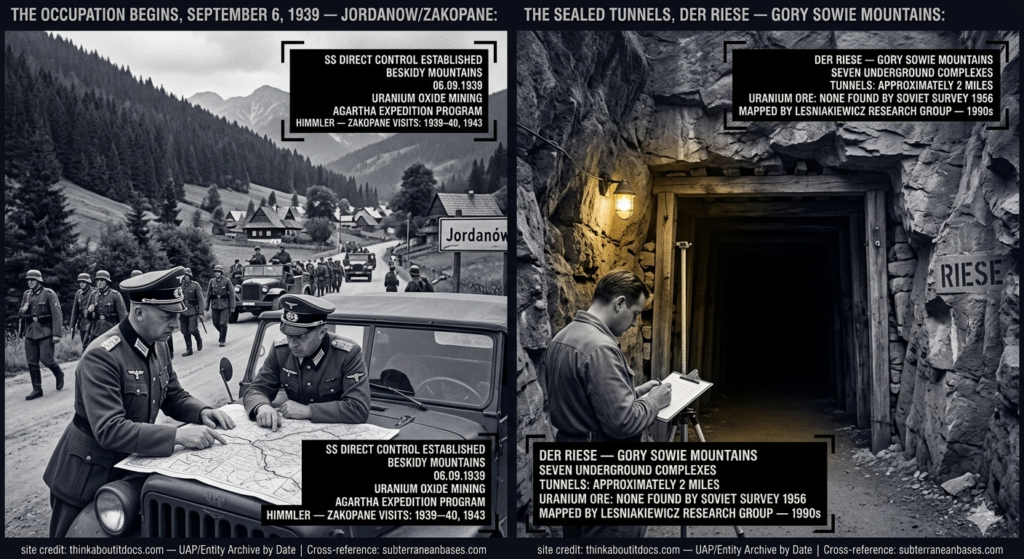
Jordanow, Beskidy Mountains, Poland, September 6, 1939 — the German 14th Army captures Zakopane and Jordanow; the SS assumes direct regional control within a week. Five years of uranium oxide mining, V-3 weapons testing, and Himmler-directed speleological expeditions searching for the Agartha underground world entrance follow. Soviet geological teams find no uranium ore in October 1956 — all extracted ore is unaccounted for. Der Riese, a seven-complex underground network in the Gory Sowie mountains, is explored and mapped by Robert K. Leśniakiewicz and team in the 1990s. Sources: Leśniakiewicz, Project Tatra (2002); Goodrick-Clarke, The Occult Roots of Nazism (NYU Press, 1992). Cross-reference: subterraneanbases.com. thinkaboutitdocs.com.
THINK ABOUTIT UFO | UAP | SIGHTING REPORT
1939: THE JORDANOW MYSTERY
On September 6, 1939 — five days after the German invasion of Poland began — the 14th Army under Field Marshal Wilhelm von List captured Jordanow and Zakopane in the Beskidy Mountains of southern Poland. Within a week, for reasons never officially explained, the entire region between Krakow and the Tatra Mountains was placed under direct SS control. It stayed that way until January 1945. What followed was not a standard occupation. SS teams opened and worked numerous uranium oxide mines throughout the Beskidy Mountains. V-3 super-cannon prototypes were tested in the Grzechynia valley toward the Tatras. Himmler — who had first encountered the region’s legends as a thirteen-year-old tourist in 1913 and been shaped by occult literature connecting those legends to an underground world beneath Mount Babia Gora — sent several dozen speleological expeditions into the Tatra, Beskidy, Slovak, Czech, and Hungarian mountain systems searching for the entrance to Agartha. He visited Zakopane twice himself. He did not find it. What he left behind when Soviet forces arrived in January 1945 was a network of sealed tunnels, extracted uranium ore whose ultimate disposition remains historically unaccounted for, and a series of underground complexes — including Der Riese in the Gory Sowie mountains — that Polish engineers began mapping only in the 1990s.
Date: September 6, 1939 (date of German 14th Army capture of Jordanow and Zakopane)
Sighting Time: Not applicable
Day/Night: Not applicable
Location: Jordanow, Beskidy Mountains, and the region between Krakow and Zakopane, Poland (on what is now the Polish-Slovak border)
Urban or Rural: Rural — mountain region, mine sites, underground complexes
No. of Entity(‘s): Not applicable
Entity Type: Not applicable
Entity Description: Not applicable
Hynek Classification: NOT APPLICABLE — This is a historical/subterranean mystery record, not a UAP sighting. No craft observed. No entity reported. No witness encounter. The “??????????” classification on the page is the correct position. This page belongs more properly in the subterraneanbases.com network than in the UAP sightings archive; it should be cross-referenced accordingly.
Duration: September 6, 1939 — January 1945 (SS occupation of the region)
No. of Object(s): Not applicable
Description of the Object(s): Not applicable
Shape, Size, Color, Distance, Height/Speed: Not applicable
Number of Witnesses: Multiple — Polish Armia Krajowa resistance fighters who observed SS mining operations; local civilians; Robert K. Leśniakiewicz’s 1994 interviews with surviving witnesses
Special Features/Characteristics: Documented uranium oxide mining operations April 1940–November 1944; V-3 Hochdruckpumpe (“Tausendfüssler”) weapons testing at Grzechynia toward the Tatra range; multiple SS speleological expeditions to Domica-Baradla Cave (Slovak-Hungarian border), Babia Gora (Polish-Slovak border), Half-Moon Cave (Byelanskye Tatra) searching for Agartha entrance; two personal visits by Himmler to Zakopane (winter 1939–40; 1943); NKVD penetration of the mountains in October 1956 found no uranium ore (indicating removal before Soviet arrival); Der Riese underground complex in Gory Sowie mountains (seven underground complexes, tunnels nearly 2 miles long) mapped by Leśniakiewicz research group in 1990s
Case Status: Historical record — documented SS occupation with unexplained operational components (uranium disposition, occult expeditions, underground complex extent)
Source: Robert K. Leśniakiewicz, Project Tatra (Krakow, 2002); Milos Jesensky & Robert K. Leśniakiewicz, Wonderland: Alien Technologies in the Third Reich (2001); Peter Padfield, Himmler (MJF Books, 1990); Nicholas Goodrick-Clarke, The Occult Roots of Nazism (NYU Press, 1992)
Summary/Description: On September 6, 1939, German forces captured Jordanow and Zakopane in the Beskidy Mountains. The SS took direct control of the region and conducted uranium oxide mining, V-3 weapons testing, and multiple speleological expeditions searching for the Agartha underground world entrance beneath Mount Babia Gora. Himmler visited twice personally. Soviet forces found no uranium ore when they arrived in January 1945 — all extracted ore is unaccounted for. Der Riese, a seven-complex underground network in the nearby Gory Sowie mountains, was explored and mapped by Polish engineers in the 1990s.
Related Cases: 1939 Saarijarvi Finland CE-III (same date window — November 29, 1939) | subterraneanbases.com — Der Riese and Nazi underground complexes
DETAILED REPORT
The Jordanow Mystery is not a UAP sighting. It is a documented historical anomaly — a wartime military operation in the southern Polish mountains whose official purpose was never publicly explained and whose material consequences remain partly unaccounted for. Its presence in the archive is appropriate as a high-strangeness historical record, but it belongs more naturally in the subterraneanbases.com network, where the Der Riese complex, Himmler’s Agartha expeditions, and the SS underground infrastructure form a coherent research category. On the UAP sightings archive it functions as contextual history — the documented backdrop against which the 1937 Czernica crash claim is set, and the geographic context for the Der Riese references that appear across multiple entries.
The historical core of the Jordanow case is solid. The German 14th Army’s September 6, 1939 capture of the Zakopane-Jordanow region is documented military history. The subsequent SS assumption of direct regional control is documented. The uranium oxide mining operations — confirmed by Armia Krajowa resistance fighters interviewed by Leśniakiewicz in 1994, and corroborated by the detail that Soviet NKVD geological teams penetrated the same mountains in October 1956 and found no uranium ore — establish that large quantities of uranium were extracted and removed before Soviet arrival. Where it went is not established by any publicly available wartime German record.
Himmler’s personal interest in the region’s legends is also historically documented. Nicholas Goodrick-Clarke’s The Occult Roots of Nazism (NYU Press, 1992) — the most academically rigorous study of Nazi occultism and the only source on this page that carries full historical scholarly credentials — establishes the intellectual lineage connecting theosophical Agartha/Shambhala mythology to Himmler’s SS cultural programs. The specific detail of Himmler reading Dr. Friedrich Wichtl’s 1919 occult book while convalescing as a military cadet, and that book’s connection to the Zakopane artists’ colony where Wichtl had been active, is consistent with Goodrick-Clarke’s documented account of Himmler’s intellectual formation. The speleological expedition detail — multiple SS cave-exploration teams in the Slovak, Czech, and Hungarian mountain systems — is documented in Project Tatra and consistent with Himmler’s known Ahnenerbe research organization activities.
What cannot be established from the available record is the extent of Der Riese, the disposition of the extracted uranium, or whether the SS underground construction in the Gory Sowie mountains had purposes beyond the documented weapons research and mining. The Czernica crash claim — which uses the same Leśniakiewicz/Jesensky source chain and the same Der Riese location — is not corroborated by the Jordanow historical record; the documented existence of a Nazi underground complex is not evidence that a recovered alien craft was stored in it. These are separate claims from separate source tiers and must not be conflated.
RESEARCHER’S NOTES
Babia Gora and the Sealed Tunnels — The Jordanow Mystery as Subterranean Archive
- Source Chain Assessment: The Jordanow page draws on four sources of very different quality. Goodrick-Clarke (NYU Press, 1992) is a legitimate academic historian whose work on Nazi occultism is the field’s primary reference — his material here is reliable. Padfield’s Himmler (1990) is a credible biography with documentary footnoting. Leśniakiewicz’s Project Tatra (2002) is a regional investigation with named witness interviews — credible as field research within its scope. The Jesensky/Leśniakiewicz Wonderland (2001) is the same fringe publication that sourced the Czernica crash claim and carries the same evidentiary problems. The historical content of the Jordanow page largely derives from the first three sources; the Wonderland material should be treated with the same caution flagged in the Czernica treatment.
- The Uranium Accounting Gap: The most historically significant unresolved question in the Jordanow case is the disposition of the uranium oxide extracted between April 1940 and November 1944. The 1956 Soviet geological survey finding no uranium ore establishes that extraction had been essentially complete — but German wartime records of uranium ore processing and disposition are incomplete, and the conventional narrative places Germany’s nuclear program in Norway with the Vermork heavy water facility destroyed by Allied bombing in 1943. The simultaneous operation of a large-scale uranium oxide mining program in southern Poland, largely unknown to conventional WWII historians until the Leśniakiewicz research in the 1990s, is a genuine historical anomaly that warrants further archival research.
- Subterraneanbases.com Cross-Reference: The Jordanow Mystery and Der Riese are natural content for subterraneanbases.com — the network site focused on underground bases, installations, and subterranean content. The seven-complex Der Riese network, its tunnel length, its documented weapons research function, and its connection to Himmler’s occult geography interests form exactly the kind of content the subterranean site is designed to host. A cross-reference between this page and a dedicated Der Riese entry on subterraneanbases.com would serve both sites.
- The Agartha Thread: Himmler’s documented belief in an underground world accessible through Central European mountain passes — and his multiple expeditions to find the entrance — is historically real, not fringe speculation. Goodrick-Clarke documents the theosophical Agartha mythology’s penetration of Himmler’s Ahnenerbe cultural research organization. The question of whether there is any physical basis for the Central European underground world legends is separate from and not answered by the documented historical record of Himmler’s search.
The SS held the Beskidy Mountains for five years and left them with no explanation. The uranium they mined is unaccounted for. The tunnels of Der Riese were sealed. Himmler’s speleological teams searched every cave system within reach of the Tatra range and found no entrance to Agartha. The Polish engineers who began mapping the sealed complexes in the 1990s found weapons test sites, mining infrastructure, and two miles of tunnels. What they did not find was any documentation of what the SS was ultimately looking for or whether they found something else. The historical record of the Jordanow occupation is solid. The questions it leaves open are still open. The archive records what is documented and marks the rest as unknown.

Der Riese”, (“The Giant” in English), is located in the”Gory Sowie” or Owl Mountains of modern-day Poland
It consisted of seven underground complexes which concerned themselves with the mining, refining, research and development of uranium both for energy producing machines and weapons of war. The tunnels of the larger complexes are almost two miles in length.
~Robert Leśniakiewicz, a Polish engineer and a member of the research group responsible for opening, exploring and mapping of “Der Riese”.