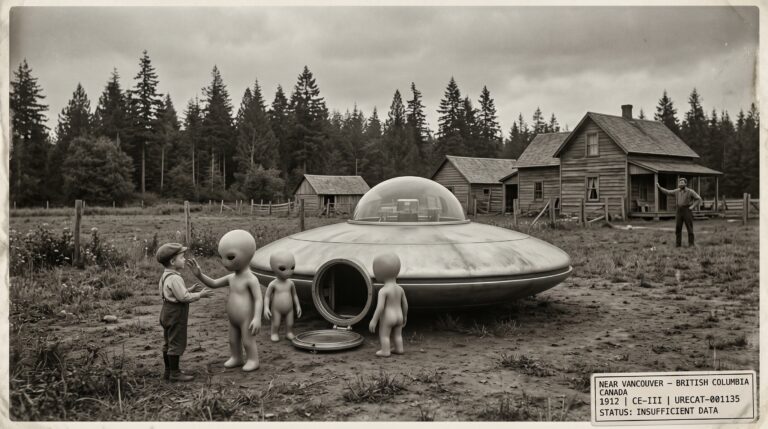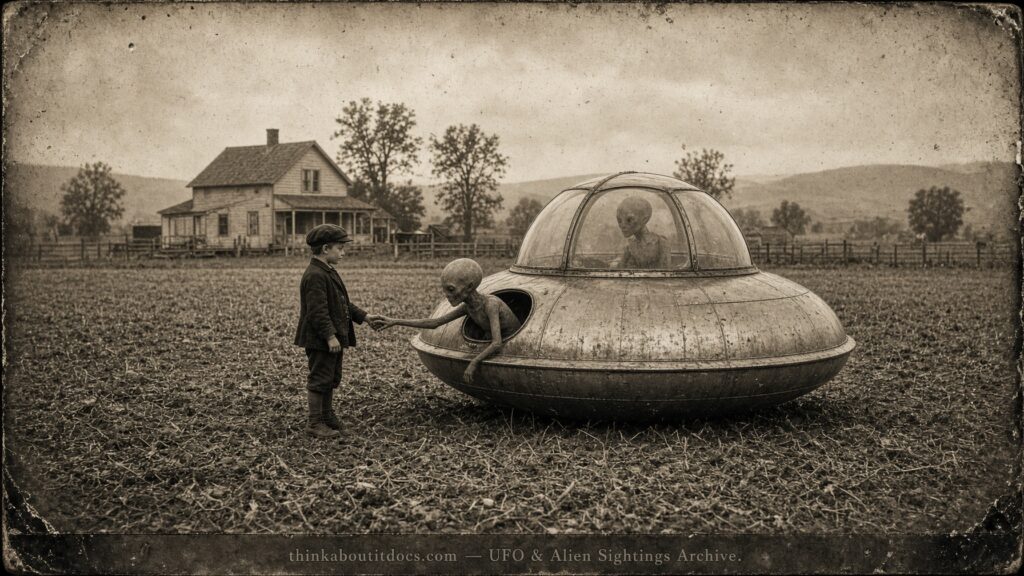
1912, near Vancouver, British Columbia — six-year-old Abram Penner reported occupants of a landed round craft examining his hands and communicating without spoken words.
THINK ABOUTIT UFO|UAP | ENTITY ENCOUNTER REPORT
The 1912 Abram Penner Encounter
A Child’s Contact Case Near Vancouver, BC
Sometime in 1912, on a farm near Vancouver, British Columbia, a six-year-old boy named Abram Penner watched a round, glass-cabined craft — “something like a helicopter” — settle onto his father’s land. What followed, by his own account, was gentle and strange in equal measure: occupants who examined his hands with evident curiosity, who moved and spoke without conventional joints or spoken language as he understood it, and a father who, afterward, told him never to tell anyone. He didn’t, not for decades. The case now survives only because later researchers eventually found him and asked.
Date: 1912
Sighting Time: Undocumented
Day/Night: Undocumented (implied daytime)
Location: A farm near Vancouver, British Columbia, Canada
Urban or Rural: Rural (farmland)
No. of Entity(s): At least 1 (direct interaction); additional occupants implied but not individually described
Entity Type: Humanoid occupants of a landed craft
Entity Description: Round feet, short legs, no knees, no elbows; communicated without spoken language (“operate on mind power”)
Hynek Classification: CE-III
Duration: Undocumented
No. of Object(s): 1
Description of the Object(s): A round craft, compared by the witness to “something like a helicopter,” with a glass cab or cabin section
Shape of Object(s): Round
Size of Object(s): Undocumented
Color of Object(s): Undocumented
Distance to Object(s): Close range (direct physical contact reported)
Height & Speed: Landed; no departure detail documented
Number of Witnesses: 2 (Abram Penner and his father)
Special Features/Characteristics: An occupant physically examined the boy’s hands with apparent curiosity; communication occurred without spoken words, “understood” by the witness directly
Case Status: Insufficient Data
Source: J. Allen Hynek and HUMCAT source chain, published in John Brent Musgrave’s UFO Occupants and Critters: The Patterns in Canada, 1979
Summary/Description: Six-year-old Abram Penner reported a round craft with a glass cabin landing on his father’s farm. An occupant examined his hands and communicated without spoken language; his father later instructed him never to speak of the encounter.
Witnesses: Abram Penner, six years old at the time (sole named witness); his father, who reportedly also saw enough of the event to instruct his son to secrecy afterward
Related Cases: Compare the 1910 Violetville, Maryland case, another young-child witness account of an occupied craft recorded decades after the fact
DETAILED REPORT
The case reaches this archive through a specific and traceable chain: it was recorded in HUMCAT, the Catalogue of Humanoid Reports, and the source is credited to J. Allen Hynek, with the fuller published account appearing in John Brent Musgrave’s 1979 book UFO Occupants and Critters: The Patterns in Canada. As with most humanoid-catalog entries from this period, the underlying interview with Penner took place many years after the event itself — Penner was recounting a childhood memory as an adult, not filing a contemporary report.
According to that account, a round craft — Penner’s own comparison was to a helicopter, though the object had no visible rotor or conventional propulsion apparatus — landed on his father’s farmland. It had a glass cab or cabin section. Occupants emerged or were visible within it, and at least one of them made physical contact with the boy, examining him with apparent curiosity rather than any hostile or clinical intent, by Penner’s telling.
His own recorded words, preserved in the catalog entry, are worth reproducing directly rather than summarizing further: “One man felt my body; they admired my hands. They have different hands than we do; they have round feet, short legs, no knees, and no elbows. They operate on mind power; I understood what they said.” That last detail — communication without spoken language, understood rather than heard — is one of the case’s more distinctive features, differentiating it from contact accounts built around dialogue in a shared or translated tongue.
The encounter ended, and Penner’s father, who appears to have witnessed enough of it to react directly, told his son never to speak of what had happened. That instruction held for a very long time. The case did not enter the ufological record until much later, when researchers working the humanoid-catalog project tracked Penner down and recorded his account as an adult looking back on a single childhood day.
RESEARCHER’S NOTES
Abram Penner — A Child’s Memory, a Father’s Silence, and What That Combination Means for the Record
- This case shares a structural feature with several others in this archive’s pre-war record: a very young witness, a instructed silence, and a decades-later recorded testimony (compare Violetville, Maryland, 1910, elsewhere on this site). That pattern recurs often enough across unrelated cases and unrelated researchers that it’s worth treating as a genuine category, not a coincidence unique to any one account — whether that category reflects a real recurring social response to a real recurring phenomenon, or a recurring narrative shape that childhood memory and later storytelling tend to produce independent of any underlying reality, is exactly the kind of question this archive can pose but not settle.
- The “no knees, no elbows, operate on mind power” description is unusually specific for a six-year-old’s account, however honestly and accurately Penner may have recalled and reported it as an adult. Specificity in a decades-old childhood memory can reflect either a genuinely vivid original experience or the natural sharpening and consolidation that happens to any story retold many times over a lifetime — including, potentially, unconsciously incorporating details absorbed from later exposure to broader UFO-contact narratives that entered popular culture between 1912 and whenever Penner was actually interviewed.
- The father’s instruction to secrecy is one of the case’s more evidentially interesting details precisely because it’s mundane: it doesn’t describe alien-imposed silence or memory suppression, just an ordinary parent’s period-appropriate reaction — fear of ridicule, disbelief, or unwanted attention — to a story that, true or not, would have marked the family as strange to their neighbors. This is a human response, not a paranormal one, and it’s consistent with how many otherwise-unrelated witnesses across this archive describe reacting to their own reported encounters.
- The sourcing chain (Hynek to HUMCAT to Musgrave) is credible and traceable, but every link in that chain is downstream of Penner’s own adult recollection — there is no equivalent of a same-week newspaper account here, the kind of contemporaneous documentation that strengthens cases like the 1913 Beningbrough, Yorkshire sighting elsewhere in this archive. This doesn’t make the account false. It does mean the case rests entirely on the reliability of one person’s long-held memory.
The Abram Penner case endures in the record because a credentialed researcher tracked down an adult who, as a child, had been told to keep a secret — and who, eventually, told it anyway. What survives is vivid, specific, and entirely dependent on the honesty and accuracy of one person’s memory of one day when he was six years old. That’s not a reason to dismiss it. It’s a reason to hold it exactly as carefully as it deserves: a genuinely striking account, honestly limited by what it is.
“One man felt my body; they admired my hands. They have different hands than we do; they have round feet, short legs, no knees, and no elbows. They operate on mind power; I understood what they said.”
— Abram Penner, recalling his 1912 encounter as an adult, documented via J. Allen Hynek and HUMCAT, published in John Brent Musgrave’s UFO Occupants and Critters: The Patterns in Canada, 1979