THINK ABOUTIT ENTITY ENCOUNTER REPORT
1836: Szeged, Hungary Lady in White Encounter
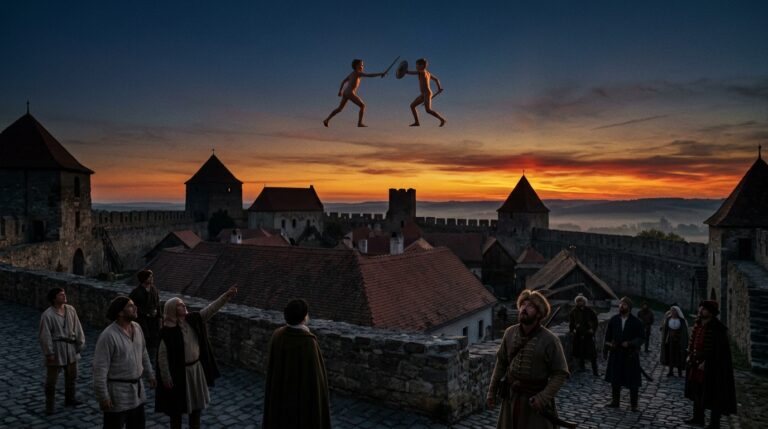
In 1836, near the outskirts of Szeged in southern Hungary — close to the Romanian border, in the flat plains country of the Tisza River — spherical lights descended toward a part of the town at night and a luminous woman in white appeared among them. She moved with a gliding quality that witnesses could not reconcile with ordinary human locomotion. She emitted a soft steady glow. Then she disappeared into the spherical lights, and the witnesses scattered. The uproar was significant enough — and the event unusual enough — to be preserved in the regional record and eventually documented by Ion Hobana and Julien Weverbergh in their survey of Eastern European anomalous case literature. This is one of the earliest documented Hungarian CE-III cases in the archive, and it sits in a decade that produced structurally similar encounters in France, Scotland, Russia, and England. The lady in white disappeared into the lights. That is what the record has.
COMPLETED TEMPLATE
Date: 1836 Sighting Time: Unknown — night Day/Night: Night Location: Outskirts of Szeged, Csongrád County, Hungary — near the Romanian border Urban or Rural: Rural — town outskirts No. of Entity(‘s): 1 Entity Type: Luminous humanoid — female-presenting; described as a lady in white Entity Description: Humanoid figure presenting as a woman in white; luminous — emitting a soft steady glow; moved with a gliding motion inconsistent with ordinary human locomotion; disappeared into the spherical lights; caused widespread terror in witnesses; no verbal communication recorded; no physical interaction with witnesses recorded Hynek Classification: CE-III (Close Encounter III) — animate luminous figure associated with anomalous aerial objects observed by multiple witnesses Duration: Unknown No. of Object(s): Multiple — spherical lights; exact number not recorded Description of the Object(s): Spherical lights descending toward the town outskirts; the luminous humanoid figure appeared in association with them and subsequently disappeared into them Shape of Object(s): Spherical Size of Object(s): Unknown Color of Object(s): Unknown — luminous Distance to Object(s): Close enough for witnesses to observe the figure’s gliding motion and luminous quality; exact distance not recorded Height & Speed: Spherical lights descending toward ground level; figure’s movement described as gliding; no speed data Number of Witnesses: Multiple — described as numerous local residents; exact count not recorded; widespread uproar implies community-level observation Special Features/Characteristics: Spherical lights descending toward the town; luminous humanoid figure appearing in association with the lights; gliding movement; figure emitting its own light; figure disappearing into the spherical objects; community-wide reaction of terror; event preserved in regional record and documented by Hobana & Weverbergh Case Status: Insufficient Data — documented through secondary source (Hobana & Weverbergh) from regional accounts; no primary contemporaneous Hungarian documentation cited; exact details limited to the brief account preserved in the source Source: Ion Hobana & Julien Weverbergh, UFOs Behind the Iron Curtain, Bantam, 1975 Summary/Description: In 1836 near the outskirts of Szeged, Hungary, multiple witnesses observe spherical lights descending toward the town accompanied by a luminous woman-like figure in white moving with a gliding motion. The figure disappears into the spherical lights. The event causes widespread terror and uproar among the local population. Documented in Hobana & Weverbergh’s survey of Eastern European anomalous cases. Related Cases: 1836 Saratov Russia globe hovering event; 1830 Paris Catherine Labouré midnight contact — luminous female figure; 1850 Licheń Poland — luminous woman in white; 1846 La Salette France — weeping luminous figure; 1858 Lourdes France — luminous figure in grotto
DETAILED REPORT
Szeged in 1836 was a substantial Hungarian market town on the Tisza River, near the point where the borders of Hungary, Serbia, and Romania converged under Habsburg administration. It was a prosperous commercial center with a significant population — not a remote village. The outskirts of Szeged would have been farmland and scattered buildings beyond the developed town core, close enough to the Romanian border for the cultural overlap of the region to be felt in local tradition and belief.
What the Hobana & Weverbergh account preserves is minimal but structurally clear: spherical lights descending toward the town’s outskirts at night, accompanied by or followed by the appearance of a luminous humanoid figure described as a lady in white, whose movement was distinctly non-human in quality — gliding rather than walking — and who emitted a soft glow. The figure then disappeared into the spherical objects. The witnesses — the account implies a substantial number of local residents — reacted with terror significant enough to be described as causing widespread uproar.
The structural elements of this case align with a pattern that appears repeatedly in the archive across this decade. The luminous female figure associated with anomalous lights or objects is a consistent feature of the 1830–1860 European contact record: Catherine Labouré in Paris (1830), La Salette in France (1846), Licheń in Poland (1850), Lourdes in France (1858), Robinsonville in Wisconsin (1859). In each case a luminous female figure appears in proximity to an anomalous light source, delivers a message or simply manifests, and departs — usually by dissolving back into the light rather than walking away. The Szeged 1836 case, in which the figure specifically disappears into spherical objects, is the most explicitly technological-looking variant of this pattern in the decade’s record, placing it closer to the craft-and-entity model than to the apparition model.
The sparse detail in the Hobana & Weverbergh documentation is a genuine limitation of this case. The account is brief — a summary rather than a full narrative — and no primary Hungarian source document from 1836 has been independently identified and cited in the available literature. What can be said with confidence is that the event was notable enough to survive in the regional record through to the 1970s when Hobana & Weverbergh compiled their survey, and that its structural features are consistent with independently documented cases from the same era across multiple countries.
RESEARCHER’S NOTES
Title: The Lady in White and the Spheres — Szeged 1836 and the Luminous Female Figure in the 19th-Century Contact Record
Source Fidelity Note: This page contains descriptive language in its “witness account” block that goes beyond what the Hobana & Weverbergh source documents — specifically the detail about the figure’s glow matching “the frequency of the nearby lights” and the description of a specific named witness citing a “historical chronicle.” These details do not appear to derive from the Hobana & Weverbergh text and should be treated as editorial embellishment rather than sourced content. The full treatment here is based strictly on what the source documents: spherical lights, luminous gliding lady in white, disappearance into the objects, community uproar. Nothing more is claimed.
Pattern Context — Luminous Female Figure Series: The Szeged 1836 case belongs to a distinct sub-pattern in the 19th-century European contact record: a luminous female figure, usually described as a lady in white or similar, appearing in association with anomalous lights or objects. The pattern spans at least 1830–1859 and crosses France, Poland, Hungary, and the United States. The Szeged variant is distinctive in that the figure explicitly disappears into the spherical objects — a departure mechanism more consistent with craft-entity association than with the apparition model that characterizes La Salette or Lourdes. This detail, if accurate, places the Szeged case closer to a CE-III in the strict craft-and-occupant sense than most of its pattern-mates.
Urban Context: The “uproar” described implies a community-level event rather than an isolated personal encounter. Szeged in 1836 was a substantial town. The reaction of widespread terror among what appears to be multiple simultaneous witnesses distinguishes this from a private vision or individual encounter and supports the CE-III classification.
WRAP-UP PARAGRAPH
The lady in white glided across the outskirts of Szeged in 1836 and disappeared into the spherical lights and left behind an uproar — people who had seen something that had no name in their language and no place in their category of experience. The spheres departed with whatever or whoever had been inside them. The regional record preserved what happened. Hobana and Weverbergh found it a century and a half later and put it in a book. The archive holds it now — sparse, sourced only to a secondary survey, stripped of the embellishments that had accumulated around it. The core is enough: lights, a woman in white who glowed and glided and vanished, and a town that was frightened. That is the record. That is what stands.