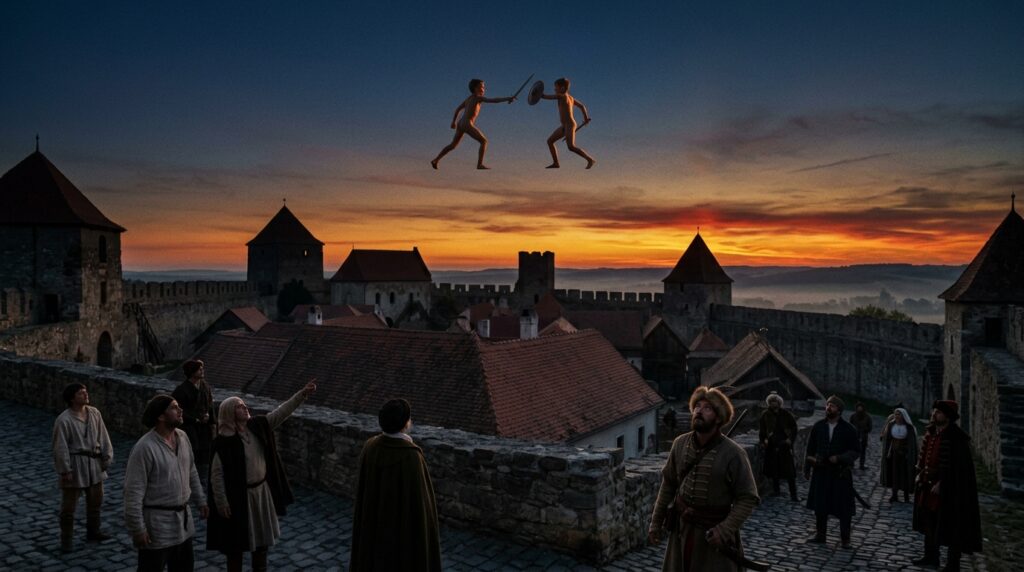
September 1556 CE — Babócsa, Hungary. At sunrise, the people of an Ottoman-occupied Hungarian frontier town watched two naked boy-sized entities armed with short swords and shields fight in the sky above their streets. In a community surrounded by real armed combat, the witnesses knew exactly what they were describing — and what they described was not human.
THINK ABOUTIT CLOSE ENCOUNTER REPORT
1556: Naked boys in the sky over Babocsa, Hungary
At sunrise in September 1556, the local people of Babócsa in southern Hungary watched two naked boys fight in the sky. They were armed — short swords in their hands, shields on their arms — and they were fighting each other in the air above the town with the organized deliberate violence of a duel rather than the chaos of a brawl. Babócsa in 1556 was a frontier fortress town on the edge of the Ottoman-occupied zone of Hungary — a place where real armed combat between real soldiers was a near-daily reality of life. The witnesses who looked up at sunrise and saw two naked child-sized figures conducting an armed aerial duel above their streets were not strangers to violence or to soldiers. They knew what a sword was and what a shield was and what two figures fighting with them looked like. What they saw at sunrise on that September morning was all of those things — but in the sky, and naked, and not human. Documented by T. Peter Park in The Anomalist No. 10, the Babócsa encounter is one of the most unusual entity morphology descriptions in the entire 16th century Hungarian record — and one of the only pre-modern cases in the archive of armed child-sized entities conducting an aerial duel over a populated city.
Date: September 1556
Sighting Time: After sunrise
Day/Night: Dawn/early morning — after sunrise
Location: Babócsa, Somogy County, Hungary
Urban or Rural: Urban — town; Babócsa was a fortified frontier town
No. of Entity(s): 2
Entity Type: Small humanoid — described as boys; naked; armed with short swords and shields
Entity Description: Two naked humanoid figures of boy-like proportions observed in the sky after sunrise over Babócsa, engaged in active aerial combat using short swords and shields strapped to their arms. The description is precise in its physical detail: specifically naked, specifically boys in apparent age or size, specifically armed with two specific weapon types — short swords and shields — and specifically fighting each other rather than displaying or performing.
Hynek Classification: CE-III — Close Encounter of the Third Kind; close observation of two animate non-human beings engaged in physical combat in the aerial space above a populated town
Duration: Not recorded — sufficient for the witnesses to observe both figures, their weapons, their shields, and the nature of their combat
No. of Object(s): None described — no craft or aerial vehicle associated
Size of Object(s): Boy-sized — proportions of boys rather than adult humans
Color of Object(s): N/A — skin-colored; naked
Distance to Object(s): Aerial — above the town; close enough for witnesses to distinguish nakedness, apparent age/size, weapon type, and combat behavior
Height & Speed: Aerial — above Babócsa at sunrise; altitude not recorded; movement consisted of combat maneuvers
Number of Witnesses: Multiple — local people of Babócsa
Special Features / Characteristics: Nakedness as a specific observed characteristic — witnesses specifically noted the absence of clothing as a defining feature of the entities; armed combat with specifically identified weapons — short swords and shields rather than general weapons; boy-sized proportions in aerial entities is one of the rarest morphologies in the pre-modern entity record; the Babócsa encounter connects to the broader pattern of aerial entity combats documented across 16th century Central Europe — 1561 Nuremberg, 1566 Basel, 1564 Belgium crowned figures — but with humanoid entities rather than geometric objects; Ottoman occupation context — Babócsa was a frontier fortress town in the most war-saturated region of 16th century Hungary; the 1560 Shenley England five naked dancing men and the 1556 Babócsa naked armed boys are documented within the same decade
Case Status: Unexplained
Source: T. Peter Park, The Anomalist No. 10
Summary/Description: In September 1556, at sunrise, local people in Babócsa, Hungary observed two naked boy-sized humanoid figures fighting in the sky with short swords and shields. The encounter occurred during the Ottoman occupation of southern Hungary. Documented by T. Peter Park in The Anomalist No. 10 as part of the broader pattern of 16th century Central European aerial entity encounters.
Related Cases: 1564 CE Belgium Three Crowned Figures in Sky | 1561 CE Nuremberg Germany Aerial Battle | 1553 CE Wittenberg Germany Giant Men in Sky | European Aerial Entity Archive
DETAILED REPORT:
September 1556. Babócsa is a small fortified town in the Somogy region of southern Hungary — in the zone that has been under Ottoman occupation since the Battle of Mohács in 1526. The Hungary of 1556 is a country divided against itself and against its conquerors: the western and northern portions under Habsburg control, the central plains under direct Ottoman administration, and Transylvania operating as a semi-autonomous principality. The frontier between these zones is exactly where Babócsa sits — a fortress town on the edge of the contested borderlands where armed violence was not an unusual event but the defining condition of daily life.
The people of Babócsa knew soldiers. They knew weapons. They knew what combat looked like.
At sunrise in September of that year, they looked up.
Two figures were fighting in the sky above their town. The account that T. Peter Park preserved in The Anomalist is economical to the point of compression — which is itself a form of precision. Six details: two, naked, boys, sky, short swords, shields on their arms. The account does not elaborate, does not theologize, does not place the encounter in any interpretive framework. It records what was observed with the specificity of people who knew what they were looking at and chose the most accurate available vocabulary for each element.
Naked. Both figures were unclothed — a specific observation that the witnesses preserved because it was specific. They were not wearing armor, not wearing robes, not in the conventional military dress of either the Ottoman soldiers or the Habsburg forces that were the visual reference points for armed men in Babócsa in 1556. Naked.
Boys. Not men. Not giants. Not angels of indeterminate scale. Boys — the scale and proportions of children or adolescents, observed clearly enough at aerial altitude for the witnesses to make this size determination with confidence.
Short swords. A specific weapon type — not long swords, not lances, not bows. Short swords. The kind of weapon used in close combat, in a duel rather than a cavalry charge. Weapons carried for fighting at close range with a specific opponent.
Shields on their arms. Each figure carried a shield strapped to its arm. The shields were being used — they were part of the combat, part of the defense against the other figure’s short sword. Two armed figures conducting a properly equipped aerial duel at sunrise over a frontier town in Ottoman Hungary.
They were fighting each other.
Not performing. Not displaying. Fighting — with the intent and the equipment of genuine combat. The witnesses who had spent years watching real soldiers conduct real combat in and around their fortress town recognized what they were looking at. Two figures, boy-sized, naked, armed, fighting in the sky above them at sunrise in September.
The Babócsa encounter fits within the broader pattern of aerial entity combat documented across Central Europe in the 1550s and 1560s. The 1553 Wittenberg Germany giant men in the sky. The 1556 Babócsa naked armed boys. The 1561 Nuremberg aerial battle between hundreds of objects. The 1564 Belgium crowned figures in the sky preceding a rain of stones. The 1566 Basel black sphere combat. The entity type varies across these accounts — from geometric spheres and cylinders in Nuremberg and Basel to fully humanoid figures in Babócsa and Belgium — but the combat or confrontation behavior connects them as a pattern of aerial entity activity concentrated in the same geographic zone across the same decade.
What distinguishes Babócsa from the others is the morphology: naked boys. No other account in the archive describes armed naked child-sized entities in aerial combat. The specificity of the description argues for genuine observed phenomenon rather than cultural invention — a 16th century Hungarian town with no reason to invent this particular combination of descriptive details chose each of them because they were accurate.
RESEARCHER’S NOTES:
The Babócsa Naked Boys — Unique Morphology, Weapon Specificity, and the 1556 Hungarian Context
- Morphological Uniqueness: The description of two naked boy-sized entities armed with short swords and shields is one of the most morphologically unusual in the entire pre-modern European entity record. It shares the naked quality with the 1660 Shenley England naked dancing men, the armed quality with the aerial army tradition documented from 1100 CE onward, and the boy-sized proportions with no direct parallel in the archive. The combination of all three — naked, boy-sized, armed — is unique to this account. Unique morphological descriptions in the pre-modern record argue for genuine observed phenomena rather than culturally transmitted narrative, since witnesses inventing encounters tend to draw on familiar existing templates.
- Weapon Identification as Observational Specificity: The specific identification of short swords rather than swords generically, and shields rather than armor generically, reflects a level of observational precision consistent with witnesses who were genuinely familiar with weapons and could distinguish between weapon types. In a frontier fortress town under Ottoman occupation, adults would have extensive daily exposure to armed soldiers and their equipment. Their specific identification of the weapon types argues for genuine close enough observation to make that distinction.
- Ottoman Frontier Context: The location of the Babócsa encounter in the Ottoman-occupied zone of 16th century Hungary provides the clearest possible witness context for an aerial combat observation. A population living in a fortress town on a military frontier, surrounded by armed conflict, would have the most developed vocabulary for describing what combat looked like — and would be the least likely to mistake something non-martial for armed combat. What they described as two figures fighting with swords and shields is what they saw as two figures fighting with swords and shields.
- The Aerial Entity Combat Pattern: The 1556 Babócsa encounter is one of multiple documented aerial entity combat events in Central Europe during the 1550s–1560s decade. The concentration of such accounts in this specific geographic zone during this specific historical period — when the same zone was experiencing the most intense military conflict in its history between Habsburg and Ottoman forces — suggests a possible connection between aerial entity activity and zones and periods of intense human conflict. The archive documents this pattern without speculating about its mechanism.
At sunrise in September 1556, the people of Babócsa looked up from their Ottoman-occupied frontier town and watched two naked boys fight each other in the sky with short swords and shields. They were specific about what they saw because they were people who knew weapons and knew combat and knew how to describe both. T. Peter Park preserved the account in The Anomalist. The archive holds it now — one of the most morphologically unusual entity descriptions in the pre-modern record, from one of the most war-experienced witness communities in 16th century Europe. Whatever fought above Babócsa at sunrise that September was naked, was boy-sized, was armed, and was fighting. The witnesses knew the difference between soldiers and whatever this was. They described it as whatever this was.