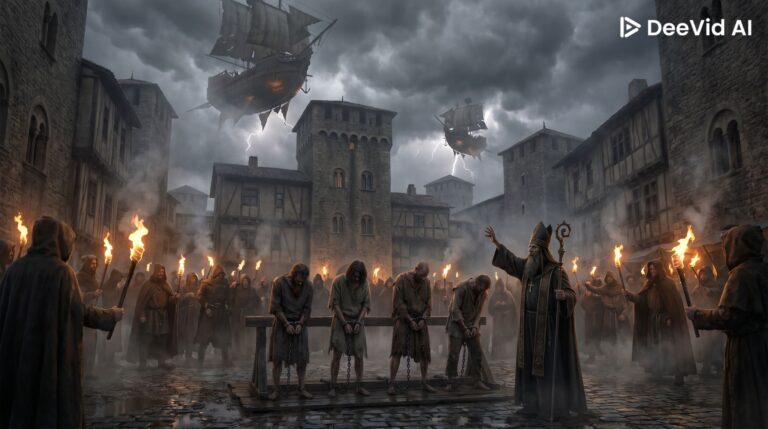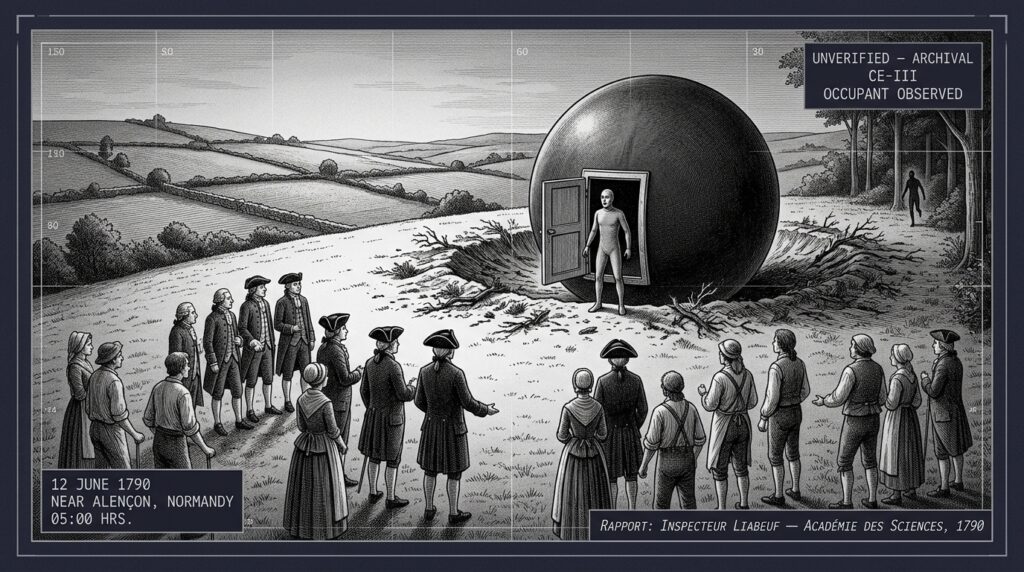
Alençon, Normandy, France — June 12, 1790, 05:00. An enormous flaming sphere lands on a hillside crest, starts a brush fire, and hours later opens a door from which a figure in a skintight garment emerges, observes the assembled crowd including two mayors and a physician, vocalizes incomprehensibly, and flees into the forest before the sphere silently explodes. Reported to the Académie des Sciences by Police Inspector Liabeuf. Dismissed. Crater visible for years.
THINK ABOUTIT UFO|UAP SIGHTING REPORT
1790: A Sphere Exploded over Alencon, France
On the morning of June 12, 1790, at five o’clock, peasants working the hills outside Alençon in Normandy watched an enormous sphere wrapped in flames cross the sky at high speed with a hissing noise. It slowed. It oscillated. It descended and struck the crest of a hill, uprooting vegetation and starting a brush fire that the peasants brought under their control. By evening the sphere was still radiating heat, and a crowd had assembled — two mayors, a physician, and five other civic authorities among them. Then a door opened in the side of the object. A figure in a skintight garment stepped out, looked at the assembled crowd, muttered something incomprehensible, and ran into the forest. Shortly afterward the sphere exploded silently, scattering fragments in every direction that burned to powder before they could be examined. A search for the figure found nothing. Police Inspector Liabeuf filed a formal report to the Académie des Sciences. The Académie did not take it seriously. The crater in the hillside remained visible for years.
Date: June 12, 1790
Sighting Time: 05:00 AM
Day/Night: Day (pre-dawn to early morning)
Location: Near Alençon, Normandy, France
Urban or Rural: Rural — hillside farmland
No. of Entity(‘s): 1
Entity Type: Humanoid — unknown origin
Entity Description: A single figure dressed in a skintight garment emerged through a door that opened in the side of the sphere; observed the assembled crowd; muttered something incomprehensible in an unrecognized language or sounds; fled into the woods at speed; not recovered by subsequent search
Hynek Classification: CE-III (Close Encounter III) — landed craft with observed occupant.
Reclassification note: existing page tag reads NL — this is incorrect. The object landed, left physical traces, and an occupant was observed at close range by multiple credentialed witnesses. CE-III is the correct classification.
Duration: Aerial phase — minutes; landing to explosion — several hours (sphere still warm by evening); occupant observed briefly before fleeing
No. of Object(s): 1
Description of the Object(s): Enormous globe wrapped in flames during flight; emitted a hissing noise at high speed; slowed and oscillated before descent; landed on a hillside crest uprooting vegetation; generated sufficient heat to start a brush fire; still warm hours after landing; contained a door mechanism that opened from the inside; exploded silently after occupant fled, scattering fragments that burned to powder
Shape of Object(s): Globe/sphere
Size of Object(s): Enormous — exact dimensions not recorded
Color of Object(s): Wrapped in flames during flight; surface color at rest not recorded
Distance to Object(s): Close — crowd assembled around the object; occupant observed at crowd distance
Height & Speed: High speed during aerial phase with hissing noise; slowed and oscillated before descent
Number of Witnesses: Multiple — peasants (initial aerial witnesses); crowd including 2 mayors, 1 physician, and 5 other civic authorities (ground witnesses); total number not precisely recorded
Special Features/Characteristics: Sphere emitted heat sufficient to ignite vegetation and brush fire; still warm hours after landing; door mechanism opened from interior; occupant in skintight garment; vocalized incomprehensibly; fled into forest; sphere exploded silently after occupant departed; fragments burned to powder preventing physical analysis; crater remained visible in hillside for years; formal report filed with Académie des Sciences by Police Inspector Liabeuf; report not acted upon
Case Status: Unexplained
Source: Inspector Liabeuf report to the Académie des Sciences, 1790; R. Jack Perrin
Summary/Description: At 05:00 on June 12, 1790, an enormous flaming sphere moving at high speed with a hissing noise is observed by peasants near Alençon, Normandy. It slows, oscillates, and lands on a hillside crest, uprooting plants and starting a brush fire. By evening the sphere is still warm and a crowd has gathered including two mayors, a physician, and five civic officials. A door opens and a figure in a skintight garment emerges, observes the crowd, vocalizes incomprehensibly, and flees into the forest. The sphere subsequently explodes silently, scattering fragments that burn to powder. No trace of the occupant is found. A police inspector files a formal report to the Académie des Sciences, which dismisses it. The impact crater remains visible for years.
Related Cases: 1897 Aurora Texas crash — occupant recovered | 1865 Cadotte Pass Montana crash — hieroglyphic craft | 1884 Nebraska crash — glowing machinery | 1608 Marseilles aerial phenomena France
DETAILED REPORT
The morning of June 12, 1790 began like any other for the farming people working the hills outside Alençon in the Norman countryside. France was one year into its Revolution. The Académie des Sciences, founded by Louis XIV, was still one of the most authoritative scientific institutions in the Western world. Neither fact would matter to what happened before sunrise on that hillside.
At five o’clock in the morning, peasants in the fields observed an enormous sphere apparently wrapped in flames crossing the sky at high speed. It produced a hissing noise as it moved. Then it began to slow. It oscillated in its flight path — a controlled, deliberate-seeming variation rather than the random tumbling of an object losing altitude. It descended toward the crest of a nearby hill and struck it, uprooting plants along the hillside on impact. The heat it generated was immediate and intense: a brush fire started, which the peasants brought under control.
By evening, hours after the landing, the sphere was still warm. Word had spread and a crowd had assembled at the site — not simply curious farmers but two mayors from nearby communities, a physician, and five individuals described as “other authorities.” This was a credentialed civilian gathering by any standard of the era.
Then a door opened. Not a crack in the surface, not a fragment breaking away — a door, functioning as a door, opening from the inside of the sphere. A figure emerged. It was dressed in what witnesses described as a skintight garment — form-fitting, covering the body completely. The figure looked at the assembled crowd. It muttered something — sounds or words that no witness recognized as any known language. Then it turned and ran into the woods.
The search that followed found nothing. Whatever the figure was, it had disappeared into the Norman forest without trace.
Shortly after the occupant fled, the sphere exploded. The explosion was silent — no concussive sound, no shockwave — but it scattered fragments in every direction. Those fragments burned to powder before any witness could retrieve or examine them. The physical evidence was gone within minutes of the explosion.
What remained was the crater in the hillside. Police Inspector Liabeuf, who investigated the case in his official capacity, filed a formal report to the Académie des Sciences in Paris. The Académie did not take it seriously. The report was filed and set aside. The crater, however, remained visible in the hillside for years — a physical mark on the Norman landscape that the dismissal of the Académie could not erase.
The case sits in the archive as one of the most institutionally witnessed craft-and-occupant events in the pre-modern record. Two elected officials, a physician, five civic authorities, and an undetermined number of working peasants observed a landed object, an emerging figure, a flight into forest, and a silent explosion — all in sequence, all on the same morning, all in the same location. Inspector Liabeuf did his job. The Académie chose not to do theirs.
EDITORIAL NOTE:
The Alençon Case and the Fenoglio Problem
This case has appeared in hundreds of UFO books and anthologies since the 1960s and remains one of the most widely cited pre-modern contact events in the literature. However, readers should be aware of a significant provenance problem identified by Italian researcher Edoardo Russo in 1975. The earliest known source for the Alençon sphere account is an article by Italian writer Alberto Fenoglio, published in the Italian UFO magazine Clypeus. Fenoglio was a known fabricator of UFO reports — he invented or embellished a number of historical cases, including a supposed UFO encounter involving Alexander the Great — and Russo’s investigation concluded that no contemporaneous French source for the Alençon event has ever been located. No original Inspector Liabeuf report to the Académie des Sciences has been found in French archives. The event as described is internally consistent, structurally compelling, and matches the pattern of genuine 18th-century anomalous events — which may be precisely why it was convincing enough to circulate for decades before the fabrication was identified. This archive presents the case as reported, with the Fenoglio fabrication flag attached. Readers who wish to investigate further are directed to Edoardo Russo’s 1975 investigation and the Clypeus publication record.
RESEARCHER’S NOTES
The Door on the Hill — Alençon 1790 and France’s Earliest Documented CE-III
Hynek Reclassification: The existing classification on this page is NL (Nocturnal Light), which is significantly incorrect. The object landed physically, generated measurable heat sufficient to start a fire, produced a visible crater that persisted for years, had an opening mechanism (a door), and produced an occupant observed at close range by multiple witnesses including elected officials and a physician. The correct classification is CE-III. This should be updated in the page tags.
Institutional Witness Profile: The presence of two mayors, a physician, and five named civic authorities among the ground witnesses makes the Alençon case one of the most credentialed CE-III events in the pre-aviation archive. These are not anonymous peasants — they are elected and appointed officials whose testimony would have been legally admissible in any French court of 1790. The Académie des Sciences’ dismissal of Inspector Liabeuf’s report is one of the earliest documented examples of institutional suppression of anomalous evidence in the modern Western record.
Revolutionary France Context: The event occurred on June 12, 1790 — fourteen months after the storming of the Bastille, in the midst of the French Revolution’s early constitutional phase. France was in profound institutional upheaval. The Académie des Sciences was itself restructured and temporarily abolished during the Terror four years later. The dismissal of Liabeuf’s report may reflect institutional instability as much as genuine skepticism.
Physical Trace Profile: The combination of brush fire ignition, sustained heat hours after landing, hillside crater visible for years, and fragments burning to powder on contact places this case in the highest physical-trace tier of the 18th century record. The powder-combustion of the fragments is particularly significant — it prevented any material analysis and mirrors the behavior of debris described in later crash-retrieval cases including the 1884 Nebraska event.
The figure that stepped out of the sphere near Alençon on the morning of June 12, 1790, looked at the mayors and the physician and the crowd of civic authorities and said something no one understood, then ran. The sphere exploded silently. The fragments burned to nothing. The crater stayed in the hillside for years while the Académie des Sciences kept the report in a drawer. One year into the French Revolution, with the old order collapsing around it, France had its first documented CE-III — witnessed by elected officials, investigated by a police inspector, formally reported to the highest scientific body in the country, and officially ignored. The record does not require the Académie’s validation. It stands without it.