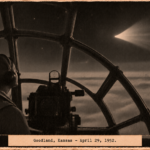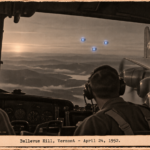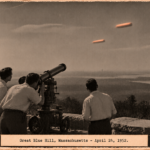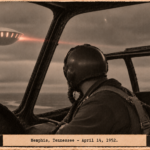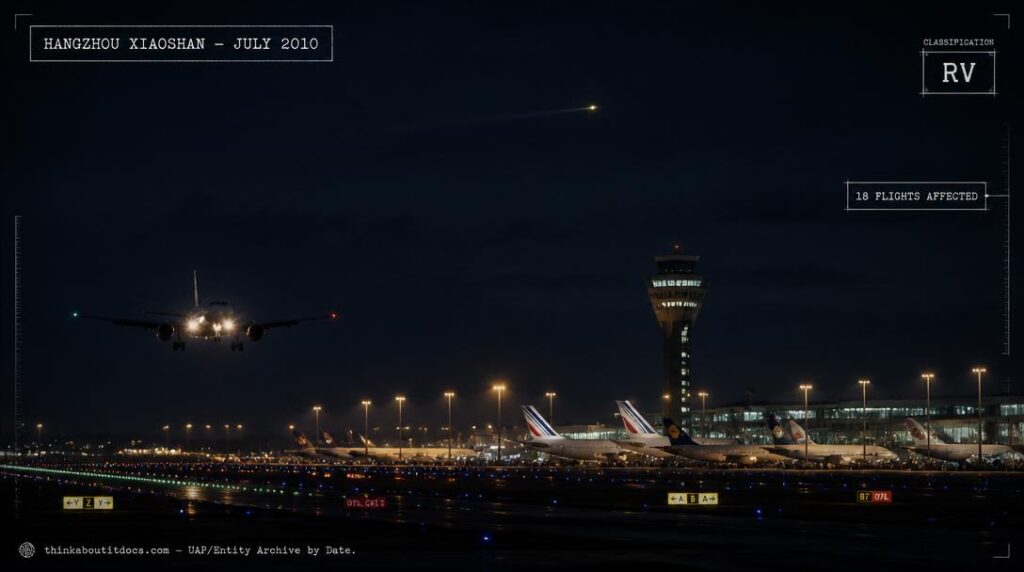
Dossier reconstruction of the object reported near Hangzhou Xiaoshan International Airport, China, July 7, 2010.
THINK ABOUTIT UFO|UAP ENCOUNTER REPORT
2010: Hangzhou Xiaoshan Airport UFO Shutdown | China Case Archive
At around 8:40 on the evening of July 7, 2010, a flight crew preparing to land at Hangzhou Xiaoshan International Airport, one of China’s busiest, spotted a fleeting, dot-shaped object and alerted air traffic control. Within minutes, the airport ground all departures and began diverting inbound flights to Ningbo and Wuxi. Eighteen flights were affected before operations resumed roughly an hour later. It remains one of the most institutionally investigated UFO cases on record — a joint civil aviation and military review, plus two separate Chinese UFO research societies who traveled to the scene themselves.
None of those investigations produced a confirmed public explanation. What they did produce is a case that’s easy to over-simplify: Hangzhou residents separately photographed a golden, comet-tailed light that afternoon and a red-and-white glow that same night, and Chinese media quickly folded all of it into one “airport UFO” story. ABC News’ own contemporaneous reporting is explicit that those civilian photos “may be unrelated” to whatever the flight crew actually saw. This entry keeps them apart.
Date: July 7, 2010
Sighting Time: Approximately 8:40–8:45 PM (airport operations suspended until approximately 9:41 PM)
Day/Night: Night
Location: Hangzhou Xiaoshan International Airport (HGH), Zhejiang Province, China
Urban or Rural: Urban — major international airport serving Hangzhou
Hynek Classification: RV (Radar/Visual) — object reported both on radar and visually by the flight crew and air traffic control
Duration: The object itself was described as a brief, “fleeting” sighting by the flight crew; the resulting airport shutdown lasted approximately 55–65 minutes as a precautionary measure. These are two distinct figures — see Researcher’s Notes.
No. of Object(s): 1 (the object that triggered the shutdown); separate, likely unrelated civilian sightings/photographs are documented independently — see Related Cases and Researcher’s Notes
Description of the Object(s): Described by the flight crew only as a fleeting, dot-shaped object; no further shape, size, or color detail is documented for this specific object
Shape of Object(s): Dot-shaped, per the flight crew’s brief description; undocumented beyond this
Size of Object(s): Undocumented
Color of Object(s): Undocumented for the triggering object. Separately, civilian photographers described a golden-lit object with a comet-like tail (afternoon) and a light emitting red and white rays (that night) — likely different, unrelated sightings
Distance to Object(s): Undocumented
Height & Speed: Undocumented
Number of Witnesses: An unspecified flight crew and air traffic control personnel directly involved in the triggering sighting; secondary sources describe hundreds of additional passengers and airport staff affected by the resulting shutdown, though not necessarily witnesses to the object itself
Special Features/Characteristics: 18 flights affected (6 departures delayed, 12 arrivals diverted to Ningbo and Wuxi); the Civil Aviation Administration of China and the Eastern Theater Command Air Force jointly investigated but never publicly released a confirmed explanation; five researchers from the Beijing UFO Research Society and the Shanghai UFO Investigative Research Center independently traveled to Hangzhou and concluded the sighting was likely just another aircraft, stating that widely circulated civilian photos and video had no direct relationship to the actual incident; arms-control analyst Geoffrey Forden proposed a Chinese DF-21 missile test launched from Jiuquan as the most likely explanation, while identifying one widely circulated photo as probably digitally altered; occurred amid a broader wave of Chinese UFO reports that summer
Case Status: Insufficient Data — see Researcher’s Notes for rationale
Source: ABC News, July 14, 2010; cross-referenced with Xinhua News Agency, Christian Science Monitor, and Baidu Baike’s summary of the CAAC/Eastern Theater Command investigation
Summary/Description: On the night of July 7, 2010, a flight crew preparing to land at Hangzhou Xiaoshan International Airport spotted a fleeting, unidentified object and alerted air traffic control, prompting an hour-long shutdown that affected 18 flights. A joint civil aviation/military investigation never publicly confirmed an explanation, while two independent Chinese UFO research societies concluded the sighting was likely a misidentified aircraft, unrelated to widely circulated civilian photographs from the same night.
Related Cases: This sighting occurred amid a wider 2010 wave of Chinese UFO reports, including a fan-shaped object reported in Urumqi, Xinjiang about a week earlier and a diamond-shaped formation of “lantern-like” objects reported over Chongqing about a week later. A broadly similar airport-disrupting sighting occurred at Chongqing’s Jiangbei International Airport roughly a year afterward. None are separately indexed in this archive.
Detailed Report
On the evening of July 7, 2010, weather conditions at Hangzhou Xiaoshan International Airport in Zhejiang Province were stable and unremarkable. Then, at around 8:40 to 8:45 PM, a flight crew preparing for descent spotted a fleeting, dot-shaped object and notified air traffic control. Aviation authorities responded within minutes: outbound flights were grounded and inbound flights diverted to airports in Ningbo and Wuxi. In total, 18 flights were affected — six departures delayed and twelve arrivals diverted — before normal operations resumed at approximately 9:41 PM, roughly an hour after the closure began.
The story exploded in Chinese media and online, generating over a million views for a video titled “Actual Footage of Long-tailed UFO at Zhejiang Airports” within a single day, even as most commenters online questioned its authenticity. Speculation ranged widely — a hidden American bomber, a Russian satellite, a new Chinese missile — with one commentator dismissing extraterrestrial explanations outright: “In my opinion, the UFO is neither a U.S. missile nor a Russian satellite. Suggestions that it is extraterrestrial are even more preposterous.”
Complicating the story further, Hangzhou residents separately released photographs from that same day: one taken in the afternoon showed an object bathed in golden light trailing a comet-like tail, and another, taken by resident Ma Shijun during an evening stroll at 8:26 PM — roughly 15 to 20 minutes before the airport closure — showed a streak of bright light emitting red and white rays. Ma himself was candid about the uncertainty: he saw a beam of light overhead, looked up, and photographed a streak of bright white light crossing the sky, but told Xinhua he had no clear answer as to whether it was a plane or “Xiaoshan Airport’s UFO.” ABC News’ own contemporaneous reporting flagged this ambiguity directly, noting that these civilian photographs “may be unrelated” to whatever the flight crew had actually seen.
The institutional response was unusually substantial for a UFO case. The Civil Aviation Administration of China and the Eastern Theater Command Air Force jointly investigated the incident, but neither body ever publicly released a confirmed explanation. Separately, five researchers from the Beijing UFO Research Society and the Shanghai UFO Investigative Research Center traveled to Hangzhou on their own initiative to look into the case; they concluded the sighting was most likely just another aircraft, and explicitly stated that the viral photographs and video circulating online had no direct relationship to the actual event at the airport.
Independent analysts weighed in as well. Arms-control specialist Geoffrey Forden, writing on his “Arms Control Wonk” blog, proposed that a Chinese DF-21 missile test launched from Jiuquan and aimed at the eastern Gobi desert was the most likely cause, while acknowledging the technical difficulty of explaining how a solid-rocket motor’s exhaust would be visible from so far away. Reviewing the various images in circulation, Forden judged one widely shared photograph — showing the object breaking up behind buildings reportedly in Hangzhou — to be almost certainly digitally altered, given the implausibly large apparent angle it would require to be genuine at that distance; he considered a separate image, showing an object with a trailing white plume, the more credible of the available photographs.
The Hangzhou incident did not occur in isolation. About a week earlier, residents of Urumqi, in China’s Xinjiang region, had reported a fan-shaped object with a white light. About a week after Hangzhou, residents of Chongqing reported four “lantern-like” objects forming a diamond shape hovering over a city park for over an hour. Roughly a year later, a broadly similar incident forced flights to divert at Chongqing’s Jiangbei International Airport, with skeptical airport workers there suggesting a sky lantern or large balloon as the likely cause.
RESEARCHER’S NOTES
The Xiaoshan Airport Shutdown — China 2010 and Three Sightings Folded Into One Story
- Two Durations, Not One: The flight crew’s own sighting of the object is described as “fleeting” — a brief visual contact — while the airport’s operational shutdown lasted roughly 55 to 65 minutes as a precautionary measure. These are two different figures; the object itself was not necessarily visible for the full duration of the closure.
- Likely Unrelated Civilian Photographs: ABC News’ own contemporaneous reporting states plainly that photographs Hangzhou residents took separately — one showing a golden-lit object with a comet-like tail in the afternoon, another showing red-and-white light taken by resident Ma Shijun at 8:26 PM — “may be unrelated” to the object that actually triggered the airport shutdown. This archive treats the flight-crew sighting and these civilian photographs as separate, only loosely connected reports.
- Two Investigations, No Confirmed Public Explanation: The Civil Aviation Administration of China and the Eastern Theater Command Air Force jointly investigated the incident but never publicly released a confirmed explanation. Separately, five researchers from the Beijing UFO Research Society and the Shanghai UFO Investigative Research Center concluded, independently, that the sighting was likely just another aircraft, and that the circulating viral photos and video had no direct relationship to the actual event.
- A Specific Proposed Explanation: Arms-control analyst Geoffrey Forden proposed that a Chinese DF-21 missile test launched from Jiuquan, aimed at the eastern Gobi desert, was the most likely cause, while acknowledging the technical difficulty of a solid-rocket exhaust plume being visible from that distance. Forden separately identified one widely circulated photo of the object as most likely digitally altered.
- Part of a Wider 2010 Wave: This sighting occurred amid a broader cluster of Chinese UFO reports that year, including a fan-shaped object reported in Urumqi, Xinjiang about a week earlier, and a diamond-shaped formation of “lantern-like” objects reported over Chongqing about a week later. A separate, broadly similar airport-disrupting sighting occurred at Chongqing’s Jiangbei Airport roughly a year afterward.
- Case Status Rationale: Filed as Insufficient Data given the substantial institutional investigation — a joint civil aviation/military review, plus two independent UFO research societies — that nonetheless never converged on a single, publicly confirmed explanation, and given the real risk of conflating the flight crew’s triggering sighting with separate, likely unrelated civilian photographs.
The Xiaoshan Airport case is remarkable less for the sighting itself — a fleeting dot, gone almost as soon as it was reported — than for how much institutional weight came down on it afterward: military and civil aviation authorities, two separate UFO research societies, and an outside missile analyst, none of whom produced a single agreed answer. It is filed as Insufficient Data because that is precisely the state the investigation was left in, not because no one looked.
“I felt a beam of light over my head.”