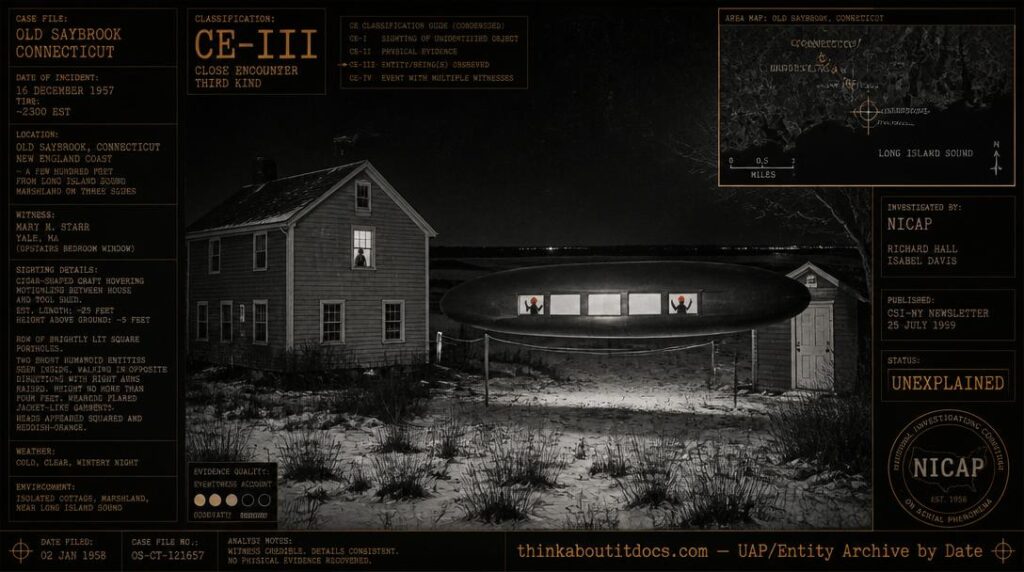
Old Saybrook, Connecticut, December 16, 1957 — A cigar-shaped craft hovered beside Mary Starr's isolated cottage. Through its square portholes, she watched three small beings with reddish-orange squared heads.
THINK ABOUTIT UFO|UAP|ENTITY SIGHTING REPORT
1957: Cigar-shaped UFO with Occupants Viewable
In the small hours of December 16, 1957, a retired schoolteacher with two degrees from Yale looked out her bedroom window in Old Saybrook, Connecticut and saw something ten feet from the side of her house: a cigar-shaped craft, 20 to 30 feet long, hovering silently above her clothesline. Through its square, brightly lit portholes, she could see figures walking inside — beings no more than four feet tall, with square, reddish-orange heads and no visible hands. This is the Starr case, investigated on-site by NICAP’s Richard Hall and Isabel Davis, published by Civilian Saucer Intelligence of New York, and placed without reservation in their “authentic” category. Sixty-eight years later, it remains one of the most carefully documented CE-III events in the American Northeast.
Date: December 15–16, 1957
Sighting Time: Between 2:00 AM and 3:00 AM
Day/Night: Night
Location: Old Saybrook, Connecticut (near Long Island Sound)
Urban or Rural: Rural (isolated coastal cottage, nearest occupied buildings distant)
No. of Entity(‘s): 3
Entity Type: Humanoid
Entity Description: Three beings, estimated no more than 3.5 to 4 feet tall. Right arms raised; no hands visible. Wore a jacket-like garment that flared out at the base. Heads were square or rectangular in shape, reddish-orange in color, with a brighter red “bulb” in the center. Witness speculated they might have been wearing helmets. Lower bodies were below sightline through portholes.
Hynek Classification: CE-III (Close Encounter III) — Close observation of an object with animate beings associated with it.
Duration: Several minutes (portholes visible) plus approximately 5 minutes (glowing/antenna phase) plus departure
No. of Object(s): 1
Description of the Object(s): Cigar-shaped, double-ended craft approximately 20–30 feet long, dark gray or black. No wings, fins, or external structures. Square, brightly lit portholes along the side. Hull transitioned through multiple states: opaque with lit portholes → full scintillating glow → dull grayish-blue with circular rim lights. A six-inch oscillating, sparkling “antenna” deployed from the near end during the transition phase. Very shallow depth — witness could see the tool shed beyond and above the craft while it hovered above a 4.5-foot clothesline. Silent throughout.
Size of Object(s): 20 to 30 feet long
Distance to Object(s): Approximately 10 feet from the north wall of the house
Shape of Object(s): Cigar-shaped (double-ended — could travel in either direction without turning)
Color of Object(s): Dark gray or black (initial); scintillating glow (transition phase); dull grayish-blue (departure)
Height & Speed: Hovering 5 feet above the ground, 10 feet from the house wall. Departed at extreme speed (“speed of a jet take-off”) in total silence after following terrain contours at low altitude.
Number of Witnesses: 1 (Mrs. Mary M. Starr)
Special Features/Characteristics: Square portholes with bright interior illumination. Three humanoid occupants visible through windows. Portholes faded when witness leaned forward; entire hull then glowed with scintillating brilliance. A six-inch oscillating, sparkling “antenna” rose from the near end. Object was double-ended and departed by reversing direction. Made a sharp 90-degree turn during departure. Small circular lights outlined the entire rim during departure phase. Followed terrain contours. Tilted steeply and ascended at extreme speed in total silence.
Source: NICAP (investigation by Richard Hall and Isabel Davis); Civilian Saucer Intelligence of New York, Newsletter #25, July 15, 1959; MUFON Connecticut
Case Status: Unexplained
Summary/Description: On the night of December 15–16, 1957, Mrs. Mary M. Starr — a retired teacher with two degrees from Yale University — was awakened at her isolated coastal home in Old Saybrook, Connecticut by bright lights. She observed a cigar-shaped craft, 20 to 30 feet long, hovering silently five feet above the ground, ten feet from her house. Through brightly lit square portholes she saw three humanoid figures — no more than 3.5 to 4 feet tall — with square, reddish-orange heads and raised right arms with no visible hands, wearing flared jacket-like garments. When she leaned forward, the portholes faded, the hull began to glow, and a sparkling antenna deployed. The craft departed by reversing direction (double-ended), executed a sharp 90-degree turn, followed terrain contours, and ascended vertically at extreme speed in total silence. Investigated on-site by NICAP (Richard Hall and Isabel Davis); published by CSI-NY; placed in the “authentic” category.
Related Cases: 1952: UFO Seen at Close Range with Occupant Aboard | 1959: Domed Saucer with Two Occupants | 1976: Fourteen Young Hikers Encounter Saucer-Shaped Object (Winsted, CT) | 1973: Kent Connecticut Sighting
Detailed Report
Mrs. Mary M. Starr, a long-time resident of Old Saybrook, Connecticut, held two degrees from Yale University and had worked as a teacher. She lived in a well-built two-story cottage situated a few hundred feet from Long Island Sound. At the beginning and end of the seasonal occupancy period, hers was the only occupied building in the immediate vicinity; the nearest houses lay to the north across marshy ground.
On the night of December 15, 1957, Mrs. Starr retired early, around 10:00 PM. Sometime between 2:00 and 3:00 AM on December 16, she was awakened by bright lights passing her north-facing bedroom window. Looking out, she observed a large object just coming to a stop approximately ten feet from the house, parallel to it. Her initial thought was that a troop carrier had gone off course and was about to crash. The object was now motionless, hovering roughly five feet above the ground between the house and the tool shed. It was cigar-shaped, approximately 20 to 30 feet long, and dark gray or black in color. It had no wings, fins, or other external structures.
Through brightly lit square portholes, Mrs. Starr observed two figures passing each other, walking in opposite directions. Their right arms were upraised, but no hands were visible. They wore a kind of jacket that flared out at the base. Their heads were square or rectangular, reddish-orange in color, with a brighter red “bulb” in the center of each. Mrs. Starr suggested the possibility that they might be wearing some type of helmet. Their feet were below the portholes and not visible. A third figure then entered from the left.
As Mrs. Starr leaned forward to see the third figure’s face more clearly, the portholes faded and the entire shell of the object began to glow with scintillating brilliance. From the nearer end, a kind of “antenna” approximately six inches long rose up. It oscillated and sparkled. Mrs. Starr believed it might be signaling for direction. The glowing and sparkling continued for approximately five minutes, then the antenna retracted and the craft began to move.
The object proved to be double-ended: rather than circling the tool shed to reverse course, it simply moved in the opposite direction. It made a very sharp right-angle turn — Mrs. Starr expected it to strike her blue spruce tree, but it cleared it, prompting her to note that “they had a good navigator.” During departure, the craft had turned a dull grayish-blue, and instead of square portholes, small circular lights outlined the entire rim. Its shape now appeared oval when viewed end-on. It dipped to follow the contour of a shallow depression beyond the garden, revealing the craft to be very shallow in depth. Over the marsh it tilted steeply and shot upward at extreme speed — comparable to a jet takeoff — in complete silence throughout the entire encounter.
Mrs. Starr saw nothing inside the craft other than the occupants — no chairs, instruments, or other furnishings. It was only upon later reflection that she fully grasped how strange the occupants were: the craft had been above her clothesline, which was 4.5 feet above the ground, yet she had clearly seen the white door and eaves of the tool shed beyond and above it. Given the craft’s shallow depth, the occupants could not have been more than 3.5 to 4 feet tall.
Mrs. Starr did not report the sighting until September 1958, when she contacted NICAP. The investigation was conducted by Richard Hall (former NICAP Assistant Director and Research Consultant) and Isabel Davis (NICAP staff). Their findings were published in CSI-NY Newsletter #25 on July 15, 1959.
Researcher’s Notes
“The Yale Teacher and the Things in the Ship”
- Witness Credibility: Mrs. Mary M. Starr holds an exceptionally strong credibility profile for a single-witness case. She held two degrees from Yale University, worked as a teacher, was a long-established community member in Old Saybrook, and had no conceivable motive to fabricate or embellish the account. Both NICAP investigators and CSI-NY independently assessed her as credible, and CSI-NY placed the case in their “authentic” category without qualification.
- Investigation Quality: Richard Hall and Isabel Davis were among the most respected civilian UFO investigators of the era. Hall served as NICAP’s Assistant Director and later as its Research Consultant; Davis was a meticulous field investigator. Their on-site investigation and the subsequent CSI-NY publication represent a standard of documentary rigor uncommon in 1950s UFO case files. The original CSI-NY newsletter article includes maps, sketches, and verbatim witness testimony recorded under the Canada Evidence Act equivalent of a sworn deposition standard.
- Cross-References: The CSI-NY investigators noted parallels to other CE-III cases involving occupants observed through windows of cigar-shaped or elongated craft — specifically the Squyres case and the Knight case. They also noted that the square portholes and the sparking/scintillating hull transition recalled elements of the Marignane Airport landing in France on October 27, 1952, as described by Aimé Michel in “The Truth About Flying Saucers” (pages 151–160), though in that case no occupants were observed and there were other differences.
- Prior Activity in the Area: Mrs. Starr noted that in the weeks preceding her sighting, there had been other reports of objects over Long Island Sound. Approximately three weeks prior, a local newspaper published a report from a hotel caretaker who observed approximately 40 oblong, reddish objects — brighter than stars, with one appearing larger than the others — scattered across a wide area of sky and moving north to south until they disappeared into a cloud bank after five minutes.
- Entity Description: The beings described by Mrs. Starr — approximately 3.5 to 4 feet tall, with squared or rectangular reddish-orange heads featuring a central brighter red “bulb,” and wearing flared jacket-like garments — do not correspond neatly to any of the standard entity classifications in the UFO literature. The head description, in particular, is highly unusual and may represent helmeted heads rather than biological morphology. The upraised right arms with no visible hands is a detail Mrs. Starr consistently reported but could not explain.
- Object Behavior: Several features of the craft’s behavior are noteworthy: (1) it was double-ended, requiring no turning maneuver to reverse course; (2) it executed a precise 90-degree turn at close quarters in a confined space; (3) it transitioned through multiple visible states — portholes illuminated, full-hull scintillation, circular rim lights — suggesting different operational modes; (4) it followed terrain contours during low-altitude departure; and (5) it departed at extreme velocity in total silence. The transition from portholes to hull glow when the witness attempted closer observation may suggest a reactive or responsive capability.
The Starr case endures because it resists easy dismissal. The witness was educated, articulate, community-established, and had no motive to fabricate. The investigators were among the most rigorous in civilian UFO research. The physical details — the clothesline establishing the craft’s altitude, the tool shed visible beyond it establishing its shallow depth, the double-ended departure avoiding a turning maneuver in a confined space — have the texture of observed reality rather than invention. The entity description is strange enough to be uncomfortable and specific enough to be useful: square red-orange heads with a central brighter element, arms raised without visible hands, jackets that flare at the base. Whether these were biological beings, suited occupants, or something else entirely, Mary Starr saw them ten feet from her bedroom window, and no one who investigated her account found any reason to doubt her.
Media